

Author: Investment Circle
“In the era of AI, all hardware is worth doing again.”
This statement may sound somewhat radical in 2024, but its value will sharply increase in 2025— as we have seen, a wave of AI smart hardware startups has emerged, with funding coming in rapidly. On the other side of the ocean, the latest valuation of the smart ring Oura Health has skyrocketed to an astonishing 70 billion yuan.
A booming scene, sweeping up investors with FOMO. This time, in addition to sifting through thousands of BP (business plan) emails, they have uniformly turned their Deal Sourcing focus toward content communities where geeks and young people gather.
The logic behind this is quite simple: compared to specifications and roadshows, what often reveals the genuine demand for a consumer-grade AI smart hardware product early on is whether the product can be understood, discussed, and questioned in public spaces.
Ultimately, all technology products aimed at the public must go through the crowd.
AI Hardware Explosion, Investors Compete for Under-the-Radar Projects
We are experiencing a great year for AI hardware.
From 2025 to now, extending from the wearable device track, AI glasses, AI toys, AI recording cards, AI rings, AI headphones, companion robots, Agent Boxes, and more segmented smart hardware products are collectively experiencing an explosion.
In the midst of this fervor, some details reveal the excitement within the investment community: in the second half of 2025, we frequently see multiple leading institutions recruiting AI/smart hardware investors, with job descriptions almost always requiring a base in hardware capital Shenzhen.
Good projects almost have to squeeze through a "three visits to the thatched cottage" scenario, especially those still under the radar, with relatively low valuations. Investors have even begun targeting potential stocks that haven't resigned yet; for example, a café next to DJI is packed with VC and FA "encouraging people to start businesses."
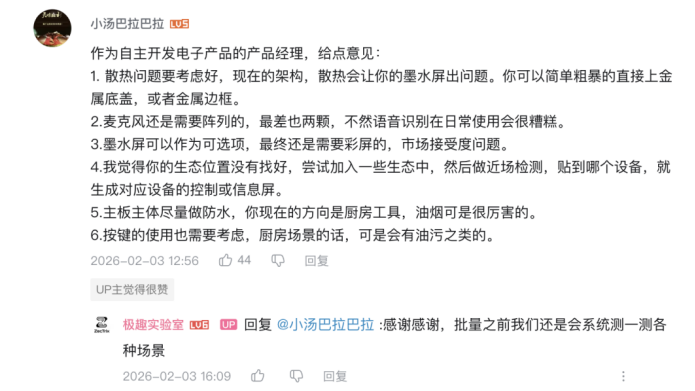
(Comment section of the AI sticky note product pre-sale video)
“After the content was published, many technical discussion directions emerged in the bullet screen and comment section, and more users began to share their similar needs: some mentioned attending cross-border exhibitions frequently, some talked about communication barriers with overseas teams during remote collaboration, and others shared experiences of inconvenient translation tools while accompanying foreign friends and relatives for medical visits or handling foreign affairs.”
“These feedback not only helped us expand the direction of influencer materials but also directly influenced our thinking on the product line,” Wu Zhen said.
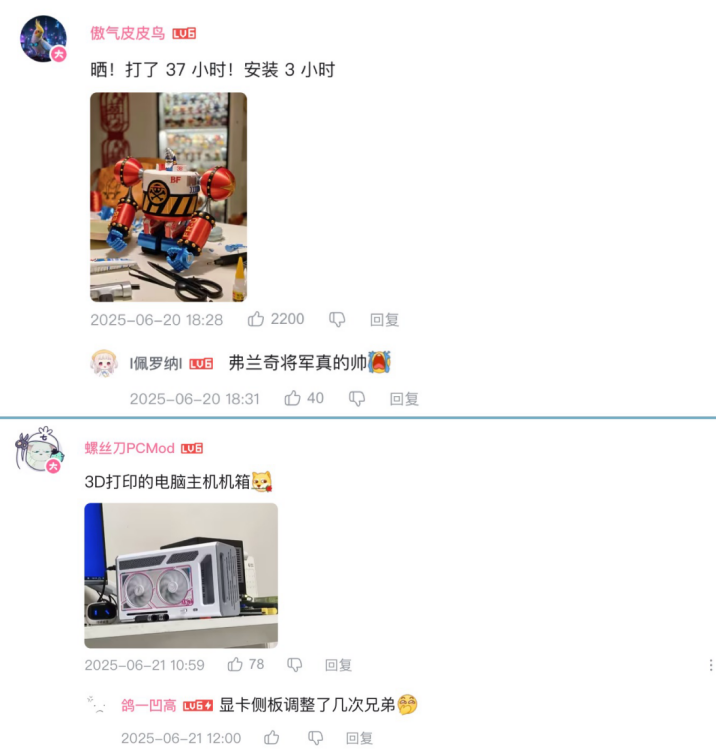
(Comment section of the video by UP owner Film Hurricane)
Enthusiasts Gather
I still remember the CES conference in January 2024.
A small orange box called Rabbit R1, dubbed "the world's first AI hardware device," caused a frenzy in the tech community, with the market calling it the iPhone of the AI era, selling 100,000 units upon release.
But success did not follow immediately. On the contrary, criticisms emerged stating that "it is not as practical as a smartphone." At that time, the prominent Rabbit R1 failed to explain well to users: what exactly can Rabbit R1 do in the present and future? What actual problems can it solve for users beneath the innovation?
To this day, user education remains the most crucial topic for AI smart hardware—when AI enters consumer electronics, the logic of product consumption is no longer confined to "enhancing life efficiency." It also encompasses higher-dimensional needs such as "releasing personal creativity" and "liberating the brain." At this point, the one who can enable users to understand, discuss, and pay for in real scenarios is the one who has truly crossed the threshold from technology products to consumer goods.
However, this is not easy. Regarding user education for AI glasses, INMO’s CMO Wu Zhen openly stated: this is not simply about conveying product information; it also requires breaking down a psychological barrier. Users need to first complete a "try-on" in their minds and confirm that integrating this device into their daily lives feels natural and not jarring before moving to the next step.
In Wu Zhen’s view, the process of psychologically building users of AI smart hardware may take longer than most consumer electronics categories. “When the day comes that users naturally wear AI glasses out without reminding themselves 'today I need to wear AI glasses,' this change in behavior may be more persuasive than many data points.”
Reshuffling Begins, Starting the Attention Competition
At the peak of enthusiasm, reshuffling is quietly underway.
The market has reached a consensus that 2026 will be the year of commercial validation for AI hardware. This also means that those chasing the trend and the fervent capital will welcome rationale and calmness.
A scene of filtering is unfolding: at the end of 2025, the AI wearable device Friend AI Necklace faced severe market resistance and fell into stagnation; following a peak in 2024, Rabbit R1 experienced an excessively high return rate amid negative feedback due to inadequate product performance, significantly declining in reputation and ultimately falling into a situation of unpaid wages and cash flow exhaustion.
Meanwhile, astute players are also beginning to cautiously adjust and optimize decisions. In February 2026, rumors surfaced that the Doubao AI glasses project was paused, and at least within the foreseeable cycle, this product line would no longer be considered a direction to pursue; earlier in January, the mobile phone manufacturer Vivo halted its AI glasses project, citing challenges in differentiation.
All of this is a reflection of the industry's differentiation.
However, it cannot be denied that in this trillion-dollar track, entrepreneurs still possess tremendous certainty and opportunity. According to AICC predictions, by 2030, the global AI-related hardware market will easily surpass trillions of dollars. In China, it is expected that the consumer-level AI hardware market (excluding mobile phones and cars) will exceed 1.27 trillion yuan by 2026 and reach 2.56 trillion yuan by 2030.
Currently, opportunities for both exiting and entering coexist; OpenAI has just announced it will launch its first AI hardware device in the second half of the year, while Meta plans to double the annual production capacity of AI smart glasses to 20 million units by the end of 2026. The latest scenes in the domestic market include JD's AI desk lamp, AI cooking machine, AI mattress, and AI wheelchair, among a batch of AI smart terminals gearing up for sale.
People remain confident that the competition for entry points behind AI smart hardware will not cease; in the AI era, it is still the era of user sovereignty.
The heatwave will push everyone forward. But when attention, product strength, and user cognition begin to clash on the same table, the battle for the endgame has only just begun.
免责声明:本文章仅代表作者个人观点,不代表本平台的立场和观点。本文章仅供信息分享,不构成对任何人的任何投资建议。用户与作者之间的任何争议,与本平台无关。如网页中刊载的文章或图片涉及侵权,请提供相关的权利证明和身份证明发送邮件到support@aicoin.com,本平台相关工作人员将会进行核查。


