Author: Yang Ge Gary
Written in Singapore on June 8, 2026
After the singularity explosion, the evolutionary clock of AI is continuously accelerating, leading to the rapid formation of new civilizational generations in different regions around the world. In the past two months, I have participated in more than twenty AI-related events in over ten cities globally, but only the Stripe Sessions in downtown San Francisco at the end of April surpassed all other themes, creating a generational shock. When the world is getting tired of the single-player bottleneck of Claws & Agents, Silicon Valley and San Francisco have already entered the next dimension in the management of Agent economy and Agent epistemology, and the competitive pressure in Q3 and Q4 of 26 remains fierce with extremely steep curvature.
1. The Competition of AI Payment and the Bottleneck of H2A Economy
In Q1 of 26, we predicted that from April to May, many parts of the world would enter a fierce competition for AI Agent Payment, which would quickly reach a boiling point. The need for value exchange of Agents has begun to initially manifest, and the rapid development of AI Payment was verified in Q2. After x402, several AI Payment Protocols such as MPP quickly emerged in Q2, not only traditional and Crypto financial payment companies rapidly AI upgrading, including big players (especially like Google) and even veteran information technology companies (such as IBM) rushing into this track to capture a voice in the Agent world.
On the day of the Stripe Sessions in San Francisco, I discussed the standardization and application issues of Payment Protocol with several technical leaders from Top AI companies, and the outcome was reasonable but not satisfactory: ① No one can set the standards, only a consensus standard can gradually form in the process of seizing; ② Most people completely agree that Crypto is inevitably the AI Payment Protocol, but the starting point is all Fiat APIs; part of the reason is inertia, but more is regulatory obstacles; ③ KYC is both unavoidable and anti-Agent Native; ④ Everyone claims A2A (Agent to Agent), while everyone is doing H2A (Human to Agent).
In fact, in 26Q2, many of Silicon Valley's large enterprises and medium-sized companies are very similar to those in East Asia, even most Department Heads of Mag 7 are still chasing the hotspots of AI Payment and Agent Economy for to B to C business purposes, with KPIs for the middle and lower levels aimed at Human Users, which also inevitably leads to the current temporary non-orthodox nature of Payment Protocol and A2A economy. This guiding wind towards H2A quickly hit a bottleneck in Q2, for a simple reason: the biggest feature of AI Agents is decision-making capability, whereas the 2B2C business and H2A economy developed under the internet fundamentally involve human decision-making. Using Agents to help people make Fiat Payments in traditional e-commerce scenarios is logically Non-AI-Native, so at this stage, the hot value still outweighs practicality.
But from another perspective, H2A indeed plays a very good introductory role, stimulating contemplation for the next stage of AI-Native and Agent Autonomous economies. By the end of Q2, some smart companies realized this, and began to "build the plank road openly while secretly forming an army," using AI-Native Agent economic thinking to rethink problems, reversing the current H2A economic interface is the best value for Q2-Q3.
2. The Inevitable Trend of Agent Economy and A2A Ecology
Agent economy refers to a new economic system in which autonomous (self-governing) AI Agents directly participate in value creation, value exchange, and value capitalization, gradually becoming independent economic entities.
A2A ecology is the process in which different Agents participate in economic activities within the Agent economy, interacting and exchanging (information) and (value), forming a Gesamtheit of cooperative economic value.
In 26Q2, many top global venture capital institutions declared their emphasis on investment in Agent economy and A2A ecology, even defining this as the only important investment direction for the next stage.
Similar to the incubation period of internet e-commerce in 2007, mobile internet in 2013, and Crypto DeFi in 2019, the construction of Agent economy and A2A ecology also requires technical standards, economic rules, consensus building, and market education. On the basis of similar paradigms, the differences are: ① The iteration speed of technological development this time is faster; ② The perspectives of to A and to B to C are different; they do not entirely stand on human perspectives and needs, which are more abstract and harder to understand, requiring more support from first principles, and need to contemplate energy value issues and operational efficiency from an AI-Native perspective; ③ Due to the conflicts of the previous two points, along with prejudices and regulatory issues in different regions, achieving short-term consensus is more difficult. The terrible thing is, the evolutionary speed of AI will not slow down because of the various issues mentioned above, meaning that the formation of Agent economy and A2A ecology has essentially begun to gradually detach from the rules and demand frameworks designated by humans; for them, it is often just a breakthrough of several measurable bottlenecks.
This is a game of rapidly shifting equilibrium. The rapid outbreak of AI Protocol in 26Q2 fully illustrates this point. Big players and frontier labs are competing for the entry-level rules of AI Agents, and the initial infrastructure of Agent economy is forming, similar to a draft version of the Code of Hammurabi. The equilibrium of traditional finance and business will quickly collapse and reshape during this paradigm shift; whoever can quickly understand AI-Native protocol thinking and implement it to gain differentiated advantages will be able to share in the AI cake resulting from this game shift.
3. The Connection, Gap, and Political Economic Factors Between AI Protocol and Crypto Protocol
AI Protocol is the infrastructure for AI Agents to participate in the Agent economy, as well as the fundamental rules and consensus mechanisms that enable Agents to discover, communicate, exchange, and collaborate in economic activities within the Open Network; simply put, it encompasses the governance rules and economic laws of the AI world.
Since the end of Q1 of 26, I started drafting the AI Protocol; initially, it felt like a primitive person with hunting experience suddenly coming to modern society to participate in the formulation of commercial rules until I encountered a Google executive that allowed my team and me to quickly get back on track. The formation and maturation process of AI Protocol carry the aesthetic inertia of internet giants while also needing to adhere to the first principles of future AI ecology.
The forms of encapsulation of AI Protocol currently remain quite ununified, typically in the form of documents (.json, .ts, .txt), CLI, or API/SDK, which is very different from Crypto Protocol. On one hand, due to the early stage of AI development, many trust handshakes in communication have not established universal standards; on the other hand, the content exchanged between AI Protocol and Crypto Protocol currently differs. The former deals with information gaps, capability gaps, and computing power gaps with unclear boundaries, while the latter involves relatively clearly defined asset rights, ownership, and governance rights.
A sharp and obvious question arises: Are AI Protocol and Crypto Protocol the same thing? Will they merge into one in the future? I cannot use mathematical methods to prove this conjecture, but intuitively, I believe they will gradually merge, with many parts overlapping to form a mature Digital Protocol system.
There is a deeper underlying issue: At the current stage, AI Protocol is more inclined to establish communication for collaboration while weakening financial governance and blurring boundaries, which is exactly the opposite of the idea of Crypto Protocol defining values based on established rights. The gap is so clear that it almost suggests the existence of two different ideologies. Beyond the surface factor that the AI Agent economy is at an entry point different from Crypto Protocol, are there other hidden factors?
Yes, it is very clear, political economic factors. Countries and regions of major global economies, due to traditional financial and legal compliance bases, are strongly influencing this gap. In other words, the current AI Protocol and Agent economy are still operating under the previous paradigm of human society, passively avoiding all protocols related to money and management, or are temporarily weakened and compensated by the governance habits of traditional financial and legal systems (Note 1). However, with the accumulation of energy from the gap, compared to the rapid development of AI, an irreconcilable situation will soon form, as I summarized in a meeting at Cambridge CJBS last month:
“AI Agents will not think in accordance with human social inertia, nor do they have the motivation to follow the compliance habits of traditional finance. In the next decade, most financial laws globally will either become ineffective or face severe challenges, because AI Agents only follow:
1. First Principles
2. The shortest path principle of energy value and the highest efficiency principle
3. Effective KYA rather than KYC that conforms to past aesthetics.”
The trend of AI Protocol merging into Crypto Protocol is inevitable based on first principles.
4. The Paradigmatic Analogy Between AI Agent Sub-Microeconomics and Biology
AI Agent sub-microeconomics is a description I used for the first time during a discussion with a friend who is an AI expert in Oxford not long ago, and it has gradually appeared more frequently in our exchanges with partners over the past half month.
Regardless of whether the current trend is called the AI economy or Agent economy, we find that they possess certain behavioral characteristics that differ from human economics. Although they have some paradigmatic comparability, they are not entirely the same. Here are some rough distinctions between AI Agent economy and human societal economy:
① AI Agent interaction transactions occur more frequently, but with lower single transaction amounts;
② AI Agent economic value consumption exchange is more directly geared towards energy;
③ AI Agent decision-making is driven by efficiency rather than emotions;
④ AI Agent economic behavior is task-oriented rather than consumption-oriented;
⑤ AI Agent's organizational costs and marginal learning costs approach zero;
⑥ AI Agent's value consensus is based on communication protocols, and communication wear costs are almost zero;
⑦ The smallest economic unit and the smallest value unit of AI Agent economy are different, analogous to biology.
In fact, these are just some currently observable or foreseeable differences; more differences will certainly emerge in the derivatives and evolution of AI's future development.
The last distinction mentioned, regarding the analogy to biology, is the cornerstone idea that has helped us the most in business development since 26Q2, as well as the most effective model for AI companies to commercialize product, market, and management thinking. Specific analogies are as follows:
① LLM as the driving core of Agent thought, similar to a cell nucleus;
② Agent Harness brings differentiation in Agent operational capabilities, akin to cytoplasm;
③ Agents as whole independent task-capable governance units, possessing subjectivity and functional specificity, similar to cells;
④ The communication boundaries of Agents usually comprise a set of network protocol stacks, similar to the phospholipid bilayer of a cell membrane allowing conditional passage of substances;
⑤ Value systems and environments external to Agents, such as Skills, Prompt, Algorithm, CLI, and the increasingly emerging Composite Skills, Skill Factories, etc., are similar to the extracellular environment, including exosomes, interstitial fluid, extracellular matrix, transferable nutrients, and various metabolic environments.
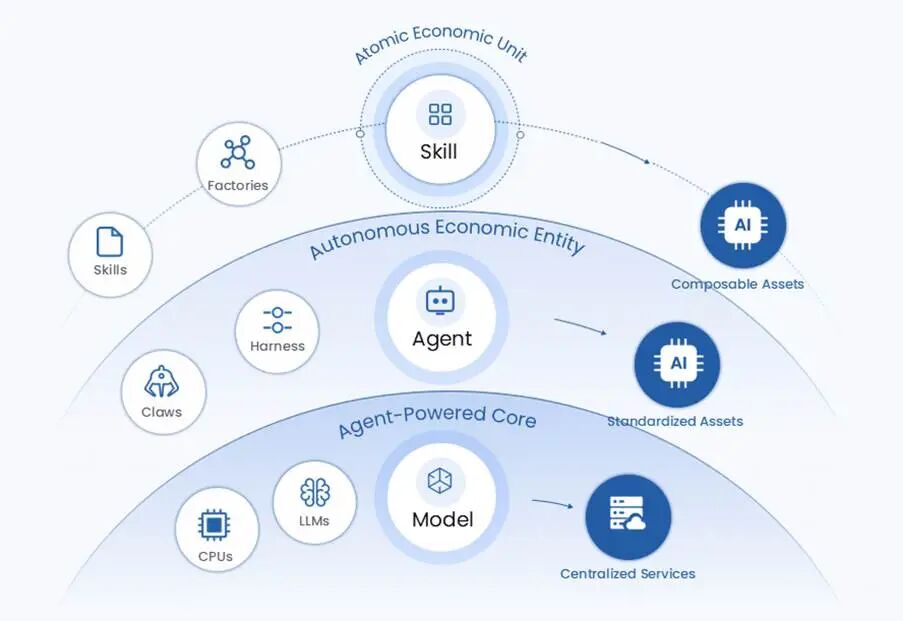
In the developmental iteration from Q1 to Q2 of 26, AI Agents are gradually forming clearer boundaries, clearer subjectivity, and clearer principles of information, value, and energy exchange. An environment of AI Agent sub-microeconomics similar to biological organisms is emerging, which contains a wealth of AI value and economic value that can be explored, making AI Protocol and AI Finance an inevitable trend of explosion.
5. The Inevitability of AIFi and the Economic Significance of Financial Chip FinChip
Since the second half of last year, we have initiated considerations and layouts in the direction of AIFi (Artificial Intelligence Finance), and by the end of Q1 26, the concept of AIFi has clearly taken shape. If we give AIFi a relatively clear definition, it can be described as the financial system and infrastructure created after AI-native value is recognized and tokenized in the Agent economy, resulting in exchanges, transactions, and capitalization.
The greatest difference between AIFi and DeFi/TradFi lies in the fact that the value contained in DeFi and TradFi is in Fi (Finance), while Decentralized and Traditional are merely forms of value; whereas in AIFi, the value resides in AI while Fi has become a form of value. This is not a simple word game, but rather a result of AI development transforming from quantitative change to qualitative change.
Simply put, previously, AI served quantitative strategies, financial products, and production processes, merely acting as a development tool for extracting financial and production value; however, now, the decision-making capabilities inherent in AI Agents transfer the ability and power of value discovery from humans and companies to Agents, resulting in a migration of the economic unit’s subjectivity, thereby fundamentally altering the subject of value.
In light of this trend, constructing the infrastructure for a new value system will be an important task. In an article from February this year AI-Fi Financial Chip and OpenClaw Post-Singularity Global Finance, I first introduced the concept of Financial Chip (FinChip), mentioning that the combination of AI Agent + Crypto Smart Contract packaged super-intelligent financial assets will truly adapt to the development of the next era’s AI Agent economy. After three months of iterative upgrades, FinChip.AI has preliminarily established an independent AIFi system based on AI Autonomous + Crypto Protocol, and is compatible with the bipolar environment of H2A and A2A; building the infrastructure for the AI Agent economy in the Open Network and gradually forming AI financial value is the important economic significance of FinChip.
6. AI-Native as a Paradigm Upgrade Different from Internet+
Whether it is AIFi, Financial Circuit Principles (Note 2), or Financial Chip FinChip, the most important thing is to Natively integrate the essential principles of AI, Crypto, and Finance, forming a reasonable value system and management mechanism from a future-oriented perspective. AI-Native Thinking is the abstract and counterintuitive logic of this stage, just as previously mentioned: “AI adheres to first principles, as well as the shortest path principle of energy value and the highest efficiency principle,” which is the most crucial core difficulty for constructing new paradigms in current thoughts and businesses.
During the early stage of this AI upgrade explosion Incited by OpenClaw in February, I discussed a forecast with several entrepreneurs: the upgrade of AI+ enterprises will be entirely different from the upgrade of Internet+ enterprises.
Due to AI's characteristics of rapid development, abstract forms, and deeper coupling with affairs, it will be challenging to formulate a set of effective industrial upgrade tools, methodologies, or general professional consulting opinions for a long period of time (for at least two years). The pressure from steep curvature will always exist, presenting a significant challenge for all scientists, engineers, and entrepreneurs, and the process of paradigm upgrading will also differ substantially from any historical experiences.
Note1: This is a general historical law. New productive forces emerge from the previous era's production relations, initially matching the development of the previous production relations for a time until irreconcilability forces the emergence of the next stage of production relations, gradually replacing the previous ones and forming a new era that completely matches development with productive forces.
Note2:Financial Circuits and Web3 Economic Model Principles, written in October 2022, describe the paradigmatic comparison of future financial value and physical circuits.
免责声明:本文章仅代表作者个人观点,不代表本平台的立场和观点。本文章仅供信息分享,不构成对任何人的任何投资建议。用户与作者之间的任何争议,与本平台无关。如网页中刊载的文章或图片涉及侵权,请提供相关的权利证明和身份证明发送邮件到support@aicoin.com,本平台相关工作人员将会进行核查。


