Written by: HM
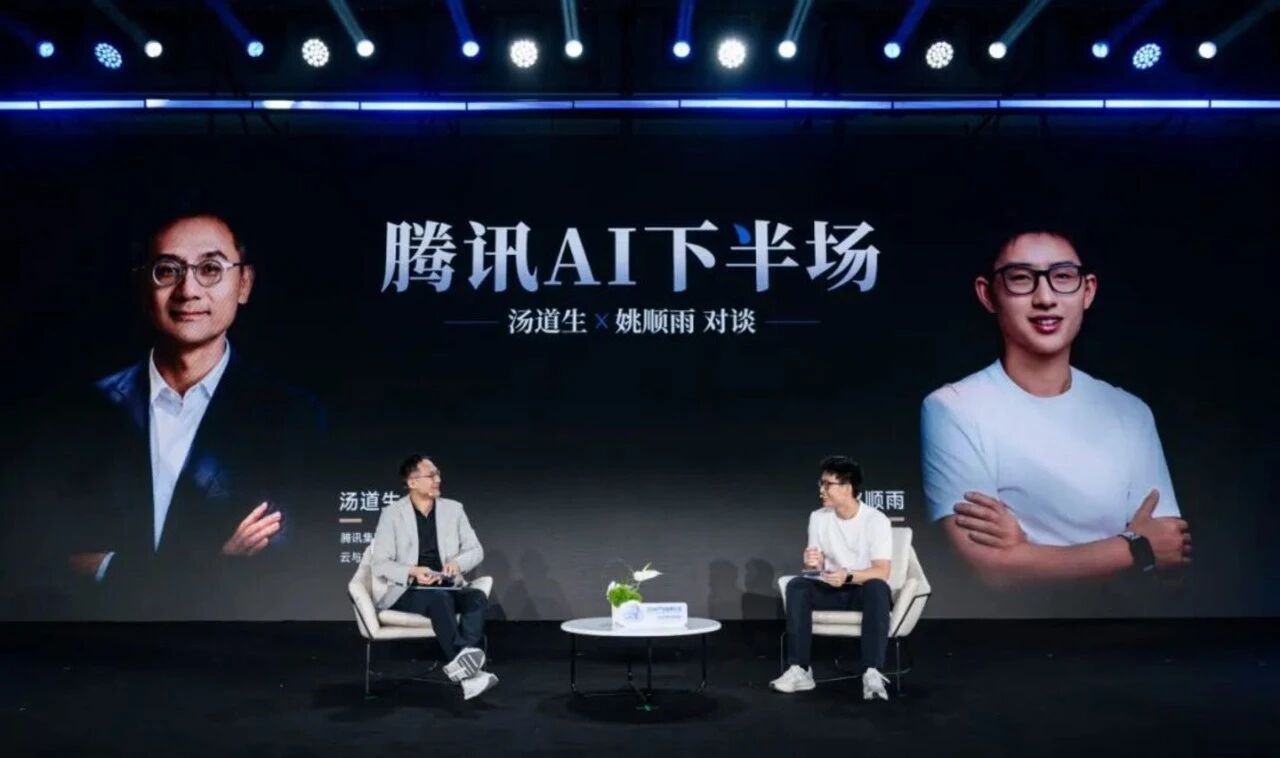
On June 5, at the Tencent Cloud AI Industry Application Conference, Yao Shunyu said:
"In China, there is a bad tendency where everyone likes to emphasize the practical value of rankings, which is greater than the value of the rankings themselves."
This was a real scene that took place at the Tencent Cloud AI Industry Application Conference on June 5. On that day, Tencent Cloud General Manager Gao Hang, Chief AI Scientist Yao Shunyu, and President Tang Daosheng rarely shared the stage, releasing a lot of solid content—but the hottest topic among the public was still Yao Shunyu's remarks.01 Daily 50 Trillion Tokens, Is Tencent Finally Catching Up?
First, let's talk about the hardest data.On that morning, Tencent Cloud General Manager and TokenHub head Gao Hang revealed: TokenHub has been online for three months, doubling every month, and currently, daily token consumption has exceeded 50 trillion.What does this number mean?To compare: three months ago, this number might have been in the hundreds of billions. Tripling to 50 trillion in three months is not linear growth; it is exponential.Behind this is the rapid implementation of Tencent's "multi-model MaaS" strategy. TokenHub not only calls on the Hunyuan model but also aggregates mainstream models such as DeepSeek, Kimi GLM, MiniMax, and Zhipu, providing developers with a unified API entry point. Users know—there is no need for individual connections; just call directly.Interestingly, just last month, OpenRouter released global data showing that the weekly usage of large models in China has already surpassed that in the United States. Tencent's TokenHub is clearly also competing for a spot on this ticket.02 Efficiency Agent Bundle, Released More than 20 at Once
The discussions are just an appetizer.At the venue, Tencent officially released this "Efficiency Agent Toolkit," covering a complete chain from individuals to enterprises:Individual users—QClaw, a local AI assistant, focusing on "WeChat direct connection." When you talk to it, it directly accesses your WeChat chat history, Tencent documents, Tencent meetings, ima knowledge base, and QQ email. No need to open apps, no need to copy and paste, just speak up.Workforce—Buddy family. WorkBuddy's personal version continues to iterate, and cloud CodeBuddy continues to be polished.Enterprise users—WorkBuddy enterprise version, Agent Suite office intelligent agent suite, enterprise intelligent agent control platform ClawPro, intelligent agent development platform ADP 4.0, taking everything along.More than 20 vertical scenarios, each scenario has its dedicated Agent.This is Tencent's first time integrating all its AI product lines into one cohesive force. Previously, the outside world often said Tencent had many products, each fighting their own battles; this is the first formal response.03 Yao Shunyu's Three Truths
Of course, the focus of the event was still on Yao Shunyu.This proponent of the ReAct architecture, OpenAI Operator and core contributor to Deep Research, joined Tencent in December last year and reports directly to President Liu Chiping. That day was his first appearance at a public company event.He said a lot, but the most memorable were three statements "not very suitable for public occasions in large companies":First: Chinese AI loves to chase rankings."The most important thing after training is to establish the correct evaluation. But domestically, there is a bad tendency to like to chase rankings."He didn’t mention names, but the whole industry knows whom he was referring to. Every company that releases a model must show off OpenRouter, and everyone claims to "surpass GPT," but the actual user experience is another matter.Second: Tencent's greatest advantage is honesty."My first impression when chatting with the big bosses was that everyone was very straightforward—where things are done well, where they are not, without hiding anything."When he said this, many Tencent employees present secretly straightened their posture.Yao Shunyu then said that Tencent operates on trust, not on metrics. This statement carries a significant weight—essentially, he publicly differentiated Tencent's cultural gene from certain "digitally driven" large companies in the country.Third: Context is the real barrier in the second half.This was his core point of the day."Models are becoming increasingly adept at transforming complex inputs into outputs. Many times, your competitive barrier comes from whether you have that most fundamental input—you know what this person or this company is doing."Translated into plain language: just having a good model is useless; you need data and scenarios, you need to know who the users are and what they did. Tencent's WeChat, Tencent documents, Tencent meetings, and QQ music generate behavior data from a billion users; this context cannot be bought with money.04 Tang Daosheng: We Do Have Fast and Slow
After Yao Shunyu, that boss took over the conversation.That day, Tang Daosheng was asked the classic question "Is Tencent AI slowing down?" He didn't dodge the question:"In such a long race, some areas are fast, some are slow, and some explorations will fail. All these reminders are good."He then said something very interesting:"I think we reacted relatively quickly to the recent wave of lobster this year."This sentence made the whole audience laugh.The "lobster" refers to Tencent's AI Agent strategy. From QClaw, WorkBuddy to Mavis, Tencent has released multiple products intensively within six months, indeed at a fast pace. However, due to the prolonged absence of the WeChat AI agent, the outside world has consistently felt that Tencent "only hears the sound of the stairs, but does not see anyone coming down."Tang Daosheng stated that this is a marathon, not a sprint.05 A Triangle and a Formula
Yao Shunyu set a goal for himself that day:To establish a long-term, AGI-based organization in China.He drew a triangle: Foundation (pre-training + post-training), Product (product implementation), Frontier (frontier exploration).The key to this triangle is balance. Most Chinese companies only focus on products and rarely do frontier exploration. Yao Shunyu wants to fill in this gap.He also summarized a formula for Tencent:The model provides capabilities, the harness provides the environment and tools, and the agent is the product that users truly utilize. No matter how strong the Hunyuan model is, without a good harness engineering system, it is just a castle in the air.This is something Peter Steinberger spoke about at Build 2026; Yao Shunyu directly borrowed it and landed it as Tencent's internal organizational methodology.Conclusion
The information density at this Tencent summit was quite high.Behind the 50 trillion daily tokens is a rapidly catching-up MaaS platform; behind the more than 20 Agents is Tencent's product ecosystem finally starting to connect; behind Yao Shunyu's three truths is a scientist's honest judgment of the industry.If we are to point out shortcomings, there are some.Tencent's product lines are indeed numerous: QClaw, CodeBuddy, WorkBuddy, Mavis, TokenHub, Token Plan... normal people may feel confused after listening. The inter-product linking logic still needs clearer narrative.But one thing is certain:The era where it was said "Tencent AI isn't working" may be about to turn the page.免责声明:本文章仅代表作者个人观点,不代表本平台的立场和观点。本文章仅供信息分享,不构成对任何人的任何投资建议。用户与作者之间的任何争议,与本平台无关。如网页中刊载的文章或图片涉及侵权,请提供相关的权利证明和身份证明发送邮件到support@aicoin.com,本平台相关工作人员将会进行核查。


