Original author: Xu Chao
Original source: Wallstreetcn
A city bets on an "impossible" project, loses money for ten consecutive years, burns through 36.6 billion in total, and finally reaps a trillion in returns—this is not a novel; it is Hefei.
On July 27, 2026, Changxin Technology (688825) officially landed on the Sci-Tech Innovation Board, with a final closing price of 49 yuan, soaring 465.82% from the issue price, and its market value immediately surpassed 3.2 trillion yuan, overtaking Industrial and Commercial Bank of China, becoming the "market value king" of A-shares. This largest DRAM chip manufacturer in China and the fourth largest in the world, after exactly ten years since its establishment, stood in the spotlight of the capital market.
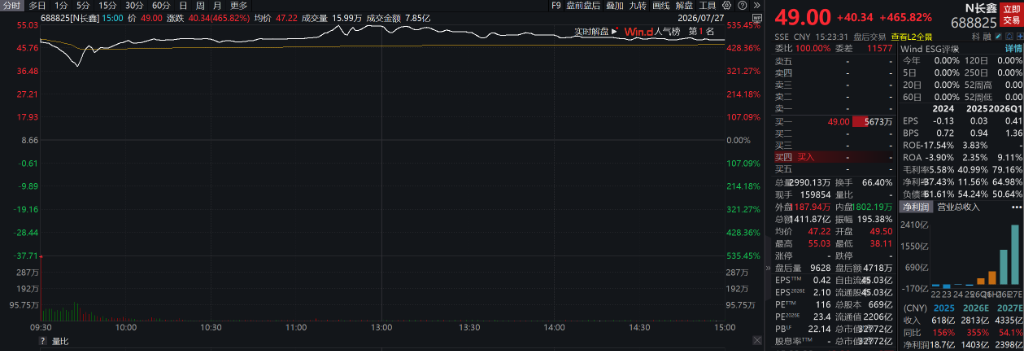
And behind this enterprise, the city that persistently ran alongside for ten years is now quietly settling a historic bill. Based on Hefei's state-owned assets system's approximately 36.79% shareholding ratio, the corresponding book value has exceeded 1.2 trillion yuan. Relying on the enormous market capitalization increment brought by Changxin Technology, the total market value of Hefei's A-shares surpassed 4 trillion yuan, rising to become the second city in the Yangtze River Delta in terms of A-share market value—a "gamble" from a central provincial capital city that wrote the most shocking footnote in China's industrial investment history.
Two decades of perseverance by one person
To understand why Hefei dared to invest, one must first understand this person, Zhu Yiming.
Zhu Yiming, from Yancheng, Jiangsu, entered Tsinghua University in 1989, and after obtaining his master's degree, went to the United States for further study, shifting to the semiconductor field, studying at the State University of New York at Stony Brook. After graduation, he entered Silicon Valley, serving as project manager in a memory chip company.
There, he witnessed an anxiety-inducing fact: memory chips are the most consumed and most standardized type of semiconductor, the "grain" of almost all electronic devices, yet Chinese players have long been absent in this arena.
In 2004, he made a life-changing decision—resigning and returning to China to start a business. The startup capital amounted to 920,000 USD, raised by several Tsinghua alumni. After the Spring Festival in 2005, he founded what would later become Ramax Technology in a two-story unfinished house in Tsinghua Science Park. Instead of directly confronting giants like Samsung and SK Hynix, he chose to enter the "marginal" market of NOR Flash, completing the initial accumulation. In 2016, Ramax Technology successfully went public.
However, Zhu Yiming's ambition extends far beyond this. He once stated, "If a computer is likened to a crown, the CPU is the jewel on the crown, and the memory is the base of the crown." "Whoever leads memory technology can dominate the entire integrated circuit industry."
Creating a Chinese version of "Samsung Electronics" has been his unchanged ultimate goal from day one of entrepreneurship.
It was also in 2016 that the opportunity arose.
The "deadlock" that others dared not touch, Hefei took on
At that time, 96% of the global DRAM market was firmly held by the three giants: Samsung, SK Hynix, and Micron, while China's self-production capacity was almost zero. The DRAM industry demands high levels of capital, talent, and technology, and its strong cyclical characteristics lead to extreme price fluctuations, making losses nearly an unavoidable "entrance tax."
Hefei, at that time, was not wealthy. But Hefei made a decision—let's do it.
This later became known as the "506" strategic project: an overall investment of approximately 150 billion yuan for Changxin's 12-inch memory wafer manufacturing base. The first phase has a total investment of 18 billion yuan, with Hefei Industrial Investment contributing 14.4 billion yuan, accounting for as much as 80%. This number, in 2016, was nearly equivalent to selling everything.
What is even more commendable is that Hefei chose to be a "true supporter."
During the darkest moments when Changxin Technology was losing money for consecutive years, with cumulative losses exceeding 36.6 billion yuan, Hefei's state-owned assets did not back down, did not withdraw investment, and even when other investors exited at the end of 2024, it actively put in nearly 2 billion yuan to take over old shares. A relevant person from Hefei Industrial Investment once articulated the essence of this logic clearly:
In the weak links of industries like chips, the probability of achieving capital returns in the short term is very low; it must be large capital, long cycles, and even cross several cycles to realize value investment.
This is not a gamble; it reflects the city's deep understanding of industrial laws and a clear judgment of national strategic needs.
China's DRAM from zero to one: a perilous breakthrough history
The path Changxin has taken is far more perilous than outsiders imagine.
At the same time as Changxin was established, Fujian Jin Hua was stopped abruptly on the eve of mass production due to Micron's lawsuit for trade secret theft. Changxin chose another path—through legal negotiations, at the cost of "hundreds of millions of dollars," obtained over 10 million DRAM technology documents, 2.8TB of core data, and numerous implementation licenses for Infineon's DRAM technology patents from the bankrupt German memory giant Qimengda.
In 2018, Zhu Yiming made a decision that stunned the capital market: he resigned as the general manager of Ramax Technology and took on the full-time role of chairman and CEO of Changxin Technology, making a solemn pledge—he would not take a penny in salary or bonuses until the project became profitable.
In September 2019, one year later, Changxin Technology launched its independently designed and produced 8Gb DDR4 chip, marking the historical breakthrough of mainland China's DRAM industry "from zero to one."
But "from zero to one" is merely an entry ticket. The real test came in 2023.
That year, global DRAM prices plummeted over 40%, with declines in mobile and PC shipments, sending the industry into a deep downturn. The three giants, relying on cost advantages, executed "counter-cyclical" strategies, maintaining high shipments and further squeezing new players.
Changxin lost money on every chip it sold but still accelerated the breakthrough of 1x nanometer process technology and overcame key technological barriers for DDR5 mass production. The company reported a loss of 16.34 billion yuan that year, setting a new record for losses since its establishment, with cumulative losses reaching 36.65 billion yuan over ten years.
Any commercial institution faced with such a performance report would have long since cut losses and exited.
But Hefei did not. During Changxin's years of continued losses, Hefei's state-owned assets chose to repeatedly invest more, provide resources, and supply ammunition.
That year, the Hefei Municipal People’s Congress Standing Committee reviewed and approved a funding expansion proposal. At the end of 2024, after Country Garden Ventures exited, Hefei's state-owned platform put in nearly 2 billion yuan to acquire old shares without any hesitation.
Behind this, Hefei established a set of institutionalized fault tolerance mechanisms: projects entering the database must be reviewed by the financial committee of the People’s Congress, major decisions must be voted on by the Standing Committee; as long as due diligence is compliant and procedures are in place, even if the project ultimately incurs losses, the decision-makers will not bear personal responsibility. It is reported that Hefei has never penalized any unit or individual due to investment failures.
It is this "affordable loss" system that enables Hefei to become a truly patient capital while other cities hesitate.
Daily earnings of 400 million, ten years of losses offset in one quarter
The turning point quietly arrived in 2025.
The demand for AI computing power completely ignited the storage super cycle. An AI server uses 3 to 5 times the amount of DRAM compared to a traditional server, while Samsung, SK Hynix, and Micron all shifted their production capacity towards the more profitable HBM, greatly widening the supply gap of conventional DRAM.
Changxin Technology happened to complete the product iteration from DDR4 to DDR5, with the capacity utilization rates of its three 12-inch wafer fabs steadily increasing from 85% to 95%. Surging demand, shrinking supply, and released capacity—a triple benefit combined created a textbook-level "Davis Double Dip."
In 2025, Changxin Technology achieved its first annual profit, with a net profit of 1.875 billion yuan attributable to the parent company.
In the first quarter of 2026, revenue reached 50.8 billion yuan, with a net profit attributable to the parent of 24.762 billion yuan, a year-on-year increase of 1688%. Converting this yields nearly 400 million yuan in daily earnings. At this pace, in less than half a year, Changxin had almost completely offset all losses from the past decade.
At this moment, Hefei's 14.4 billion yuan "first investment," along with subsequent continued contributions over the decade, finally realized its value.
Beyond the trillion floating profit: a city's industrial reshaping
The 1 trillion on paper is just the tip of the iceberg of Hefei's returns.
Ten years ago, the northwest suburb of Hefei, where Changxin's factory is located, was still a rural landscape interspersed with farmland and wasteland. Today, huge gray-white factory buildings stretch horizontally for hundreds of meters, dense silver air ducts, corridors, and industrial pipelines crisscrossing in the air; outside the plant, research buildings, employee apartments, cafeterias, commercial centers, fast food restaurants, and supermarkets have opened one after another, playfully referred to as "Changgang CBD."
By the end of 2025, the total number of employees at Changxin Technology reached 19,300, with more than 6,000 in R&D, most aged between 25 and 35, the majority holding master's degrees or higher. These young, highly educated employees with strong purchasing power are fundamentally changing the consumption structure and urban temperament of the surrounding area.
The changes at the industrial chain level are even more profound.
Leveraging the leading effect of Changxin Technology, Hefei has gathered over 450 integrated circuit companies, forming a complete industrial chain from design, manufacturing to packaging and testing, becoming one of the few cities in the country with a full integrated circuit industrial chain. In 2016, the output value of Hefei's integrated circuit industrial chain was only about 18 billion yuan; by 2025, this figure reached 151.4 billion yuan, a growth of 7.4 times.
More noteworthy is the collaborative effect of industries. Changxin's memory chips, along with BOE's panels and electric vehicles from NIO and BYD, jointly create Hefei's industrial landmark of "integrated chip, display, and automobile," forming an intersupportive and deeply integrated industrial ecosystem—Chip Union provides panel display driver chips for BOE, while Jiefa Technology supplies automotive-grade MCU chips to BYD and NIO, and the internal circulation of the industrial chain is accelerating formation.
"Hefei model," why others cannot learn it
After the listing of Changxin Technology, outside attention once again turned to the "Hefei model." However, in reality, around 50 investigation teams flood into Hefei every month, writing millions of words in research reports, yet they have never incubated a truly replicable sample.
Hefei itself clearly states: this model has four prerequisites, none of which can be missing.
Wealthy enough. In 2008, Hefei invested 6 billion in BOE, equivalent to 20% of that year's fiscal revenue. The Changxin project bore ten years of cumulative losses of 36.6 billion yuan. Without corresponding fiscal maneuvering space, there is simply no way to answer this question.
Strong enough fault tolerance mechanism. Hefei was the first in the country to establish a "due diligence exemption" system, where project decisions are made as long as the process complies and due diligence is in place, even if losses occur, decision-makers do not bear personal responsibility. The local government has never penalized any unit or individual due to investment failures, which gives the confidence to "dare to invest."
Accurate enough industrial judgment. Each of Hefei's investments has been made at the coldest moments in the industry—BOE during massive global losses in the panel industry, NIO when its stock price fell to 1 USD and 18 cities rejected it, and Changxin when there were no Chinese players in the global DRAM market. This counter-cyclical layout relies on years of systematic judgment on industry trends, rather than chasing fads.
Broad enough policy window. Hefei caught the golden decade when China's manufacturing industry was climbing from low-end to mid-and-high-end, with the demand for domestic substitution being real and urgent. As pointed out by Song Xuetao's team at Guojin Macro, Changxin "caught up" with the overlap of domestic substitution, storage security, and AI demand expansion, which in itself also indicates the foresight of national strategic planning.
The paradigm shift in Chinese urban development
Behind Changxin Technology's listing, a more macro proposition is emerging: beyond land finance, urban development needs a new engine.
The path of Hefei provides an answer: using state-owned assets as early capital, then leveraging capital markets for amplification, to build a system capable of continuously producing good companies. From 2015 to 2021, during the real estate boom, Hefei's total land transfer fees were approximately 551.6 billion yuan; yet, just the book profit of Hefei's state-owned holdings in Changxin Technology is nearing 1 trillion yuan.
This is not just Hefei's story, but a paradigm shift in the competitive logic of Chinese cities is occurring: from "attracting investment" to "industrial cultivation," from "land finance" to "equity finance," from "transplanting a large tree" to "nurturing a forest."
The listing of Changxin Technology is the final answer to Hefei's decade of patient capital, as well as a test that more cities cannot avoid.
免责声明:本文章仅代表作者个人观点,不代表本平台的立场和观点。本文章仅供信息分享,不构成对任何人的任何投资建议。用户与作者之间的任何争议,与本平台无关。如网页中刊载的文章或图片涉及侵权,请提供相关的权利证明和身份证明发送邮件到support@aicoin.com,本平台相关工作人员将会进行核查。


