Key Takeaways:
- Citing Section 301, the USTR claims Brazil’s Pix hurts US market firms, proposing tariff actions against it.
- After 7 billion April transactions, Lula defends Pix’s market dominance and will next block changes.
- Ahead of October’s polls, Flavio Bolsonaro met Donald Trump to discuss Section 301 market rules.
Pix, Brazil’s flagship instant payment system, has returned to the spotlight after being mentioned in the recent report from the Office of the U.S. Trade Representative (USTR).
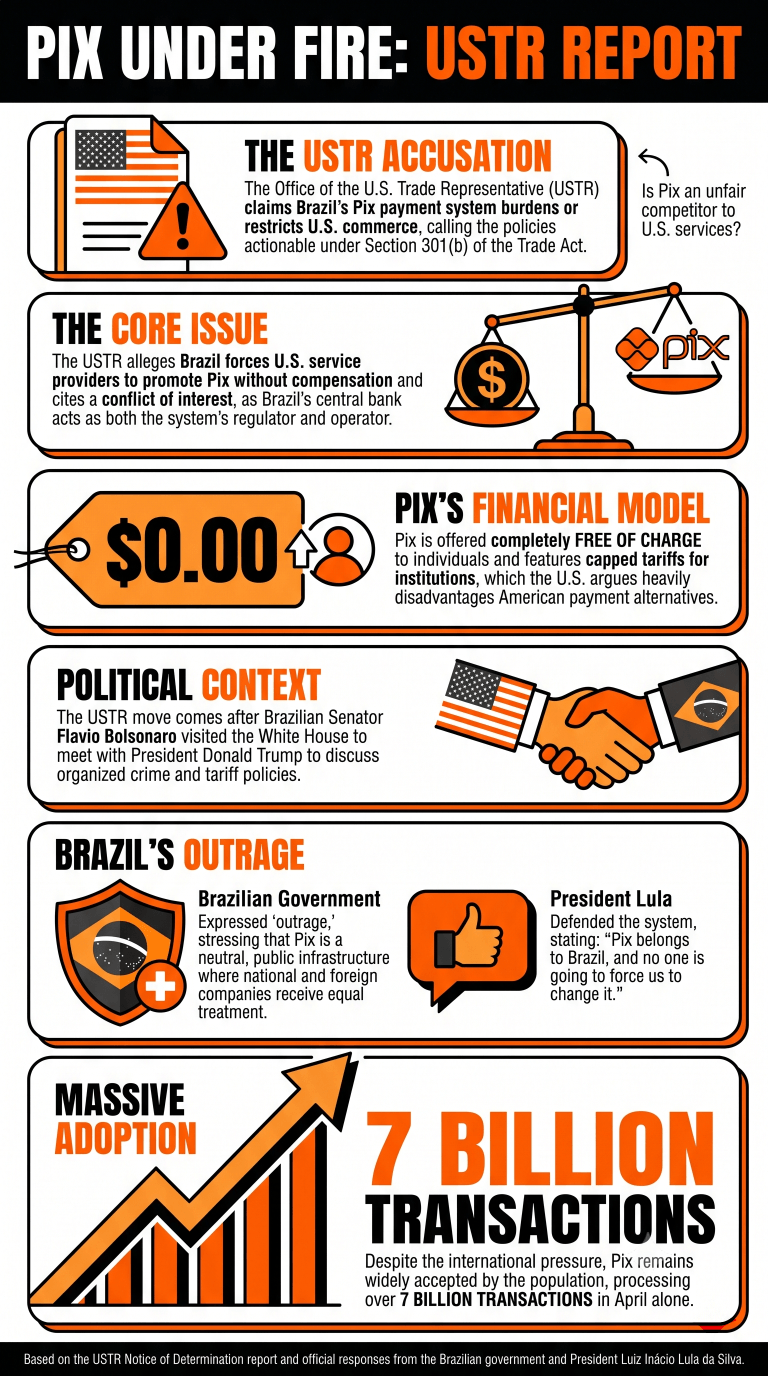
The report determined that, alongside other alleged causes, including preferential tariffs, anti-corruption enforcement, intellectual property protection, ethanol market access, and illegal deforestation, Pix burdens or restricts U.S. commerce, and the policies behind its establishment are “actionable under Section 301(b) of the Trade Act.”
On the “Notice of Determination and Request for Comments Concerning Action Pursuant to
Section 301,” the USTR claims that “the acts, policies, and practices of Brazil related to its preferential treatment of Pix are a burden or restriction on U.S. commerce by imposing costs on U.S. services providers and by forcing U.S. providers to promote their Brazilian competitor, without compensation.”
The USTR determined that the central bank’s dual role as Pix’s regulator and operator creates a conflict of interest and disadvantages U.S.-based alternatives by offering it free of charge to individuals and capping its tariffs for institutions.
The move comes after Senator and presidential candidate Flavio Bolsonaro, President Luiz Inácio Lula da Silva’s strongest contender in October’s elections, visited the White House and met President Donald Trump to discuss organized crime and tariff policies if he clinched a hypothetical victory at the polls.
The Brazilian government has expressed outrage at these preliminary conclusions, stressing that under Brazilian law, national and foreign companies receive equal treatment.
“PIX is a free, public infrastructure for instant payments, operated by the Central Bank of Brazil and widely accepted by the population. Its rules apply uniformly and neutrally, and U.S. companies actively participate in this ecosystem,” an official press release pointed out.
Lula also defended Pix, which processed over 7 billion transactions in April. “Pix belongs to Brazil, and no one is going to force us to change it, given the service it provides to Brazilian society,” he declared.
免责声明:本文章仅代表作者个人观点,不代表本平台的立场和观点。本文章仅供信息分享,不构成对任何人的任何投资建议。用户与作者之间的任何争议,与本平台无关。如网页中刊载的文章或图片涉及侵权,请提供相关的权利证明和身份证明发送邮件到support@aicoin.com,本平台相关工作人员将会进行核查。


