Author: Doo (Compound Foundation)
Translation: Deep Tide TechFlow
Deep Tide Introduction: Korea has always been one of the most enthusiastic markets for global retail crypto investors, with the "kimchi premium" reaching as high as 20%. Now the premium has turned negative for the first time, reflecting not only the collapse of altcoins but also a massive exit of retail funds from the crypto market, which is of significant reference value for understanding current market sentiment.
The cryptocurrency premium in Korea is turning negative, which is quite unusual, as there is usually a premium in Korea. By the way, the presence of premium or discount in Korea is often due to capital controls that make arbitrage difficult.
Here are some thoughts on why a discount is occurring.
1. The speculative market is declining
The Korean market is known for speculation, pushing the premium above 20% at one point. However, as the crypto market has continued to struggle, especially altcoins, market interest has been declining.
2. The Korean stock market is performing much better, draining liquidity from cryptocurrencies
The Korean stock market has almost doubled compared to last year, with several tech companies, including Samsung and SK Hynix, leading the growth. This means that the liquidity previously in cryptocurrencies is shifting to the Korean stock market.
3. The upcoming cryptocurrency tax in Korea is also changing market preferences
Cryptocurrency taxation in Korea has been delayed multiple times because Korea does not have a good enough infrastructure to collect cryptocurrency taxes, and it is also a very unpopular political topic. However, the current government has at least confirmed that it will start taxing cryptocurrencies from next year.
Translator's Note: Real-time data confirms that discounts are occurring
Real-time monitoring data from the Korean Telegram channel "김프 출입국 사무소" (Kimchi Premium Immigration Office) provides direct evidence for the above judgment. This channel specifically tracks the premium or discount of the Korean crypto market relative to international markets. Below are three sets of data recorded within the same day:
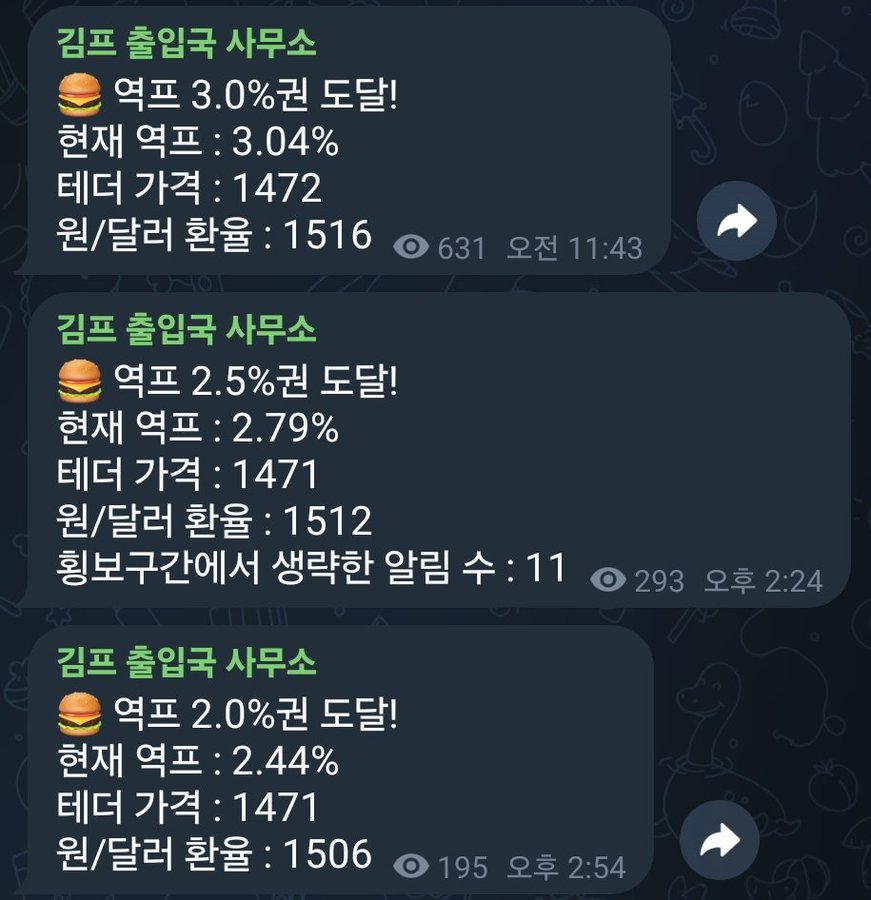
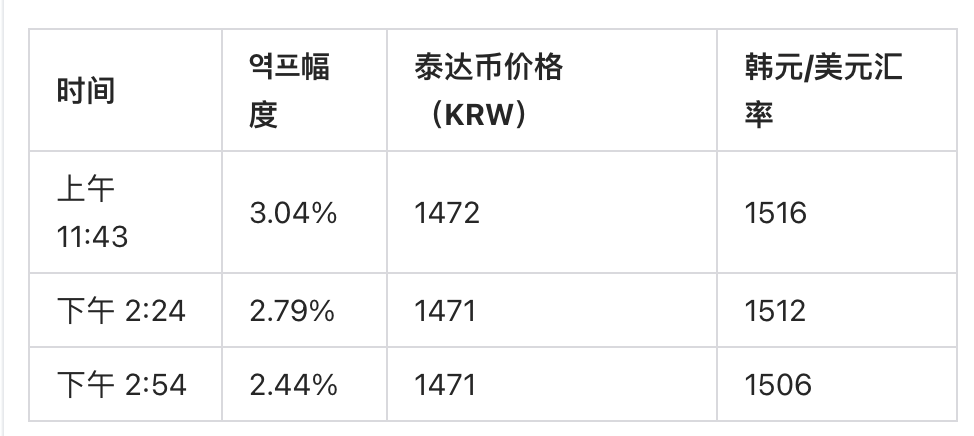
"역프" is the abbreviation of "역 김치프리미엄", meaning reverse kimchi premium—the prices of crypto assets in the Korean market are lower than in the international market, in other words, buying coins in Korea is cheaper than overseas.
Several details can be observed from the data:
First, the discount narrowed from 3.04% to 2.44% during the day, but remained above 2%, indicating that the discount is not a fleeting fluctuation, but a market state with some persistence.
Second, the price of Tether (USDT) stabilized at 1471–1472 Korean won, while the Korean won/USD exchange rate ranged between 1506–1516 during the same period, with the difference directly contributing to the discount—the demand for stablecoins in the Korean market is insufficient, and buying power is significantly weak.
Third, the channel omitted 11 warning pushes within the sideways range, meaning that the discount has persisted over a longer period, with only minor fluctuations that did not trigger the reporting threshold.
This set of data confirms the core judgment of the article on a micro level: Korean retail investors are withdrawing from the crypto market, and the trend of net capital outflow has left a clear mark on the price structure.
It is worth noting that the voluntary formation of such a detailed premium monitoring system in Korea itself indicates that "김프" has long been one of the core trading signals in the Korean crypto market.
Now that this signal has turned negative for the first time, its symbolic significance is far more than just the numbers themselves.
Data shows that this year, the total market capitalization of listed companies in Korea has soared by 86% to reach $5 trillion; whereas India's total market capitalization has dropped to $4.8 trillion. Since the beginning of this year, the Korean stock market has consecutively surpassed the stock markets of Canada, Germany, the UK, and France; the total market capitalization has risen to sixth in the world.
免责声明:本文章仅代表作者个人观点,不代表本平台的立场和观点。本文章仅供信息分享,不构成对任何人的任何投资建议。用户与作者之间的任何争议,与本平台无关。如网页中刊载的文章或图片涉及侵权,请提供相关的权利证明和身份证明发送邮件到support@aicoin.com,本平台相关工作人员将会进行核查。


