Futu Securities has successors.
Written by: Liu Honglin
Many years later, when Futu Securities stands at the Wan Chai Pier of the Asian Financial Ruins, it will always remember that distant afternoon in the summer of 2026 when it quietly exited the stage.
On May 22, the Securities Regulatory Commission disclosed an administrative penalty notification regarding the illegal cross-border business activities of institutions such as Tiger, Futu, and Changqiao. On the same day, the Securities Regulatory Commission and eight other departments also released a comprehensive rectification plan for illegal cross-border securities, futures, and fund operations, mentioning a two-year concentrated rectification period, clearing illegal existing business, and prohibiting foreign institutions from conducting marketing solicitation, account opening, trade order processing, and funds transfer services within the country.
On June 1, Children's Day, Binance, the world's largest cryptocurrency trading platform, launched trading of U.S. stocks and ETFs supported by its own securities. On Binance, users can directly trade over 7,000 U.S.-listed stocks and ETFs with cryptocurrency, with some assets supporting 24/5 trading.
Futu Securities has successors
In the past, many mainland users accessed Hong Kong and U.S. stocks through internet brokers like Futu, Tiger, and Changqiao. They made account opening, market data, trading, information, communities, Chinese customer service, and mobile experience smooth enough that the vast majority of mainlanders could buy and sell U.S. stocks for the first time, withstanding the winds and rains of a capitalist market.
It is precisely this smooth experience that allowed institutions like Futu to endure a fatal blow from the Securities Regulatory Commission: without permission, engaging in marketing, processing trade orders, and providing related securities business services within the country and earning profits, constitutes "illegal cross-border operations by foreign institutions."
However, the demand for Hong Kong and U.S. stocks will not automatically disappear due to a prohibition.
After the traditional brokerage path was compressed, existing users need to manage their positions, while new users will seek new entry points. We cannot expect that everyone who used to buy U.S. stocks will suddenly return to fully invest in A-shares overnight.
When water is blocked, it will inevitably flow elsewhere.
On June 1, Children's Day, a friend reminded me: switching the system language from Simplified Chinese to Traditional Chinese reveals a "Traditional Finance" module in Binance. What comes to the forefront is 7,000 U.S. stocks and ETFs, comparable to Futu Securities.
Previously, when we mentioned Binance, the first response was cryptocurrencies, contracts, wealth management, Launchpad, and wallets. Now, by integrating U.S. stocks into its account system, Binance effectively tells users: you can navigate traditional finance without leaving this exchange.
More importantly, this action does not impose restrictions on mainland users.
Of course, there are still restrictions for users; Binance's announcement states that services are only available to eligible users in permissible jurisdictions and do not serve the United States or Americans.
How Binance maintains compliance gracefully
To allow users to purchase U.S. stocks compliantly, Binance has made significant efforts in its corporate structure.
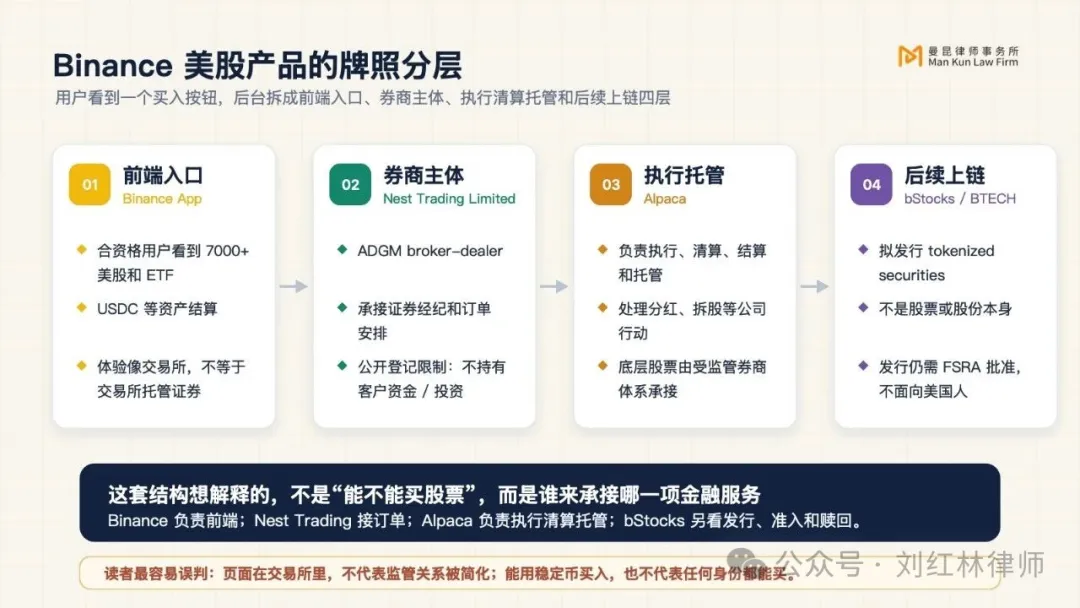
Compliance structure of Binance's U.S. stock products
According to Binance's announcement, Nest Trading Limited is the brokerage/dealer entity under Binance's Abu Dhabi Global Market framework. In the ADGM public registry, Nest Trading Limited's FSP number is 260000, with an effective date of January 5, 2026, and Nest Trading neither holds nor controls customer investments.
Users see U.S. stocks and ETFs on the Binance front end, and after placing an order, Nest Trading acts as the introducing broker, routing the order to Alpaca for execution, clearing, settlement, and custody.
The exchange entity Binance does not handle or custody user securities. This differentiates Binance from many "on-chain U.S. stocks" slogans. It does not stuff brokerage, order arrangements, execution clearing, and securities custody into the exchange entity. What you see is a buy button, but behind it are front-end access, ADGM licensed entities, U.S. clearing brokers, securities custody, corporate actions, regional access, and risk disclosures.
Binance's announcement emphasizes that bStocks are tokenized securities representing certain U.S. stocks and ETFs, issued by a special purpose vehicle registered in ADGM, BTECH Holdings Ltd. The issuance also requires FSRA approval; bStocks are not the stocks or shares themselves, and holders will not directly own the underlying stocks of the listed companies.
After clarifying the compliance structure, the issue does not end there.
Who bears the weight for Binance through storms
If you think life is serene, it's likely that someone is bearing the burden for you.
Often, platforms engage in compliance to create room for explanation with regulators, banks, brokers, institutional clients, media, and partners. They can prove they have entities, licenses, cooperative brokers, regional restrictions, and risk warnings. This work is certainly essential. Without these arrangements, in the international financial market, one might only be able to sit at the children's table.
But the workload of compliance does not work magic. It will not turn all gray into white, nor will it make all risks disappear automatically.
Platforms can require users to promise they are not from restricted regions, conduct KYC, set regional access, and clearly state that they are not open to certain jurisdictions.
Based on the law of conservation of energy, risks cannot disappear; they can only be transferred throughout the universe.
For exchanges like Binance, they can break down the front-end, orders, clearing, custody, and tokenized securities issuance into layers, making each layer have explainable entities and documents. However, for KOLs, community leaders, agents, business, and growth teams long nurtured by the crypto community, Binance's compliance may not alleviate their concerns: are you sharing content or helping foreign platforms conduct prohibited promotional efforts towards domestic users as explicitly stated by regulatory bodies like the Securities Regulatory Commission?
In the past, KOLs helped exchanges with promotions, employing a set of well-established methods: referral links, rebates, promotional pages, trading tutorials, deposit tutorials, community conversions, and live Q&As. Previously, discussions often focused on issues of virtual currency trading, services by foreign exchanges for domestic users, advertising, and compliance with rebates.
But now that exchanges have started incorporating traditional securities assets like U.S. stocks and ETFs into their account systems, there is an additional layer of consideration regarding cross-border investment in securities.
If a KOL says on a domestic platform, “You can now buy U.S. stocks on Binance,” along with a referral link and rebate code, it becomes difficult for them to present themselves merely as ordinary content creators providing legally neutral evaluations. Previously, you were just helping a digital asset exchange without clearly defined illegal prohibitions in China gain volume; now, once the underlying products become U.S. stocks and ETFs, it naturally falls into the scope of assisting foreign institutions in conducting cross-border securities business aimed at domestic investors.
This is financial innovation, the reality behind graceful compliance.
While it's said that the bigger the storm, the more valuable the fish, compared to the serene years in far-off Abu Dhabi, whether it's the wind, rain, or yourself, understanding the risks and returns while immersed in it remains prudent.
免责声明:本文章仅代表作者个人观点,不代表本平台的立场和观点。本文章仅供信息分享,不构成对任何人的任何投资建议。用户与作者之间的任何争议,与本平台无关。如网页中刊载的文章或图片涉及侵权,请提供相关的权利证明和身份证明发送邮件到support@aicoin.com,本平台相关工作人员将会进行核查。


