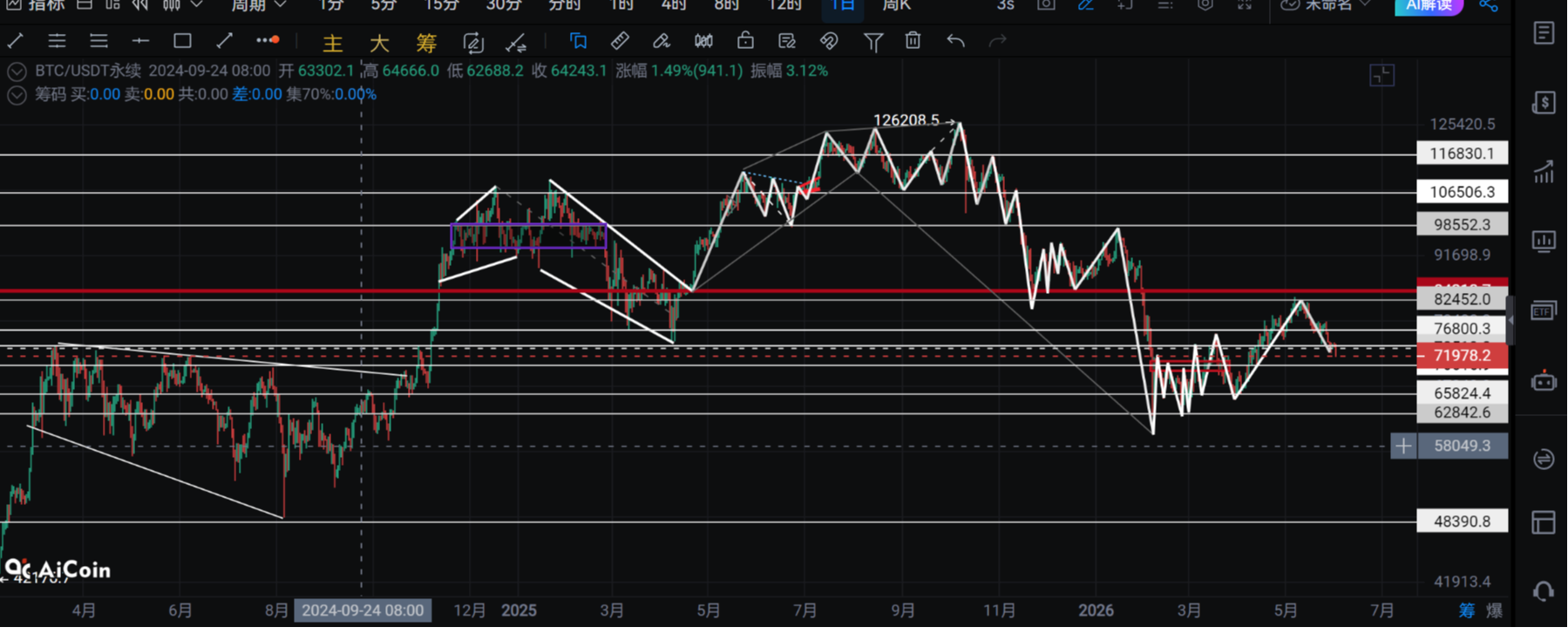
In a macro window that was already fragile, the leading institutions that were once seen as "buying only" have started to loosen their grip. On June 1, 2026, the market revealed that Strategy had sold 32 BTC for the first time in the previous week, with an average transaction price of about $77,135, cashing out approximately $2.47–2.5 million. This scale is insignificant in its asset pool but constitutes a symbolic turning point on an emotional level—on-chain data shows that Strategy still holds about 843,706 BTC, with an average cost of about $75,699 per coin, resulting in a current unrealized loss of about $2.932 billion. Meanwhile, on-chain analyst Yu Jin disclosed that BitMine has an unrealized loss of about $8.116 billion on Ethereum, bringing the losses of these two major long positions into the spotlight. On a macro level, BVIX reported around 36.78 points and EVIX around 49.5 points, both rising by about 1.66% and 1.48% respectively during the day; gold fell back to about $4,461.96 per ounce, silver dropped to about $74.46 per ounce, and the three major U.S. stock indices opened lower, with the Dow Jones down about 0.3%, S&P 500 down about 0.2%, and Nasdaq down about 0.19%. The highly correlated MSTR opened down about 9%. Amid the renewed tensions in the Middle East, the premium on volatility has been elevated overall. A question thus emerges: when institutions like Strategy and BitMine simultaneously incur massive unrealized losses on BTC and ETH, and macro risk appetite cools down simultaneously, how will this "balance sheet pressure + rising volatility" resonance reshape the volatility range of Bitcoin and Ethereum, the leverage structure, and the risk pricing of on-site funds?
Signal Price of the First Sale of 32 BTC
Under the long-standing narrative of "buying only, not selling," Strategy's sale of 32 BTC last week appeared more like a public symbolic transaction rather than a genuine reduction of holdings. Calculated at an average price of about $77,135, this $2.47–2.5 million sale compared to its total holding of about 843,706 BTC is merely noise that can't even be rounded off but shattered the market's imagination that this institution would "always be a bottom buyer." In the past, the market viewed Strategy's continuous accumulation as a "rigid buy" on the Bitcoin demand curve, a structural demand that increased its purchases as prices fell. Now, these 32 BTC seem to serve as a new anchor point—informing all participants that this institution is not unidirectionally bullish, and it is willing to change into a marginal seller at a certain price level.
Peter Schiff's comments on X further magnified the narrative tension surrounding this symbolic sale—his interpretation of the switch from "major buyer" to "seller" as a signal of weakening demand support. The intuitive effect on the demand curve is: what was originally viewed as a rightward shift of institutional demand, continuously expanding, is now redrawn by the market as a curve that may contract and even switch to "selling on highs." This implies that part of the demand that once relied on "Strategy taking a position" will choose to wait or lower their entry prices, leading to a decline in purchasing depth at high levels; regarding derivatives, bulls no longer assume "large institutions providing a floor," and the willingness to go long with high leverage naturally shrinks in the context of increasing volatility, with funds tending to reduce leverage, shorten duration, or even hedge tail risks through options. When such symbolic sales are viewed as a preview of potentially greater selling pressure in the future, it effectively raises Bitcoin's risk premium and prompts the market to reprice Strategy's substantial holdings from "bottom support" to a potential source of supply that could be released at any moment.
Shadow of Unrealized Loss on 843,706 BTC
On-chain data presents a calm yet nearly cruel outline: Strategy has about 843,706 BTC on paper, with a diluted cost of about $75,699 per coin, corresponding to an unrealized loss of about $2.932 billion at current prices. Unrealized losses themselves do not equate to a mandatory sell-off, but when this scale is concentrated under a single entity, it tends to be amplified by the market in every price correction—not as a "paper number," but rather like a potentially collapsing tower of long positions at a high level. In the past, this position was packaged into a narrative of "long-term holding," but now, as prices fall below the average cost and substantial unrealized losses are exposed, it more resembles a "locked supply" nailed to the chart, compelling all participants to consider Strategy's risk preferences, sources of funds, and tolerance levels as core variables when assessing downward space.
Under such conditions, the existence of concentrated long positions starts to elevate the market-wide volatility premium through expected channels. BVIX has already risen to around 36.78 points, reflecting traders' repricing of future volatility: once the market believes that Strategy might not only symbolically sell 32 but might choose to reduce holdings or hedge on-chain during further corrections, then the structures of BTC's spot, futures, and options will be rearranged accordingly. On the spot side, buyers are more inclined to lower prices, waiting for the "top address to offload," while liquidity that was originally willing to chase higher prices retreats to a watchful area; on the futures side, the term premium for long positions compresses, with structures leaning towards shorter-term, lower-leverage defensive longs, while hedging positions are added on rebounds; on the options side, demand for tail protection pushes up the long-term bearish sentiment and volatility levels, shifting BTC's risk center from "supported by large accounts" to "top bulls are also potential supply." This essential cognitive shift is a key source of the current increase in volatility premium.
BitMine's $8.1 Billion Unrealized Loss on ETH
As the market focuses on Strategy's unrealized losses in Bitcoin, another set of figures disclosed by on-chain analyst Yu Jin shines the spotlight on Ethereum: BitMine has an unrealized loss of about $8.116 billion on its ETH position (according to a single source). The specific holdings and costs have not been disclosed, leaving outsiders unable to draw a precise "liquidation price range," but the scale itself serves as a narrative anchor—on a day where macro risk appetite weakens, with EVIX around 49.5 points rising approximately 1.48%, such losses remind everyone that top bulls on the Ethereum chain are also being repriced by volatility.
Compared to BTC, the risk transmission chain within the ETH ecosystem is longer and more intricate: a large number of staking derivatives and leveraged products amplify BitMine's substantial unrealized losses from a single account's profit and loss into an entire chain's interest rates, collateral ratios, and liquidation thresholds. When macro volatility rises and the pressure on top bulls amplifies, the most direct responses are reducing positions or hedging—whether selling spot to hedge or adding shorts on the derivatives side, will form a "shrinkage effect" on ETH spot liquidity, staking yield rates, and DeFi interest rate curves: the combined pressure of spot selling and declining risk appetite pushes the risk premium on staking yield higher, causing on-chain borrowing rates to rise under the demand for risk compensation. Meanwhile, on one hand, Strategy faces an unrealized loss of about $2.932 billion on BTC, and on the other hand, BitMine incurs about $8.116 billion of unrealized loss on ETH. The market begins to reprice between these two major long chains: BTC's "institutional long + quasi-traditional asset" narrative contrasts with ETH's "high leverage, high derivatives" structure, forcing both to pay different volatility premiums. Funds oscillate between these two main lines, seeking which side's risk-return ratio is more worthwhile to endure, and this is one of the critical variables that will determine whether the subsequent volatility can converge or further amplify.
BVIX Rises, Gold Falls
On the same day that the unrealized losses of Strategy and BitMine were laid bare to the market, volatility itself was also being repriced. On June 1, 2026, BVIX reported about 36.78 points, rising approximately 1.66% during the day, while EVIX rebounded around 49.5 points. Gold dipped to about $4,461.96 per ounce, down about 1.62% for the day, and silver also retreated to about $74.46 per ounce, down about 0.91%. The three major U.S. stock indices opened lower, with the Dow Jones down about 0.3%, S&P 500 down about 0.2%, and Nasdaq down about 0.19%. Superficially, it appears that the latest developments in the Middle East have depressed risk appetite; more importantly, this combination of "increased volatility + traditional safe-haven asset pullback + lower stock index opening" indicates that funds are not simply flowing from risk assets to precious metals, but are shrinking duration and increasing cash weight across a broader range, preferring to buy volatility on the options side first before deciding on the next asset allocation.
When BVIX and EVIX rise while gold and silver weaken, BTC and ETH, as high beta assets, face not only price direction uncertainty but also an environment that demands higher volatility premiums: the implied volatility in the options side is revised upward, pushing up hedging costs, and the term structure between long and short cycle contracts becomes more likely to shift from flat to steep, raising the holding costs of high-leverage positions. For major bulls holding significant unrealized losses, this means that continuing to "hold positions" incurs higher financing costs, while any actions to reduce positions or hedge may be magnified by the market into a new source of volatility, questioning whether this cycle of "rising volatility prices—contracting risk appetite—deepening high beta discounts" will self-reinforce, becoming a core constraint on BTC and ETH pricing in the coming weeks.
MSTR Tumbles and Technology Stocks Diverge
On the same day, MSTR opened down about 9%, while Nvidia rose about 2.7% and Microsoft rose about 3% on the positive news surrounding Arm architecture-based RTX Spark PC chips. This contrast of "strong performance of AI leaders + pressure on crypto beta stocks" puts the market's repricing of Strategy's unrealized losses and Bitcoin price risks under the spotlight: in the eyes of investors, MSTR is no longer just a growth stock but is seen as an amplifier of high leverage, concentrated bullishness, and Bitcoin volatility. As Strategy carries an unrealized loss of about $2.932 billion in Bitcoin and BitMine's loss reaches about $8.116 billion in Ethereum, BTC and ETH as "institutional long assets" are being systematically discounted. This discount is not only reflected in the price itself but also in the flow of funds—more positions are migrating from high-leverage contracts to spot reductions, while some risk appetite retreats to cash and on-chain dollar assets, leaving "high beta stocks" pressured in the market. In the future, whether Strategy continues to sell or hedge through derivatives, whether BitMine reduces its ETH exposure, and whether BVIX and EVIX maintain high levels around 36.78 points and 49.5 points, will jointly determine whether this risk repricing driven by the unrealized losses of top bulls is a quickly digestible shock or the starting point of a new wave of volatility cycles in the crypto market.
Join our community to discuss and grow stronger together!
On-chain Telegram community: https://t.me/AiCoinWhaleData
On-chain community: https://www.aicoin.com/link/chat?cid=N6OVMor5g
AiCoin on-chain Twitter: https://x.com/aicoinwhaledata
Exclusive AiCoin Hyperliquid Benefits: https://app.hyperliquid.xyz/join/AICOIN88
Exclusive AiCoin Aster Benefits: https://www.asterdex.com/zh-CN/referral/9C50e2
免责声明:本文章仅代表作者个人观点,不代表本平台的立场和观点。本文章仅供信息分享,不构成对任何人的任何投资建议。用户与作者之间的任何争议,与本平台无关。如网页中刊载的文章或图片涉及侵权,请提供相关的权利证明和身份证明发送邮件到support@aicoin.com,本平台相关工作人员将会进行核查。