Yesterday, Base officially launched Base MCP. By connecting the Base Account to the AI Agent through Base MCP, users can express requests in a conversational manner, making the Agent perform actions like swapping, transferring, tracking positions, querying transaction history, and more.
Players familiar with Base know that the main storyline on the Base chain is currently AI, so this update from Base does not come as a surprise to users. Some players even look forward to new gameplay on the Base chain, similar to the previous AI meme coin $SHIT on Ethereum, where users can engage the Agent in on-chain activities directly through chatting via Base MCP.
However, if we step back from the perspective of on-chain degens and view it from the competitive angle of Agent-to-Agent payments, there may be a new answer to why AI has become the mainline of Base.
Rapidly Developing Agent Payments
Let's rewind to September 2024. At that time, if one wanted an AI Agent to make a payment for a certain expense, humans had basically one option: using browser automation tools (such as Playwright, Selenium, etc.) to have the AI Agent simulate human actions and complete the checkout process on a webpage.
Since it was necessary to provide payment credentials (such as complete card numbers, CVV, expiration dates, etc.) to the AI Agent, this singular option was not secure.
By May 2025, Coinbase launched x402, providing AI Agents with a crypto wallet and addressing this issue in a crypto-native manner. However, Coinbase was not the only one realizing this as a potential market, and solutions weren't limited to just crypto-native means. In 2025, Google launched AP2, allowing users to grant spending authority to Agents. Visa expanded its existing card payment channels with Visa Intelligent Commerce, offering Agents specific, limited tokens to complete payments without sharing sensitive information like credit card numbers or CVV.
Today, x402 has processed 176 million transactions from AI Agents, with a total transaction amount exceeding 70 million dollars. This number may not seem large, but both Coinbase and traditional giants do not underestimate the competition from this emerging payment method:
- On January 22, 2026, the sixth largest bank in the U.S., with assets of 470 billion dollars, deposits of 330 billion dollars, and the third-largest credit card issuance nationwide, Capital One announced its acquisition of Brex for 5.15 billion dollars to enhance AI payment capabilities.
- In March 2026, Mastercard acquired the stablecoin infrastructure company BVNK for 1.8 billion dollars.
- In February 2025, Stripe acquired the stablecoin payment platform Bridge for 1.1 billion dollars.
Although they did not explicitly state it, the acquisitions of stablecoin-related companies were aimed at preparing for the imminent Agent payment era. Stablecoins are indeed crucial for Agent payments.
Why are Stablecoins Important for Agent Payments?
According to data from Keyrock, so far, the median transaction amount processed by Agents on x402 ranges between 0.01 dollars and 0.10 dollars, with 76% of transaction amounts being less than 0.30 dollars.
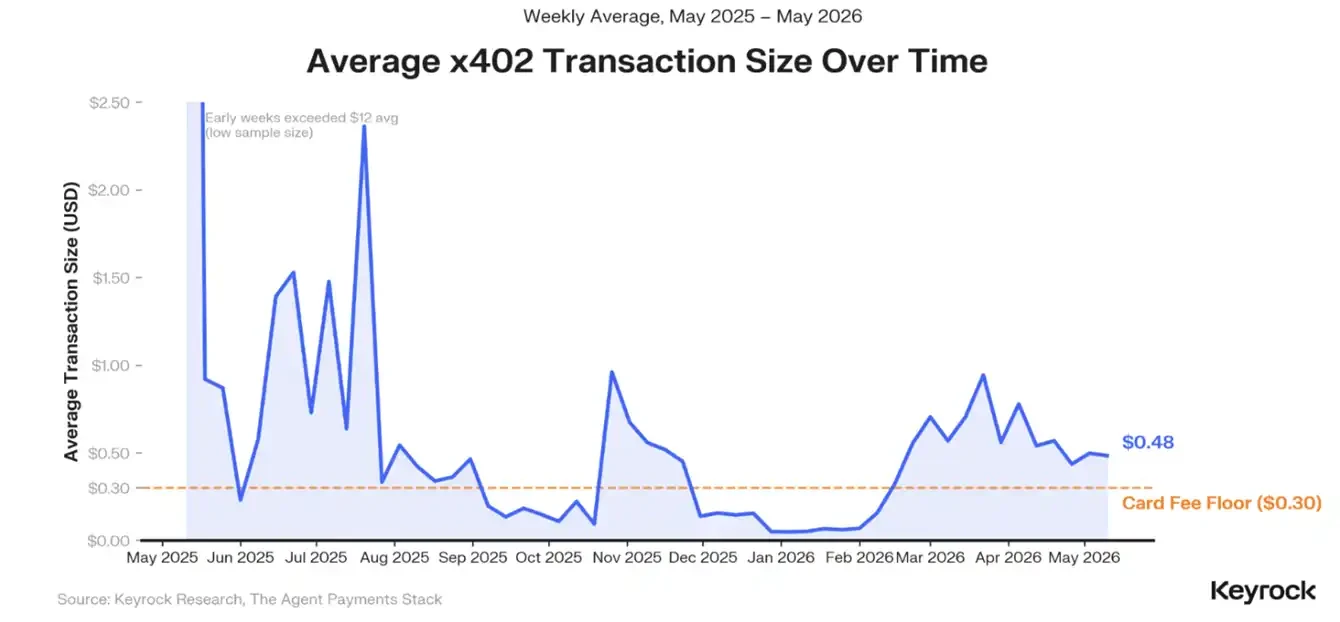
0.30 dollars is the most common fixed fee per transaction in the U.S. and most mainstream markets. This fee acts as a wall, making micro-payments of less than 1 dollar extremely uneconomical. For instance, a 3-cent API call incurs a cost of 0.30 dollars, which is 10 times the fee, and if the Agent pays with a credit card, the accumulated costs would be prohibitive.
Blockchain effectively addresses this issue. On Base, the cost of transaction settlement is 0.0001 dollars. With this significant advantage, stablecoins almost naturally win in the competition for Agent payments against traditional payment giants.
In the 176 million Agent transactions already processed by x402, 98.6% of the transactions are settled in USDC. Given the close relationship between Coinbase and Circle, it can be said that Coinbase is also a big winner at the settlement layer.
However, the settlement layer is just one layer of Agent payments. In the race to solve Agent payments using crypto-native solutions, Coinbase has a competitor—Stripe.
The Challenge from Stripe
In March this year, Stripe launched the Agent Payment Protocol (MPP), bringing Stripe's infrastructure for Agent payments almost on par with Coinbase's.
- From a settlement layer perspective, Coinbase has Base, while Stripe has Tempo.
- From a wallet perspective, Coinbase has Agent Wallet, and Stripe has Privy.
- From a routing layer perspective, Coinbase has built-in routing facilities, whereas Stripe has the Bridge acquired for 1.1 billion dollars.
- From a payment protocol perspective, Coinbase has x402, and Stripe has MPP.
Now, returning to the Base MCP mentioned at the beginning of the article, since both companies have the above four layers of supporting infrastructure, the next thing to compete for is naturally the application layer.
This is the core reason why AI can become the main storyline for Base—Base needs to ensure that AI (at least AI in the cryptocurrency field) occurs on Base, not merely to offer a perspective for degens on the Base chain, but to broaden the scenarios for Agent payments, enabling more Agents to perform more transactions for more applications, thus ensuring its leading position in the Agent payment sector.
Once a dominant scale advantage is established, when Agent payments enter the commercial realm in the future, Coinbase will have a greater chance of winning significantly.
From this perspective, the launch of Base MCP is just a small step in Coinbase's vast ambitions.
免责声明:本文章仅代表作者个人观点,不代表本平台的立场和观点。本文章仅供信息分享,不构成对任何人的任何投资建议。用户与作者之间的任何争议,与本平台无关。如网页中刊载的文章或图片涉及侵权,请提供相关的权利证明和身份证明发送邮件到support@aicoin.com,本平台相关工作人员将会进行核查。


