Original | Odaily Planet Daily (@OdailyChina)
Author | jk
On May 24, the Haifang Road in Tsim Sha Tsui, Hong Kong, was surprisingly quiet.
A week ago, this place was still the "account opening street" for mainland investors, with brokerage stalls and mobile vehicles lined up, bustling with crowds. Hong Kong stock account opening had zero commission, stock giveaways, support for new listings, and relaxed proof of address... In order to attract mainland customers, brokers had almost lowered the thresholds to the floor.
However, just seven days later, the door slammed shut. Now, mainland customers wanting to open a Hong Kong stock account not only have to sign a written declaration, promising that the funds come from abroad and have never falsified documents, but even after signing, they may still receive a "not approved" notification.
The turnaround began on May 22. Combined regulatory measures from both regions landed simultaneously, directly affecting millions of mainland investors who invest in overseas markets through Hong Kong brokerages.
How severe is this regulatory storm? What is the real experience of mainland residents trying to open accounts in Hong Kong now? What compliant channels remain for investing in overseas assets? Odaily Planet Daily dissects each point for readers.
1. Cross-Strait Cooperation, The "grey channel" for Hong Kong stock investment is blocked overnight
On May 22, Hong Kong and mainland regulatory bodies launched coordinated efforts almost simultaneously, attacking from both South and North.
The Hong Kong Securities and Futures Commission (SFC), after reviewing account opening procedures of 12 securities brokerages, issued an unusually stern circular. The document pointed out several significant deficiencies: inadequate due diligence on account opening documents, acceptance of suspicious or forged documents during the process, and obvious weaknesses in managing cross-border relationships with overseas intermediaries. The SFC bluntly stated that these accounts might be used for illegal transactions, and the risk of money laundering cannot be ignored.
For mainland investors, the SFC listed additional "three-piece" requirements in the circular's annex: new accounts must submit a written declaration, with deposits, withdrawals, and settlements only allowed through qualified bank accounts opened in the client's name. The core content of the written declaration includes: confirmation that all investment funds come from legal sources outside of mainland China, the account has never been closed due to suspicious documents, any changes must be reported to the brokerage within seven business days, and agreement to disclose relevant information to law enforcement agencies.
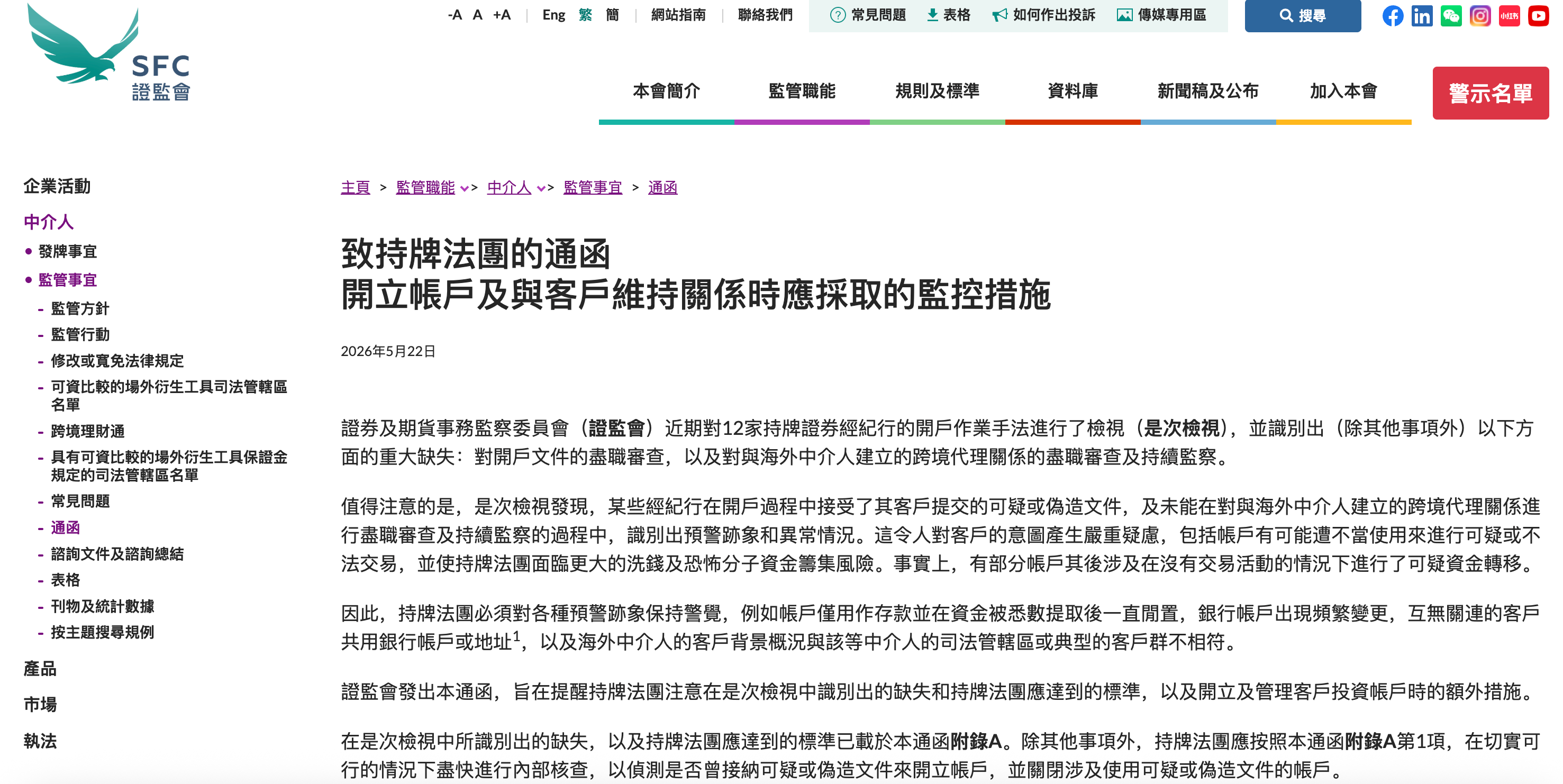
The SFC required all licensed institutions to immediately conduct self-inspections, close accounts opened using suspicious or forged documents, as well as "dormant accounts" with zero balances and no transactions for 12 months. Senior management was explicitly named, warning that those seriously negligent in compliance could face regulatory and enforcement actions.
Almost at the same time, the China Securities Regulatory Commission (CSRC) in conjunction with eight ministries (Ministry of Industry and Information Technology, Ministry of Public Security, People's Bank of China, State Administration for Market Regulation, Financial Supervisory Commission, National Internet Information Office, State Administration of Foreign Exchange) officially issued the "Implementation Plan for Comprehensive Rectification of Illegal Cross-Border Securities, Futures, and Fund Business"—the plan sets a two-year concentrated rectification period, during which existing accounts are only permitted to sell or transfer funds, no new accounts are allowed, and prior administrative penalties were announced for Tiger Brokers, Futu Securities, and Changqiao Securities for illegal conduct. The range, strength, and determination of execution in this combination punch are rare in recent years of financial regulatory history.
Two documents, from different regulatory systems, point to the same issue: The model through which numerous mainland investors have invested in Hong Kong and U.S. stocks via Hong Kong brokerages, which has long existed in a legal grey area, is officially declared over. Regulation this time is serious.
To understand why this action is so resolute, one must look back over the past two to three years to see how "wide" this channel has been.
From 2023 to early 2025, the markets for Hong Kong and U.S. stocks surged in turns, leading to a dramatic increase in demand for account openings among mainland investors as many new IPO opportunities emerged in Hong Kong. At that time, internet brokerages represented by Futu, Tiger, and Changqiao penetrated the mainland user base significantly due to smooth Chinese App experiences, low or even zero commissions, and support for direct deposits in RMB. Some Hong Kong brokerage platforms did not require proof of address, or did not conduct substantial address verifications, and even allowed deposits via stablecoins (USDT). Opening accounts was almost just a click away.
As early as July 2016, the SFC had issued a risk warning, naming Tiger Brokers, Futu Securities, and others offering foreign securities trading services. At the end of 2022, the CSRC conducted a regulatory campaign targeting offshore brokerages like Tiger and Futu. However, the rectification effects were limited, with existing accounts still used normally, and some platforms even continued to accept new customers from the mainland through various workaround methods after the corrections.
This time, the official response is much harsher. The policy focus has shifted from limiting new accounts to rectifying existing ones, completely locking out all previous spaces indicated by regulation.
2. "With the written declaration in hand, account opening still fails"
As soon as the new regulations were announced, those taking action quickly bought tickets to Hong Kong, but the account opening did not go smoothly. Over the past week, multiple photos titled "Written Declaration for Mainland Investors" have circulated on social media, all from mainland individuals who personally attempted to open accounts at offline stores of Hong Kong brokerages.
Blogger AB Kuai.Dong described a friend's personal experience: the individual went to Hong Kong specifically to apply for a U.S. and Hong Kong stock account at Yingli Securities, was asked to sign the "Written Declaration for Mainland Investors", filled out all materials, waited for over an hour, and was still told "account opening review failed." Blogger Simon recorded a similar experience; his friend walk-in to open an account, signed the declaration, and waited over an hour, ultimately also failing.
From the declaration texts shared by multiple accounts, it appears that the document's content is highly consistent with the SFC circular’s annex requirements, indicating that brokerages have quickly implemented the new regulations.
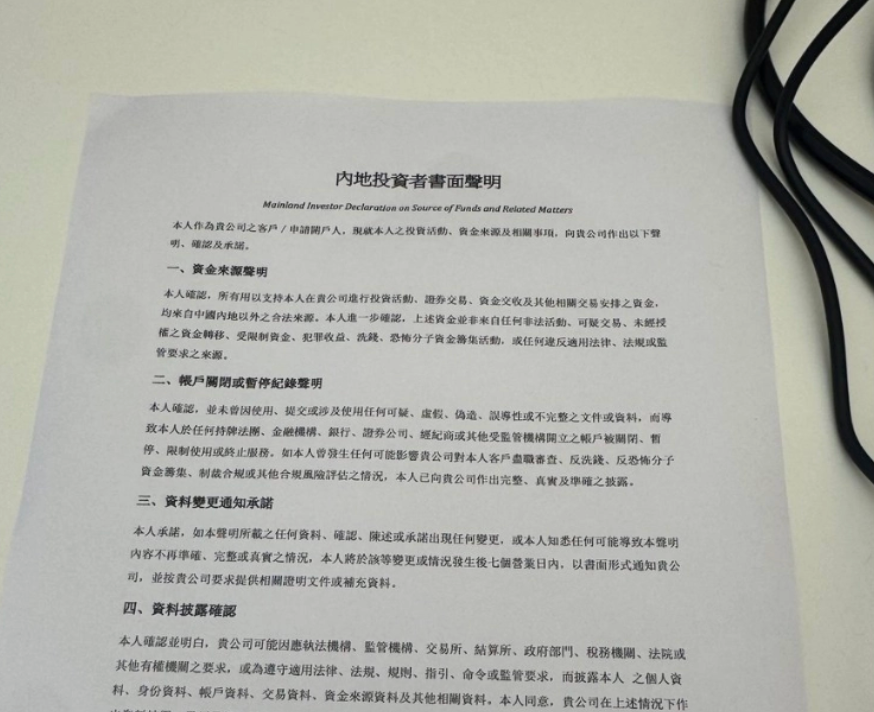
It's worth noting that even signing the declaration does not guarantee successful account opening, while refusing to sign will definitely result in an inability to open an account. Blogger Li Zhi provided a straightforward interpretation of this: Brokerages, by requiring clients to sign this declaration, are effectively doing two things: first, they are shifting compliance responsibility; if something goes wrong, they can claim "the client declared their funds were legal"; second, they are sifting clients, because most mainlanders trading Hong Kong and U.S. stocks through Hong Kong brokerages have been in a legal grey area; this declaration asks them to confirm on paper that funds come from abroad, which itself is a barrier.
Reports from CaiLianShe on May 27 also confirmed this phenomenon, prevalent among almost all brokerages in Hong Kong: since May 26, there have been new requirements on the documents provided by clients opening investment accounts through offline banking channels in Hong Kong, requiring a declaration of the legal source of funds. A representative from a foreign bank in Hong Kong also confirmed to CaiLianShe reporters that the requirement for signing relevant declarations indeed exists.
It is understood that the newly added document is titled "Cross-Border Disclosure Declaration (Applicable to Investment Account Application Business)." According to documents shown by clients, the core content of the declaration states: The individual opening the investment account must confirm "all funds used to support investment activities and related settlements come from legal sources outside mainland China"; it is also required for mainland residents to note that investment account services only apply to investors physically present in Hong Kong (for instance, living or working in Hong Kong), and they must ensure that the source of funds is legal and compliant.
The document further clarifies that to comply with regulatory requirements in Hong Kong, banks may ask clients for relevant proof documents; if these cannot be provided, service may be refused, and already opened services may also be terminated. Notably, it is not just new account openings that are affected. An official customer service representative from a Chinese bank confirmed to CaiLianShe journalists that mainland investors who opened investment accounts between May 23 and 25, 2026, must also supplement the new cross-border declaration; the policy does not offer any transitional buffer.
3. Who can still open accounts? A review of existing compliant windows
This tightening has directly shut down the entrances of major internet brokerages for mainland clients, but not all channels are closed.
Brokerages that have completely stopped accepting new mainland clients: Futu Securities, Tiger Securities, Changqiao Securities, Huasheng Securities. The four have closed new account opening channels; some existing accounts can still trade normally, but according to regulations can only sell in one direction, waiting to fully retire after the two-year transition period ends.
Currently, the licensed Hong Kong brokerages that still retain limited channels for mainland residents (as of the publication date, the situation is still evolving):
Yingli Securities is currently one of the few Hong Kong brokerages still supporting direct account openings for mainland users, holding Hong Kong SFC license numbers 1, 4, and 9, and its U.S. subsidiary is also registered with the SEC and regulated by FINRA, having a relatively well-established compliance system. However, from the latest feedback on social media, following the implementation of the new regulations, Yingli's account opening review for mainland residents has clearly tightened, with a sharp increase in offline walk-in account opening failures; whether or not one can pass largely depends on whether the applicant genuinely meets the condition of "funds coming from outside mainland."
Fosun Wealth and ZhiFu Securities are two additional options that still retain channels for mainland users.
Some bloggers claim that Fosun's official latest news states that its adjusted account opening policy does not require proof of address anymore, but applicants must use VPN or handle the process in person in Hong Kong; users with virtual bank cards from ZhongAn, Tianxing, HSBC, etc., must show their location as Hong Kong when opening an account. Odaily has verified with the official Fosun that this account opening policy is a rumor; opening an account still needs to comply with the compliance policies mentioned above.
For users with overseas identities (such as international students, work visa holders, and overseas permanent residents), the conditions are relatively lenient, but they still must provide proof that funds come from abroad.
Opening an account is just the first step, How to deposit money is also a core constraint in the new regulations.
The SFC circular explicitly states that deposits, withdrawals, and settlements for mainland investors' accounts can only be conducted through accounts opened in the client's name at licensed banks in Hong Kong or qualified jurisdictions. Methods that involve transferring funds through third parties or unknown sources have been clearly blocked. This means that earlier tactics like currency exchange through money changers, friends transferring funds, or depositing via USDT to circumvent foreign exchange controls are no longer compliant.
In practical terms, being able to deposit smoothly requires holding a local Hong Kong real-name bank card. Virtual banks like ZA Bank and Tianxing Bank support FPS transfers and can deposit normally into brokerage accounts; some brokerages (like Yingli Securities) also support the eDDA quick deposit feature that can be linked to ZA Bank. Therefore, for users without a Hong Kong bank account, obtaining a Hong Kong bank card before opening a securities account has become an indispensable step in the process.
In summary, after May 2026, the compliant pathways for ordinary mainland investors to invest in Hong Kong and U.S. stocks have been significantly narrowed, but they have not been completely closed. Given the current circumstances, several routes remain viable.
The most stable path: Compliant identity, compliant funding channels, and a Hong Kong bank account. International students, overseas work visa holders, and residents of Hong Kong and Macau with offshore proof documents can still open accounts at licensed brokerages like Yingli, ZhiFu, and Fosun, with tourists facing a significant chance of failure, especially needing to be cautious about the source of funds.
Policy compliant channels: Stock Connect, QDII, and Cross-Border Wealth Management Connect. These are the directions that regulators clearly hope to guide capital flow towards; although the varieties are limited and the quota has a ceiling, they are fully compliant, and affected mainland investors' funds are expected to gradually migrate to these channels.
On-chain pathways: Hyperliquid, xStocks and other platforms provide technical alternative solutions; for users who can meet the requirements for opening accounts through these platforms, it is another option. However, it needs to be pointed out that such on-chain products have clear boundaries on compliance levels. Recently, many projects offering cryptocurrency products for Hong Kong stocks have already sent announcements stating that they will no longer provide such products in response to recent regulations in Hong Kong. Meanwhile, the majority of products in this category do not accept registrations from mainland China users, making them more suitable for those living overseas.
Conclusion: Significant tightening, but opportunities still exist
This tightening is a concentrated release of long-accumulated tensions. The disorderly expansion of Hong Kong brokerages towards mainland clients over the past few years, while bringing substantial user growth, has also left many compliance risks, including forged documents, unclear sources of funds, and misuse of dormant accounts. The synchronized crackdown of regulatory authorities on both sides has sent a clear message to the market: The dividend period of this grey channel has ended.
For mainland investors who still have needs for allocation in Hong Kong and U.S. stocks, the road ahead will not be easier, but compliant options still exist. The route chosen depends on one’s identity status, risk tolerance, and self-judgment of compliance boundaries. In any case, one must be clear before signing any written declaration: once signed, the legal responsibility falls on the individual.
(Odaily Note: This article is a comprehensive summary based on the official circular from the Hong Kong Securities and Futures Commission, announcements from the mainland CSRC, reports from CaiLianShe, Yicai, and social media firsthand information, for informational reference only and does not constitute investment advice.)
免责声明:本文章仅代表作者个人观点,不代表本平台的立场和观点。本文章仅供信息分享,不构成对任何人的任何投资建议。用户与作者之间的任何争议,与本平台无关。如网页中刊载的文章或图片涉及侵权,请提供相关的权利证明和身份证明发送邮件到support@aicoin.com,本平台相关工作人员将会进行核查。


