Using Korean won-denominated platforms such as Upbit, Bithumb, Coinone, Korbit, and Gopax as samples, and comparing them with the Korea Composite Stock Price Index (KOSPI), it can be observed that domestic funds have completed a drastic reallocation in less than a year: In August 2025, the trading volume of domestic cryptocurrency assets in Korea was approximately 99% of the KOSPI trading volume, with both scales nearly level. However, by May 2026, this ratio had shrunk to about 8%, with cryptocurrency transactions reduced to only one-tenth of the stock market’s level. According to estimates from a single source, since the peak in August 2025, the trading volume of virtual assets in the domestic Korean won market has accumulated a decline of about 71% (this figure still needs further cross-validation with more data), significantly underperforming the KOSPI, which has continuously reached new highs due to semiconductor prosperity and policy stimulus, leading to an increasingly widening gap in trading scale. Combined with the recent negative Kimchi Premium of Bitcoin in the Korean market, it indicates that local investors' marginal demand for cryptocurrency assets has noticeably cooled, with overall fund allocation and risk appetite shifting from the high-leverage, high-volatility cryptocurrency market to traditional assets like stocks represented by the KOSPI.
From Equal Standing to One-Tenth: A Cliff-like Drop in Trading Volume
Data from Korean won-denominated platforms, mainly covering local spot exchanges such as Upbit, indicates that in August 2025, the trading volume of Korea's virtual asset market once reached about 99% of the KOSPI trading volume, making both scales nearly equal, marking a peak for domestic funds' “crypto/stocks” allocation that was close to a 50-50 split. However, by May 2026, this ratio plummeted to about 8%, with cryptocurrency trading volume reduced to roughly one-tenth of the KOSPI. Estimates from a single source indicate that since the peak in August 2025, the virtual asset trading volume in the domestic won market has accumulated a reduction of about 71%, and following the futures clearing and price collapse in September-October 2025, there has been no evident recovery, with trading activity remaining in a prolonged low range.
In contrast, the KOSPI has maintained a high level of trading activity supported by semiconductor prosperity and policy stimulus, showing no signs of contraction similar to those in the cryptocurrency market. On the same timeline, while cryptocurrency trading volume slid from “almost equal” to “only one-tenth,” the stock market continued to amplify the profit effect and absorb new funds, gradually widening the gap in trading volume proportions. Some analysts believe that this change in ratio from 99% to 8% reflects not only the divergence in trends between the two markets but also the systematic shift of local investors’ funds and attention from high-volatility cryptocurrency assets toward the KOSPI. This reversal of ratio levels essentially indicates a reordering of risk-return dynamics by Korean retail investors and local funds concerning cryptocurrency assets and stocks.
Futures Clearing Storm: A Vacuum After the Cryptocurrency Crash
The timeline is clear: In August 2025, the trading volume ratio of Korean won-denominated cryptocurrency to KOSPI was still close to 99%, with both sides’ trading volumes nearly equal, and leveraged funds and short-term traders were highly active in the cryptocurrency market. However, according to a single source, in September-October 2025, the Korean virtual asset market experienced a massive futures clearing event, leading to a rapid deleveraging, which triggered a swift crash in cryptocurrency prices. Many high-leverage longs were forcibly liquidated, and profits and margins were quickly wiped out, leading to the passive exit of a batch of high-frequency accounts that had originally supported trading activity.
After the clearing, the domestic virtual asset market entered a “vacuum period” in trading. Analysts point out that in the months following the crash in September-October 2025, the trading volume of Korean won-denominated cryptocurrencies entered a pronounced downtrend, in stark contrast to the peak in August. Estimates from a single source indicate that the cumulative decline since the August peak was about 71%. During this period, the high-density concentration of risk events—futures clearing, price collapse, and account liquidation risk—coincided timed-wise with a cliff-like weakness in trading volume. Market perspectives generally view the two as part of a causal chain: the clearing storm severely impacted the risk tolerance of leveraged funds and short-term traders, weakening their willingness to add margins and re-enter the market, laying the groundwork for the prolonged lag of Korean cryptocurrency trading volume behind the KOSPI in terms of liquidity and sentiment.
Semiconductor Bull Market and Policy Whirlwinds Pulling Funds Away
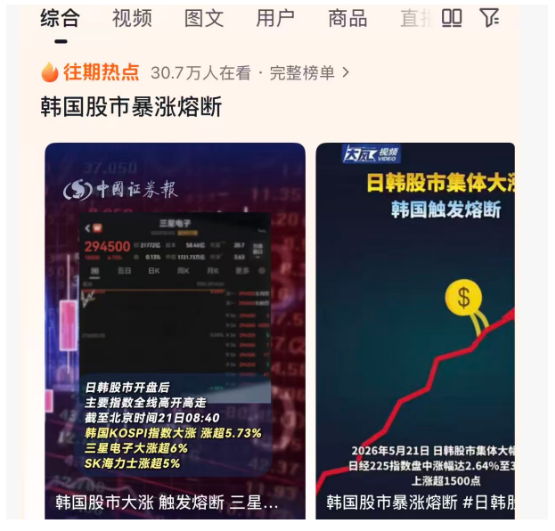
Synchronously with the clearing and contraction in the cryptocurrency market, the Korean stock market has followed a completely opposite trajectory. Reports indicate that after September-October 2025, during which cryptocurrency prices and trading volumes continued to weaken, the KOSPI surged, hitting new highs driven by the buoyancy in the semiconductor industry; concurrently, stock market stimulus policies introduced by the Korean government directly benefited the local stock market, further reinforcing this upward trend. The result is that in August 2025, the trading volume of domestic Korean won-denominated cryptocurrencies was still close to “1:1” with the KOSPI (about 99%, according to Sources A and C), but by May 2026, this ratio had shrunk to approximately 8% (according to Sources A and C), with the gap dramatically widened in less than a year.
Some analysts see this as not merely a “cooling of cryptocurrencies,” but as a significant “funds migration” driven by clearly divergent policy directions and profit expectations. On one side is the high-volatility asset undergoing futures clearing and price collapse, with emotions and leverage preferences severely impacted; on the other side are the KOSPI, buoyed by the semiconductor boom and government stimulus policies, which continues to hit new highs and create a strong profit effect. Under the dual considerations of risk-reward ratio and policy guidance, funds have structural motivations to withdraw from the former and shift to the latter. The drop in cryptocurrency trading volume relative to the KOSPI from nearly equal to one-tenth, alongside the consistently negative Kimchi Premium reflecting decreased local demand, has been interpreted by the market as a sign that Korean fund allocation has now phase-shifted towards traditional assets supported by policy, such as the stock market, reinforcing the pattern of the trading volumes of the two asset types inversely affecting one another.
Kimchi Premium Turns Negative, Freezing Retail Investor Sentiment
The so-called Kimchi Premium essentially refers to the premium or discount level of cryptocurrency asset prices on Korean local exchanges relative to the average transaction price on major global exchanges. When the premium is positive, it indicates that local prices in Korea are higher than the global average; when the premium turns negative, it means that local prices are lower than or at most very close to the global average. Recently, Bitcoin’s Kimchi Premium in the Korean market has been in negative territory for a long time, with some opinions suggesting it fluctuates between slight discount and slight premium, although specific values still need more statistical validation. Monitoring from briefings clearly indicates that as of May 2026, Bitcoin prices at several major Korean won exchanges were overall lower than or close to the global average, establishing a price “discount” as a norm rather than a transient anomaly.
From the perspective of fund behavior, the ongoing negative Kimchi Premium signifies a clear weakening of local buying pressure: on one hand, Korean investors are no longer willing to pay an extra premium for the buying access to the local market; on the other hand, prices remaining long below or only close to the global average also lack the incremental funds necessary to rapidly restore local pricing. Industry insiders generally view this negative premium pattern as a direct signal of weakened local demand and cooling sentiment. Coupled with the aforementioned significant decline in trading volume of virtual assets in the domestic Korean won market since the peak in August 2025, with the trading amount relative to the KOSPI dropping to about 8% by May 2026, the long-term turn to negative Kimchi Premium not only aligns with the trend of declining trading volume but also confirms on the price dimension that the investment enthusiasm of Korean retail investors and local funds for cryptocurrency assets has entered a phase of retreat.
Retreat from Korean Cryptocurrency Market: Are Retail Investors Exiting or Changing Tracks?
Looking at the timeline more broadly, from the near “1:1” (approximately 99%) alignment of cryptocurrency trading volume with KOSPI in August 2025 to just about 8% remaining by May 2026, estimates from a single source indicate that domestic Korean won-denominated cryptocurrency trading volume has cumulatively declined by about 71%. When combined with the large-scale futures clearing and price collapse recorded by a single source during September-October 2025, and later the KOSPI continuously hitting new highs driven by semiconductor prosperity and policy stimulus, this more resembles a phase-driven retreat spurred by a cascading deleveraging, stock market profit effects, and policy orientation. The long-term shift of the Kimchi Premium into negative territory implies that local marginal buying needs have significantly weakened, with the simultaneous cooling of price and volume supporting market interpretations that funds are migrating from high-volatility cryptocurrency assets to stock markets with stronger policy and industrial backing. However, whether this change is a temporary retreat caused by cyclical risk aversion, or a mid-to-long-term reallocation shaped by regulation and industry structures, still lacks sufficient evidence. Key indicators that need to be continuously monitored include: overall trading and active account numbers for domestic Korean won-denominated cryptocurrency spot and derivatives, the trading volume share and relative performance of the KOSPI, whether the Kimchi Premium continues to be negative, returns to a convergence, or turns positive again, as well as the directional linkage of these variables under global market conditions and national regulatory changes, to more clearly assess whether the retreat of the Korean cryptocurrency market will reverse in the next cycle.
Join our community, let’s discuss and grow stronger together!
On-chain Telegram community: https://t.me/AiCoinWhaleData
On-chain community: https://www.aicoin.com/link/chat?cid=N6OVMor5g
AiCoin on-chain Twitter: https://x.com/aicoinwhaledata
Exclusive AiCoin Hyperliquid benefits: https://app.hyperliquid.xyz/join/AICOIN88
Exclusive AiCoin Aster benefits: https://www.asterdex.com/zh-CN/referral/9C50e2
免责声明:本文章仅代表作者个人观点,不代表本平台的立场和观点。本文章仅供信息分享,不构成对任何人的任何投资建议。用户与作者之间的任何争议,与本平台无关。如网页中刊载的文章或图片涉及侵权,请提供相关的权利证明和身份证明发送邮件到support@aicoin.com,本平台相关工作人员将会进行核查。