The SEC postpones the "innovation exemption" for "tokenized stocks." Who is fiercely opposing it?
Written by: Azuma (@azuma_eth), Planet Daily
In the early hours of May 23 Beijing time, Bloomberg cited sources as saying that the U.S. Securities and Exchange Commission (SEC) has postponed its planned "innovation exemption" program. This program was initially intended to greenlight products related to "tokenized U.S. stocks," but due to numerous concerns raised by market participants, the SEC decided to delay the progress.
As a result of this negative news, the cryptocurrency market experienced a sharp drop, with BTC falling below 76,000 USDT and ETH also dropping below 2,100 USDT; the impact on the concept of "tokenized U.S. stocks" was even greater, with ONDO directly retracting its short-term gains gained yesterday due to the "SEC punishing firms like Tiger, Futu, and Changqiao," and as of the time of publication, it reported 0.382 USDT, with a 24-hour drop of 6.4%.
The innovation exemption was suddenly halted at the last moment
Since the current chairman Paul Atkins took office, the SEC has shifted from its previous hardline stance of "law enforcement instead of regulation" to a more accommodating approach towards providing a compliant testing ground for the crypto industry.
Earlier this week, rumors circulated in the market that the SEC would release an exemption proposal as early as this week, intending to allow trading platforms to provide on-chain token trading services for already listed securities (such as NVDA, AAPL, TSLA, etc.) under looser regulatory conditions. This exemption was pushed by SEC Chairman Paul Atkins and Commissioner Hester Peirce, aiming to provide a legitimate testing space for tokenized securities, with the market interpreting this as a significant signal of U.S. regulators' further support for tokenized securities.
However, this innovation exemption, which was supposed to be officially revealed to the public this week, was abruptly hit with the brakes at the very last moment. Insiders disclosed that the SEC has sent the draft back and started to consult securities exchanges and other market participants intensively again.
From "universally greenlit" to "emergency brakes," what kind of resistance is the SEC actually facing? In this epic game regarding "putting U.S. stocks on the blockchain," who is passionately opposing?
The opposing force comes from Wall Street
Similar to the CLARITY bill, which also faces resistance (see "Why Has the CLARITY Review Been Postponed Amid Such Serious Industry Disagreement?"), among those fiercely opposing this exemption proposal, the front line is occupied by the traditional forces of Wall Street, represented by Citadel Securities and the Securities Industry and Financial Markets Association (SIFMA).
As early as several months ago, when this policy was still in the wind phase, these traditional financial giants had already submitted a strongly worded letter of opposition to the SEC. In summary, the core opposition arguments from Wall Street mainly focus on the following three levels.
First, there are concerns that the market may experience liquidity fragmentation issues. Institutions like Citadel Securities have warned that allowing various third parties to disorderly issue "synthetic U.S. stocks" by bypassing the issuer could lead to U.S. stock assets being fragmented and scattered across numerous DeFi platforms that lack interconnection, depth, and price transparency. This would not improve efficiency but rather leave investors unable to determine the actual value their tokenized stocks correspond to at a given moment.
Second, there are worries that U.S. stock tokens could threaten traditional compliance boundaries. How can it be ensured that the transactions of these third-party tokens do not become a breeding ground for money laundering on anonymous or pseudo-anonymous public blockchain networks? Wall Street giants argue that the current technological means available on decentralized platforms cannot effectively enforce core investor protection mechanisms such as AML and KYC.
Third, there are still gaps in technology and law. Institutional representatives citing legal opinions point out that allowing a third-party crypto platform, not authorized by companies like Apple and Microsoft, to realize "voting rights and dividend distribution for token holders" on-chain still carries uncertainties under the current legal framework and technological path.
There are also reservations within the SEC
It is noteworthy that this wave of opposition does not only stem from Wall Street's "vested interests," but there are also cautious reservations within the SEC.
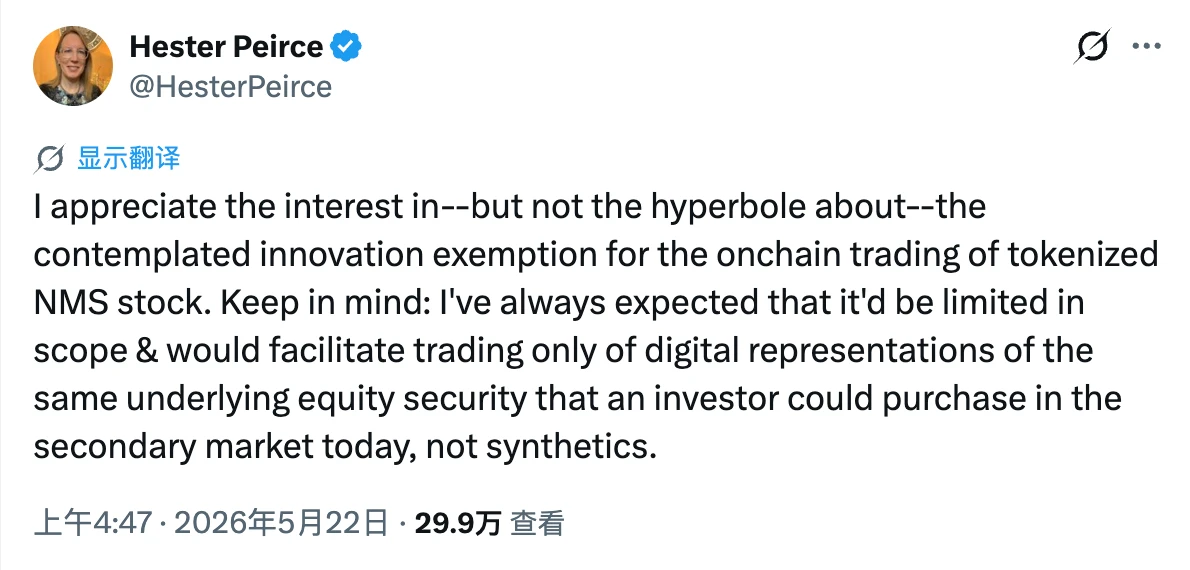
Hester Peirce, a longtime ally of the crypto community affectionately referred to as "Crypto Mom," publicly expressed her change of stance on X yesterday, stating that the scope of this exemption should be strictly limited.
Peirce stated that what the SEC should allow is those attempts to digitize or tokenize their own stocks on-chain led by "the issuer themselves or their affiliates"; rather than allowing a bunch of synthetic assets issued by third parties to appear in the market, disconnected from regulatory control. In other words, the "tokenized U.S. stocks" that Peirce wishes to see should be led, authorized, or endorsed by the specific listed company itself (i.e., the issuer), and must guarantee that investors have the same rights as ordinary shareholders (such as dividends, voting rights, etc.), and not the current market's more mainstream, third-party issued derivative synthetic tokens that track the performance of underlying stock prices.
Even a vocal supporter of crypto innovation like Peirce chooses to stand on the side of "restricting the scope of the exemption," this indicates the significant legal compliance resistance this proposal faces.
What will the future of tokenized stocks look like?
This week's "delay in advancement" undoubtedly dealt a blow to the RWA (real-world assets) sector that is on the verge of explosion. The short-term crash of related concept tokens like ONDO also reflects the market's earlier expectations for "comprehensive on-chain compliance of U.S. stocks" may have been overly optimistic. But it is undeniable that regardless of how regulators' attitudes fluctuate, the trend of combining U.S. stock assets with blockchain technology has already become an irreversible tide. Under the shadow of this regulatory game, both the crypto native forces and orthodox Wall Street institutions are actually racing crazily on their respective tracks.
On one hand, crypto native forces are tearing open a breakthrough from the bottom up. Projects like Ondo, xStocks, and MSX are actively bringing U.S. stock assets on-chain, while Hyperliquid, Trade.xyz, and various major CEX platforms are also indirectly providing a window for global crypto users to invest in U.S. stocks through perpetual contracts. This innovative demand from the grassroots is constantly forcing regulators to provide clear answers.
On the other hand, Wall Street is also accelerating its layout of related businesses. The Depository Trust & Clearing Corporation (DTCC) plans to officially launch limited production trading of tokenized assets in July this year, and to expand the promotion in October; Nasdaq is also intensively developing a blockchain-based stock issuance framework; the Intercontinental Exchange (ICE) has chosen to collaborate with leading exchanges in the crypto sector like OKX to jointly promote the research and development of tokenized stocks and crypto-related products.
Essentially, this postponement of the exemption is a fierce collision between the innovative attempts of new forces and the defensive mechanisms of traditional powers. Based on the current event developments, the SEC has yet to make a final decision on the draft amendments, which means the "innovation exemption" has not been completely killed off, but it is foreseeable that under the fierce counterattack from Wall Street giants and internal amendments within the SEC, even if this exemption can be reinstated in the future, its radical nature and applicable scope may face some "discount."
The dream of fully opening up "tokenized stock" trading may still have a long way to go in the tug-of-war of regulation, but the door to asset tokenization has been forced open and is destined to remain ajar.
免责声明:本文章仅代表作者个人观点,不代表本平台的立场和观点。本文章仅供信息分享,不构成对任何人的任何投资建议。用户与作者之间的任何争议,与本平台无关。如网页中刊载的文章或图片涉及侵权,请提供相关的权利证明和身份证明发送邮件到support@aicoin.com,本平台相关工作人员将会进行核查。


