Author: David, Shenchao TechFlow
Someone from OpenAI has gathered again.
On May 19, former OpenAI co-founder, former Tesla AI director, and renowned Vibe Coding expert Andrej Karpathy officially announced his joining Anthropic.
Karpathy joined OpenAI when it was founded in 2015, later went to Tesla to serve as AI director, and in 2024 started his own company for AI education, Eureka Labs.
In simple terms, he is someone who is already financially free, has his own company to run, and doesn't need to work for anyone else. But he still changed jobs.
What is even more unusual is that this kind of top-tier figure does not report directly to Anthropic founder Dario Amodei. Anthropic's official statement is that he will report to the head of pre-training, Nick Joseph.
This position and context, if placed within a traditional tech company, would probably correspond to a director level. And his direct reporting superior, Nick Joseph, is also someone who came from OpenAI...
So the situation is, an OpenAI co-founder goes to the competitor's company as a subordinate, his boss is also a former OpenAI employee. And the competitor company Anthropic's founder, Dario Amodei, also comes from OpenAI, having been the research vice president before leaving.
This is quite interesting.
The author looked through Anthropic's internal list, from founder Dario and Daniela Amodei siblings, to John Schulman, who jumped from OpenAI in 2024 to supervise alignment research, then to Nick Joseph, and finally to Karpathy who just reported in...
This company has already become like an OpenAI reunion that has moved to the competitor's site to start anew. If the Americans also implement the popular "non-compete agreements" used by domestic giants, the venue of this reunion would probably need to be changed to the courthouse today.
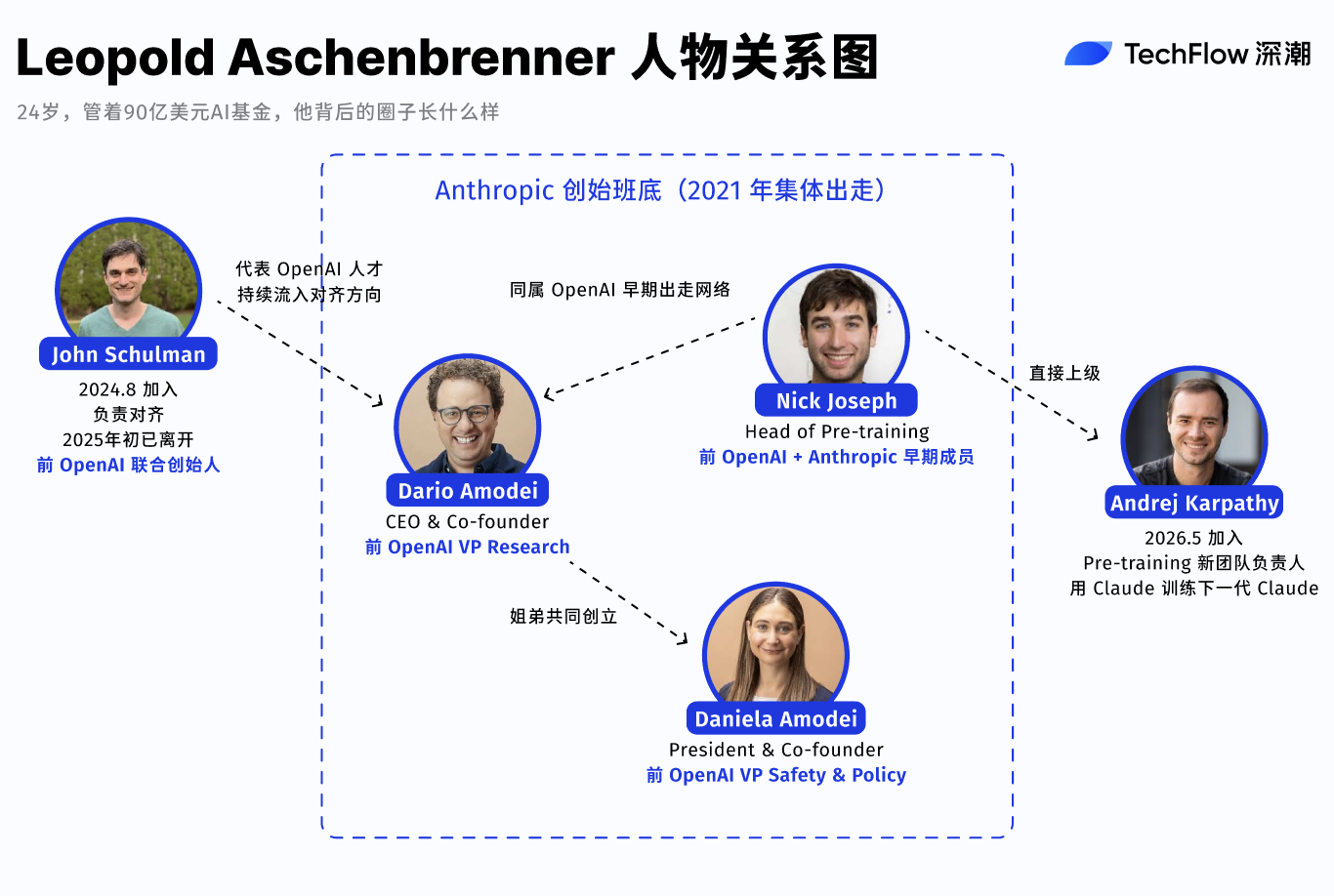
The co-founder works for former colleagues, just to let Claude train itself
Karpathy's specific task upon joining is to build a new team. According to an official statement from an Anthropic spokesperson, it is called "using Claude itself to accelerate pre-training research."
Translated into plain English, let AI train itself.
Generally speaking, pre-training is the most costly and resource-intensive phase for large models, determining a model's final core capabilities. In the past, this relied entirely on humans, where researchers designed training plans, engineers ran large-scale training tasks, and the effectiveness had to be assessed months later.
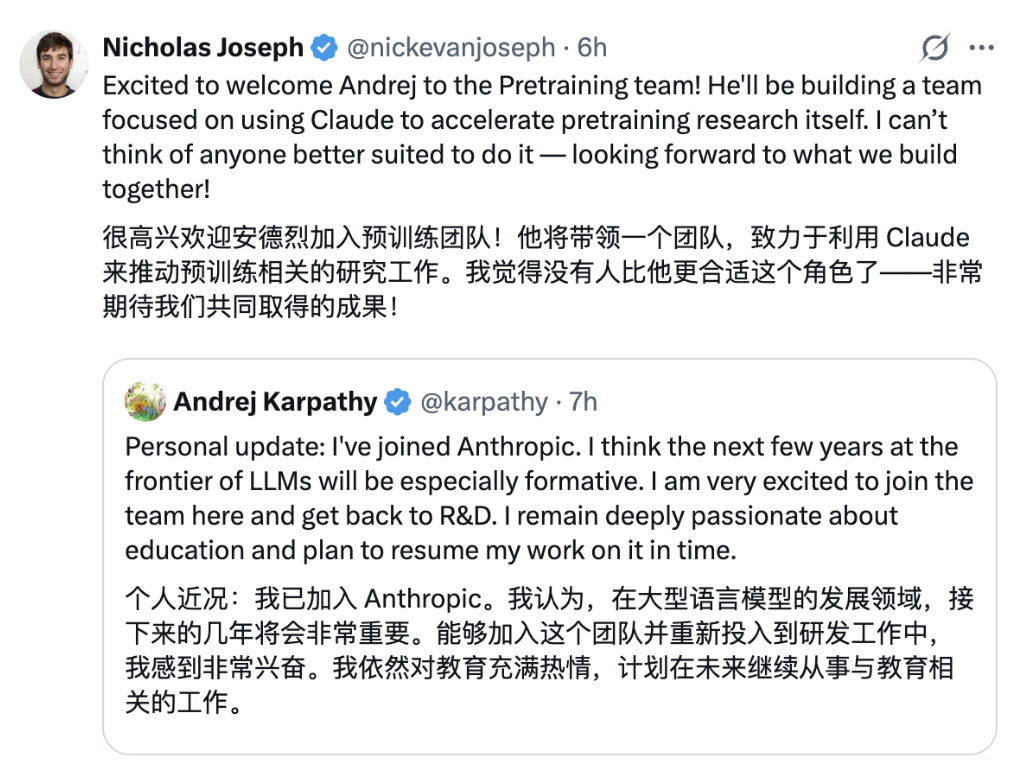
Now, the team that Karpathy is leading is integrating Claude itself into the training process of the next generation Claude. In other words, part of the R&D work for the next generation Claude will be done by the current generation Claude itself.
If this could really work, the iteration speed of AI would no longer be linear. Anthropic co-founder Jack Clark mentioned this direction in early May, stating that he is "increasingly inclined to think" that AI accelerating AI research is happening faster than expected.
Back to Karpathy. A person who is not short on money, fame, or positions, and who already has an education startup, why would he choose to work under a former colleague?
The only logical explanation is that he believes that AI self-training is particularly important in the coming years, important enough to justify him putting everything else aside to do it, aligning perfectly with his interests and capabilities.
Insufficient computing power, top experts to the rescue
Having AI perform self-training is actually driven by business reasons.
In early May, Dario Amodei admitted at the company's developer conference something not very flattering: in the first quarter of this year, Anthropic's revenue and usage skyrocketed 80 times year-over-year, but the company had originally planned for only a tenfold increase.
Growth came in 8 times faster than expected, the company wasn't prepared for this much computational power at all. The direct consequence was that various paid versions of Claude Pro, Max, and Code experienced different levels of throttling, leading to a chorus of complaints from paying users.
The reason is simple: GPUs were truly insufficient. This company has been almost frantically buying computing power over the past few months.
The most dramatic deal was signed on May 6 with Musk's SpaceX. According to CNBC reports, Anthropic secured all the capacity of the Colossus 1 data center owned by SpaceX. Colossus 1, located in Memphis, Tennessee, houses over 220,000 Nvidia GPUs with a power capacity exceeding 300 megawatts, enough to power 300,000 households.
The irony here is that Colossus 1 was originally meant for Musk's own xAI's computational power. And Musk had criticized Anthropic as "misanthropic" on X back in February. The only reason they could sit down and discuss business was that Musk was still in a legal battle with OpenAI.
The enemy's enemy is also a supplier of computing power, which makes sense.
Besides the SpaceX deal, Anthropic also signed a collaboration for up to 5 gigawatts of computing power with Amazon, another 5 gigawatts with Google and Broadcom, and struck a $30 billion deal with Microsoft and NVIDIA, plus a $50 billion investment with Fluidstack for U.S. domestic infrastructure.
This sounds like a lot of money being spent aggressively. However, an IDC report in May pointed out that compared to OpenAI, Anthropic's actual dedicated computing power available for training is still somewhat lacking.
OpenAI's approach is clear: stack computing power, stack data centers, stack parameters. This path is one that Anthropic surely cannot follow.
Thus, having AI train AI, Anthropic has no other choice. Using one GPU more intelligently is equivalent to buying another GPU. Therefore, bringing in the expert Karpathy here is an attempt to save on GPUs that cannot be bought by using brain power.
Out of 11 OpenAI co-founders, only 2 are left
If Karpathy is equivalent to a data center, OpenAI has lost much more than just one person.
And this did not start with him.
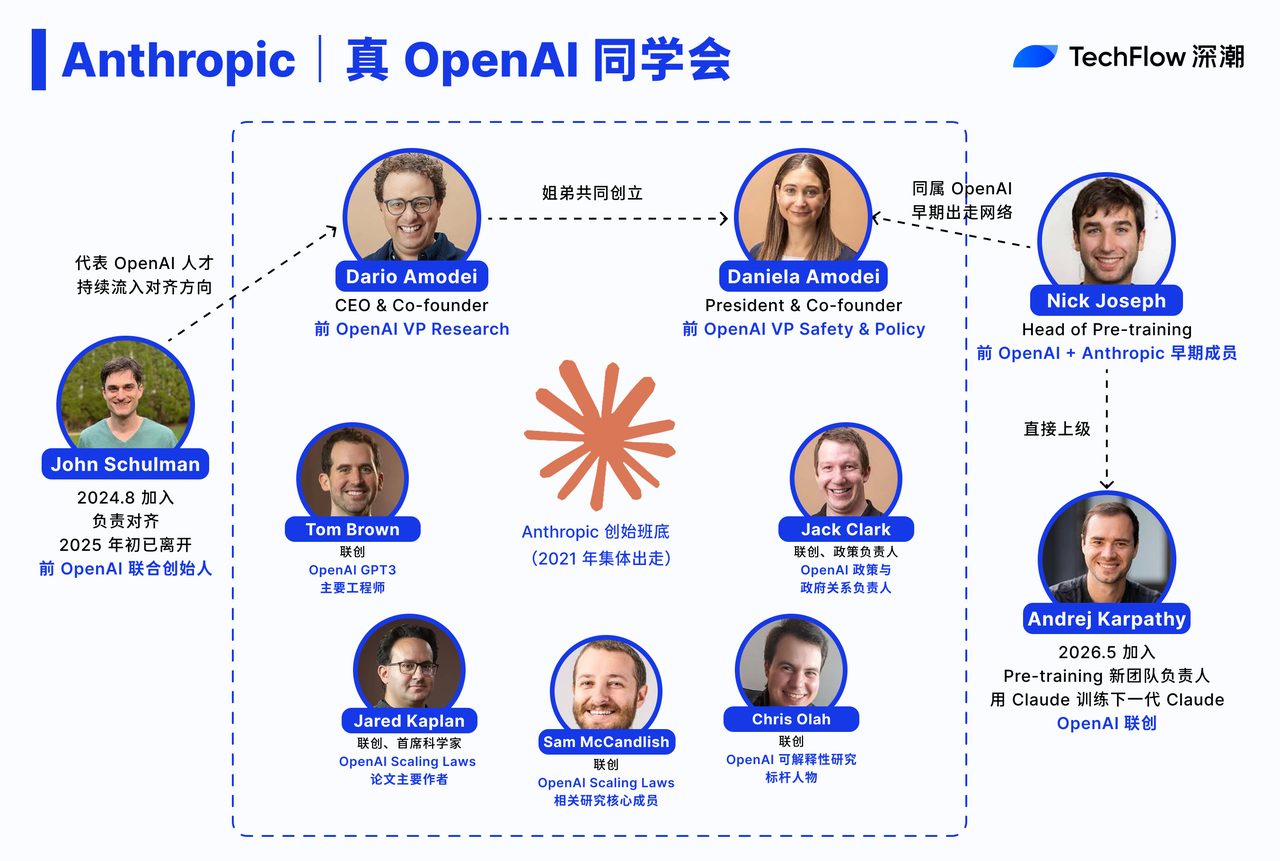
From the beginning, Anthropic was formed by a group of people who came out of OpenAI. In 2021, OpenAI lost seven core employees all at once, including the vice president of research, the vice president of safety policy, the chief engineer of GPT-3, two authors of the scaling laws paper, a leading figure in interpretability research, and the director responsible for policies. They collectively registered a company named Anthropic.
This is why outsiders jokingly refer to this company as the "OpenAI reunion."
Subsequently, more people joined. In 2024, OpenAI co-founder John Schulman and former alignment manager Jan Leike joined, followed this year by Karpathy and his boss Nick Joseph, along with a group of less well-known but equally critical researchers.
This group did not disperse to start their own companies elsewhere. They collectively came to the same place. More critically, they have no intention of returning.
Public reports indicate that the core reason for this group leaving OpenAI in 2021 was disagreement with the company's rapid commercialization and the inability of safety research to keep up. Five years later, OpenAI secured billions in investment from Microsoft, turned ChatGPT into a consumer product, and as of May this year, even integrated an advertising management backend into it. Any business in the U.S. can now advertise directly within ChatGPT.
And for those who left five years ago due to the rapid commercialization, there is even less reason to return today.
Zooming out a bit, out of the original 11 co-founders of OpenAI, only 2 remain at the company, CEO Sam Altman and president Greg Brockman. The other 9 have all left in various forms.
Those who left in 2024 represent almost the entire top layer of OpenAI. CTO Mira Murati, chief scientist Ilya Sutskever, alignment research lead Jan Leike, and co-founder John Schulman all announced their departures rather concentratedly within that year. In 2025, another 12 executives left, along with 7 core researchers who were poached by Meta all at once during the summer.
These individuals have either founded their own AI-related companies or joined competitors like Anthropic, but almost no one has switched careers or chosen to return to OpenAI after leaving.
Anthropic appears to be the biggest beneficiary of this migration. However, the root of the attrition may lie with OpenAI. Karpathy might not be the first to arrive, and likely not the last.
免责声明:本文章仅代表作者个人观点,不代表本平台的立场和观点。本文章仅供信息分享,不构成对任何人的任何投资建议。用户与作者之间的任何争议,与本平台无关。如网页中刊载的文章或图片涉及侵权,请提供相关的权利证明和身份证明发送邮件到support@aicoin.com,本平台相关工作人员将会进行核查。


