Google stated that "search is entering the era of intelligent agents." Google Search is now powered by Gemini 3.5, capable of executing tasks on a large scale, and the search box has transformed into an AI entrance, with intelligent agents continuously executing tasks.
Written by: Li Dan
Source: Wall Street Insights
On Tuesday, the 19th, Eastern Time, Google, under Alphabet, released a series of AI updates at its annual developer conference Google I/O 2026, from redesigning Google Search to launching the Gemini Omni and 3.5 Flash models, as well as the Gemini Spark intelligent agent, and publicly unveiling the next generation of AI glasses for the first time. Google is aiming to integrate AI throughout the entire internet ecosystem—search, Android, office applications, video, and even next-generation hardware.
Alphabet and Google CEO Sundar Pichai revealed during the keynote that the monthly active users for the Gemini application (App) have doubled within a year, exceeding 900 million; the "AI Overviews" feature in Google Search has now surpassed 2.5 billion monthly active users; and the number of users of the "AI Mode" has exceeded 1 billion.
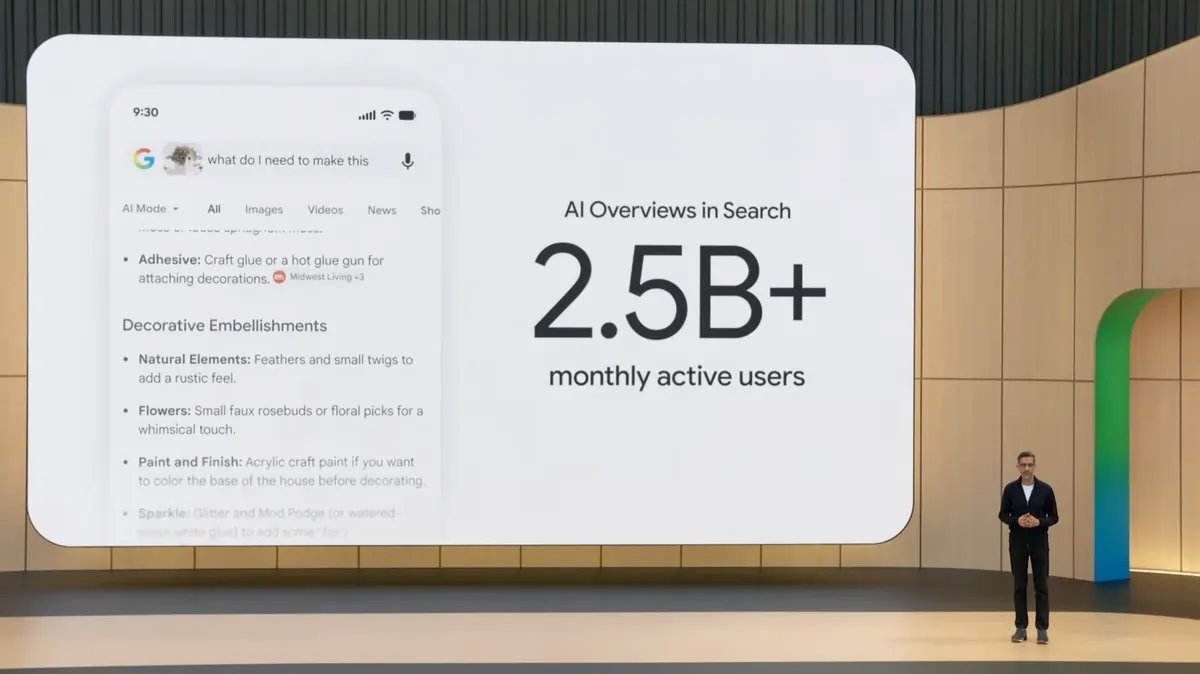
Pichai emphasized that AI is no longer just a chatbot but is "the next generation of computing platforms." He stated at the conference, "AI is illuminating every part of the company."
The introduction of the Gemini Omni model, Gemini 3.5 Flash, the continuously task-executing Gemini Spark intelligent agent, as well as the adjustment of the AI subscription system, shows that Google is trying to upgrade Gemini from a chatbot to an "AI operating system" that covers search, office, development, video, and mobile ecosystems.
This conference is seen as Google's comprehensive counterattack against competitors such as OpenAI and Microsoft. Over the past year, with ChatGPT changing users' search and content consumption habits, Google’s traditional search business has faced its greatest challenge since its inception, and the I/O conference clearly showcased its latest strategy: to utilize the largest internet traffic entrance globally to embed AI "natively" throughout the entire Google ecosystem.
The Biggest Revamp of Search in 25 Years: The Search Box Becomes an AI Entrance
One of the core changes at this I/O is Google's complete AI transformation of its search business.
Reportedly, Google is redesigning its iconic search box to better handle user queries to the AI chatbot that are "longer and more complex."
The new search box will:
- Support more natural language input;
- Make it easier to upload images and files;
- Automatically assist users in refining searches;
- Support AI agents in continuously executing tasks.
Nick Fox, head of Google's Knowledge and Information, stated, "Users should be able to input any question that comes to mind directly into the search box."
Google also plans to introduce an Agent feature in search to assist users: tracking topics of interest; booking services; managing health information; creating personalized task panels. Some features may only be available to paid subscribers.
Industry insiders believe this means Google Search is transitioning from a traditional "link distributor" to an AI task entrance.
Google's Strongest Multimodal Model Gemini Omni Unveiled
One of the core updates at this conference is Google's launch of the new Gemini Omni model.
Multiple tech media reported that Gemini Omni is positioned as Google's most advanced multimodal AI system, capable of handling text, images, video, voice, and real-time interactive tasks simultaneously.
Compared to previous Gemini series, the biggest changes in Omni are:
- Greater emphasis on real-time interaction;
- Better suited for Agent (intelligent agent) scenarios;
- Ability to continuously execute tasks across applications and devices.
Industry analysts believe Google is directly competing with OpenAI’s GPT-5 Agent system and Microsoft's advancing Copilot ecosystem.
Google executives repeatedly emphasized at the conference that "AI is not just about answering questions, but is beginning to truly complete work." This change indicates that Google's AI strategy has shifted from "chat assistant" to "task execution platform."
Gemini 3.5 Flash Focuses on Speed and Low Cost; 3.5 Pro to Launch in June
In addition to the flagship model, Google also launched Gemini 3.5 Flash.
According to information from the I/O conference and Google's developer page, the Flash series is positioned for low latency, high response speed, and lower inference costs, mainly targeting: developers; mobile devices; real-time interaction; AI programming and automation scenarios.
As a lightweight new member of the Gemini model, Gemini 3.5 Flash has cutting-edge technical capabilities, priced at only half that of comparable cutting-edge models, and in some cases, as low as one-third. Google announced that Gemini 3.5 Flash will become the global default model for the "AI Mode" in the Gemini App and Google Search functions.
Google stated that it has enhanced the cybersecurity protection of Gemini 3.5 Flash, making it "less likely to generate harmful content while also being less prone to misflag secure query requests."
Google also revealed that its more powerful version, Gemini 3.5 Pro, is currently being used internally but will be available to a broader audience next month, in June.
Media pointed out that Google is clearly aware that AI competition is no longer just "who is the smartest," but who is faster, cheaper, and more suitable for large-scale deployment.
In the era of Agents and real-time AI, the importance of latency and cost is rapidly rising.
Reports indicate that Gemini 3.5 Flash will become one of the important foundational models for Google’s new generation of AI subscription systems.
Gemini Spark: Google Officially Bets on "AI Agents"
Compared to model updates, Gemini Spark has attracted more market attention.
Google defines it as a "continuously running AI agent" that can execute tasks long-term in the background. Multiple media outlets labeled this the most strategically significant release of this I/O.
According to Google’s demonstration, Gemini Spark will be able to:
- Automatically organize emails;
- Monitor user schedules;
- Track webpage information;
- Manage documents;
- Complete cross-application workflows;
- Even make purchases and reservations on behalf of users.
Reports state that Google is promoting a concept of "always-on AI," meaning AI no longer waits for user commands but actively handles tasks.
Google Vice President Josh Woodward stated, "Spark represents a significant shift for Gemini." Industry insiders believe this indicates that the AI industry is transitioning from the "chatbot era" to the "agent era."
In the past, whether it was ChatGPT or Gemini, they were essentially "conversation tools"; whereas Spark is closer to a real digital assistant.
Google clearly hopes to leverage Gmail, Chrome, YouTube, Docs, and the Android ecosystem to make Gemini an AI execution entry point on the internet.
"We Are Entering the Era of Search Intelligent Agents"
Google executives stated at the I/O conference, "We are entering the era of search intelligent agents." Google Search, enhanced by the Gemini 3.5 model, has achieved a leap in performance, capable of executing complex tasks such as planning travel itineraries through search.
Google Search product vice president Robby Stein demonstrated the intelligent agent capabilities that Gemini possesses. He said, "We firmly believe that the best search experience should be one that truly serves you."
With the new Google Search "AI Overviews" feature, users will receive an interactive experience during their searches—for example, digging deeper into the mysteries of black holes. For different search topics, the search function can even automatically generate corresponding animated demonstrations and customized user interfaces.
Google Search possesses the ability to execute tasks on a large scale. It can automatically construct mini apps for users, aiding in efficiently handling extensive tasks. A typical application scenario is when a user seeks inspiration for weekend family entertainment; Google Search can start from scratch to craft a detailed weekend activity plan tailored to the user.
Google and Samsung's AI Glasses Coming This Fall
Hardware is also a significant theme at this I/O.
Google publicly showcased the next generation of AI smart glasses for the first time, marking its return to the smart glasses market. Google announced that it has partnered with Samsung and eyewear manufacturers Gentle Monster and Warby Parker to launch smart glasses equipped with the Gemini assistant. Google stated that these glasses will be compatible with Android and iOS devices and are expected to be released later this year.

Shahram Izadi, head of Android XR products and platforms, stated, "These are just the first two designs within a larger series of products set to be launched this fall." He pointed out that these glasses aim to provide information "privately through audio to the user‘s ear rather than displaying it on a screen."
Samsung indicated that this device will combine the Android XR platform with Gemini AI capabilities to create a "smart wearable computing experience."
The I/O conference showcased that these AI glasses can: provide real-time translation; recognize surrounding environments; offer navigation; engage in voice interaction; and invoke the Gemini intelligent agent.
Industry analysts believe that Google is trying to replicate Android's ecological advantage in the smartphone era by combining AI Agents with AR devices to position itself for the next generation of computing platforms.
Reconstructing AI Subscriptions: Launching a $100/month Developer Plan
Aside from models, another significant change at the conference is Google's re-designing of its AI charging system.
Google announced a new AI subscription plan for developers at a monthly fee of $100. This plan will provide:
- Higher Gemini API call quotas;
- Advanced features for AI Studio;
- Gemini Code Assist;
- Google Cloud credits;
- Higher-level Agent access.
Analysis suggests that this means Google is starting to fully commit to commercializing developer relations.
Previously, OpenAI and Anthropic established a first-mover advantage in the enterprise and developer markets, whereas Google, despite its strong model capabilities, has been somewhat slow in advancing its developer ecosystem.
Now Google clearly hopes to reclaim developers through lower prices and deeper tool integrations.
AI Ultra Monthly Fee Reduced from $250 to $200
Meanwhile, Google has also adjusted its flagship AI subscription plan, AI Ultra.
Previously, AI Ultra's monthly fee was $250, but Google has now announced a reduction to $200.
AI Ultra currently offers: access to the highest-level Gemini model; Deep Think reasoning capabilities; advanced Agent features; AI video and image generation; AI programming capabilities; advanced features for NotebookLM; and higher API and contextual limits.
The market views this price adjustment as a response to the rapid escalation of the AI subscription war.
Over the past year, OpenAI launched ChatGPT Pro; Anthropic enhanced Claude Max; Microsoft expanded its Copilot enterprise subscriptions; and xAI is also pushing Grok premium memberships. Google’s reduction of Ultra’s price is intended both to expand its user base and signifies that the competition among large models is shifting from "technological warfare" to "price wars."
免责声明:本文章仅代表作者个人观点,不代表本平台的立场和观点。本文章仅供信息分享,不构成对任何人的任何投资建议。用户与作者之间的任何争议,与本平台无关。如网页中刊载的文章或图片涉及侵权,请提供相关的权利证明和身份证明发送邮件到support@aicoin.com,本平台相关工作人员将会进行核查。


