Compiled by: Felix, PANews
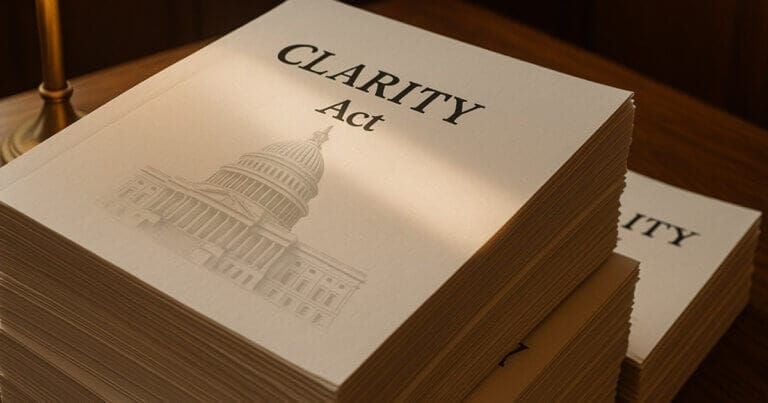
On May 14, during a meeting of the U.S. Senate Banking Committee, the highly anticipated CLARITY Act was passed in the committee's review process. Prior to this, the review process of the bill had been stalled for four months. During the meeting, several hours of exchanges took place between Republicans and Democrats, ultimately leading to 13 Republican members and 2 Democratic members voting to advance the bill, while 9 Democratic members opposed it.
After passing the review stage, the bill will enter the next phase. First, it will be merged with a similar bill that was previously passed by the Senate Agriculture Committee along party lines. After merging, the bill will be amended, and the final version will be submitted for a full Senate vote, requiring 60 votes to pass. Subsequently, the U.S. House of Representatives will also need to approve the amended bill. Finally, it will require Trump’s signature to take effect. The most challenging part of this process is obtaining the 60 votes in the Senate, and Republicans will need to continue to lobby moderate Democrats for their support.
Despite the bill making substantial progress, two Democratic senators (Ruben Gallego and Angela Alsobrooks) voted in favor alongside all Republican senators, but many important issues remain to be addressed, including financial crimes and ethical issues related to federal officials using cryptocurrencies, and the Senate has very limited time to complete this work.
Several Amendments Discussed and Rejected
During the review process, many amendments proposed by senators were either adopted or rejected due to partisan disagreements, addressing different aspects of cryptocurrency regulation.
During the review stage, the clause on an artificial intelligence sandbox proposed by committee chairman Tim Scott, as well as Warren's provisions regarding "tokenization loopholes" and money laundering, were considered. Warren cited reports that Iran was charging ships using the Strait of Hormuz a cryptocurrency toll to evade sanctions.
Lummis stated that in response to the amendment proposed by Warren, the CLARITY Act would address the regulatory issues surrounding cryptocurrency mixers. Scott's amendment was ultimately adopted, while Warren's amendment was not approved.
Warren proposed another amendment requiring U.S. banking regulators to report information related to deceased sex offender Jeffrey Epstein. She referred to Epstein as "an early supporter of cryptocurrency." Lummis stated that this provision was unrelated to digital assets and should not be included in the bill. Lawmakers voted along party lines, and this amendment ultimately failed to pass.
Democratic Senator Catherine Cortez Masto expressed overall support for the CLARITY Act during the review process and proposed an amendment aimed at granting law enforcement greater power in cryptocurrency-related cases. This amendment ultimately failed due to partisan disagreements.
Democratic Senator Tina Smith proposed an amendment to prevent federal agencies from bailing out cryptocurrency companies in the event of another collapse of the crypto market. Smith described this move as a "preventive measure" against cryptocurrency market volatility, and she, along with all Democrats, voted in favor of the amendment, but it ultimately failed due to party division.
Ethical Issues Remain a Focus of Discussion
The committee also reviewed an amendment proposed by Democratic Senator Chris Van Hollen, which addresses potential conflicts of interest between Trump, his family's World Liberty Financial company, and the cryptocurrency industry.
Republican Senators Bernie Moreno and Scott defended the president, accusing Hollen of "personal attacks." All 13 Republicans voted against the provision. Hollen stated: "From the president down to Congress, those directly involved in these policy decisions should not have the power to issue these specific assets and tokens."
Warren also expressed similar concerns in another amendment aimed at continuing to fund the Consumer Financial Protection Bureau in response to attempts by the Trump administration to close the agency starting in 2025.
Moreover, although Republican Senator Angela Alsobrooks eventually voted in favor, she stated, "This does not mean I will vote to support the passage of the CLARITY Act in the full Senate; we have much work to do," and "I will continue to negotiate on ethical guidelines." At the hearing, Republican Senator Ruben Gallego indicated that his support could change if an agreement on the president's ethical guidelines is not reached in the future.
Since Trump's campaign for re-election in 2024, President Trump and his family have invested in numerous cryptocurrency projects. World Liberty Financial company has gained substantial profits from the sale of WLFI "governance" tokens. Additionally, just days before the inauguration, the meme coin $TRUMP was launched, with its valuation at one point skyrocketing to nearly $80 billion before crashing. Just last month, Trump hosted a private dinner at Mar-a-Lago for major holders of the $TRUMP coin.
The White House has clearly stated its opposition to the bill targeting President Trump, so failing to reach an agreement on the president's ethical guidelines could also lead Trump to refuse to sign it.
After months of intense lobbying, closed-door negotiations, and political tug-of-war, although passing the review is indeed exciting, the bipartisan rifts, ethical controversies, and the subsequent tests in the full Senate and House signal that this regulatory battle is far from over.
Related Reading: What Major Impacts and Significance Does the Passing of the CLARITY Act Have on the Crypto Industry?
免责声明:本文章仅代表作者个人观点,不代表本平台的立场和观点。本文章仅供信息分享,不构成对任何人的任何投资建议。用户与作者之间的任何争议,与本平台无关。如网页中刊载的文章或图片涉及侵权,请提供相关的权利证明和身份证明发送邮件到support@aicoin.com,本平台相关工作人员将会进行核查。


