STRC VS SATA: The Path of Bitcoin's Yield
Bitcoin itself does not yield, but the capital market is attempting to package the balance sheet of BTC Treasury companies into “yield-like assets” that can be traded, provide dividends, and be financed. This is the context in which $STRC and $SATA emerged.
STRC stands for Strategy, which is the variable-rate perpetual preferred stock originally issued by MicroStrategy. It is a preferred stock tool designed by Strategy to continue financing the purchase of BTC.
Buying STRC fundamentally means not buying the price flexibility of BTC, nor the high volatility of MSTR common stock, but rather buying the credit of Strategy and earning returns through cash dividends paid by Strategy. Its underlying support relies on Strategy's BTC reserves, dollar reserves, capital market financing capabilities, and market recognition of @saylor.
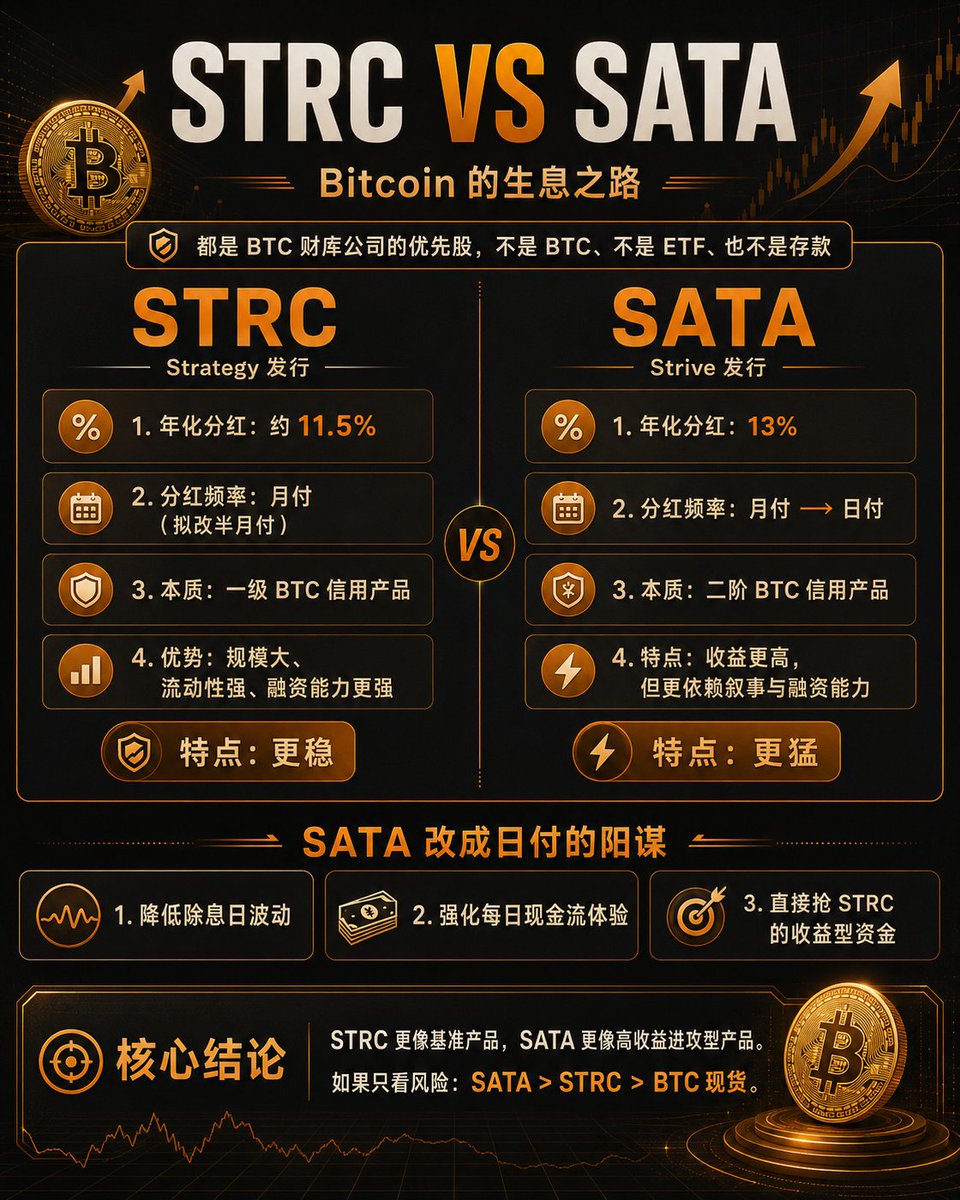
The current annualized dividend yield of STRC is approximately 11.5%, distributed monthly, with a target to trade around a par value of $100. The core of this design is to make STRC a relatively stable BTC Treasury credit yield product.
For Strategy, as long as STRC can stabilize near its par value, it can continue to finance through the issuance of preferred stock and then use that financing to purchase BTC, creating a financing flywheel.
SATA, on the other hand, is the variable-rate perpetual preferred stock issued by Strive. It shares a similar direction to STRC, both being preferred stock tools used by BTC Treasury companies for financing, but SATA is clearly more aggressive.
The current annualized dividend yield of SATA is 13%, higher than STRC, and Strive has announced that it will change SATA from monthly dividends to dividends every business day, meaning daily payments.
The intent here is quite clear.
First, daily payments can reduce price fluctuations caused by ex-dividend days.
Monthly payment products are likely to experience price disturbances around the registration date and ex-dividend days; by changing to daily payments, dividends are divided into smaller pieces, and holding for one day provides one day's cash flow, making it easier for the price to fluctuate around the par value of $100.
Second, daily payments can enhance the experience of cash management-like products.
A 13% annualized yield with monthly payments is just a high-yield preferred stock, but if changed to daily payments, the investors' experience turns into daily earnings, daily cash flow, resembling yield from on-chain stablecoins, DeFi yield assets, or BTC credit yield products in the U.S. stock market.
Third, daily payments aim to capture funding from STRC.
Strategy is only planning to change STRC from monthly to semi-monthly payments, while Strive has directly changed SATA to daily payments, essentially telling the market that SATA offers higher yields and more convenient dividend methods.
However, a higher yield often represents a higher risk.
The commonality between STRC and SATA is that neither are BTC, nor ETFs, nor deposits, but rather preferred stocks.
Preferred stocks are indeed prioritized over common stocks but rank below creditors, with preferential rights to dividends and liquidation but without ownership of $BTC or redemption rights for BTC.
Thus, both STRC and SATA cannot be understood as holding BTC yielding; more accurately, they are holding preferred stocks of BTC Treasury companies, receiving cash dividends paid by the company.
The real difference lies in the source of credit.
STRC's credit comes from Strategy. Strategy is currently the largest BTC Treasury company, with a larger BTC reserve, stronger market recognition, superior financing capabilities, and better liquidity.
SATA's credit comes from Strive. Strive is smaller, has a shorter financing history, and less market validation, so it must attract funds with higher yields, more frequent payment methods, and a stronger product narrative.
More critically, Strive's reserves include not only BTC and cash but also STRC. This means that buying STRC directly assumes Strategy's credit. In contrast, buying SATA assumes Strive's credit as well as Strategy's credit.
This constitutes the second-order risk of SATA.
If BTC rises, both STRC and SATA will perform well, with SATA potentially being more attractive due to its higher yield and daily payment experience.
If BTC consolidates, STRC resembles a mature BTC credit yield product, while SATA continues to attract yield-focused funds through its 13% yield and daily payments.
However, if BTC falls, STRC tests Strategy's cash reserves, BTC reserves, and financing capabilities, while SATA tests Strive's own cash, BTC, STRC holdings, and continued financing capacity.
So, whose risk is higher? Personally, I feel it is SATA.
Of course, this does not mean that STRC is without risk; in fact, during a decline in Bitcoin prices, both STRC and SATA carry significant risks, but relatively speaking, SATA, with its double risks, naturally faces the greatest pressure.
免责声明:本文章仅代表作者个人观点,不代表本平台的立场和观点。本文章仅供信息分享,不构成对任何人的任何投资建议。用户与作者之间的任何争议,与本平台无关。如网页中刊载的文章或图片涉及侵权,请提供相关的权利证明和身份证明发送邮件到support@aicoin.com,本平台相关工作人员将会进行核查。


