A set of encryption standards and a trading order book cannot meet the demands of all assets.
Written by: Boaz Sobrado, Forbes
Translated by: Saoirse, Foresight News
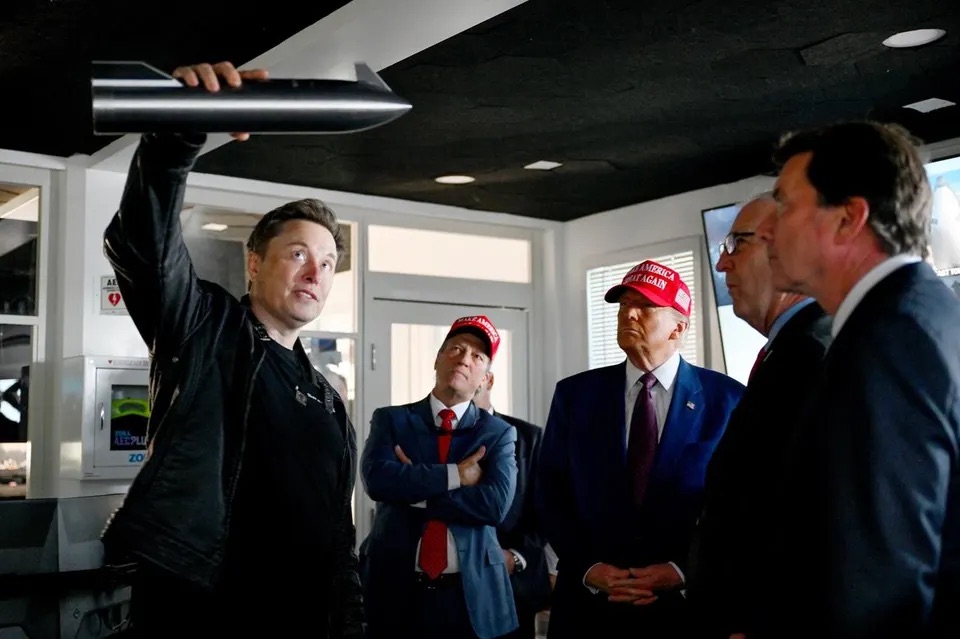
On November 19, 2024, in Brownsville, Texas, before the sixth test flight launch of SpaceX's "Starship" rocket, Musk showed the control room to the newly elected President Trump and members of Congress. SpaceX's billionaire owner Musk is a close friend of Trump and has been invited to co-lead the newly established Department of Efficiency with former presidential candidate Vivek Ramaswamy. (Brandon Bell / Getty Images)
In February 2026, Tessera launched a SpaceX stock tokenization product on the Solana public blockchain, with an initial implied valuation of $800 billion. Tessera founder Chan Ahn stated on the "On The Margin" podcast that by the end of April, its implied valuation had surpassed $1.5 trillion. Since its launch two months ago, the trading volume was approximately $97 million, with fewer than 500 holders. The key significance is that the market has already pre-priced SpaceX, while ordinary retail investors have not been allowed to participate in its rumored $1.7 trillion valuation IPO.
This is precisely the core logic that Chan Ahn repeatedly emphasizes, and the reason institutional funds are beginning to take asset tokenization seriously. "I worked for many years at Goldman Sachs and JPMorgan, engaged in structured derivatives business," Chan Ahn said, "I found that the real excess return opportunities are actually in the private market. But for a long time, cumbersome processes, minimum investment thresholds, and geographical limitations have closed the private market to the top 0.1% of the population."
Another former Goldman Sachs trader, Yoon Auh, has built another important part of the Wall Street tokenization ecosystem on another public blockchain. In December last year, BOLTS Technologies, founded by him, launched a quantum risk-resistant pilot project on the Canton Network. The Canton Network is a blockchain network aimed at traditional institutions, processing over $40 trillion in repurchase transactions monthly and holding approximately $60 trillion in real-world assets. In the same podcast, Yoon Auh suggested that all blockchains currently enforce all assets to share the same set of encryption mechanisms, which he believes has fundamental flaws, and he has applied for related patents for this.
Why Solana Became the Host Public Blockchain for T-SpaceX
The Tessera product structurally falls under the category of loan equity products. Chan Ahn stated: "We can issue T-series tokens without permission, and the product structure is a loan participation right." The underlying SpaceX stock is stored in an independent asset account company in the Cayman Islands, with each token fully collateralized one-to-one with the underlying SpaceX stock, and the asset reserve is publicly verifiable on-chain through Chainlink's reserve proof oracle. This product holds a legal opinion that it is not a security, and for this reason, Tessera does not need to enforce user KYC, allowing any Solana wallet to participate in investment without permission.
The most challenging aspect of implementation is not the technology, but the legal and structural design. Chan Ahn admitted: "Moving private equity and other real assets onto the chain, the hardest part is legal compliance and structural construction, obtaining a truly legally effective opinion that it is not a security. We ultimately chose to use a Cayman special purpose company to build the loan participation right structure, which can adapt to existing legal systems while satisfying the programmable characteristics of blockchain assets."
The second major difficulty is the oracle data service. Chainlink has specifically customized a data feed for Tessera, marking the first collaboration between the two companies. "The biggest issue with moving assets from off-chain to on-chain is trust; many past real asset tokenization projects have stumbled on this point." This customized oracle can publicly disclose the exact number of shares held by the Cayman accounts in real-time, verified by a professional auditing agency, and linked to the chain in real-time, allowing investors to check the circulation of tokens against the underlying real asset reserves at any time.
The fee structure is very friendly to retail investors. Traditional private placement products have entry fees of 10%-20%, annual management fees of 2%-5%, and a 10%-20% exit fee. Tessera, on the other hand, takes on the underlying assets at original price and only charges a 0.2% transaction fee for each transaction, with fees automatically allocated through the Solana Token-2022 standard. Chan Ahn mentioned that the $97 million trading volume over two months allowed the project to achieve about $100,000 in monthly normalized revenue. Tessera is set to launch T-Kalshi in May, with plans to tokenize companies like Tether, Kraken, Anthropic, and OpenAI in the future.
Why Canton Network Needs a Brand-New Encryption Security Architecture
Yoon Auh's viewpoint is that the underlying facilities for Wall Street tokenization cannot remain securely in existence under the current encryption system over the long term. Having worked in traditional finance for decades, he previously served as Vice President of IT at Goldman Sachs. He believes that every blockchain today uses a fixed encryption algorithm; Bitcoin, Ethereum, and Solana all share the same elliptic curve encryption. Once quantum computers break elliptic curve encryption, the security protections of all currencies and tokens on-chain will fail at the same time.
The QFlex protocol tested by BOLTS on the Canton Network allows users to choose different encryption protection schemes for each transaction. Yoon Auh stated in a podcast interview: "By decentralizing the choice of encryption lock types and layers to the user wallet level, users can select and define their own security plans, configuring each transaction individually. This transforms the originally static, uniform security mechanism across the entire network into a dynamic, customizable security system."
The underlying logic aligns with private banking services for ultra-high-net-worth clients: "Why should an asset worth one hundred dollars and one worth over one hundred million dollars use the same security standards?" The pilot, launched in December 2025, primarily targets the $60 trillion in real assets on the Canton Network — such vast funding can hardly bear the systemic collapse risk posed by quantum computing breaches. Canton is operated by traditional financial institutions and does not cater to ordinary retail investors; QFlex's core clients are mainly traditional financial institutions.
Yoon Auh candidly stated the payment logic of institutions: "Traditional finance has never been averse to paying for proprietary technology and patent licenses; this is standard in the industry. Only the crypto-native circle has the inherent belief that 'everything must be open source to be considered safe.'
The Common Logic of Two Major Layouts
Two former Goldman Sachs professionals are building different public blockchains but serve the same market logic: Chan Ahn focuses on ordinary retail investors, enabling them to purchase high-quality unlisted company equity that was previously monopolized by institutions; Yoon Auh targets large traditional institutions, creating encryption infrastructure that can withstand future quantum risks for trillion-level assets. Both disagree with the industry's default logic that a single encryption standard and order book can meet all asset needs.
Chan Ahn has his own views on the division between public and private offerings, as well as identity access rules: "The reason for the distinction between public and private markets and the complex access and identity verification processes is rooted in the past lack of sufficient advanced technology to break down barriers. Now the technology has matured." Currently, the U.S. Commodity Futures Trading Commission, the Securities and Exchange Commission, and the Federal Reserve have begun to coordinate the formulation of regulatory rules for tokenized assets and are taking a technology-neutral regulatory stance on underlying financial products.
Yoon Auh envisions the future from a structural perspective: now customizable encryption locks can be developed, and in the future, anti-fraud rules could be self-defined, and later on, the choice of clearing and settlement methods could become user-defined. "By handing all choices over to users, hosted on a unified blockchain, we can completely rewrite the power dynamics and overall security logic of blockchain."
There are also rational doubts in the industry: T-SpaceX trades 24/7, but underlying private equity does not have synchronous circulation attributes, which poses a risk of pricing misalignment; the Cayman asset structure has not yet been tested through genuine judicial litigation; the Canton Network's $60 trillion in real assets has never experienced real quantum attack scenarios. However, the arrangements made by these two former structured derivatives professionals indicate that funds in traditional finance, which seek to allocate private equity assets without wanting to bear custodial risks, now have new avenues — not limited to pure crypto assets like bitcoin and not confined to the closed system of traditional investment banks.
Wall Street has already increased its investment in crypto-native channels: Intercontinental Exchange invested $2 billion to enter Polymarket; Stripe acquired Bridge for $1.1 billion; monthly trading volumes of stablecoins have already surpassed those of traditional ACH transfers. Asset tokenization is the next core growth avenue, and the industry will not see a single public blockchain dominate but will form clear divisions of labor: Solana + Cayman structure serving retail private investment; Canton + quantum security system hosting trillion-scale real assets for institutions.
免责声明:本文章仅代表作者个人观点,不代表本平台的立场和观点。本文章仅供信息分享,不构成对任何人的任何投资建议。用户与作者之间的任何争议,与本平台无关。如网页中刊载的文章或图片涉及侵权,请提供相关的权利证明和身份证明发送邮件到support@aicoin.com,本平台相关工作人员将会进行核查。


