
Doubao will also start charging.
On May 4, Doubao quietly updated its App Store page with a statement regarding its paid version service. The statement mentioned that to better serve professional users, Doubao will launch a paid subscription system that includes more value-added services while retaining the free version, and disclosed three pricing tiers: Standard version 68 yuan/month, Enhanced version 200 yuan/month, and Professional version 500 yuan/month.
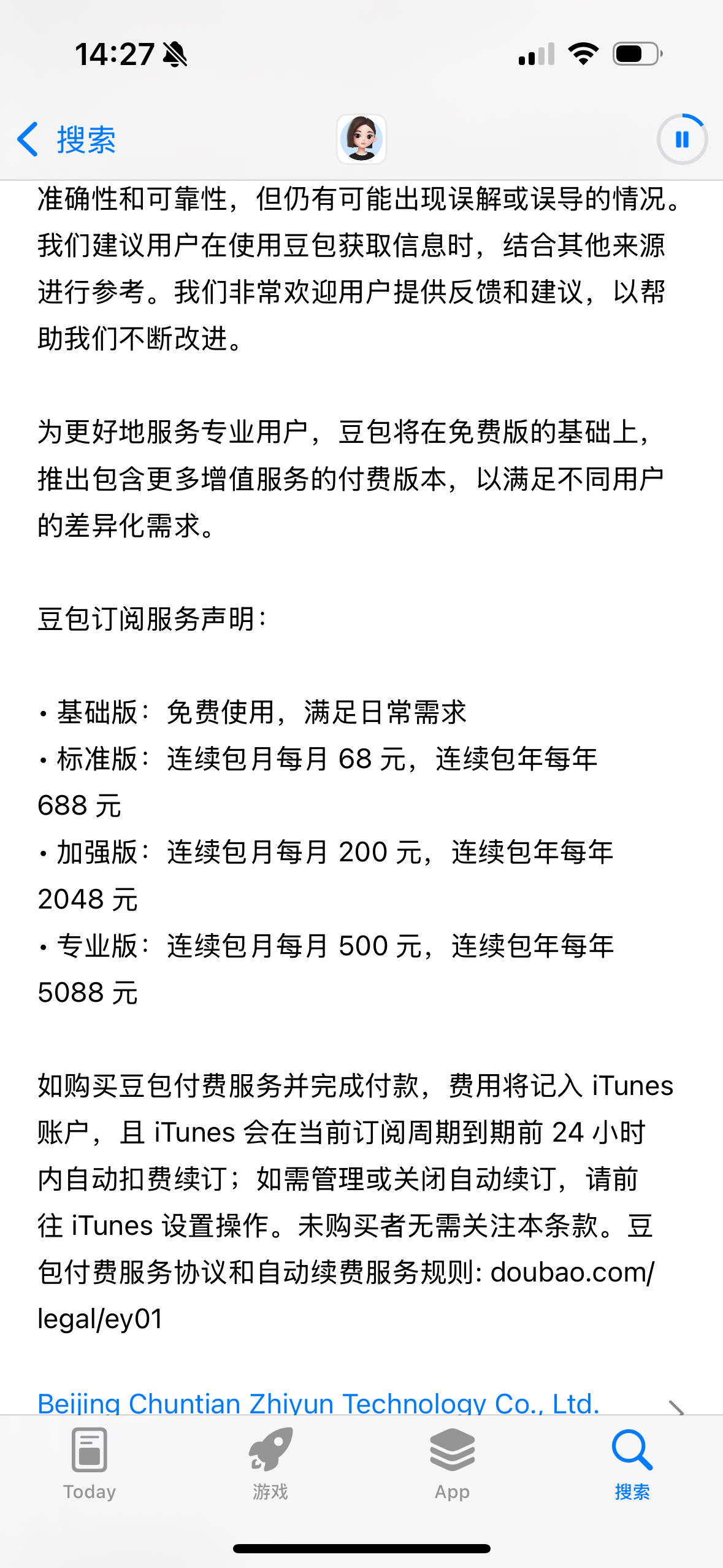
Image source: Geek Park
The news immediately sparked heated discussions. Some people are worried about the end of free benefits, others criticize the pricing as beyond expectations, and some had already anticipated this day. After all, with 320 million monthly active users and 1.8 billion daily interactions, relying solely on a free model is not a long-term calculation.
Essentially, this is something the entire industry "can think of and can do": the unsustainability of the free model for large domestic AI models is an open consensus, and leading players have already experimented with paid models. ByteDance, holding the absolute number one position in C-end AI users in China, has never faced technical or capability issues regarding paid subscriptions, just a matter of timing.
So, in the current context where the C-end subscription business is widely recognized as challenging and the price war among large models has hit the floor, can Doubao's commercialization attempt actually succeed?
Free Basis and Maximum 5088 Yuan/Year
According to reports, Doubao's paid features will mainly focus on complex tasks and productivity scenarios, such as PPT generation, data analysis, film production, etc. As model capabilities continue to upgrade, the product can meet an increasing number of complex, high-value tasks. However, such tasks require more computing power and reasoning time, hence Doubao plans to launch paid services to meet these complex scenario demands.
Regarding the free version, Doubao's official response stated, "Doubao will always provide free services. Based on free services, Doubao is also exploring the launch of more value-added services to meet diverse user needs. The details of the relevant plans are still in the testing phase and full information will be released through official channels once formally launched."
In other words, the functionalities that users can currently use for free, such as researching information, writing basic copy, daily Q&A, and learning assistance, can still be used for free in the future. The core logic of the paid version is to offer "value-added services" and will not affect the daily user experience of regular users.
This strategy is not new; leading global AI products like ChatGPT and Claude adopt a "basic free + advanced paid" tiered model: first, use free features to penetrate user mindset and cultivate habits, then serve core users willing to pay for high-value capabilities.
As for the price of 500 yuan/month, is it expensive or not?
Simply looking at the numbers, the professional version priced at 500 yuan/month does reset the price ceiling for general AI assistants in the domestic market. But when placed within the global AI product pricing framework, the conclusion becomes completely different.
Combining the paid pricing of major global AI products in May 2026, we can derive comparisons: First, the 68 yuan standard version is only about 10 yuan higher than Baidu Wenxin and iFlytek Spark, essentially hitting the mainstream benchmark line for domestic AI pricing without straying from the acceptance range of mainstream users. Second, the 200 yuan enhanced version is in the same price tier as ChatGPT Plus and Claude Pro’s 145 yuan monthly fee, targeting the main paid tier of leading global AI products for users with high-frequency productivity needs. Third, the 500 yuan professional version is indeed the first attempt at high-end pricing for domestic general AI products, though it does not touch the global pricing ceiling of ChatGPT Pro and Claude Max; it is essentially a trial of the payment capacity of heavy professional users in the domestic market.
However, the question of whether pricing is expensive or cheap is always related to the value matching.
500 yuan/month might just be the coffee costs for many people for a month, or a regular meal for two. For content creators, programmers, and small business owners who need to interact frequently with AI to accomplish core production tasks, a 24/7 assistant that can write, calculate, and analyze is much cheaper than hiring staff; yet for ordinary users who only occasionally look up information or write emails, paying even for the 68 yuan standard version does not seem necessary.
Why Now: ByteDance's Calculations
Why now?
Before discussing whether Doubao's paid model can work, a more critical question is—why did ByteDance choose this moment to launch?
After all, in terms of payments, ByteDance has not been fast. Players like Baidu Wenxin, Kimi, and iFlytek Spark launched mature subscription systems as early as 2024, while Doubao only took action in 2026. It may be because at this moment, ByteDance has cleared up two calculations.
The first calculation is about growth: the marginal benefits of achieving scale through free offerings have nearly reached their limit.
QuestMobile data shows that as of May 2026, Doubao’s monthly active users have surpassed 345 million, with an average daily conversation volume of 1.8 billion, firmly at the top of the domestic C-end AI application rankings, covering a full user group from students, working professionals to creators and small business owners.
The user pool of the domestic internet is just this large. All users that should be exposed to AI have basically been covered, and relying solely on a free model to throw money at it can no longer generate new increments, but rather incurs actual computing costs for each new conversation.
The second calculation is regarding the market: domestic user education on AI payments has been completed.
When large models first exploded in 2023, domestic users viewed AI as a "novel toy," with strong resistance to payments; but by 2026, the industry has completed a full user education cycle.
Industry data shows that the payment conversion rate for domestic AI tool users rose from 8% in 2024 to 11% in 2025, with over 30% willingness to pay among high-frequency users such as professionals and creators. Users have generally accepted the business logic of "free basic functions, paid high-value productivity capabilities."
By entering the market at this time, ByteDance no longer needs to engage in thankless market education; it simply needs to convert from an existing pool of paying users.
Bargaining Chips and Challenges
The challenges of the domestic C-end subscription business are evident: achieving an annual renewal rate of 30% for tool products is already at the industry top level; price war involvements are normalized, and switching costs for users are nearly zero.
The core contradiction of the paid business for large models is the balance between "payment revenue" and "computing costs," where ByteDance holds the leading technical advantages in this regard.
The essence of large model commercialization is a straightforward calculation: can revenue cover computing costs?
This is an industry-wide dilemma. Willingness to pay often correlates with heavy usage; yet high-frequency usage implies higher computing consumption.
ByteDance's advantage lies in its model efficiency and cost control being at the top tier domestically—public technological data indicates that Doubao 2.0 has achieved a 43% improvement in inference efficiency, with the first package omission time in lengthy context scenarios reduced by over 25% compared to mainstream industry models, while maintaining a success rate of 99.98% in high concurrency scenarios, placing stability at the top tier of the industry; at the same time, its inference cost for ten thousand tokens is only 38% of that of overseas leading models in the compliant domestic pathway, providing a significant cost advantage that allows it to better support stable operations for high-computing tasks in the paid version.

Image source: Visual China
However, several structural issues in the domestic C-end subscription market have not yet been truly solved by any player, nor is ByteDance an exception.
The first issue is that users are willing to pay, but not willing to keep paying.
The free gene ingrained in the domestic internet for over twenty years has deeply rooted in users’ behaviors, which is the core issue faced by all subscription products.
Even currently, achieving an annual renewal rate of 30% for domestic C-end tool products is considered the industry's highest level, while similar overseas products typically have renewal rates above 60%. The core reason is that domestic user payments are mostly "emergency payments": needing to write proposals or complete projects this month, they temporarily activate a monthly membership and immediately unsubscribe afterward, lacking the habit of sustained long-term payments.
More crucially, ByteDance lacks successful experience in this area. ByteDance's past commercialization successes primarily stemmed from advertising, e-commerce, and live streaming rewards, rather than from C-to-C subscription businesses. Even the premium memberships for Jianying and Douyin are only supplementary revenue, never creating a tiered subscription system for a core national product. Faced with the industry's dilemma of "low sustained payment willingness" among domestic users, ByteDance has no ready solutions, which is the biggest unknown.
The second issue is the "substitutability" of paid value.
Currently, the paid core functions disclosed by Doubao, including in-depth document analysis, PPT generation, deep data analysis, and batch high-definition images, are fundamentally industry-wide capabilities—most free versions of domestic competitors have already provided basic services, with many open-source models being able to achieve it entirely for free through local deployment.
If Doubao's paid version can only offer "faster response times, more invocation counts, and slightly enhanced model capabilities," without realizing overwhelming experience improvements and irreplaceable exclusive value, users will not develop a willingness to pay continuously. Even ByteDance’s ecosystem linkage, if limited to shallow functionalities, rather than embedding a true closed-loop experience in users' production processes, cannot form real payment rigidity. Ultimately, it is highly likely to result in the common industry problem of "initial month trial payment excitement, followed by high unsubscription rates in the subsequent month."
The third issue relates to the "bottomless pit" of computing costs. This is the core and most difficult contradiction to resolve.
The more paid users there are, the higher the revenue; but in AI, the more paid users there are, the costs may also rise correspondingly, or even faster. Without usage restrictions, paid revenue may not cover costs at all, leading to a "more paid users, more losses" death spiral; conversely, if usage is restricted, it directly harms the paid experience, resulting in user dissatisfaction and reputation collapse, falling into the dilemma of "frequency limitations losing users, while no limitations losing costs."
This is a balance issue that is almost unsolvable. Even ChatGPT hasn’t resolved it—ChatGPT's operational losses exceeded 5 billion dollars in 2024, and subscription revenue could not cover costs. Even with better cost control capabilities, it is challenging for ByteDance to completely escape this industry-wide death cycle.
Finally, the price war will inevitably return.
The competitive logic of the domestic market is straightforward: once a product proves to be "profitable," other players will quickly follow suit, then undercut with pricing.
Once competitors initiate another round of price cuts, subsidies, and free membership campaigns, Doubao will face a dilemma: if it follows suit, it will fall into the "low-price trap" it deliberately avoided, damaging the original pricing system and cost model; if it does not follow suit, it risks losing a significant number of price-sensitive users.
ByteDance has historically won battles in many fields through low prices and subsidies, but this time, as the higher-priced party, whether it can withstand price competitions and persist with value-based pricing poses a significant test.
Easy Start, Difficult Long Run
Returning to the core question: can Doubao's paid subscription work?
The answer is actually quite clear. Achieving a scale of paid users and completing initial commercialization is highly probable in the short term; however, whether a healthy profit loop can be achieved in the long run, becoming a benchmark for domestic C-end AI subscriptions, is filled with uncertainty.
In the short term, the basic pool of 345 million monthly active users remains, and even achieving a 1% conversion rate would quickly form a scale of 3.45 million paying users.
But in the long run, whether this can truly succeed does not depend on how large the user base is, how strong its model capabilities are, or how obvious ByteDance's ecosystem advantages are, but rather on whether it can resolve two fundamental issues: first, can it truly turn ByteDance's ecosystem advantages into irreplaceable payment rigidity for users, rather than just marketing gimmicks; second, can it escape the industry's vicious cycle of "low-price involution, low renewal rate, and cost overruns" in the domestic C-end subscription landscape and find a truly healthy and sustainable business model.
For the entire domestic AI industry, Doubao's commercialization attempt has far-reaching significance beyond the product itself. If Doubao succeeds, then the C-end commercialization of the domestic large model industry will have found a viable path that does not rely on low-price involution; if it ultimately stumbles on structural industry challenges, domestic large model players will need to rethink: how can the C-end subscription model truly succeed?
免责声明:本文章仅代表作者个人观点,不代表本平台的立场和观点。本文章仅供信息分享,不构成对任何人的任何投资建议。用户与作者之间的任何争议,与本平台无关。如网页中刊载的文章或图片涉及侵权,请提供相关的权利证明和身份证明发送邮件到support@aicoin.com,本平台相关工作人员将会进行核查。


