Author: Wednesday, Shenchao TechFlow
Insight from Shenchao: The final round of negotiations between Samsung Electronics and the union officially collapsed on May 13, and a strike involving 40,000 workers is set to begin on May 21. The Reddit community (WallStreetBets channel) was immediately flooded with bullish posts about Micron Technology (MU), with the core argument being: Only three companies in the world can produce HBM4, and one of them is about to halt production for 18 days. Micron, as the only supplier with factories in the United States, will become the biggest beneficiary.
Micron's stock price has surged approximately 140% over the past month, with Deutsche Bank setting a target price of $1,000, and retail investors claiming $1,300. However, this is essentially a "binary wager": if the strike is resolved, the logic of the surge could instantly reverse.
The labor negotiations between Samsung Electronics and the union officially collapsed on May 13, and a strike lasting 18 days, involving over 40,000 employees, is now on countdown.
This news has quickly ignited the trading enthusiasm in the U.S. retail investor community regarding the memory chip supply chain, with Micron Technology (NASDAQ: MU) becoming the focus of discussion.
Popular Reddit Post: "Micron is the cleanest play on the imminent Samsung strike"
A post on the U.S. stock board quickly received over 500 likes, with the title directly stating "MU is the cleanest play on the imminent Samsung strike".
The core argument of the post's author, willbabu, can be broken down into four layers:
Firstly, HBM4 is the biggest bottleneck in the entire AI infrastructure, with only three companies in the world able to produce it: Samsung, SK Hynix, and Micron. If Samsung halts for 18 days, it will take weeks rather than days to reset the production lines, and the actual impact far exceeds 18 days.
Secondly, although SK Hynix is the leader in the HBM field, its DRAM, NAND, and HBM capacity have all been locked in at contract prices to NVIDIA until the end of 2026, giving it "nothing to sell" when spot prices surge. Micron is also sold out on HBM until 2026, but the difference is: if Samsung stops for 18 days, the prices of spot DRAM and NAND will soar, and Micron has more standard DRAM and NAND capacity than SK Hynix, allowing it to directly benefit from the price rise.
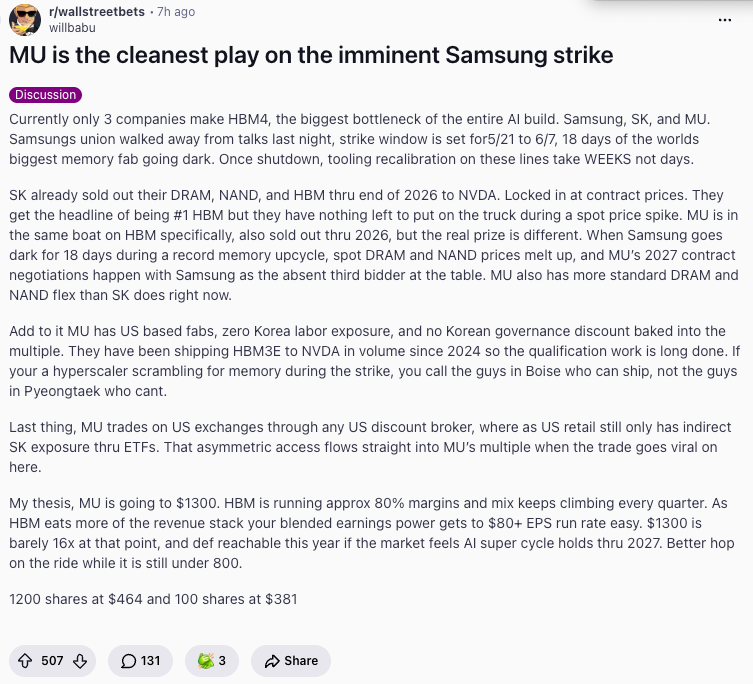
Thirdly, Micron has structural advantages that SK Hynix does not possess: a factory in the United States (located in Boise, Idaho), zero exposure to Korean labor risks, and no governance discounts from Korean chaebols. The original statement in the post is straightforward: "If you are a super large cloud manufacturer in urgent need of memory chips during the strike, will you call someone in Boise who can deliver or someone in Pyeongtaek who cannot?"
Fourthly, Micron is directly listed on U.S. exchanges, while U.S. retail investors can only hold SK Hynix indirectly through ETFs. This "asymmetrical accessibility" means that when the strike trading spreads within the retail community, capital will disproportionately flow into Micron.
The post author disclosed a holding of 1,200 shares (average price $464) plus 100 shares (average price $381), with a target price of $1,300. Their calculation logic is that the HBM business maintains approximately 80% gross margin, and its proportion of revenue continues to rise, making the blended earnings per share (EPS) easily exceed $80, with the $1,300 corresponding to a forward price-to-earnings ratio of only about 16 times.
Samsung Negotiation Breaks Down, Strike Enters Final Countdown
The excitement in the retail community has its realistic basis.
According to the Korea Times reports on May 13, the final round of mediation talks between Samsung Electronics and its largest union officially collapsed on that day. The union demanded that Samsung allocate 15% of operating profit as employee bonuses and write it into the labor contract, while Samsung's proposed 10% plan was rejected. Both sides had sharp disagreements over the distribution of performance bonuses related to AI.
The strike is scheduled from May 21 to June 7, involving over 40,000 employees, most of whom are from the semiconductor manufacturing department. According to analysts cited by the Korea Times, the losses caused by the strike could reach 1 trillion won (about $671 million) per day. Samsung has filed for an injunction with the Suwon District Court in an attempt to prevent the strike, with a ruling expected before the start of the strike.
According to Jefferies research, this strike could affect about 3% of the global memory chip production capacity. JPMorgan estimates that Samsung's operating profit for the year may decrease by over 40 trillion won as a result. More seriously, prolonged production halts could lead Samsung to lose key customers such as NVIDIA.
Micron Surges 140% in a Month, Huge Discrepancy in Target Prices between Institutions and Retail Investors
The market is already pricing in this supply shock.
Micron’s stock price has soared from a low of about $310 in March, reaching a 52-week high of $818.67 during intraday trading on May 11, with an increase of around 140% in a month, pushing its market capitalization above $900 billion. It rested at around $766 on May 12. According to Yahoo Finance data, Micron's revenue in the last fiscal quarter (Q2 2026) reached $23.9 billion, a year-on-year increase of 196%, with earnings per share of $12.20, exceeding expectations by 32.8%.
On the institutional side, Deutsche Bank raised Micron's target price to $1,000, the highest on Wall Street. Analyst Sidney Ho believes that AI-driven HBM demand is a structural trend, and supply tightness may continue until 2028.
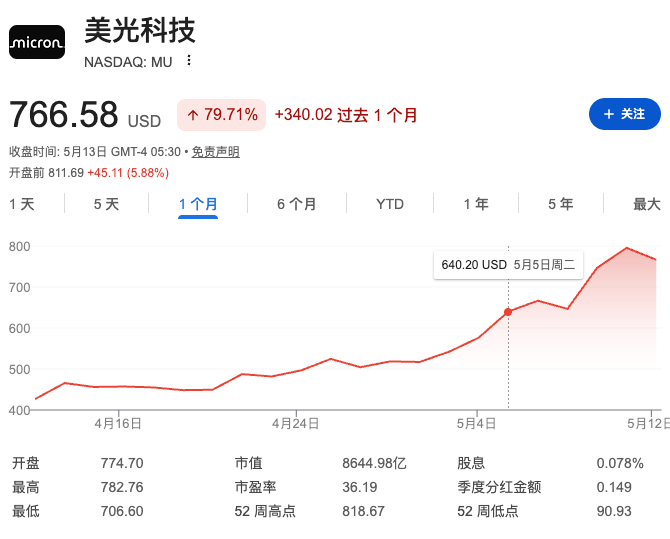
However, the Wall Street consensus target price is only $581.89, significantly lower than the current stock price, reflecting a divergence in institutional valuations of the current pricing. The $1,300 target price shouted by retail investors on WallStreetBets far exceeds any institutional predictions.
Core Risk: Resolution Equals Reversal
The biggest risk in this trade is also very clear: it is essentially a binary wager.
Ainvest's analysis points out that Micron's stock price surged 75% in a month (this data corresponds to a slightly earlier time window than the latest surge), and if the Samsung strike ends in a resolution, the stock price faces a severe risk of reversal. JPMorgan also warns investors that the ultimate result of the labor dispute is the "clearing event" of the current market, and prior to this, the risk of directional bets is extremely high.
The memory chip market itself is already highly cyclical. Even without a strike, memory contract prices are projected to rise by about 60% this year. If a strike occurs, it would add another layer of shock to an already tense supply and demand situation; if it does not occur, the market will need to reassess how much "strike premium" is included in the current pricing.
Samsung still has the possibility of reaching a final agreement before May 21, although the probability currently appears low.
免责声明:本文章仅代表作者个人观点,不代表本平台的立场和观点。本文章仅供信息分享,不构成对任何人的任何投资建议。用户与作者之间的任何争议,与本平台无关。如网页中刊载的文章或图片涉及侵权,请提供相关的权利证明和身份证明发送邮件到support@aicoin.com,本平台相关工作人员将会进行核查。


