Compiled & Edited by: Shenchao TechFlow
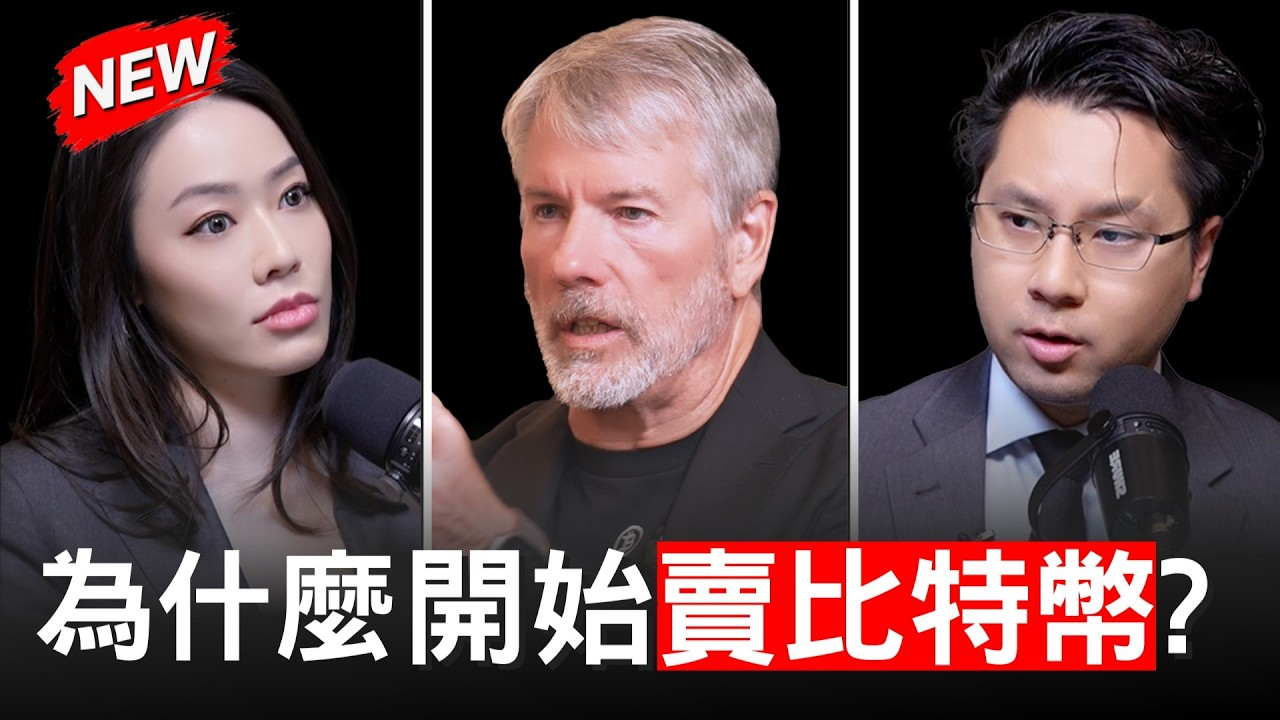
Guest: Michael Saylor, Executive Chairman of Strategy
Hosts: Bonnie, David
Original Title: Michael Saylor, the Bitcoin Master, goes head-to-head! Why is Strategy prepared to sell coins?
Podcast Source: Bonnie Blockchain
Broadcast Date: May 9, 2026
Editor’s Introduction
In this episode of the podcast, Strategy’s Executive Chairman Michael Saylor systematically explains, for the first time after the latest earnings report conference call, "selling Bitcoin to pay STRC preferred stock dividends when necessary,” a statement that has shaken the market, which directly contradicts his long-time iconic slogan "never sell your Bitcoin." His core explanation is: the breakeven point for STRC is 2.3% of the Bitcoin holdings, as long as BTC's annual growth exceeds 2.3%, the company can still remain a net buyer of BTC each month and quarter, even if it occasionally sells BTC.
What readers should pay more attention to are the three points that Saylor threw out: First, Strategy issued 60% of the preferred stock in the U.S. this year, and a single company reactivated the entire U.S. preferred stock market; Second, the Sharpe ratio of STRC reaches 2.5–3, higher than Nvidia (about 1.7) and top hedge funds (maximum 2.2), making it "the highest risk-adjusted return financial instrument in the public market"; Third, Bitcoin's "killer application" is already clear, which is not payment, but as credit collateral; digital credit is the stepping stone to a trillion-dollar digital currency market.
Key Quotes
The Shift to "Selling BTC to Pay Dividends"
- "We want the market to understand that it is the capital gains from Bitcoin that are paying the STRC credit dividend. Sell 1 million dollars of STRC, and then buy back 1 million dollars of Bitcoin."
- "I'm known for 'never sell your Bitcoin,' so when we say we might sell, the entire internet exploded. But to put it more precisely, it should be 'never be a net seller of Bitcoin'; just saying it that way isn’t catchy enough."
- "Even in these times, if we sell 1 Bitcoin, we will buy back 10 to 20. Once everyone understands, this shouldn’t be a problem at all."
- "Any company that gives up its options will eventually regret it. No matter what."
STRC's Economic Model
- "Our breakeven rate is 2.3%. That means as long as the issued STRC does not exceed 2.3% of the Bitcoin holdings, we will always be net buyers of Bitcoin, even if selling BTC to pay dividends."
- "STRC is at the core of the Bitcoin value accumulation engine. In April, we sold 3.2 billion dollars of STRC and bought 3.2 billion dollars of Bitcoin. The monthly dividends are approximately 80 to 90 million dollars, essentially buying 30 Bitcoins and selling 1."
- "Our excessive collateralization rate for Bitcoin is 5:1. For every 5 dollars of Bitcoin, we issue 1 dollar of credit, and this 1 dollar has a clear yield."
Response to "Ponzi Scheme" Accusations
- "Peter Schiff thinks Bitcoin itself is a Ponzi scheme, and he has no fondness for anything in this field."
- "If you don't recognize the legitimacy of Bitcoin, then you will never recognize the legitimacy of any derivatives based on it."
- "To draw an analogy, if a real estate development company issues bonds to finance, buys land at 10,000 dollars per acre, and after development, it becomes 100,000 dollars per acre, then cashes in that capital appreciation, nobody would question that this company is a Ponzi scheme. What we are doing with Bitcoin is the same thing."
Bitcoin Market Liquidity and Buying Impact
- "We buy 100 million dollars of Bitcoin in an hour, and the price doesn’t move; we buy 200 million dollars, the price doesn’t move; we buy 200 to 300 million dollars and then stop, and the price actually increases."
- "Bitcoin is the deepest and most liquid capital market in the world. Want to make a billion-dollar trade with 20x leverage on the weekend? Bitcoin can do it. Need a billion dollars of credit in an hour? Bitcoin can provide it."
- "I have accumulated about 62 billion dollars of Bitcoin, more than anyone I know. If a company could systematically influence this market, that would be an overestimation of us; this is a global market with its own dynamics, and a single announcement from the Chinese government can push the price."
Digital Credit is Bitcoin's "Killer Application"
- "In the past 12 months, it has become clear that Bitcoin has at least one killer application, which is digital credit (digital credit). A 1.5 trillion-dollar asset class, with daily trading volume reaching hundreds of billions, the killer application is as collateral for credit."
- "STRC is the most liquid credit tool in the market and the largest preferred stock, with a Sharpe ratio of 2.5 to 3. The highest Sharpe ratio for credit tools is only 0.5, Nvidia is 1.7, S&P is 0.9, Bitcoin itself is 0.85, and top hedge funds top out at 2.2. The risk-adjusted return of digital credit exceeds all financial strategies in the public market."
- "This year, we issued 60% of the preferred stock in the U.S., making us the largest credit issuer in the country. Last year and this year, we have reactivated the entire preferred stock market."
- "Digital credit is the stepping stone to digital currency and digital yield. Yield coins are exploding, products from Apex grew from 0 to 300 million in 8 weeks; products from Saturn grew from 0 to 110 million in 6 weeks. The market behind this is a trillion dollars and is spreading virally."
Macro and AI
- "Even with tightening monetary policy, geopolitical conflicts, and trade wars, these are just headwinds that may slow us down; when they reverse, they become tailwinds. But Bitcoin will continue to grind upward because miners contribute only 10 to 12 billion dollars of native supply each year, 450 Bitcoins a day. For every 10 billion dollars of capital we gather, we buy out an entire year's supply."
- "We wouldn’t be able to create STRC without AI; I used AI to create Strike, Strife, Stride, and Stretch. If you are a Bitcoin treasury company, the smartest thing is to use digital intelligence to carve out digital credit from digital capital."
Why Willing to Sell BTC
Host Bonnie: Something happened 19 hours ago that shocked the internet, what is it?
Michael Saylor: You must be talking about our earnings call. We announced at the meeting that we are willing to sell Bitcoin if necessary to finance STRC's preferred stock dividends.
Host Bonnie: I believe this is a well-considered shift. What’s the logic behind it?
Michael Saylor: The most important point is that we want the market to understand that the capital gains from Bitcoin are paying STRC credit dividends. We sell 1 million dollars of STRC and immediately buy back 1 million dollars of Bitcoin. We expect Bitcoin to appreciate about 30% each year, with past actual growth close to 40%. We are stripping away the first 11% of capital gains to pay credit dividends.
But the market has been a bit confused about where the dividends are coming from. For most of the time this tool has operated, we have been paying dividends by selling common stock MSTR. MSTR is a derivative of Bitcoin and typically trades at a premium, so what we are actually selling is Bitcoin derivatives. However, some are worried that in the future, we may not be able to sell stock, and there are shorts saying we must sell stock; on the other hand, there are narratives saying the company will never sell Bitcoin, and this has evolved into: "Since they won't sell Bitcoin, then Bitcoin doesn't count as an asset, and the 65 billion dollars on the balance sheet should be zero."
Having 65 billion dollars worth of assets valued at zero, that’s not acceptable. We don’t want the rating agencies to think the company has zero assets; we want them to see the 65 billion. There are still people on the internet who claim this is a Ponzi scheme because we use stock issuance to pay preferred stock dividends.
What we need to do is clarify the business model: issue credit, make capital investments in a thing called "Bitcoin"; the speed of appreciation of this investment is faster than dividends, and then cash in that capital appreciation to pay dividends. We believe the clearest way to express this is to tell the market that the company doesn't have to always sell common stock; it can sell highly appreciated Bitcoin to pay dividends, which is paying credit dividends with capital gains.
To draw an analogy with a real estate development company. It issues bonds to finance, buys land at 10,000 dollars per acre, and after development, it rises to 100,000 dollars per acre, then cashes in that capital appreciation. You can sell the land, lease it, or refinance, and no one will question this company. What we are doing with Bitcoin is the same thing.
I’m famous for saying "never sell your Bitcoin," so when we say we might sell, the internet exploded. But to say it more precisely, it should be "never be a net seller of Bitcoin"; just saying it that way isn't catchy enough or a trend. I can tell you, during these periods, even if we sell 1 Bitcoin, we will buy back 10 to 20 more. So basically, buy 10, sell 1, net buy 9, and continuously create Bitcoin. Once everyone understands this, it really shouldn't be a problem; however, currently, the discussion areas are indeed quite lively.
Host Bonnie: Can you elaborate on how to "sell one buy ten"?
Michael Saylor: The biggest value accumulation engine for Bitcoin is Stretch. We issued 3.2 billion dollars of STRC in April, so we bought 3.2 billion dollars of Bitcoin. The monthly dividends are about 80 to 90 million dollars, raising 30 billion, paying out 80 to 90 million in dividends, which is essentially buying 30 Bitcoins and selling 1.
Our breakeven rate is 2.3%. That means as long as the issued STRC credit scale does not exceed 2.3% of the Bitcoin holdings, we will always be net buyers of Bitcoin, even if we sell BTC to pay dividends. Another perspective: as long as Bitcoin's annual growth exceeds 2.3%, we can always afford to pay dividends and continue to appreciate, without ever having to sell common stock.
In the first four months of this year, we have sold about 5 billion dollars of STRC, and at this rate, the annual issuance rate will reach 15% to 20%. The breakeven line is 2.3%, so we buy 20, sell 2, net buy 18. As long as the company is growing, the BTC purchased will always exceed the BTC sold. I expect that every month and every quarter in the future, we will always be net buyers of Bitcoin.
Host Bonnie: Before passing it to David, one last question. Many investors adhere to "never sell your Bitcoin" as a creed. Do you think they should continue to do so?
Michael Saylor: Yes, you should be a net accumulator of Bitcoin. When I say "never sell," I mean that if you must spend it for something, then during that same period, replace it. There are people in the crypto circle who advocate using Bitcoin to buy things; if you need to spend, then get it back. You cannot be a net seller because Bitcoin is capital. By the end of each year, you should have more Bitcoin than you had at the beginning of the year.
To draw an analogy, if Google invests 1 billion dollars in data centers and earns 10 billion, netting 9 billion, that would not impact the dollar market, right? Google sells dollars to buy data centers; the dollars are fine, and Google’s business model is also fine; everyone would see that as a rational decision, spending money to earn more money. If you spend 1 Bitcoin to earn 10 Bitcoin, that has no issues for Bitcoin and no issues for the company. This actually makes the company stronger because we can utilize the liquidity market for crypto, Bitcoin spot trades 20 billion dollars daily, and derivatives 50 billion dollars; this is a powerful energy source. When the liquidity in the equity capital market is lower than that of the Bitcoin commodity market, we need the ability to switch to it.
Any company that gives up its options will eventually regret it, no matter what. For example, if we say we will never repurchase our own stock, and only issue stock forever, the shorts will drive the stock price down to 1 dollar, far below the net asset value (NAV), and then we will buy it back. So what we said on yesterday’s call is: we are ready to exchange STRC for MSTR, BTC for MSTR, or fulfill obligations using BTC or MSTR. Everything is based on the company's best interest. But in the long term, we expect to be net accumulators of Bitcoin, and that won't change. How assets are traded daily, whether selling credit, equity, or capital assets, depends on the market and mispricing.
We also said yesterday that we are ready to repurchase our own bonds. Our corporate bonds are trading at a discount and undervalued, so buying is reasonable, and selling is not. We do not sell undervalued assets; we buy them and arbitrage away that inefficiency. If the market knows we will do this, it will price these tools more fairly, benefiting all investors, and it is our fiduciary duty to our shareholders.
Bitcoin is Digital Capital, Not a "Ponzi Scheme"
Host David: I read a tweet you retweeted this morning: One of your biggest critics, Peter Schiff (a gold supporter and long-term bearish on Bitcoin) wrote: "Yesterday Saylor admitted that when necessary, MSTR will sell Bitcoin to pay STRC dividends. I think this commitment does indeed help extend the so-called Ponzi scheme further. But I guess when that day comes, he will suspend the dividends, let STRC collapse, rather than let Bitcoin collapse." How do you respond?
Michael Saylor: Peter thinks Bitcoin itself is a Ponzi scheme. He doesn’t like anything in this field. Bitcoin is digital capital, and we create a digital treasury company by issuing equity and credit instruments to buy this capital. Bitcoin will continue because it represents a tokenized form of global economic wealth with full ownership rights. We have built the STRC credit tool on top of it, stripping away volatility and lowering risks, distilling a return from digital capital. If you don’t recognize the legitimacy of Bitcoin, then you will never recognize the legitimacy of any derivatives based on it. But for those who believe Bitcoin is a legitimate asset, what we are doing is straightforward: 5:1 over-collateralization, for every 5 dollars of Bitcoin, issuing 1 dollar of credit, and this 1 dollar of credit has a clear yield.
Many believe Bitcoin is a legitimate asset but cannot stand its volatility. They wouldn't take the money for their children’s tuition in the fall to buy Bitcoin because they have to account for it in 12 weeks. For these people, digital credit makes a lot of sense: the principal is protected and stable, yielding three to four times what money market funds offer. It is the characteristics that make Bitcoin superior to other capital assets that allow us to pay higher dividends.
Host David: I'd like to verify a theory with you before handing it back to Bonnie. Some traders have noticed that after each STRC dividend payout, the ex-dividend price drops below par and stays there for a day or two, or even longer; once it rebounds to par, Strategy starts buying Bitcoin. So they start racing to front-run this model, buying Bitcoin before STRC gets close to par, betting that you and Strategy will buy BTC at par. What do you think?
Michael Saylor: Near the dividend record date, there will be huge buying demand for STRC, because after the record date, there is about 90 cents in dividends to collect. So before the record date, STRC might see billions of dollars in trading volume, and the day after the record date could drop by 60 to 70 cents, then slowly rebound to par over a week or two. These are arbitrageurs; their calculation is: occupying 1 million dollars of capital for one day and being locked up for just 12 days a year can secure about a 42% annualized return. Their math holds; it benefits us as well, creating liquidity and participation, and it will continue to exist.
As for the second question, can we front-run the Bitcoin market? The Bitcoin derivatives market has a daily volume of 50 billion dollars. Will anyone have enough capital to drive this market? Unlikely. My point is that Bitcoin, in a certain sense, is the "square of tech capital." What drives Bitcoin are trade wars, hot wars, diplomatic policies, geopolitical tension triggered by wars (Ukraine, Iran), and currency wars; for example, will SOFR (secured overnight financing rate) go down to 200 basis points? Are there any yield curves being flattened? It's clear that we are in a relatively tight monetary environment, and these macro factors are the main driving forces behind Bitcoin.
I can tell you a fact; we buy 100 million dollars of Bitcoin in an hour, and the price doesn’t change; buy 200 million dollars, and the price doesn’t change; buy 200-300 million dollars and then stop, and the price actually goes up. So anyone who thinks they have that kind of energy, unless you can throw 30 billion dollars in one afternoon, it’s hard to do so. I've spent an enormous amount of money, accumulating more Bitcoin than anyone I know; we have accumulated about 62 billion dollars of Bitcoin. I believe this is a global market with its own dynamics driven by diplomatic policies; a single announcement from the Chinese government can move Bitcoin price. To say that our company has systemic importance sounds appealing, but I don't believe that.
Host Bonnie: Why did you buy so much Bitcoin, but the price didn’t move?
Michael Saylor: The market is very deep and very liquid. Suppose one day I make a big purchase of 1 billion dollars; 1 billion is 1/50 of 50 billion. When talking to traders, you will find that the Bitcoin spot is 20 billion, derivatives 50 billion; what does 1 billion mean in a 400 billion, 500 billion, or 600 billion bucket? This is the world's deepest and most liquid capital market, and that’s what makes it special. On the weekend, if you want to make a 1 billion dollar trade with 20x leverage, Bitcoin can do it. If you need 1 billion dollars of credit in an hour, Bitcoin can provide it.
Macro factors are the main drivers; sometimes the market does have its own logic. Micro factors also play a role: the formation of digital credit, the formation of bank credit, and investors’ sentiment towards digital assets. But Bitcoin is bigger than any of us can imagine; this is actually why we have confidence in it; no single player can support or suppress it.
Host Bonnie: If the Strait of Hormuz (the throat of global oil shipping, accounting for about 1/5 of the world's oil transport) remains closed for the foreseeable future, a few things may happen: one is that inflationary pressure may persist; the second is that at some point, the Fed will need to lower interest rates but will be stuck by high inflation. What will the liquidity look like? If the Fed gets stuck, what will happen to Bitcoin?
Michael Saylor: Tightening monetary policy, global trade being highly tense, high geopolitical tensions triggered by diplomatic policies or wars (Ukraine, Iran), these are all headwinds that may create some suppression. Once they reverse, they become tailwinds. But Bitcoin will grind upward regardless. The reason is that miners contribute only 10 to 12 billion dollars of native supply each year, with 450 Bitcoins a day. For every 10 billion dollars of capital we raise, we buy out an entire year’s supply.
Banks create 10 billion dollars of credit; that’s the first round on the axle. We sell 10 billion dollars of STRC digital credit; that’s the second round. 10 billion dollars flows into IBIT (BlackRock Bitcoin Spot ETF); that’s the third round. These capital movements, digital credit packaging, bank credit, are the fundamental underpinning of the market and all point in a positive direction. No matter what the macro conditions are, you will see continuous increases. The macro wind is just a matter of rhythm; when grinding up at a speed of 30%, it may soar to 50%; when there is a headwind, it will be a little slower.
Bitcoin's "Killer Application"
Host David: Has your argument about Bitcoin changed?
Michael Saylor: No. But I must say that it has become very clear that Bitcoin is digital capital. One clear thing over the past 12 months is that Bitcoin has at least one killer application, which is digital credit. In a 1.5 trillion-dollar asset class, trading hundreds of billions daily, the killer application is as collateral for credit. If digital capital is the best-performing capital asset, then there is reason to believe that the best-performing credit asset can be constructed on top of it.
Over the past year, what I've seen is that STRC is the most liquid credit tool in the market, the largest preferred stock, with the highest Sharpe ratio. We have constructed a tool with a volatility of 3, a dividend yield of 11.5%, and a Sharpe ratio of 2.5 to 3. To note, the highest Sharpe ratio for credit tools is only 0.5; the highest for stocks is Nvidia at around 1.7; S&P at 0.9, Bitcoin itself at 0.85, all below 1. The best hedge funds top out at 2.2. Therefore, the risk-adjusted return of digital credit is better than any financial strategy and any tool in the public market. I couldn't say this 12 months ago, but the logic behind it is coherent; if Bitcoin is the best-performing capital, then convertible bonds backed by Bitcoin are the best-performing convertible bonds, and credit tools like STRC are the best-performing preferred stocks.
By the way, let me ask you a question. Do you know what percentage of the preferred stock market in the U.S. we issued this year?
Host David: I guess over 70%.
Michael Saylor: We issued 60% of the preferred stock in the U.S., making us the largest credit issuer in the country for both last year and this year. We have reactivated the preferred stock market, and it has exploded. So the new concept is: digital capital drives digital credit. You will see that digital credit is the stepping stone to digital currency and the digital currency market. Yield coins are exploding: Apex created one, growing from 0 to 300 million in 8 weeks; Saturn created one, growing from 0 to 110 million in 6 weeks. The digital asset space, the crypto space, and TradFi are all innovating explosively, and the driving force behind this is digital credit, with Bitcoin making digital credit possible. This may be the most exciting thing this year.
The Impact of AI
Host David: My last question, and then I’ll hand it back to Bonnie to wrap up. Some Bitcoin miners are already transitioning, redirecting their mining power to supply AI data centers. Will you join this so-called "AI transformation"? If so, how will you participate?
Michael Saylor: I think it is a good thing that Bitcoin miners can now benefit from investing in high-performance, high-power computing. What we are doing is refining digital credit with digital intelligence. How does AI impact our business? We couldn’t create STRC without AI. I used AI to create Strike, Strife, Stride, and Stretch. How do we create digital credit? Take a piece of digital capital and use digital intelligence to refine a form of digital credit that has specific risk characteristics, volatility, yields, and currency structures, and then push it into the public market.
If you are a Bitcoin treasury or a digital treasury company, the smartest thing is to carve out digital credit from digital capital using digital intelligence. This is the stepping stone and financial fuel for creating digital currency and digital yield. The market for digital currencies and digital yields is a trillion dollars and is spreading virally right now.
Host Bonnie: One last question. Was it "Have Space Suit—Will Travel" (a sci-fi novel by Robert Heinlein from 1958) that brought you to MIT? Before returning to MIT, before this book, before Bitcoin, what would you say to your younger self?
Michael Saylor: In the first grade, my parents motivated me by saying they’d give me 10 cents for every book I read. At that time, I was obsessed with comic books, and I remember that a comic book cost 25 cents. So, doing the math, I needed to read two and a half "real books" to buy one comic book. I was highly motivated, and that summer, I read about 100 books. I would go to the library, borrow 10 at a time, read them, and return them. Later, I discovered science fiction: Heinlein, Clarke, Asimov; I read "The Moon Is a Harsh Mistress" (Heinlein's 1966 work), and "Have Space Suit—Will Travel," finishing them all by the third or fourth grade.
I must say that these science fiction readings drove my intellectual development. Boys in elementary school are very malleable. In "Have Space Suit—Will Travel," there’s an alpha male protagonist who fixed his own spacesuit, was picked up by a spaceship, traversed the universe, and saved humanity from a bunch of worm-eyed monsters, returning to Earth. What was his reward for saving humanity? An MIT full scholarship. I thought to myself: If those who save humanity think MIT is good, then it’s certainly good enough for me. Damn it, I have to go to MIT.
Host Bonnie: If Musk invited you to go to Mars, would you go?
Michael Saylor: It depends on what kind of spaceship he offers.
免责声明:本文章仅代表作者个人观点,不代表本平台的立场和观点。本文章仅供信息分享,不构成对任何人的任何投资建议。用户与作者之间的任何争议,与本平台无关。如网页中刊载的文章或图片涉及侵权,请提供相关的权利证明和身份证明发送邮件到support@aicoin.com,本平台相关工作人员将会进行核查。


