It is not AI that will replace you, but those who are better at using AI than you.
Written by: Zhao Ying
Source: Wall Street Journal
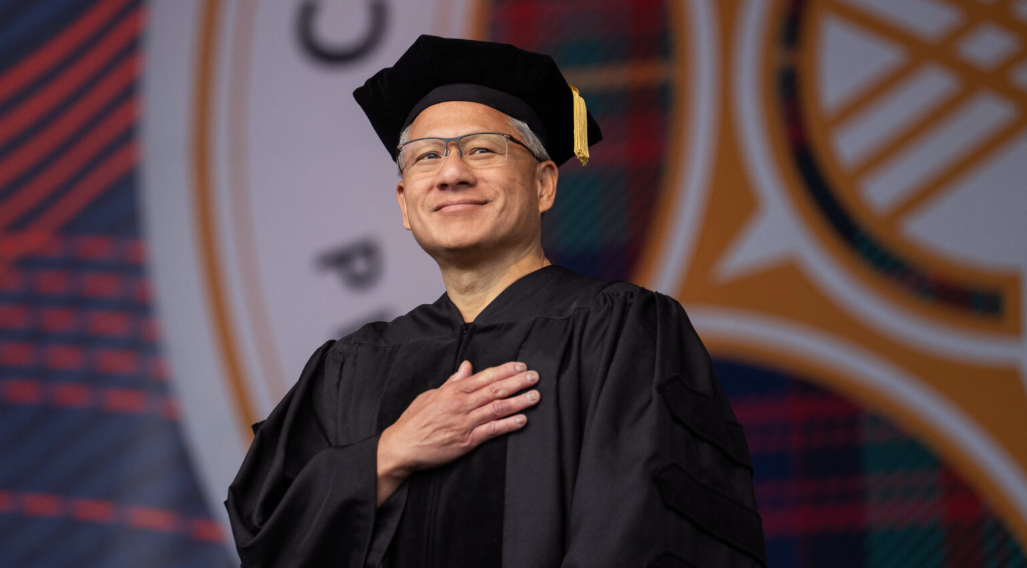
NVIDIA founder and CEO Jensen Huang chose to face the topic of AI with optimism at a time when public anxiety about artificial intelligence continues to rise. On the 10th, he delivered a speech at the Carnegie Mellon University Class of 2026 graduation ceremony, arguing that now is the best time to start a career and calling for all sectors to embrace the AI revolution with an open and responsible attitude.
In his speech, Huang compared the current moment to the early days of the PC revolution, emphasizing that AI is creating the largest wave of technological infrastructure development in human history. "No graduating class has more powerful tools or broader opportunities than you," he told the thousands of graduates in attendance. "We are all at the same starting line."
He told the graduates that artificial intelligence is bridging the "digital divide," allowing anyone to create something useful. He stated that this means many new opportunities will arise for young people in the coming years.
This statement stands in stark contrast to the current market sentiment. A survey by the Pew Research Center found that about half of Americans feel "more worried than hopeful" about the prevalence of AI in everyday life.
Meanwhile, several companies, including Cloudflare and Snap, have laid off employees this year citing enhanced efficiency from AI, and the unemployment rate for recent graduates rose to a four-year high at the beginning of 2026. Huang's comments carry important signals for market participants who are evaluating the long-term investment value of the AI industry.
AI is reshaping industry patterns; graduates stand at a historical starting point
Huang characterized AI as a paradigm shift that surpasses any past technological revolution in his speech. He reviewed previous waves of PCs, the internet, mobile internet, and cloud computing, noting that these transformations collectively laid the groundwork for this historical moment.
Huang described AI as the core engine driving "American re-industrialization," calling it "a once-in-a-generation opportunity." He emphasized that the opportunities brought by AI are not limited to the technology sector; they extend to electricians, plumbers, steelworkers, technicians, and various builders, truly expected to bridge the digital divide and allow the powers of computing and intelligence to benefit a broader population.
Responding positively to job anxiety; criticizing "doomsday theories" within the industry
Addressing external concerns about AI's impact on employment, Huang directly responded in his speech: "AI is unlikely to replace you. But those who are better at using AI than you might."
This remark acknowledged the real pressures in the job market and pointed out a pathway for graduates to respond—embracing AI proactively rather than avoiding it passively.
Huang also criticized the pessimistic rhetoric within the industry. Earlier this month, he specifically pointed out comments from some tech leaders in a podcast, stating that Anthropic CEO Dario Amodei's warning about AI eliminating 50% of entry-level white-collar jobs, as well as Elon Musk's claim of a "20% extinction probability" for humanity, were "not helpful."
Calling for responsible advancement of AI; emphasizing safety and innovation in parallel
In his speech, Huang did not shy away from the real risks associated with AI but emphasized the need to advance this revolution with a "clear-headed" attitude. He pointed out that every major technological revolution in history has been accompanied by both fear and opportunity, and the AI revolution is no exception.
He used radiologists as an example to explain the relationship between AI and human work: AI can automate the task of reading imaging scans, but it cannot replace the mission of doctors caring for patients. AI automates tasks, enhancing the value of humans.
Huang laid out four parallel action programs for this generation: advancing safely, formulating prudent policies, making AI widely accessible, and encouraging everyone to actively participate. He also called on policymakers to "establish reasonable safeguards to protect society while allowing innovation, discovery, and progress to advance."
免责声明:本文章仅代表作者个人观点,不代表本平台的立场和观点。本文章仅供信息分享,不构成对任何人的任何投资建议。用户与作者之间的任何争议,与本平台无关。如网页中刊载的文章或图片涉及侵权,请提供相关的权利证明和身份证明发送邮件到support@aicoin.com,本平台相关工作人员将会进行核查。


