Author: Claude, Deep Tide TechFlow
Deep Tide Introduction: The first quarter of 2026 technology giants' earnings season reveals a new phenomenon: while AI helps companies freeze their workforce and reduce positions, its own token consumption and GPU depreciation are eroding profit margins in reverse. Shopify's subscription business gross margin is suppressed by LLM costs, Roblox's full-year profit margin guidance is cut by about a quarter directly attributed to AI incremental investment, and the four companies Amazon, Meta, Microsoft, and Google will have a total AI capital expenditure of $725 billion in 2026, an increase of 77% year-on-year. The two ends of AI dividends, labor savings and computing power consumption, are reconciled in the same financial report for the first time, with the latter clearly being larger.
The first quarter earnings season is applying a corrective patch to the simple narrative of "AI replacing labor."
A number of tech companies, while providing results of frozen hiring and accelerated product iteration, are forced to explain a more tricky issue to investors: the soaring depreciation of AI chips and unpredictable token consumption are eating away at the money saved from layoffs.
Shopify President Harley Finkelstein stated at the earnings meeting on May 5, 2026, that AI now accounts for over 50% of the company's code writing work, helping Shopify deliver more than 300 products and features while keeping employee numbers stable. However, during the same earnings report, company management also acknowledged that the gross margin of subscription solutions is partially offset by the costs of large language models (LLM), and this dynamic will continue.
Shopify: The LLM Cost Black Hole Behind 80% Gross Margin
Shopify's Q1 subscription solutions gross margin is 80%, unchanged from the same period last year, but the cost of maintaining this figure is changing.
According to Shopify's 10-Q filing with the SEC, the costs for subscription solutions grew by 20% year-on-year in the first quarter of 2026, reaching $148 million, compared to $123 million in the same period last year. Among these, the cloud and infrastructure costs (including AI-related usage) increased by $22 million, which is the main driver of cost expansion. Shopify CFO Jeff Hoffmeister stated at the earnings meeting that economies of scale and improvements in support efficiency are "partially offset by rising LLM costs, primarily driven by merchants using Sidekick, and this dynamic is expected to continue."
Sidekick is the AI assistant embedded in Shopify's platform, and its weekly active stores grew by 385% year-on-year this quarter. Merchants using Sidekick created over 12,000 custom applications this quarter, a month-on-month growth of over 200%, with nearly half of the Shopify Flows generated by AI. AI-driven store traffic increased eightfold year-on-year, with AI search-generated orders rising nearly 13 times.
But this explosion in usage means an exponential growth in AI inference calls. Each interaction a merchant has with Sidekick and each proactive suggestion generated by the Pulse function corresponds to a token bill paid to upstream model suppliers.
Shopify separates the accounts of "internal AI" and "external AI" for investors: using AI to write code and reduce personnel costs is a victory in the "cost game," while providing AI products to merchants is a strategic choice to "deeply bind infrastructure costs with merchants' usage." Finkelstein summarized this logic at the earnings meeting as "AI is a structural advantage, not just a cost."
Roblox: A Quarter of Profit Margin Downgrade Directly from AI
Roblox CFO Naveen Chopra disclosed at the Q1 2026 earnings meeting on April 30 that about a quarter of the profit margin downgrade relative to the previous guidance comes from AI incremental investments and adjustments to DevEx (developer sharing) for users aged 18 and over in the U.S.
Roblox currently runs over 400 AI models on its own and cloud GPUs, processing 1.5 million inference calls per second, covering scenarios such as discovery recommendations, safety communication, market recommendations, and 3D generation.
The company management is attempting to cut inference costs through business model adjustments. Roblox co-founder and CEO David Baszucki stated at the earnings meeting that the upcoming "Roblox Reality" project, a technology that can run 2K real-time photorealistic video models at 60Hz, will not be offered for free. "This will use cloud computing resources. We will have some form of subscription or payment mechanism, so we think we can offset the costs on the real-time inference side," explained Baszucki.
Chopra added that the company's capital expenditure guidance for 2026 remains unchanged, mainly relying on deploying GPUs in its own data centers to meet inference needs throughout the year, while some training tasks still use the cloud. Roblox previously revealed that by the end of 2025, it had achieved a tenfold increase in efficiency on specific workloads like security review and content discovery by migrating some AI inference loads from third-party clouds to its own data centers.
However, Roblox's full-year guidance for this quarter includes multiple pressures such as the aforementioned AI incremental investment, fixed cost deleveraging due to lowered expected booking scale, and the increase of DevEx rates to 37.8% aimed at content creators of 18+ years old, ultimately prompting the market to reprice its full-year profit margin.
Industry Ledger: $725 Billion Capital Expenditure Against $2.7 Billion Wage Savings
The micro cases of Shopify and Roblox are situated within a larger macroscopic structural imbalance.
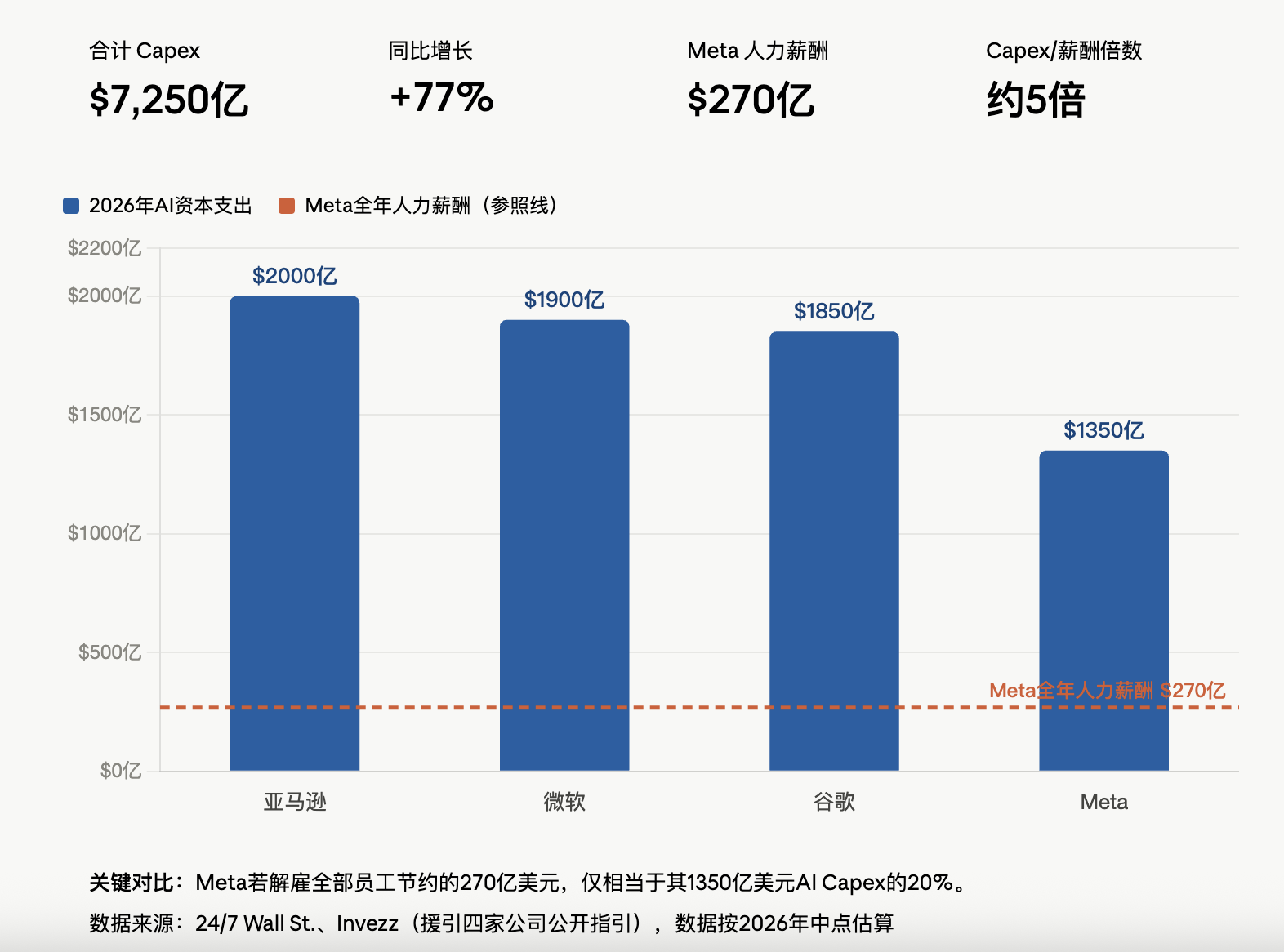
According to data cited by 24/7 Wall St., the total AI capital expenditure of the four companies Amazon, Meta, Microsoft, and Google will reach $725 billion in 2026, a year-on-year increase of 77%. Among these, Meta's full-year capital expenditure guidance ranges from $125 billion to $145 billion, meaning expenditures on data center construction can reach up to $370 million per day; Microsoft's capital expenditure for the calendar year 2026 is $190 billion, and Amazon has committed $200 billion.
This calculation stands in stark contrast to labor expenditure ratios. The total compensation for Meta's workforce, including all salaries, benefits, and equity incentives, is about $27 billion. Even if Meta were to fire all employees tomorrow, the saved costs would only account for less than one-fifth of its 2026 infrastructure expenditures.
Wedbush Securities analyst Dan Ives estimated in a report on April 25 that Meta's upcoming layoffs of 8,000 people could free up about $2.4 billion in operating expenses, which would only offset about 12% of the incremental depreciation drag in 2026. In other words, every dollar spent on AI computing power would require nearly ten dollars in labor cost savings to fully offset.
Meta CFO Susan Li positioned Meta's layoffs at the Q4 2025 earnings meeting as "creating a more streamlined operating model to help offset the large investments we are making." This statement clearly classifies layoffs as a financial tool for AI capital expenditure rather than a byproduct of productivity improvement.
The Victory of Model Suppliers, the Dilemma at the Application Layer
The biggest beneficiaries of this ledger game are the underlying model and computing power suppliers. Microsoft Cloud's gross margin has maintained at 69% under the pressure of AI infrastructure expansion, OpenAI's gross margin is estimated to be about 50%, and Anthropic's is about 60%. Nvidia also recorded a gross margin level of approximately 70% in fiscal year 2026.
On the other hand, application layer companies, especially those that both consume AI and package AI capabilities as subscription products for sale, face a new financial structure: revenues are highly correlated with AI usage intensity, but the cost curve is dictated by upstream model suppliers, and every model upgrade may bring new token consumption.
Tanay Jaipuria pointed out in his analysis of AI gross margins that although the inference costs for single models are decreasing at a rate of 80%-90% annually, the prices of cutting-edge models remain stable or even rise. If application layer companies insist on calling the strongest models in every request, their cost of goods sold (COGS) is actually driven by the price cards of model suppliers.
Shopify's response is to position AI products as a strategic entry deeply bound to traffic and merchants, making the growth of inference costs an agent indicator of "platform embedding depth"; Roblox's solution, on the other hand, is to separate high-end AI experiences from the free tier, mandating users to pay for inference costs. Behind the two paths is the same consensus: purely relying on layoffs to save money to cover AI computing bills mathematically does not add up.
免责声明:本文章仅代表作者个人观点,不代表本平台的立场和观点。本文章仅供信息分享,不构成对任何人的任何投资建议。用户与作者之间的任何争议,与本平台无关。如网页中刊载的文章或图片涉及侵权,请提供相关的权利证明和身份证明发送邮件到support@aicoin.com,本平台相关工作人员将会进行核查。


