Author:Bao Yilong
Investors are turning their attention to Asia, searching for the next breakthrough in the global stock market rally.
Driven by the wave of artificial intelligence, the South Korean stock market has led global gains this month, attracting a significant influx of capital. The implied volatility in the options market has surged to extreme levels, with derivative strategists recommending long positions.
All these signals point to a single judgment: the upward trend in Asia may just be beginning.
According to wind trading desk news, Morgan Stanley's Asia-Pacific team has recently emphasized that the underlying driving force of the Asian industrial cycle is shifting from traditional real estate and general manufacturing inventory replenishment to AI and its infrastructure, energy security and transformation, defense, and supply chain resilience investments.
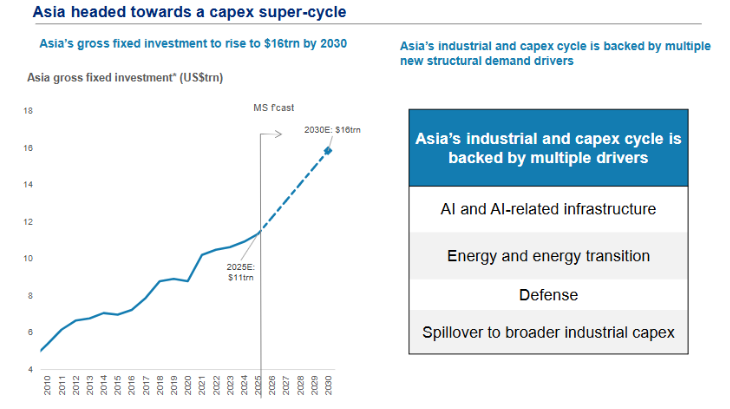
(By 2030, Asia's fixed investment total will increase to 16 trillion dollars)
Morgan Stanley predicts that the scale of fixed asset investment in Asia is expected to rise from approximately 11 trillion dollars in 2025 to 16 trillion dollars by 2030, with a nominal investment compound annual growth rate of about 7% from 2026 to 2030, significantly higher than recent levels.
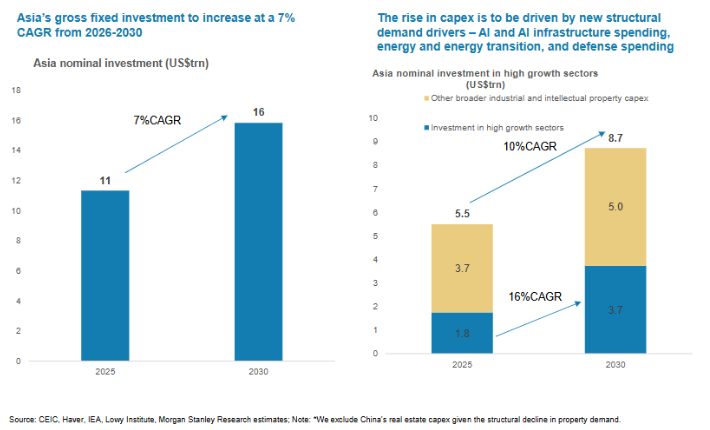
(From 2026 to 2030, Asia's total fixed capital investment will maintain a 7% compound annual growth rate)
The underlying logic of the "super cycle": Asian capital expenditure must significantly accelerate
The core difference in this round of the Asian industrial cycle is that AI has brought capital expenditure back to the forefront.
In the past two years, market discussions on AI have focused more on models, applications, and the "Seven Giants" of US stocks. However, from an Asian perspective, the true meaning of AI is the comprehensive expansion of chips, storage, servers, optical modules, data centers, power systems, and cloud infrastructure.
Morgan Stanley notes that the proportion of global CIOs who list AI as a top priority has risen to 39%. Correspondingly, global investment in AI data centers is expected to reach approximately 2.8 trillion dollars between 2026 and 2028, with an annual growth rate of about 33%.
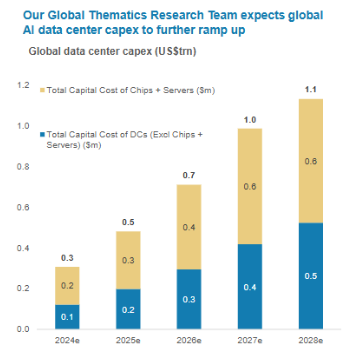
(Capital expenditures related to data centers in the global artificial intelligence sector will increase further)
Asia is at the center of the AI hardware supply chain: from TSMC, Samsung, and SK Hynix to semiconductor, server, optical communication, and cloud infrastructure companies in mainland China, all will benefit from this investment cycle.
The report also predicts that capital expenditure of major chip companies is expected to rise from approximately 105 billion dollars in 2025 to about 250 billion dollars annually by 2028, indicating that AI is a capital-intensive race.
China’s role is particularly noteworthy.
Morgan Stanley believes that China's AI is a competition of complete system capabilities: computing power determines speed, cloud platforms determine scale, token usage determines economics, and application scenarios determine value attribution.
Against the backdrop of ongoing external restrictions on chips, the synergy of domestic AI chips, local cloud platforms, and large model ecosystems is becoming a new main line for technology investments in China.
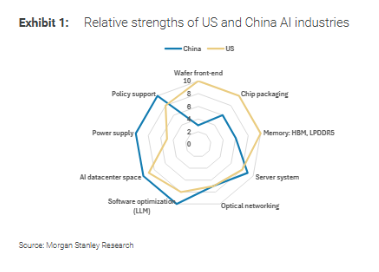
(Relative advantages of the artificial intelligence industry between China and the United States)
The judgment indicates that China's AI chip market may reach 67 billion dollars by 2030, with the local self-sufficiency rate expected to rise to 86%.
Whether this forecast will be fully realized still needs to be observed, but the direction is very clear: the localization of computing power has gradually shifted from a policy proposition to a business proposition.
The story of China's manufacturing exports is expanding from "the three-piece set of electric vehicles" to robots
In recent years, the most striking aspects of China's export structure have been the new three items: electric vehicles, lithium batteries, and photovoltaics.
The report suggests that the next phase of growth in Chinese manufacturing may come from robots, especially industrial robots and humanoid robots.
Morgan Stanley points out that China has captured about half of the global incremental demand for industrial robots. It is estimated that the global shipments of humanoid robots will reach about 13,000 to 16,000 units by 2025, with approximately 90% coming from Chinese manufacturers. In contrast, markets like the United States and Japan are still more in the prototype or early validation stage.
Interestingly, the report draws parallels between current Chinese robot exports and electric vehicle exports from around 2019: at that time, electric vehicle exports had yet to enter an explosive phase, but the supply chain, policy support, and manufacturing capacity were basically ready.
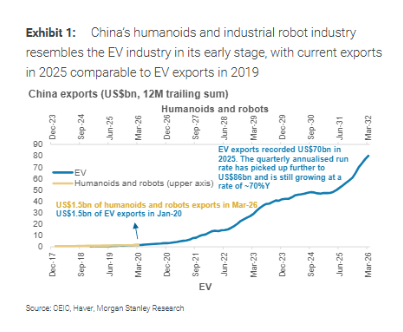
(The development stage of China's humanoid robot and industrial robot industries is similar to that of the early-stage electric vehicle industry)
Today, the robot industry is also exhibiting similar characteristics—while the market scale is not large, the speed of expansion in the industrial chain is rapid.
According to data, China's humanoid robots and related robot exports reached approximately 1.5 billion dollars in March 2026, a rolling 12-month scale, which is similar to the level of China's electric vehicle exports in early 2020.
In the following years, electric vehicle exports rapidly expanded, with around 70 billion dollars exported in 2025, and the quarterly annualized run rate further rising to about 86 billion dollars.
Of course, whether robots can replicate the growth curve of electric vehicles will depend on cost reductions, the opening up of application scenarios, and the overseas regulatory environment. However, China's advantages in components, complete machine manufacturing, supply chain collaboration, and rapid iteration are beginning to emerge.
Energy security and defense spending are providing the second and third growth poles
The other side of the expansion of AI data centers is the immense demand for power and energy infrastructure. The more computing power is concentrated, the greater the importance of electricity, heat dissipation, power grids, and energy storage.
Morgan Stanley believes that the energy shock will catalyze investments in energy security across Asia, and the proportion of renewable energy in Asia's primary energy consumption is still low, indicating significant room for subsequent investments.
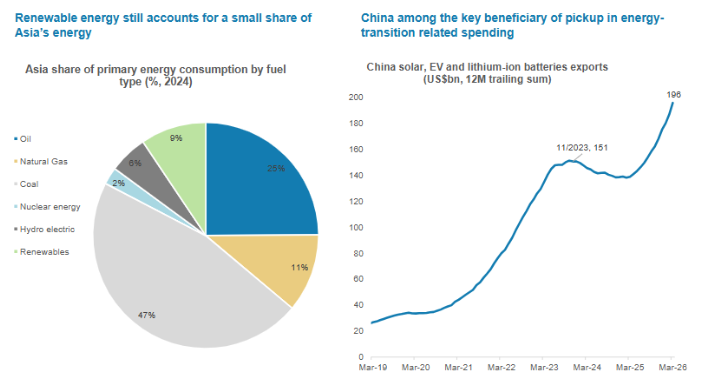
(The proportion of renewable energy in Asia's energy structure remains small, with China significantly benefiting from increased spending related to energy transitions)
China has industrial advantages in photovoltaic, electric vehicles, and lithium batteries, with related exports nearing the 200 billion dollars mark in a rolling 12-month scale, making it a significant beneficiary of this round of capital expenditure in energy transitions.
Meanwhile, defense spending is also showing a structural upward trend in several Asian economies.
Defense spending as a proportion of GDP has increased in countries such as Japan, South Korea, and India. China and South Korea are also among the top ten defense exporters globally.
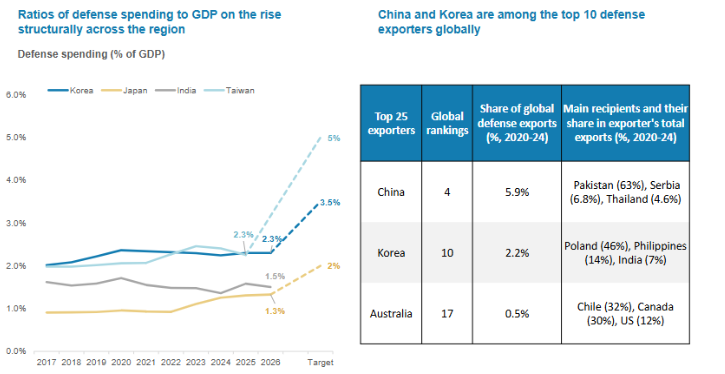
(Across the entire region, the ratio of defense spending to GDP is on the rise)
For capital markets, this means that demand in industries such as high-end manufacturing, materials, electronic components, and precision equipment may receive longer-term support.
In other words, AI provides the demand for computing power, energy provides the infrastructure constraints, and defense and supply chain security provide "resilient investments" against the backdrop of geopolitical factors. The combination of these three forms the foundation of the Asian super cycle.
Who benefits the most? China, South Korea, and Japan are at the core of the industrial chain
In terms of regional beneficiaries, Morgan Stanley highlights China, South Korea, and Japan.
Mainland China stands out for its completeness of the industrial chain, manufacturing scale, engineering capabilities, and emerging export categories such as new energy and robots.
South Korea has advantages in storage, HBM, batteries, and certain equipment materials; Japan has deep accumulations in semiconductor equipment, materials, precision manufacturing, and industrial automation.
The share of capital goods exports also reflects this issue. Reports show that Thailand is around 38%, China about 36%, Japan about 35%, and South Korea about 30%. This implies that when the world enters a new round of equipment investment cycles, these economies will exhibit more pronounced elasticities in external demand.
Finally, looking at the structure of capital markets, industrial, technology hardware, and material-related sectors hold high weights in these markets, making it easier for macro capital expenditure cycles to map to stock market performance.
This also indicates that the pricing logic in the Asian market may change in the coming years, with a focus on which companies within the capital expenditure chain have orders, technological barriers, and profit elasticity.
Risks that cannot be ignored: Overcapacity, profit margins, and geopolitical friction
The narrative of the super cycle is compelling but does not mean that all industries or companies will benefit simultaneously.
First, the expansion of capital expenditure may bring about periodic supply pressures.
China's new energy industry has already proven that scale advantages can quickly open up the global market, but it may also come with price competition and fluctuations in profit margins. The industries of robots, AI hardware, photovoltaics, and energy storage may face similar issues in the future.
Second, technological limitations and export controls remain variables.
While there is vast potential for the localization of AI chips, there are still shortcomings in advanced processes, HBM, EDA, and equipment materials. The report also mentions that domestic chips still lag behind top US chips, but competitiveness can be enhanced through system optimization, advanced packaging, and software adaptation.
Third, employment structures will also be affected by AI.
Morgan Stanley's research on "Future Work" estimates that about 90% of occupations will be affected to varying degrees by AI automation and augmentation. In its sample companies, early applications of AI have led to over an 11% increase in productivity, but also accompanied an average net decline of about 4% in job positions, with significant differences between countries and industries.
For China, how to promote retraining and job transition while improving efficiency will be an important issue for medium- to long-term policy and corporate management.
Fourth, market fluctuations may increase. The report also cautions that the gap between bullish and bearish scenarios in regional markets is widening, indicating that investor expectations regarding AI capital expenditures, export orders, and profit realizations will continue to diverge.
免责声明:本文章仅代表作者个人观点,不代表本平台的立场和观点。本文章仅供信息分享,不构成对任何人的任何投资建议。用户与作者之间的任何争议,与本平台无关。如网页中刊载的文章或图片涉及侵权,请提供相关的权利证明和身份证明发送邮件到support@aicoin.com,本平台相关工作人员将会进行核查。


