- Artificial intelligence ranked among the most-cited risks in the Fed’s latest financial stability survey.
- Debt-funded AI spending could increase leverage across companies, lenders, and funding markets.
- Private credit and labor pressures may widen AI’s impact if market expectations weaken.
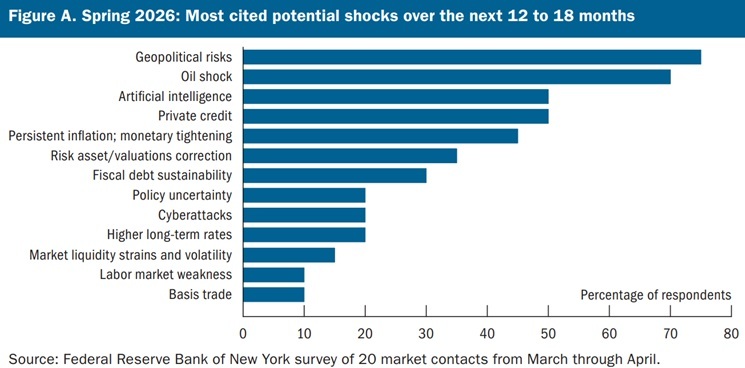
The Federal Reserve released its latest Financial Stability Report on May 8, showing that artificial intelligence (AI) is emerging as a growing financial-system concern. In spring 2026, 50% of surveyed market participants cited AI as a possible shock, up from 30% in fall 2025. That placed AI among the most-cited risks over the next 12 to 18 months, alongside geopolitical tensions, an oil shock, persistent inflation, and private credit stress.
The survey appears in the Fed’s Financial Stability Report, which presents the central bank’s current assessment of the U.S. financial system. The Fed said financial stability supports full employment, stable prices, a safe banking system, and an efficient payments system. AI’s growing presence in the survey reflects broader concern that the technology could affect multiple parts of the financial system, including asset valuations, borrowing levels, labor markets, and credit conditions.
The report stated:
“AI-related risks were in focus as well, particularly concerns around equity valuations, debt-financed capital spending, and risks to the labor market.”
During March and April, New York Fed staff surveyed 20 financial-market participants, including professionals at broker-dealers, banks, investment funds, and advisory firms. They were asked which shocks could have the largest negative effect on U.S. financial stability over the next 12 to 18 months. The report said the findings reflect market participants’ views, not official positions of the Federal Reserve Board or the New York Fed.
Beyond technology stocks, respondents connected AI to broader financial vulnerabilities. Elevated equity valuations tied to AI optimism could become unstable if growth or profit expectations weaken. Debt-funded capital spending was another concern as borrowing can create leverage across companies, lenders, and funding markets. Labor-market weakness also entered the discussion, reflecting concern that wider AI adoption could pressure employment in some sectors.
Capital spending tied to AI drew attention as more investment is being financed through borrowing. The Fed did not predict an AI-driven crisis or say AI spending is already destabilizing markets. Still, the survey shows market professionals are watching how AI-related debt could interact with high asset prices and tighter financial conditions if expectations change.
The Fed report detailed:
“Respondents raised several risks related to AI, including equity valuations; that capital expenditures are increasingly funded by debt, creating leverage in the system; and that widespread adoption of AI may contribute to labor market weakness.”
Private credit added another channel. Respondents said AI-driven disruption could weaken credit quality for some borrowers. The report also noted redemption requests and weaker sentiment in parts of private credit. That makes AI relevant beyond public technology shares, linking it to borrowers, lenders, leveraged financing, and broader market confidence.
Taken together, the survey shows AI moving deeper into the Fed’s financial-stability framework. It was not the top-ranked risk, with geopolitical risks and an oil shock ranking higher. Still, the jump from 30% to 50% suggests market participants increasingly see AI as a possible amplifier of valuation pressure, leverage buildup, credit stress, and labor-market strain.
免责声明:本文章仅代表作者个人观点,不代表本平台的立场和观点。本文章仅供信息分享,不构成对任何人的任何投资建议。用户与作者之间的任何争议,与本平台无关。如网页中刊载的文章或图片涉及侵权,请提供相关的权利证明和身份证明发送邮件到support@aicoin.com,本平台相关工作人员将会进行核查。


