Author: Gallina, CryptoPulse Labs
At the end of April, the South Korean National Tax Service officially launched its preparation for taxing virtual assets, planning to implement it in January 2027 and prepare for the comprehensive income tax declaration in May 2028.
This taxation will cover income from the transfer and leasing of virtual assets, with a tax rate of 22% applicable to annual income exceeding 2.5 million won, expected to involve about 13.26 million people.
To this end, the National Tax Service plans to obtain data from local trading platforms such as Upbit, Bithumb, and Coinone, and promote the launch of a comprehensive analysis system for virtual assets to establish a complete tax infrastructure.
The taxation of virtual assets in South Korea is transitioning from policy preparation to institutional implementation, while facing practical challenges of cooperation with trading platforms and regulatory coordination, which may become an important window for observing the global cryptocurrency market.
1. Preparation Before Tax Implementation: How the National Tax Service Constructs the Virtual Asset System
The South Korean National Tax Service classifies income from the transfer and leasing of virtual assets as "other income," explicitly setting the tax rate at 22%, aiming to establish a systematic and operable taxation mechanism.

Previously, the taxation of virtual assets experienced two delays in 2022 and 2024, reflecting the challenges of integrating technology, law, and market coordination. The clarification of this target timeline indicates that the tax infrastructure has entered the final preparation stage.
The National Tax Service plans to obtain trading data from major domestic exchanges while building a comprehensive analysis system for virtual assets, promoting cross-platform data integration. The launch of this system will enable tax authorities to monitor capital flows, track income distribution, and provide data support for future tax declarations.
More importantly, this taxation plan will also rely on the OECD's CARF international information exchange agreement, sharing data on overseas investors starting next year to prevent capital outflow and tax evasion.
By incorporating virtual assets into the "other income" category instead of traditional capital gains, the South Korean tax system simplifies the collection process while laying the groundwork for subsequent regulatory classification.
This move reflects the South Korean government's transition from fragmented regulation to institutional management in the field of digital assets, aiming to establish a transparent and enforceable tax framework while balancing compliance and market stability.
2. Tug-of-War Between Regulation and Crypto Platforms: Data Sharing and Compliance Challenges
During the implementation of tax preparation work, the relationship between South Korean authorities and various trading platforms shows subtle tension.
Recently, the South Korean Personal Information Protection Commission investigated Upbit and Bithumb, focusing on whether the two platforms shared order book data with overseas platforms without user consent.
These cross-border data transmissions are primarily used to enhance trading liquidity but may violate relevant provisions of personal information protection laws. The investigation has completed written inquiries and on-site inspections, with results expected to be announced in the second half of 2026.
Previously, both trading platforms had been reviewed multiple times due to inadequate performance of anti-money laundering obligations or other compliance issues, with Bithumb facing record fines for violations.
Similarly, in recent times, the South Korean crypto industry collectively opposed further tightening of anti-money laundering regulations.
According to reports from Yonhap News Agency, the Digital Asset Exchange Alliance (DAXA) represents 27 registered virtual asset service providers (VASP) and submitted opinions regarding the proposed amendments to the enforcement decree of the Specific Financial Information Act.
The new regulations require that when domestic VASPs transfer virtual assets to foreign VASPs, regardless of the risk level, any amount reaching 10 million won (approximately 6,800 USD) or more must be reported as a suspicious transaction report (STR).
These regulations are intended to strengthen anti-money laundering monitoring, but the requirement to "indiscriminately report large cross-border transfers" may cause a disconnect between regulatory targets and the practical operational capabilities of the industry.
DAXA pointed out that the rules' requirements ignore the risk level of transactions, reducing the value of the AI risk control systems invested by exchanges, such as Upbit's abnormal transaction detection, turning intelligent compliance into mechanical reporting.
At the same time, the new regulations will increase the annual reporting volume of South Korea's five major trading platforms—Upbit, Bithumb, Coinone, Korbit, and Gopax—from about 63,000 last year to over 5.4 million, making practical operations extremely challenging.
The industry also opposes the proposed additional requirement to verify the accuracy of customer information, arguing that it adds obligations not explicitly defined by law.
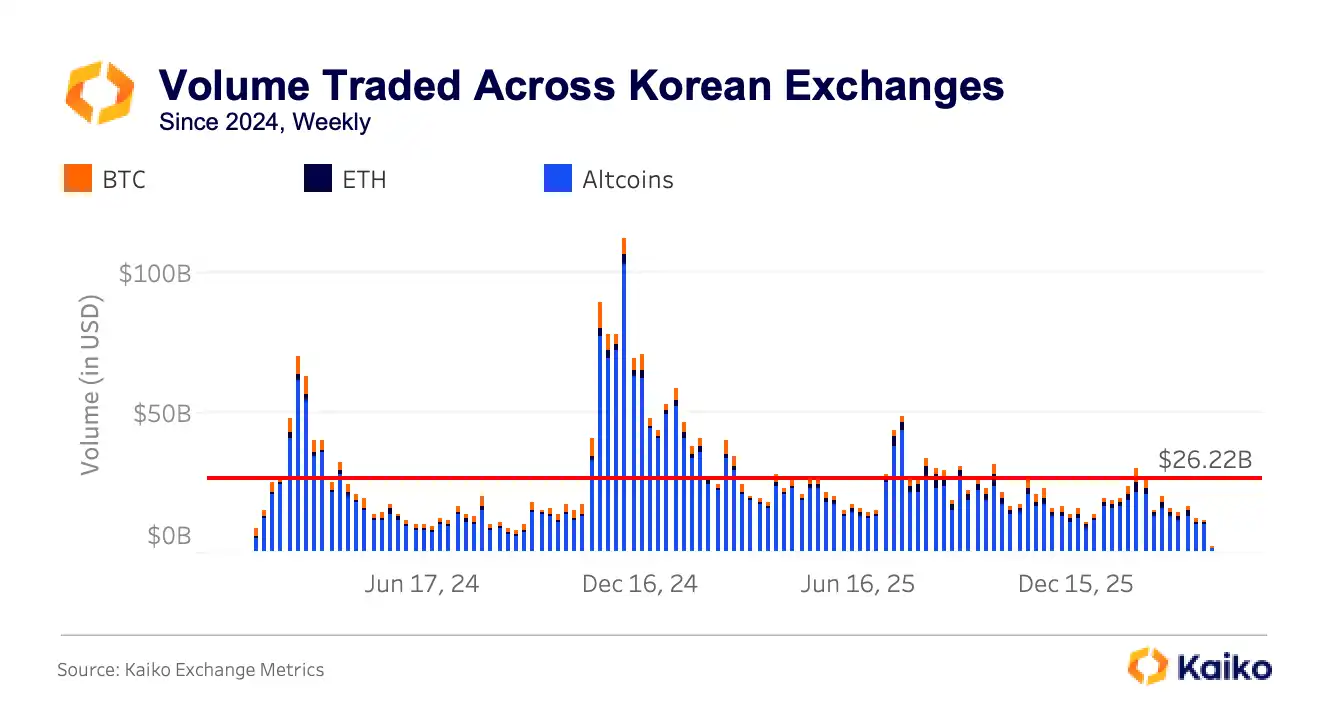
The highly localized characteristics of the South Korean virtual asset market cannot be ignored, with its trading volume accounting for 30% of the global market and altcoins making up 85%, with relatively low proportions for Bitcoin and Ethereum. Most market participants are retail investors, exhibiting clear speculative characteristics.
This structure places continuous pressure on trading platforms to maintain liquidity while fulfilling compliance obligations. The friction between regulatory demands and platform business objectives reflects, to some extent, the unique investor behavior and institutional environment of the South Korean market.
3. Capital Flow and Price Volatility: Potential Transmission of Tax Policies
The advancement of virtual asset taxation in South Korea directly impacts its domestic market. Taxation will regulate investor behavior, increase tax transparency, and may slow down short-term speculative actions.
At the same time, leveraging cross-border information exchange agreements, the space for capital outflow is restricted, promoting a more stable order in the domestic market. Taxation policies will also affect the operational strategies of exchanges, as platforms need to make adjustments between ensuring liquidity and compliance.
From a global perspective, although the South Korean market has high trading volumes, the high proportion of altcoins leads to relative shallowness in overall depth, making price volatility significantly transmitted to the global market.
After the implementation of taxation, the distribution of funds in the market may be reshuffled, potentially decreasing the trading enthusiasm for high-volatility domestic assets, impacting international investors' participation strategies in the Asian market.
South Korea's regulatory model and information-sharing experience may serve as references for other countries, demonstrating the possibilities for global virtual asset taxation and compliance systems.
The clear timeline for this taxation and the construction of technical infrastructure also provide institutional expectations for international capital, allowing the global market to have clearer references for price discovery, liquidity risks, and investment strategies related to the South Korean market.
Especially in cross-border fund management and personal information protection, South Korea's practices may become reference cases for other jurisdictions in policy formulation.
Conclusion
The launch of virtual asset taxation by the South Korean National Tax Service marks a significant progress from policy formulation to institutional management. Despite friction between domestic trading platforms and regulatory agencies, the establishment of taxation and data infrastructure helps to regulate the market and control capital flows.
The high speculative nature and cross-border trading characteristics of the South Korean market mean that its taxation practices not only affect the domestic ecosystem but may also serve as a reference for global cryptocurrency regulation and taxation models. Observing the market response after the final implementation of taxation will help understand the trends and challenges of the global virtual asset market in its process of institutionalization.
免责声明:本文章仅代表作者个人观点,不代表本平台的立场和观点。本文章仅供信息分享,不构成对任何人的任何投资建议。用户与作者之间的任何争议,与本平台无关。如网页中刊载的文章或图片涉及侵权,请提供相关的权利证明和身份证明发送邮件到support@aicoin.com,本平台相关工作人员将会进行核查。


