What exactly has caused Saylor to completely change his stance on Bitcoin today? And who would still be willing to believe this person now?
Written by: Alexander S. Blume, Forbes
Translated by: Saoirse, Foresight News
Although I am really reluctant to spend more energy analyzing Strategy, the company and its repeatedly changing development goals, product lines, and public statements, the asset allocation strategy of this company has indeed become the core influencing factor of Bitcoin's short-term trend, so it is worth a serious analysis. This week, during the earnings call of Strategy, Executive Chairman Michael Saylor made a complete turnaround, now stating: under certain circumstances, the company may consider selling the Bitcoin held on its balance sheet. The core question is: what exactly has prompted his current thoughts? And who would still be willing to believe this person?
Clearly, there are still some people who choose to continue trusting him. Cult-like leaders typically possess these characteristics: arrogant and flamboyant, shaping an infallible persona, setting loyalty tests, monopolizing the narrative, exercising personal authoritarianism, and implementing dual standards for accountability, all while possessing a strong personal charisma. Now the company's plans and public stance have changed again, and supporters of Strategy are desperately trying to justify this change; one has to admit that this has already formed a blind, unquestioning adoration by the followers.
It is easy for outsiders to see that Strategy holds over 800,000 Bitcoins on its books and spends billions of dollars almost every week to continue increasing its holdings, and thus assume that this company has unlimited operational space and great growth potential. The company's consistent value logic is to bind its Bitcoin asset exposure and seek excess returns by using leverage. Saylor has publicly emphasized multiple times how crucial it is to hold onto Bitcoin. But the reality is starkly different: over the past year, Strategy's stock price has fallen by 53%, while Bitcoin itself has only decreased by 17%.
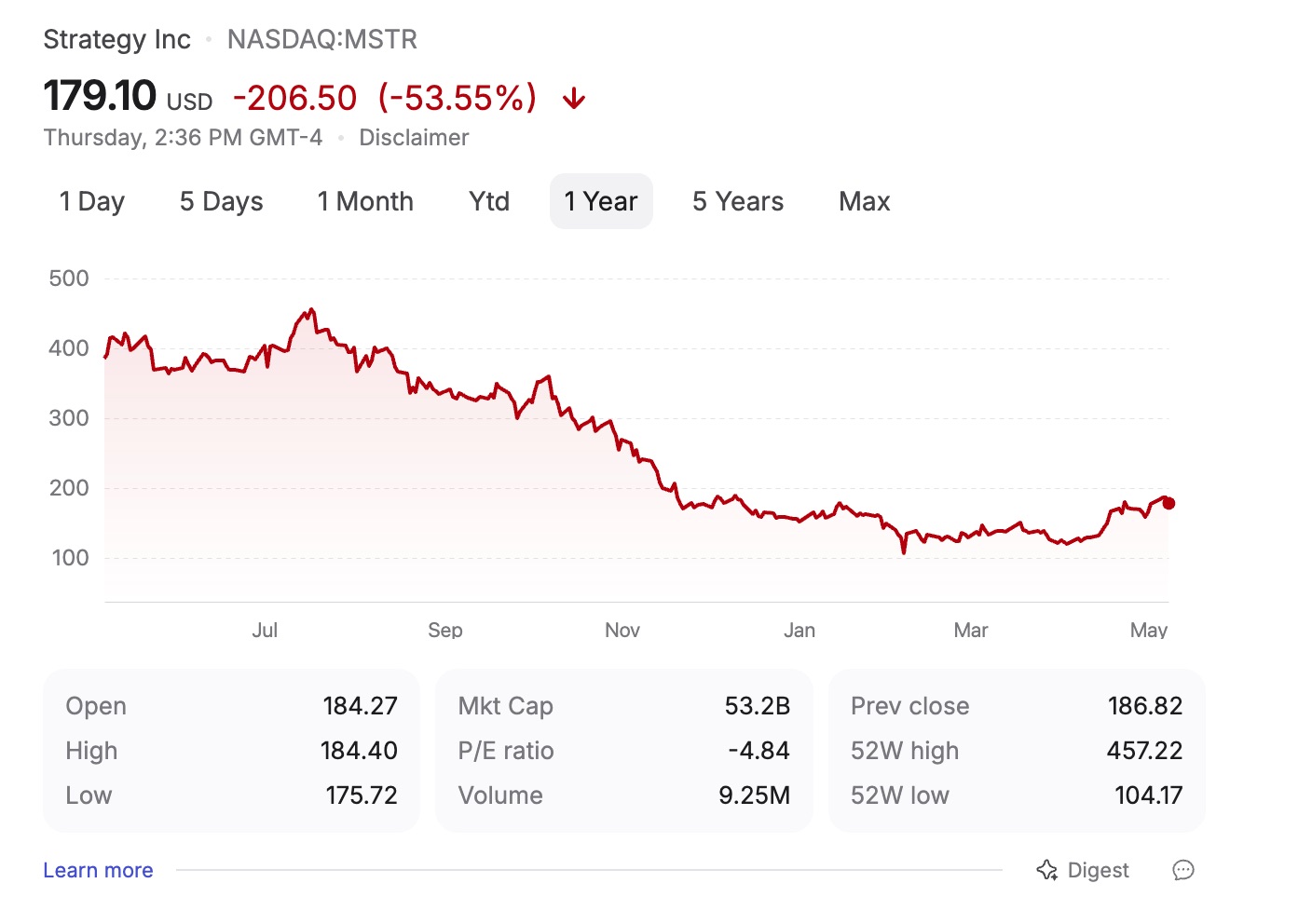
The stock price of Strategy has dropped over 53% in the past 12 months.
Despite the sharp decline in stock price, Strategy has pulled out its self-created "Bitcoin Per Share" growth data to prove that its operations are fine. However, this self-created metric is at best only indirectly related to the stock price. When its decline is three times that of the underlying asset, no one cares anymore about the so-called Bitcoin per share metric.
The valuation logic of the entire Strategy ecosystem fundamentally forces the hard currency attributes of Bitcoin and MSTR stock into a binding relationship. So why would Strategy go against its own most sacred principle in its value proposition — never sell Bitcoin — taking the risk of overdrawing the trust of enthusiastic investors to suddenly change its tune? The reality is that: Strategy must continuously stay ahead of market expectations, even outrunning its own investors' expectations, in order to continually absorb larger scales of funding requirements and maintain its expansion growth rate.
His approach relies on the upward momentum of its stock and the market's speculative heat, on one hand issuing new shares to raise capital and subsequently increasing its Bitcoin holdings (sometimes also allocating USD assets), and on the other hand constantly issuing new types of bonds and debt-like products to inject liquidity.
Recently, its most relied-upon tool is STRC. This perpetual preferred equity is at the very bottom of the company's debt structure, has no direct claim on any Bitcoins, can be redeemed at any time by the company, and the distribution rate may change every month. So far, STRC has attracted massive amounts of funds into Bitcoin layouts.
There's no need to elaborate on the complex operational details of various debt and equity products; it's enough to clarify three core facts:
- All investment products under Strategy do not directly hold Bitcoin and have no ownership rights to Bitcoin;
- The performance of these products is not directly linked to Bitcoin's price movements and is only determined by the supply and demand of the products themselves;
- The underlying logic of various products is contradictory: on one hand, they claim to efficiently accumulate Bitcoin, while on the other hand, they must continuously repay USD debts.
This operating model is, at best, an unprecedented and increasingly complex tightrope walk. To stabilize the situation and also to raise the credit valuation of MSTR in the eyes of institutional investors, Saylor has to make statements that he can sell Bitcoin, at least verbally promising he will reduce holdings if necessary. These institutional investors are not concerned about Bitcoin itself nor do they agree with its value proposition; they only care about whether they can safely get back their USD principal in the future, which is precisely the core target audience Saylor aims to scale up.
Online, there are AI marketing ads everywhere, suggesting that ordinary people can buy STRC, achieve an 11.5% return, and enjoy a stable retirement and carefree life. But reality is the complete opposite; this product encompasses all investment risks:
- Risk reliant on key individuals;
- No principal return guarantees;
- Secondary market liquidity and price volatility risks;
- Dividend rates fluctuate and are not fixed;
- The company's existing software business cash flow continues to shrink and is fundamentally unable to support increasingly heavy debt interests;
- The product is at the very bottom of the capital hierarchy, with a very low priority for repayment;
- When the market declines, it is easy to trigger negative chain reaction risks;
- The interest rate risk arising from the overall fluctuating interest rate environment.
Similar risk points can be listed further.
Simply put, this product cannot be considered a stable retirement financial tool. This is not unreasonable, but the problem is that: Saylor and his followers deliberately package it as a safe asset comparable to a vault and even promote that it can steadily outperform junk bonds to achieve high returns.
Like the three-body problem, the various related products under Strategy and their interactions with public market investors have endless second-order and third-order chain influences, with a logic that is too complex to deduce. Even if Saylor himself is exceptionally intelligent, he cannot possibly predict all subsequent trends.
This model may barely sustain for some time.
However, savvy professional investors on Wall Street are already contemplating how to dismantle this business model: shorting the company's stock, shorting Bitcoin, profiting from it. The core of this game ultimately focuses on undermining market trust in Saylor and Strategy itself. Such products may not collapse due to underlying technical issues, but they can easily fail completely due to a collapse in market confidence. The recurring shifts in core principles of the product and the frequent reversals of position are consuming investors' trust every day.
A concentrated sell-off by investors would trigger STRC, and even drag down Bitcoin's price. Involving multiple variables and compounded by various constraints from the public market, Saylor and Strategy cannot possibly predict all combinations of risks. More crucially, Saylor's interests do not align with those of ordinary investors at all. His personal wealth, MSTR stock holdings, self-serving attitude and industry position could drive him to make decisions that harm the interests of regular investors.
The original intention of Bitcoin was to combat the arbitrary decision-making by self-serving financial policymakers and the resulting Cantillon effect. However, Strategy has replicated such profit-driven chaos within the Bitcoin ecosystem, which is reminiscent of the traditional fiat currency system.
In the long run, Bitcoin itself will not face fundamental shocks. However, countless blindly following faithful investors in Strategy might ultimately incur heavy losses, waking up to exit this blind following only after pouring in all their resources. Regardless of the outcome, as the core leader, Michael Saylor will still remain among the billionaires.
免责声明:本文章仅代表作者个人观点,不代表本平台的立场和观点。本文章仅供信息分享,不构成对任何人的任何投资建议。用户与作者之间的任何争议,与本平台无关。如网页中刊载的文章或图片涉及侵权,请提供相关的权利证明和身份证明发送邮件到support@aicoin.com,本平台相关工作人员将会进行核查。


