Author: Wanxiang Blockchain
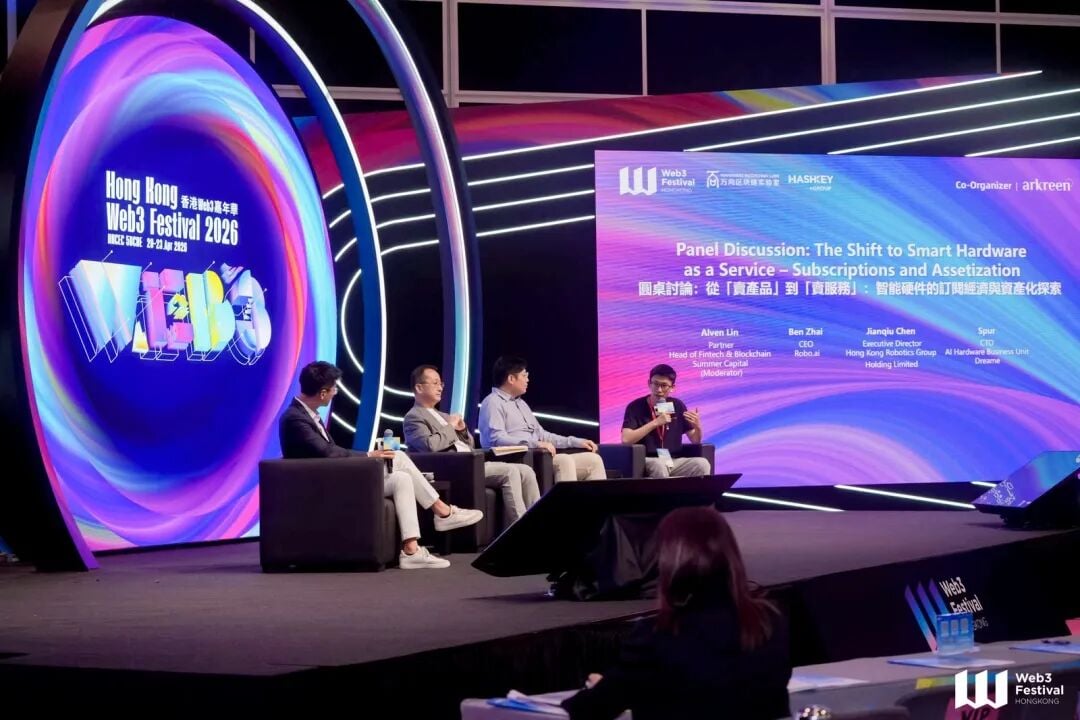
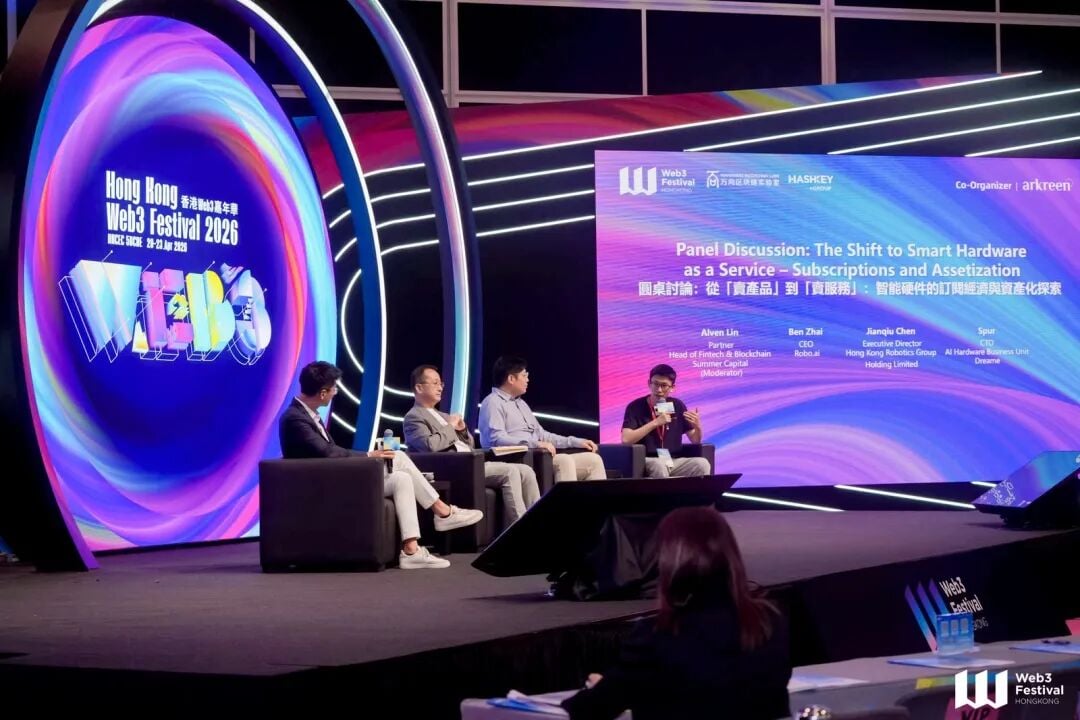
From April 20 to 23, the 2026 Hong Kong Web3 Carnival, co-hosted by Wanxiang Blockchain Laboratory and HashKey Group, was successfully held at the Hong Kong Convention and Exhibition Centre. On April 21, at the conference stage One·Feng, Summer Capital financial technology and blockchain partnerAlven Lin served as the host, along with Robo.ai CEOBen Zhai, the executive director of Hong Kong Robot GroupChen Jianqiu, and CTO of AI hardware division at Zhui Mi TechnologySun Zexuan discussed the topic of “From ‘Selling Products’ to ‘Selling Services’: The Subscription Economy and Assetization Exploration of Smart Hardware” in a roundtable discussion.The following text is organized based on the on-site discussion, with some edits that do not affect the original meaning.
Alven: Welcome to the Hong Kong Web3 Carnival. I am the host of this roundtable, Alven, and also a partner in the financial and blockchain sector at Summer Capital. Summer Capital is a multi-strategy investment institution in Hong Kong that began its investment in the crypto market back in 2017. We are also one of the main investors and initiators of Solana’s second largest DAT company—Solana Company, and this morning we also hosted a joint event here. Today, I am honored to invite three heavyweight guests in the smart hardware device field to discuss the subscription economy model of smart hardware and potential development opportunities with us. First, let’s have our three guests introduce themselves briefly.
Ben: My name is Ben, and I am from a company headquartered in Dubai that is listed on NASDAQ. Our company has undergone several transformations since going public, especially in recent years, which is quite aligned with today’s theme and the theme of the conference, and I will share more details with you later. Our company is called Robo.ai.
Chen Jianqiu: Hello everyone, I am Chen Jianqiu from Hong Kong Robot. Our Hong Kong Robot mainly provides one-stop solutions for robotics, covering everything from product research and development to scene expansion, operational services, and subsequent RWA asset tokenization. I will share more details later, thank you.
Sun Zexuan: Hello everyone, my name is Sun Zexuan (Spur), and I am from Zhui Mi Technology. Our main business at Zhui Mi Technology is robotic vacuum cleaners. I previously worked at the blockchain laboratory at the Paris Institute of Technology, where I successfully launched a rocket while in France. I am currently the technical head of the AI hardware department, familiar with both AI hardware and blockchain, so I am here today to share some insights, thank you all.
Alven: Thank you to the three guests for your introductions. Today, our guests come from very diverse backgrounds, with expertise in robotics and AI, as well as experience in hardware product sales to both B2B and B2C markets. The subscription economy business model for hardware is more common in the software industry, often referred to as the SaaS model. However, this model is not as prevalent in the hardware device arena. Yet there are some innovative models, such as the battery swapping services launched by some new energy vehicles, which essentially represent a hardware subscription mechanism. However, not all hardware devices universally adopt this subscription method.
Today, I would like to discuss the following topics with the three guests: past experiences and challenges in smart hardware sales; the exploration and thinking of transforming from selling products to selling services; the assetization and RWA practices derived under the hardware subscription model; and the potential new trends that the hardware industry may face under the current AI model-driven environment. Let's start with the topic of hardware sales, which is more familiar to everyone. Each of your companies has significant experience in product sales in both B2B and B2C markets, covering robotics, aircraft, and a diverse range of consumer products. In this process, I would like to ask the guests to share some successful experiences in traditional hardware sales or the challenges you have faced. Have these challenges prompted you to gradually shift towards selling services? Jianqiu, please start.
Chen Jianqiu: Okay, thank you, Alven. From the perspective of selling services, this is actually a very rigid demand currently. Because there is still a substantial gap between current robotic products and real user services. We have engaged with many B2B clients, and what they truly want is to solve problems in various scenarios, such as having robots patrol or provide health guidance. They want services, and products are merely tools to meet these service needs. However, the gap in the middle remains significant. Clients may approach robotic manufacturers, but manufacturers are often unwilling to provide services and prefer to provide products only. Therefore, we have conducted a lot of explorations, including our self-developed cloud brain, to serve the operators. It requires an operational service personnel to help the scene achieve these functionalities.
There is an interesting point here: it is very difficult to educate clients to become robot experts. However, we can build an operational platform where operational parties can master the knowledge and tools needed, directly empowering the scene parties. The ultimate effect of services is merely about cost reduction and efficiency increase, and these two points can directly generate economic benefits. With economic benefits in place, many issues such as product pricing will be resolved swiftly. That's about it, thank you.
Ben: Over the past several years, I must say I have participated in several entrepreneurial processes involving companies with subscription service elements. In fact, the earliest subscription model or SaaS model began in the late 1990s with Salesforce. At that time, Salesforce in the United States was booming in the capital market, and everyone felt that the SaaS model was becoming extremely popular. Later, this model gradually extended from software services to hardware and other sectors. As the host mentioned, I had the privilege of participating in the founding of several new energy vehicle companies in China more than a decade ago, one of which is quite influential and can be said to have made revolutionary innovations in the entire automotive industry. Nowadays, half of the newly added vehicles in the sales of new energy vehicles in Mainland China every year are new energy vehicles. But twelve or thirteen years ago, there was a strong sense of fear surrounding new energy vehicles due to range anxiety and safety concerns.
Our founder, Mr. Li Bin of NIO, took a very revolutionary step in the face of this anxiety from users: to separate the car and the electricity, as the battery accounts for about 40% of the total cost. To alleviate people’s anxiety about range, safety, and long-term value depreciation, he created a brand new model called BaaS. We know that SaaS stands for Software as a Service, and Mr. Li Bin created BaaS, or Battery as a Service. This model can be regarded as the first use of a subscription-like model in genuinely large-scale intelligent equipment.
I also served another new energy vehicle company, which later also went public on NASDAQ and was then said to be a company that truly utilized subscription-based services. Therefore, it can be said that several companies began experimenting with this model more than a decade ago, but the challenges were numerous, and I believe the host will mention them later. However, I feel that whether it is subscription models, BaaS, SaaS, or various blockchainization of smart equipment in the future, they are essentially similar; the core intention is to lower the barriers for user usage, reduce heavy asset investments, and maintain continuous cash flow. The ideas are the same, but the products we face now are becoming increasingly different. Next, let’s hear from Zhui Mi and the other guests.
Alven: Zhui Mi is now one of the top companies in China and even globally in the fields of smart appliances and smart hardware, in terms of shipment volume. Here, could you share what your most successful experience is? In the sales process across so many product lines and in the channels for international sales, what do you consider your most successful experience? What challenges do you think you may face?
Sun Zexuan: Actually, I come from the AI hardware department of Zhui Mi, and our main product at the moment is the Zhui Mi AI Ring. So today, I will primarily answer questions surrounding the subscription theme.
Currently, in the field of AI rings, there is a leading company called Oura Ring, whose business model is primarily subscription-based, currently having around 2 million subscription users. This indirectly proves that Oura is essentially a software company rather than a hardware company. Our overall strategy with the Zhui Mi AI Ring is to attack subscription-based competitors like Oura by providing users with free basic services and through a one-time purchase model. We aim to quickly attract price-sensitive and subscription-averse users, especially in the Chinese market.
But from a long-term perspective, the overall value of AI hardware tends to stabilize. Therefore, the sustained value based on AI-enhanced services plus high-quality data is continuously growing. So our judgment about the future is very clear: the future must be based on AI service business models. As for why Zhui Mi has a high iteration speed, it is mainly due to the strategy and vision of our CEO Yu, who empowers every entrepreneur, every BU head, and every product manager with greater motivation and gives us more opportunities for innovation, enabling our iteration speed to be very strong. That's all.
Alven: Thank you for the sharing, Spur. From the sharing of the three guests just now, you may find that hardware sales and subscription are not mutually exclusive or in opposition to each other. In many cases, acquiring customers through hardware sales is a foundational service behavior, while subscription service models can enhance user stickiness or extend the paid lifecycle.
Sun Zexuan: I would like to add to our strategy. We use high-value hardware as an entry point to acquire high-quality data and establish long-term relationships and trust with users. The future will be built on cutting-edge AI and high-quality data to create deep personalized SaaS services for which users are willing to continue paying. We are also pushing forward around software.
Alven: Understood. In this process, the subscription of hardware and hardware sales are actually integrated into one. Compared to traditional pure software subscriptions, what subtle differences will this model have in operation? In this process, what do you think is the threshold for users to purchase subscription service products? Or rather, what is the ultimate motivation for users? What challenges have you faced?
Sun Zexuan: I will again take the AI ring as an example, as this is our current main business. Our AI ring will be launched in October 2025 and will appear on CCTV's Spring Festival Gala in 2026. After AWE 2026, we received a 100 million order, with monthly sales of around 5 to 10 million RMB, and we are currently expanding into overseas markets.
Our mission and vision are: I believe a ring is a perfect entry point for sensors. We aim to create a next-generation AI interaction entry. A ring has the advantage of clear physical data perception capabilities. Secondly, it can integrate AI, having strong AI interaction abilities to understand users. Based on this, it becomes a great sensor and entry point. As a result, more users are willing to accept such devices, interact with them, and obtain personal physical data to better serve themselves.
Chen Jianqiu: Actually, our scenarios will also have some differences because our product value is relatively high. For example, the charging patrol robot we are currently developing costs hundreds of thousands. Many customers feel that the initial installation costs are too high and may need to invest billions. Therefore, we consider a lot in this area. Our goal is to serve the operators well. In addition to the cloud brain mentioned earlier, we are also exploring a one-stop operational service that includes an operational platform and personnel. Furthermore, we are actively exploring the dedicated track of RWA in the robotics field. We have recently launched the first RWA platform for robots, and will soon introduce the first RWA project for robots. This essentially helps project parties transition from a one-time purchase to a subscription-like monthly payment model. From first principles, people are more accustomed to paying monthly fees. For example, the future largest application market is robot nannies, and people are likely more accustomed to paying a few thousand monthly salary rather than making a one-time payment of several hundred thousand. Therefore, subscription-based models indeed make it easier for high-value robots to enter thousands of households.
Ben: Just now, Mr. Merlin made an introduction; their product is called Arkreen. This company is also a Singapore blockchain company that we co-invested with Hash Global. I can explain why we decided to invest in Arkreen to address your previous question. As previously mentioned, cars costing hundreds of thousands or four to five hundred thousand, where batteries account for 40%, removing that 40% significantly lowers the barrier. Your robots are also expensive, costing tens of thousands. However, Arkreen's unit product is not pricey, perhaps a few hundred dollars, around 500 dollars. But they are now considering deploying it in Africa. For African merchants or end-users, 500 dollars is not a small amount. Therefore, to some extent, whether it’s the SaaS model, BaaS model, or future RaaS model of robots, ultimately all aim to lower the barriers. If now charging costs one cent per minute, or 10 cents for half an hour, it reduces the usage threshold and emergency threshold. Thus, while SaaS or subscription models have existed for nearly thirty years, I believe with services, hardware, software, AI, and various new products continuously emerging—especially in new scenarios where people are unfamiliar with products and unaware of safety and durability—subscription models or variations of traditional SaaS models represent excellent models. This is also connected to the next step of Tokenization—Tokenization essentially breaks large entities into smaller ones.
Alven: Right, so the guests have also introduced another topic, which I want to discuss with everyone: when the subscription model brings about a new cash flow mechanism, how can it be assetized, and even engage in the currently hot concept of asset tokenization or RWA in Hong Kong's Web3? I see there are many discussions on this aspect at this conference. How are you building the entire RWA structure? From legal frameworks to sales, and to user interaction platforms, please discuss your current explorations or practices regarding this from your respective perspectives. The legal framework is one aspect; how to securitize assets; after tokenization, how does it interact with current crypto-native DeFi protocols and engage with the community? What experiences can you share from this process?
Ben: I will take our investment in Arkreen as an example again. When we went public in 2021, it was based on the concept of new energy vehicles and smart cars to NASDAQ, and later underwent several adjustments. In fact, last year we believed that the integration of intelligent assets and smart assets is a very viable path. Therefore, since last year, we have made different investments and attempts in blockchain enterprises, DePIN companies, and the tokenization of smart hardware.
I’ve always said that our investment in Arkreen represents for our company, which evolved from a traditional new energy vehicle listed company, a ticket to enter Web3, digital currency, or a sort of tuition fee or advertisement fee. Our attempts last year, besides investing in Arkreen, also included transforming our original new energy vehicles into smart vehicles, then from smart vehicles into unmanned vehicles, and extending from unmanned vehicles to other unmanned and smart equipment. Last year in Dubai, we announced our Robo.ai, claimed to be the first intelligent vehicle with a digital wallet and digital identity. The digital wallet and digital identity correspond to each device having its independent identity. We are also working with Arkreen and other partners to explore cooperation on how to turn all future unmanned vehicles and each robot into devices equipped with independent digital wallets and digital identities. As payments between people gradually transition to payments between machines, how do we facilitate the realization of the so-called “machine economy” in the future? I believe that it is not far away. Therefore, we are making various attempts and hope to find more partners through this opportunity.
Speaking of the RWA concept, in fact, this term has already been around for four to five years, focusing primarily on real estate projects at first. However, today, I feel that through participating in the Hong Kong Web3 Festival over the past two days, a significant change has been perceived—compared to last year, although our scale may be slightly smaller this year due to various impacts, the emphasis on hardware and real-world assets has significantly increased. Last year, 90% of talks were still about the traditional ways. However, this year, you can see that our first keynote speaker today is the CEO of a traditional automobile company, Lotus Motors. Although I do not believe the content he discussed has substantial innovations related to Web3, inviting him as an opening guest itself sends out a positive signal: everyone is evolving from the original virtual world, digital assets, and smart assets toward the direction of integrating with real-world assets.
Alven: Okay, thank you. Jianqiu, what experiences can you share regarding your products and the RWA component?
Chen Jianqiu: Sure. RWA is indeed very hot now, being a major topic of this conference. Currently, RWA exists more as a financial tool, where the core still depends on the underlying assets being of sufficient quality. In the early stages, the return rates for real estate-related RWA may not be particularly high, but now, with the maturity of robotics technology and products, the return rates from robots as well as their outreach will continue to expand.
For example, taking the charging project we are currently focused on: we are working on destination charging—mobile charging robots in underground parking lots of communities and office buildings. This is actually a very good case. First, from the user side, we can combine with stablecoins to pay for electricity. On the RWA side, after users purchase shares of the robot, when the users’ stablecoins enter the contract, payments can be directly proportionate to shares for the users. The entire process can be completely transparent, which represents a natural synergy.
Secondly, our robot products will generate significant cash flow. We have calculated that the return rates are actually quite high. We also have operational services and cloud brain services, and all data can be encrypted on-chain—this is also a direction we are exploring in cooperation with Arkreen. Including data from the charging process, all can be put on chain. This represents a very good point for the integration of robotics with Web3. We are not limited to our own products; in the future, we also welcome partners like Ben and Zhui Mi to join us and explore the robotics RWA sector together. We also encourage more partners on site to communicate more, thank you.
Alven: I would like to ask if Zhui Mi has any layout or exploration in the Web3 field? How do you view the RWA under the subscription economy model, or the possibilities on RWA?
Sun Zexuan: Our department is currently not focusing much on hardware assetization; we primarily concentrate on data assetization and data privacy. However, I believe in the future, whether hardware that is closely bound with data can proceed to RWA transformation is a direction worth considering. That’s about it.
Alven: Right. Just now I felt that the convenience brought to assets by blockchain is not just transparency but also fairness and accessibility. At the same time, much data can be put on-chain, the flow of data has become clearer, and data sovereignty is more intact. Additionally, in the Web3 field, there is also a unique economic model called token incentives. Many Web3 projects will incentivize user behavior through tokens. If hardware subscriptions are also a form of long-term user payment behavior, could we generate a flywheel effect in this track through a combination of "incentives + user subscriptions"? This would prompt users to actively provide feedback on usage behavior and even on-chain data, and upon receiving incentives, they could access more advanced services and products. Do you think this mechanism is feasible?
Sun Zexuan: I believe it is very feasible. I see the biggest intersection between AI hardware and blockchain as trust and incentives. In terms of trust, we aim to protect users' private data through privacy computing in blockchain cryptography, which is the first point. The second point is Tokenomics, that is, tokenization. In our context, it can be understood as points. Because the AI ring can monitor users' physical data in real-time, including sleep data, heart rate, exercise data, etc. Therefore, we hope that when users engage in positive behaviors, we provide token incentives. In the future, these tokens can be used to offset subscription fees, thus allowing for more advanced AI-enhanced services. Therefore, Tokenomics has a strong connection and integration point with blockchain and fintech. I particularly recognize that blockchain or Web3 has two technical support points: first is cryptography, and the second is fintech. These two will definitely drive Web3 forward, increasing the overall efficiency of human operations.
Alven: Good, thank you. Jianqiu, what is your view on this?
Chen Jianqiu: Actually, this is really interesting. Incentives can encourage our users to participate in the ecosystem more. For instance, regarding the health field mentioned earlier, users can upload more data, which leads to a more complete health data record for themselves; for our institutions, it allows for better model training. For the robotics business, incentives can encourage more users to engage in the robotics ecosystem, achieving human-machine coexistence. For example, during charging, users might need to unplug or plug in the cable, and in this process, they can voluntarily participate and receive token rewards, which can be used for their own charging later.
On the other hand, if robots encounter problems temporarily, users helping to address these issues can also integrate them into the ecosystem, thereby reducing our operational maintenance costs. Thus, this represents a very good technical and behavioral model.
Ben: I believe that whether it’s subscription-based or tokenization, including the lowering of barriers mentioned earlier, there indeed exists a paradox. What is this paradox? On one hand, tokenization, SaaS models, and BaaS models lower the barriers and fragment the value; but on the other hand, to truly utilize these models properly, the barriers become even higher.
I had the privilege of serving as the chairman of the user trust at NIO for several years. NIO has excelled in user services, resulting in extremely high user stickiness. Among NIO's new car repurchase rates, nearly 70% of new users were recommended by existing users. This is a hard-to-imagine figure in the automotive industry. However, the costs to achieve that are substantial. I think that all subscription-based, tokenization initiatives, or models that fragment value, or SaaS models, each have three barriers:
First, capital. You require substantial capital investment.
Second, consistency. The user experience must be consistent to continue renewing subscriptions—whether it’s for next year or next month.
Third, trust. As mentioned by Zhui Mi, for service providers or hardware providers, it’s about our commitment. What I do is not a one-time deal.
Only when capital, consistency, and commitment meet can a real moat be built. Otherwise, if the moat isn't built well, it could soon drown you. Therefore, I think this isn't that simple. Whether it’s Web3 logic or blockchain logic, returning to fundamentals, it is not significantly different from traditional business. Returning to fundamentals, it’s still a matter of human nature.
Alven: Yes, I believe that the next stage of development for Web3 must return to the essence of traditional business. The design of token economies cannot merely be construed as what we previously discussed as pure utility tokens or incentive tokens; it must return to how to empower project parties or companies in creating value and stickiness in the process of providing users with services. Each guest just mentioned a word—AI. The development of AI over the past few years can be seen everywhere, from foundational large models to embodied intelligence, and even new world models, and the points of AI + Crypto are being widely discussed. I would like to invite the three of you to share what your companies' layouts or product lines in the AI field look like at present? In the AI era, what profound impact do you believe this will have on the original hardware devices, products, or services? Or are you also facing many challenges and needing transformation and reform? In this process, will AI change user subscription habits and behaviors?
Ben: We changed our listed company name to Robo.ai in August of last year. I think this is a very interesting decision we made transitioning from a traditional new energy vehicle listing company, and it serves as a signal. But your second question is more important. After the name change, our business model, team, and board of directors underwent restructuring. What is left? What remains is a true return to the essence of business. We have real cash flow, real turnover, real profits, a real team, and our own proprietary technology. So for us, the challenges are enormous. This is why I am very eager to use this opportunity to cooperate with partners like Hong Kong Robot and Zhui Mi. In fact, Zhui Mi also tried to venture into automotive last year and came to me; their CEO visited Dubai numerous times. I hope to achieve truly deep, meaningful, and practical cooperation through this event. I also thank Arkreen for providing us with this platform, effectively giving our company a small advertisement, thank you.
Chen Jianqiu: AI has been very popular in recent years, with technology evolving rapidly. This year, the term I’ve likely heard the most is “intelligent agents.” We have several designated sectors, one being robotics, and another being health-oriented robots, which is more of a health project, quite similar to Zhui Mi. We are also developing traditional Chinese medicine intelligent agents. You may have seen that our Chinese medicine intelligent agent recently received the highest rating globally, which is backed by many harrowing experiences. This ultimately reflects our exploration of user needs and deeper dives into the technology itself.
In fact, creating an intelligent agent in the AI era isn’t particularly challenging; however, creating a high-quality one is very difficult. Particularly in a brutally competitive environment, it becomes even exponentially more difficult. Thus, we need to think more from the user’s perspective to help them solve tangible problems. There are many interesting points within this that could be discussed with everyone. For instance, in health intelligent agents, there are some common issues. For example, we all know how a good daily routine should look, but due to social engagements or business obligations, it might not be feasible to live according to the ideal conditions. For instance, if I must attend a social gathering at night, whether I should have Baijiu, wine, or whiskey is an interesting point. We have also monitored this through various devices, discovering, for instance, that drinking beer might allow for better rest, while drinking wine could leave one feeling fatigued the next day. All of these insights can be backed by data, demonstrating how we can maintain better health even under less-than-ideal living conditions. This is the change AI and intelligent agents bring to our lives, thank you.
Sun Zexuan: I believe that for AI hardware, AI is the most crucial component. I think in the future, most hardware companies will be based on AI services, and our company will certainly adopt a subscription model grounded in AI services, which is our fundamental business model. Thus, we are currently fully focusing on AI and making progress in that area.
Alven: From what I gathered, AI will generate many new service paradigms on your existing hardware products. Under this paradigm, many new user subscriptions will emerge, whether related to the previously mentioned health agents or other functionalities on your products. The last question is open-ended, still revolving around the intersection of hardware, AI, and Crypto. Quickly asking the three of you, where do you think the most likely intersection will occur?
Chen Jianqiu: I believe the most likely outcome is having AI help you make money. If AI receives Crypto, it equates to having trust, proof of existence, and payment capability, significantly aiding in making money while performing rapid decision-making to earn some side income. I think this represents a very direct application. Moving further, in future health scenarios, many areas can integrate AI and Crypto; there are numerous potential intersections.
Sun Zexuan: For our department, I believe the most important point is that AI serves as the next-generation human-machine interaction entry point. The best conjunction for AI can solve a significant number of scenarios, such as combining NFC payments with blockchain, creating a payment scenario.
Ben: I 100% agree on payments. Payments are undoubtedly the most challenging and also the most enticing frontier, while simultaneously being the part with the most opportunities in the machine economy.
Alven: It appears that there is still vast potential for imagination in this direction. Today, time is limited, and there are many topics we have not covered, but I sincerely thank the three guests for sharing their long-term experiences in their respective companies and sectors with us. I believe the combination of AI, Crypto, and smart hardware will have significant potential for imagination. Thank you all for your time and participation.
免责声明:本文章仅代表作者个人观点,不代表本平台的立场和观点。本文章仅供信息分享,不构成对任何人的任何投资建议。用户与作者之间的任何争议,与本平台无关。如网页中刊载的文章或图片涉及侵权,请提供相关的权利证明和身份证明发送邮件到support@aicoin.com,本平台相关工作人员将会进行核查。


