
Author: Turbo Guo @TurboGuo |IOSG Ventures
Acknowledgments: Thanks to Meggie for the insights provided regarding the content of this article, especially the main theme.
What does a young person look like?
They may be brave, imaginative, eager to achieve quick success, yet also fearful of missing out, radical, and fervent. 250 years of history can indeed be termed young for a country.
This feeling stems from my experience attending the closed-door Trump Crypto Conference & Gala Luncheon at Mar-a-Lago. Mar-a-Lago is Trump's residence and winter White House, as well as a private social club, making this event particularly unique, akin to attending a wealthy, exuberant friend's gathering, where even the chairs are golden.
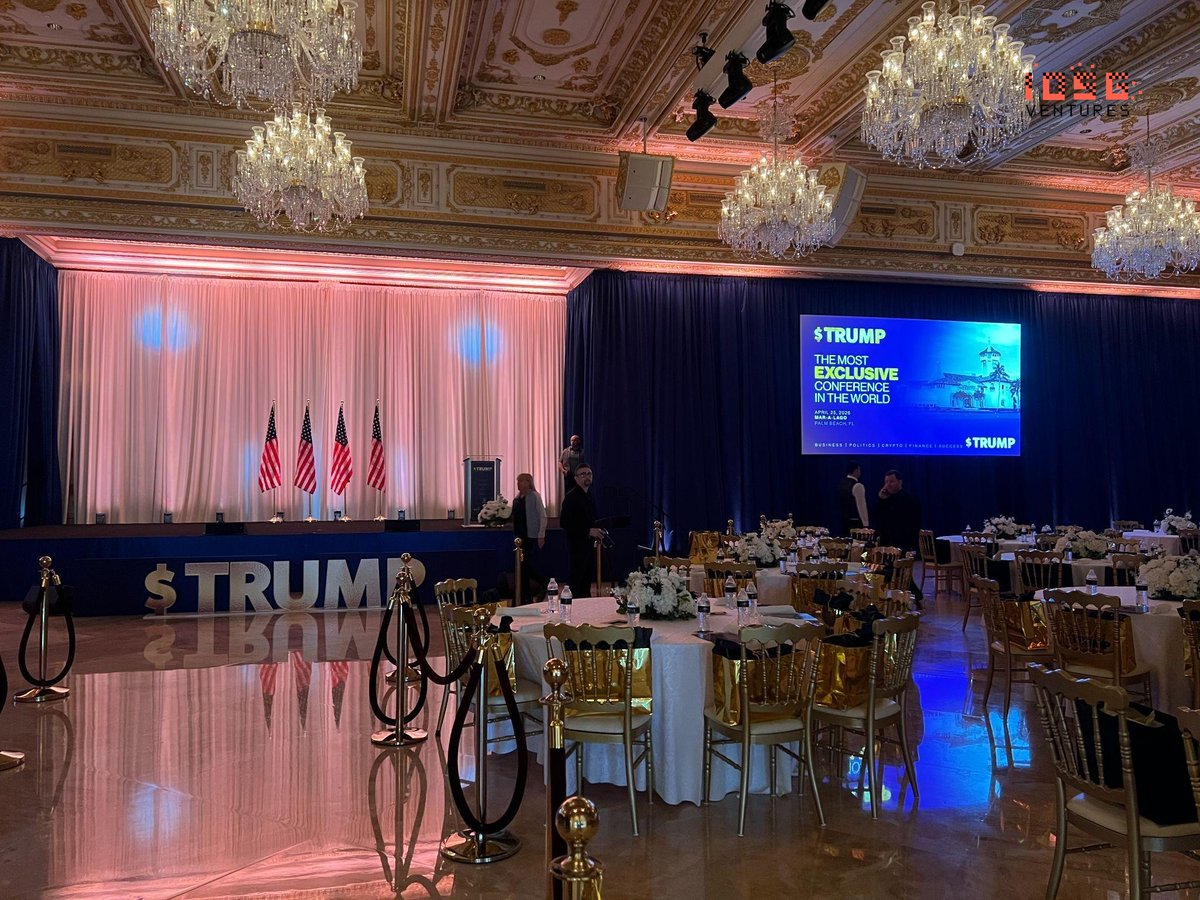
The thirty-six month countdown
The most easily exposed trait of youth is radicalism. Tony Robbins, one of the speakers, is a well-known speaker and best-selling author who stood on stage repeatedly saying one phrase: thirty-six months. He stated that within thirty-six months, robots will replace numerous jobs, quantum computing could reverse old encryption algorithms, and autonomous driving will upend eight million driver positions. He packaged this figure into a countdown: The thirty-six month countdown has begun. Thirty-six months sound uncomfortably short, yet he showed no intention of softening it.
Nikil, the founder of Alchemy, provided another brand of radicalism. He outright declared: within five years, funds transferred by AI agents will exceed the total combined of all humans, and no dollar will pass through bank accounts anymore. He demonstrated on stage how his agent "Dave the Minion" helps him book Uber rides, control twenty devices at home, buy flowers for his girlfriend, and monitor his body fat percentage increase in Costa Rica.
Afterwards, I continued chatting with Nikil, who mentioned that the company would soon launch agent cards, likely a white-label solution allowing other projects to release their own agent payment cards. The logic behind this product aligns with Nikil's stage declaration that "within five years, no dollar transactions will pass through the banking system."
Sister Wood also expressed a similar viewpoint. She pointed out that the AI training costs drop by 75% annually, and inference costs decrease by 98%, making it the most "deflationary" technology in history. She mentioned AI-generated content would first surpass human creation in 2025 and predicted that within ten years, it would exceed the total amount of all human writing ever. I was fortunate to chat with her for a moment; her view of the entire industry was generally bullish with no particularly cautious stances.
Putting these predictions together creates a common scent: everyone agrees that in the next three to five years, the world will be reshaped along the paths they described. This is a very American, very youthful expression.
American prosperity: placing oneself in the nexus
If radical predictions represent youthful "thought," then resource integration embodies youthful "action." A common way for Americans to achieve prosperity is by connecting different circles, building influence, and positioning themselves as nodes of information and resources.
Tony Robbins is the ultimate version of this path.
He walked off stage, weaving between small tables, no more than half a meter away from me. He discussed many topics—AI, Crypto, robots. In his speech, he mentioned Marc Benioff of Salesforce, Brett Adcock from Figure AI, the three 22-year-old dropout founders of Mercor, IBM Vice Chairman Gary Cohn, among others; he woven these names together to build his credibility. Honestly, his understanding of Crypto isn't particularly profound, and his judgments may not be more accurate than those of any founder present, yet he has a deeper understanding than the average person in every field while remaining shallow compared to experts. This position carries the most significant communicative power.
Many CEOs of large companies may no longer conduct firsthand research, so they sit to listen to Robbins speak. Robbins converses with experts from various industries to gain insights, organizes the information, and presents it to these CEOs, while also writing books to share the information with the public. He effectively combines the identities of a best-selling author, resource integrator, and top speaker. He demonstrates the extreme approach of "doing business equals resource integration" in America.
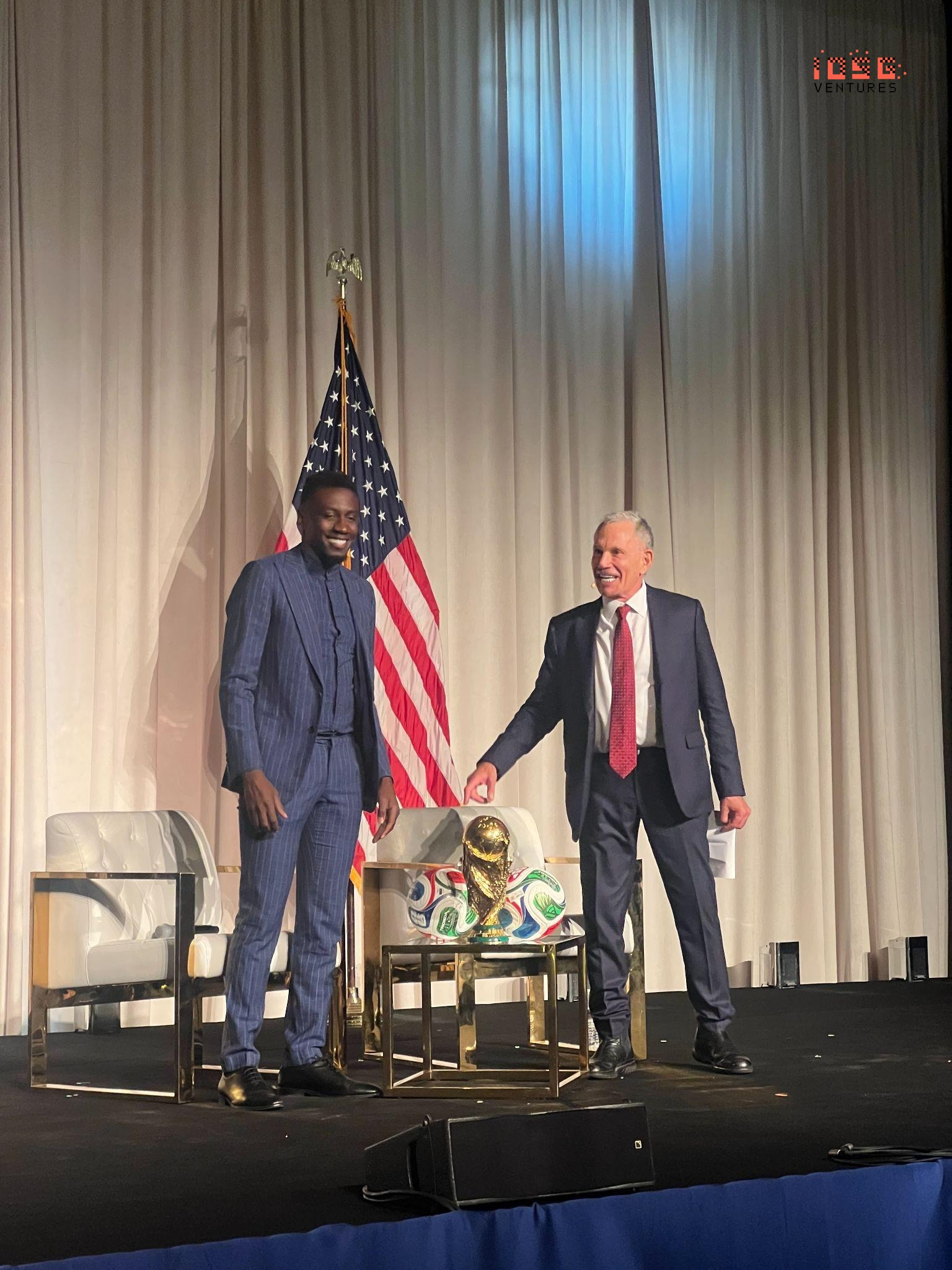
Note: French football team
Similar logic can be seen in others present as well. Andrea from Trendex introduced me to the concept of Superstar coin, which tokenizes members of the French national football team, F1 drivers, and various sports stars. Purchasing a certain number grants specific fan benefits. Friends familiar with crypto would not find this unfamiliar, but not everyone has the ability to clinch so many deals. Interestingly, they brought the FIFA World Cup trophy to the event—this was my first time seeing it up close. The nature of such projects is also distribution; you are not selling technology; you're selling the influence the star has already accumulated.
Another core conclusion regarding influence came from my conversation with former a16z GP Arianna Simpson. If all startups use the same AI development tools in the future, the same shipping capability implies that technical differences are converging, and distribution channels and user acquisition capabilities will become the defining advantages. This is a judgment entirely from the investor's perspective, rather than a technical perspective.

Note: Former a16z GP Arianna Simpson, billionaire Tim Draper, Luke from Delphi Digital
Enthusiastic audience
If you only look at the podium, this youthfulness may seem abstract. However, when I shifted my gaze from the stage to the audience, things became more intuitive.
The most interesting aspect is the group photos. People on stage are immediately surrounded by the audience once they come down, forming a small circle. This radicalism is not solely the privilege of speakers; the same quality exists among the audience. Everyone wants to leave evidence proving they were indeed in the room, spoke to that person, and seized that moment.
While those on stage forecast the future with terms like 36 months and 5 years, the audience captures the present through selfies. Both ends share the same mindset: fear of missing out. This creates a very real mirror.
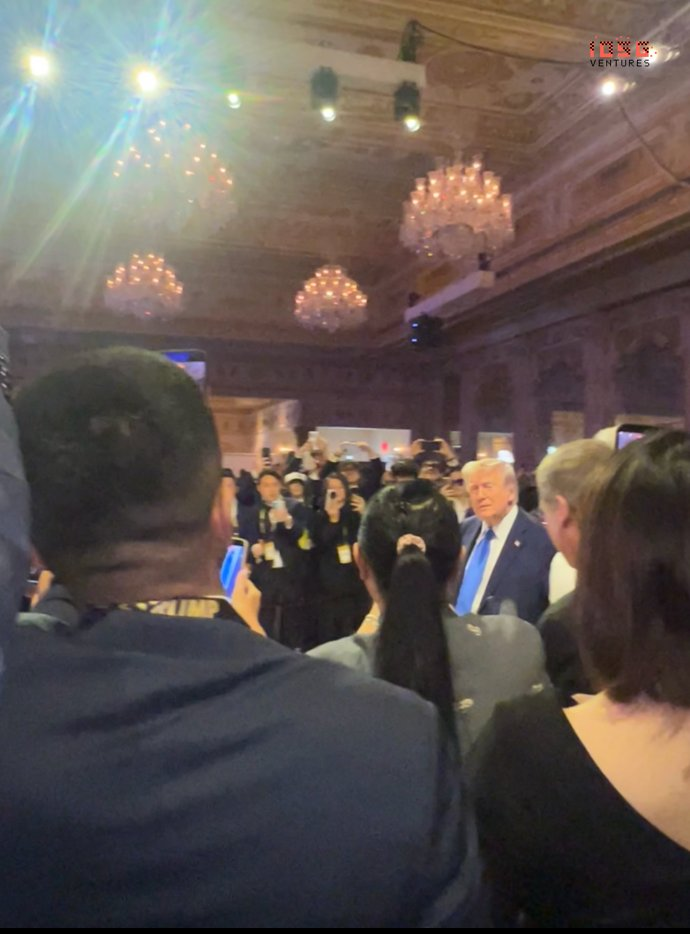
Note: Trump in the crowd
Those already in the room do not need to prove themselves
Yet there was another group entirely different that day. They entered the venue, casually networked, then sat down to listen to the speeches, the entire process didn’t appear particularly thrilling. They were not rushing for selfies, not pushing to the front of the guests, and didn’t clap for every piece of data presented.
Perhaps when a person genuinely feels they belong to a place, they don't feel particularly excited about it.
Among this group are representatives from established institutions that have been present for years, some close friends, and habitual attendees who treat such events as social gatherings. For them, being in Mar-a-Lago is not a proof of identity, but a continuation of daily life. They share the same room with the enthusiastic crowd clamoring for selfies, yet they exist on two very different frequencies.
Viewing these two groups in the same room captures the entire essence of this conference.
Young America
This country, at least those present at that event, did not showcase a sophisticated or mature atmosphere; it displayed a driven, eager-to-prove-itself, loud young person. The crypto industry possesses this quality as well, freshly recognized by regulations, just receiving favorable policy directions, and witnessing easing attitudes from the SEC, thus it is both excited and anxious, wanting to seize every 36 months while fearing missing out on every photo op.
Speakers use prophecies to lock in the future, audiences use photos to capture the present, and businesspeople use resource integration to lock down their positions; only that small group who has been in the room for many years quietly sits in the corners, watching the younger generation declare their existence with vigor.
This state has its limitations. Youth is prone to overcommitment. Every prophecy may slow down in implementation due to reality; young nations are also likely to confuse "volume" with "ability." More frighteningly, this sort of prophecy and volume appears particularly real on the stock prices.
Yet youth has its advantages. It is willing to redo everything, eager to shove traditional finance, AI, robots, quantum, stable coins—elements that should evolve slowly—into a three-year time frame. It is willing to bear the risk of overcommitment because it believes it has time.

Note: Outdoor pool and bar, photographed in the morning, bar and small hamburger bar have not been set up yet.
When the event concluded, everyone gathered by the pool outside, chatting, eating, drinking, and my friends and I were engaging in light banter. Honestly, Mar-a-Lago is quite beautiful, with neatly trimmed lawns and excellent food and drinks, and the sunshine is lovely, sitting there gives you a feeling that you are standing in a very high position. This experience can enhance a person's confidence, which is a wonderful thing; afterwards, when communicating with people much stronger than oneself, one can be more composed. However, whether this truly changes anything is up to each individual, just like playing at your classmates' party where everyone seems to have a great time, but in the end, everyone returns home, continuing their individual anxieties.
Author's Note: This article is based on the author's firsthand account and discussions during the Trump Crypto Conference & Gala Luncheon at Mar-a-Lago in April 2026. The project information and market opinions mentioned are for reference only and do not constitute investment advice.
免责声明:本文章仅代表作者个人观点,不代表本平台的立场和观点。本文章仅供信息分享,不构成对任何人的任何投资建议。用户与作者之间的任何争议,与本平台无关。如网页中刊载的文章或图片涉及侵权,请提供相关的权利证明和身份证明发送邮件到support@aicoin.com,本平台相关工作人员将会进行核查。


