Currently, SEO is the easiest moat to build in Web3.
Author: Ruthy
Translation: Chopper, Foresight News
Most Web3 projects completely overlook search engine optimization (SEO). They assume that users and partners will not actively search on Google and feel that with Discord and Twitter, organic traffic is insignificant.
But the real data is in front of us: "Solana yield optimization" has a monthly search volume of 8,000, "best crypto prediction market" sees 12,000 searches per month, and "leveraged token trading" has 15,000 searches per month.
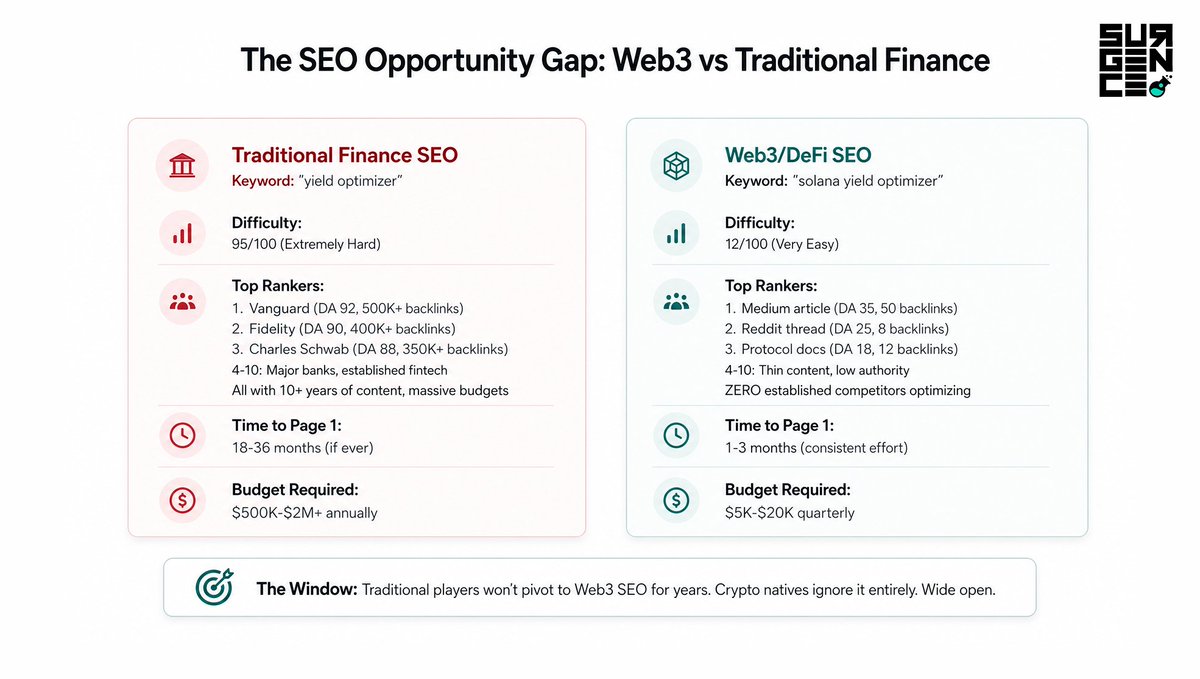
How competitive are these keywords? Very weak. The keyword difficulty score ranges from 10 to 25. Traditional financial institutions are unwilling to enter this field, and crypto practitioners have yet to realize the value of SEO.
Currently, there is a 12–18 month window, and whoever enters first can monopolize the organic search traffic of Web3. Here are the specific steps.
Why Web3 projects generally ignore organic search traffic
Web3 companies abandon SEO for three main reasons:
Reason one: Assuming target users will not actively search
Inherent cognition holds that crypto users discover new projects from Twitter and communities, not Google. The reality is that early native players may not rely on searches, but millions of new users in the future will definitely search.
When newcomers look for DeFi yield tools, their first reaction is to Google; if they hear about prediction markets and want to learn more, they will actively search. Google’s homepage ranking directly determines which protocol users ultimately choose.
Reason two: Mistakenly thinking SEO takes too long to show results
In traditional financial sectors, competitive keywords often take 18–36 months to rank. But Web3 is entirely different; it only takes 1–3 months. The industry competition is extremely weak, and as long as content is consistently and steadily produced, one can reach Google's homepage in a single quarter.
Reason three: Not understanding how to do SEO for blockchain products
SEO in the crypto industry is completely different from ordinary SaaS industries: keyword logic differs, content structure varies, and technical optimization requirements are distinct. The vast majority of Web3 teams lack SEO professionals, and simply give up.
How to seize the track in advance
Currently, the industry window is massive, and the complete implementation steps are as follows:
Step one: Identify keywords
Using tools like Ahrefs, SEMrush, etc., search for keywords like "a public chain + yield optimizer," "best type of crypto protocol," "how to perform a certain operation in DeFi."
Filtering criteria: monthly search volume 1,000+, keyword difficulty below 30, with commercial conversion intent.
For example: Solana staking yield, crypto leveraged trading, prediction market platforms, DeFi liquidity mining. These types of keywords have stable search volumes and almost no strong competitors.
Step two: Quickly establish authoritative content barriers
Only 30–50 high-quality articles are needed to build website domain authority. Publish 3–5 articles weekly, continuing for 8–12 weeks. Focus on four types of content: practical tutorials, competitive comparisons, industry popularization, in-depth protocol analysis, and market trend analysis.
Example structure for "Solana yield optimizer" keyword:
- Article 1: "What is the Solana yield optimizer? A complete guide"
- Article 2: "Comparison of five Solana yield optimizers"
- Article 3: "How to maximize Solana on-chain yield"
Each article targets a group of related long-tail keywords, naturally embedding links to their own products while accumulating industry theme authority.
Step three: Acquire high-quality backlinks
The highest value backlinks in Web3 come from project ecosystem collaborations, industry blogs, crypto news media, research platforms, and community forums.
Effective practical methods include publishing guest articles on media outlets like CoinDesk, Decrypt, The Defiant, announcing ecosystem collaborations with other projects, releasing ecosystem integration guides, and producing original industry research reports that are cited and re-shared by crypto analysts.
Goal: Publish 5–10 high-quality backlinks monthly, prioritizing authoritative websites with a domain authority of 40 or higher.
Step four: Optimize for cryptocurrency searches
The search terms of crypto users differ significantly from traditional finance. They search for APY rather than the full term annual percentage yield; they search for TVL rather than the full term total value locked; they use Degen to refer to high-risk speculative players.
Writing content should align with industry terminology, use the users' language, and answer the questions users genuinely care about.
Exclusive technical SEO optimization for blockchain products
Blockchain projects have many exclusive technical SEO points that the vast majority of teams will overlook.
Customized Web3 structured data markup
Generic structured data for search engines cannot adapt to crypto products; Schema markup needs to be customized. It should include: protocol type, supported public chains, TVL, APY range, security audit status, and smart contract address. These can help Google accurately identify the business attributes of the project, gaining more exposure in relevant searches.
DApp page speed optimization
Web3 native DApps generally load slowly; wallet connections, on-chain data queries, and real-time market data can increase delays.
The solution: Split marketing pages from DApp application pages. Marketing pages ensure fast loading times, capture rankings, and retain traffic; DApp pages can relax speed requirements somewhat, allowing users to enter after they have already accepted the brand.
Goal: Keep marketing page loading times under 2 seconds.
Content continuous update strategy
The crypto industry's market conditions change rapidly, so the content must remain timely. Core pages should be updated weekly: TVL data, APY yield rates, asset support lists, and key protocol indicators. Google favors fresh content in fast-evolving industries.
Articles should note "last updated" dates, and popular content should be updated every 90 days.
Internal link structure layout
Use a core page + branch page structure to build overall site logic.
For instance: Core page: "Comprehensive guide to Solana on-chain yield" (focusing on critical keywords) Branch pages: various yield strategy guides, protocol comparisons, technical documentation. All branch pages link back to the hub page, and the core page should backlink to all branch pages.
This structure can efficiently transmit page authority and facilitate Google's recognition of overall site theme relevance.
Timeline: Reach Google's homepage in 90 days
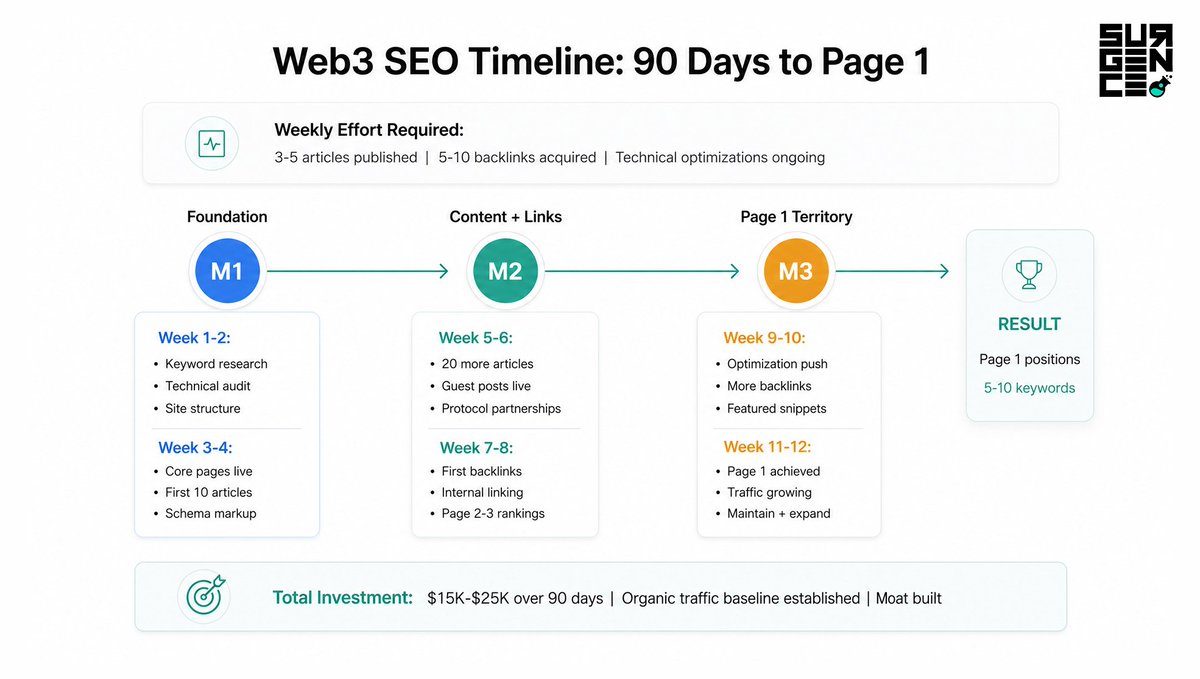
Here is a more practical timeline for implementing Web3 SEO:
First month: Weeks 1–2, keyword research, competitive analysis, website technical audit, developing content strategy; Weeks 3–4, launch core pages, publish first 10 articles, deploy structured markup.
Second month: Weeks 5–6, update 20 more articles, guest articles in industry media, project collaboration announcements; Weeks 7–8, first batch of quality backlinks established, improve overall internal linking, with keywords gradually moving to the second and third pages of Google.
Third month: Weeks 9–10, refine popular content, enhance backlink layout, aim for featured snippets; Weeks 11–12, stabilize 5–10 core keywords on Google’s homepage, with organic traffic continuously increasing, and begin maintenance mode.
Conclusion
Currently, SEO is the easiest moat to build in Web3.
Traditional financial institutions will not enter crypto keywords in the coming years, and crypto-native teams generally underestimate SEO and lack understanding. The industry window is wide open.
With just 90 days of stable cultivation, one can rank for multiple core keywords on Google’s homepage; the overall investment cost is $15,000–$25,000, resulting in stable organic traffic with compounding growth over the years. While costs are still low and competition is weak, build your SEO moat as soon as possible.
免责声明:本文章仅代表作者个人观点,不代表本平台的立场和观点。本文章仅供信息分享,不构成对任何人的任何投资建议。用户与作者之间的任何争议,与本平台无关。如网页中刊载的文章或图片涉及侵权,请提供相关的权利证明和身份证明发送邮件到support@aicoin.com,本平台相关工作人员将会进行核查。


