Written by: invest wallstreet
Daily addition of $96 million in revenue, completing 13 years of AWS's journey in just one year.
While everyone is still debating whether GPT or Claude is smarter, Anthropic has quietly raced ahead with the most terrifying growth curve in human commercial history.
$30 billion in 3 months! The growth record in the AI industry has been completely rewritten
In May 2026, a report from Semi Analysis shocked the entire tech circle:
Anthropic's Annual Run Rate (ARR) has exceeded $44 billion!
Anthropic's ARR trajectory has almost no historical reference.
According to the company's CEO Dario Amodei, since the first revenue was obtained, annual revenue has grown by about 10 times each year:
In 2022, the ARR was about $10 million, in 2023 about $100 million, in December 2024 about $1 billion, in September 2025 about $7 billion, in December 2025 about $9 billion, in February 2026 about $14 billion, in March 2026 about $19 billion, in April 2026 about $30 billion, and by May 2026 has surpassed $44 billion.
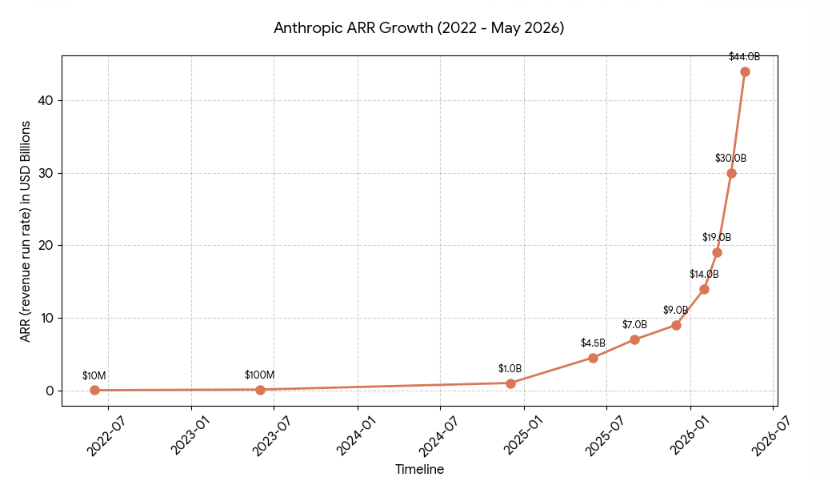
How terrifying is this number?
- By the end of 2025, its ARR was only $9 billion;
- In February 2026, it rose to $14 billion;
- In just 3 months, it surged by $30 billion, averaging about $9.6 million added per day.
In the history of the entire software industry, this speed has no precedent:
- AWS took 13 years to reach $35 billion in annual revenue;
- Salesforce was founded in 1999 but only crossed the $20 billion mark in 2021;
- ServiceNow took a full 20 years to exceed $9 billion.
Anthropic completed in one year what others took more than ten or twenty years to achieve.
Even scarier is that its growth curve is still steepening.
Investors have gone crazy. Anthropic is pushing for a round of $50 billion financing, corresponding to a valuation of over $1 trillion, and some investors even submitted subscription intent within 48 hours.
Many say that this is Claude's model winning over OpenAI. But the truth is far more complicated.
Anthropic's true victory is that it has found three golden paths to AI commercialization, none of which any previous AI company could simultaneously walk.
First Path: From "Toy" to "Infrastructure," enterprise clients are eager to pay
Anthropic's main growth engine has never been consumer-facing chatbots, but enterprise clients on the B-side.
Now, among the Fortune 10, 8 are paying customers of Claude.
Enterprises consuming over $1 million annually have expanded from a dozen two years ago to now around a thousand; the number of customers spending over $100,000 per year has directly increased sevenfold in the past year.
The most critical change is that enterprises are no longer buying AI just to "keep up with trends."
In the early days, enterprises procured AI with budgets from digital departments, doing a proof of concept (PoC), and ended up delivering just a one-page PPT.
But now, Claude has penetrated the core processes of enterprises:
- Legal uses it to review contracts;
- Finance uses it for analysis;
- Consulting uses it to organize materials;
- R&D uses it to write code;
- Customer service uses it to handle calls.
This directly changed how AI generates revenue:
- Previously, software was charged per seat, with more users needing more licenses;
- Now, Claude charges per usage, with payment depending on task completion.
Every reasoning, every invocation, every automated process translates into real revenue.
Anthropic's smartest move was connecting to the three major cloud platforms: AWS, Google Cloud, and Microsoft Azure.
For enterprise IT departments, it means they do not have to change their existing architecture or switch providers, and can directly use Claude. This is the real reason it was able to increase its enterprise AI market share from 10% to 65% within a year.
There is a saying in the industry: the model determines the trial, and distribution determines the expansion.
Second Path: Claude Code, a super bridge connecting C-side and B-side
If enterprise clients are the foundation of Anthropic's revenue, then Claude Code is the core catalyst for this $30 billion surge in 3 months.
Launched in May 2025, Claude Code did not follow the old path of OpenAI by first targeting the consumer side and then shifting to the business side, but directly aimed at tens of millions of developers worldwide.
Now, its annualized revenue has reached $2.5 billion, and its weekly active users have doubled since January 2026. Some analyses estimate that about 4% of global GitHub public submissions have already been generated or contributed to by Claude Code.
Its most magical aspect is that it completely blurs the boundary between To C and To B:
1. A developer first uses it on their computer to debug and write scripts;
2. Thinking it’s useful, they recommend it to the team, which integrates it into the team’s codebase;
3. As more people use it, the company decides to purchase it uniformly, configuring permissions and security processes.
Personal usage habits thus evolve step by step into an organization-level long-term pay model.
Slack, Notion, and Figma have all taken this path, but the killing power of AI products is much greater—what they directly enhance is productivity.
When a developer writes less boilerplate code or a legal professional reviews a draft contract less frequently, the effects can be immediately reflected in the delivery cycle. As long as efficiency is visible, the budget will continuously follow.
Ultimately, Anthropic has simultaneously tapped into the traffic dividends of the C-side and the revenue depth of the B-side.
Third Path: Gross margin rising from 38% to 70%, finally breaking free from the "burning money" curse
All AI companies face the same question: Is all the money you earn spent on buying GPUs?
Previously, the large model industry had an unresolvable curse: the more users there were, the higher the inference costs; the stronger the product, the more frequently it was invoked. As long as the gross margin does not rise, no matter how high the revenue, it is just another way of burning money.
But Anthropic has broken this curse.
The most critical data in the Semi Analysis report is: Anthropic's inference gross margin has soared from 38% 12 months ago to over 70%.
This means it has transformed from a "burning money for growth" model company into an AI infrastructure company with software-level gross margin structure.
This qualitative change comes from the combination of various factors:
- Significant improvement in model inference efficiency;
- Optimization of caching and routing technologies;
- Increased hardware utilization;
- Enterprise contracts bringing stable loads;
- Cloud partners sharing infrastructure pressure.
This is also the core reason why investors are willing to give it a 23 times ARR valuation.
The valuation logic in the AI industry has changed:
- Early on, it was about who had the smartest models;
- Now, it’s about who can lower costs.
Whoever can reduce inference costs first will gain an absolute advantage in price wars and large enterprise contracts.
In Conclusion: In the second half of AI, it’s not about the models
Of course, Anthropic still faces many challenges.
It is expected to start its IPO by the end of 2026, aiming to achieve a real annual revenue of $26 billion. However, ARR is just the speedometer, not the finish line.
Can the enthusiasm for trials turn into long-term contracts? Can Claude Code pass the security audits of large enterprises? Will there be counterattacks from OpenAI, Google, and Meta? These are all uncertainties.
Nevertheless, Anthropic has already proven one thing: enterprise AI demand has completely crossed the exploratory stage.
Now, more and more companies are asking not "What can AI do?" but "Which old systems, old processes, and old positions can be replaced or restructured by AI?".
Over the past 20 years, software companies have moved all workflows to the cloud.
In the next 10 years, AI companies will directly ingest part of those processes into models.
And the place where Anthropic is running the fastest is precisely where this replacement is happening most intensely.
Its growth myth not only redefined the growth speed of AI companies but also unveiled the real winning hand for the second half of the AI industry:
It is not about whose model is smarter, but who can first build a complete business loop from "personal habits → organizational processes → infrastructure → continuous profitability."
In summary: $30 billion in 3 months, Anthropic has proven the true future of AI commercialization through three golden paths.
免责声明:本文章仅代表作者个人观点,不代表本平台的立场和观点。本文章仅供信息分享,不构成对任何人的任何投资建议。用户与作者之间的任何争议,与本平台无关。如网页中刊载的文章或图片涉及侵权,请提供相关的权利证明和身份证明发送邮件到support@aicoin.com,本平台相关工作人员将会进行核查。


