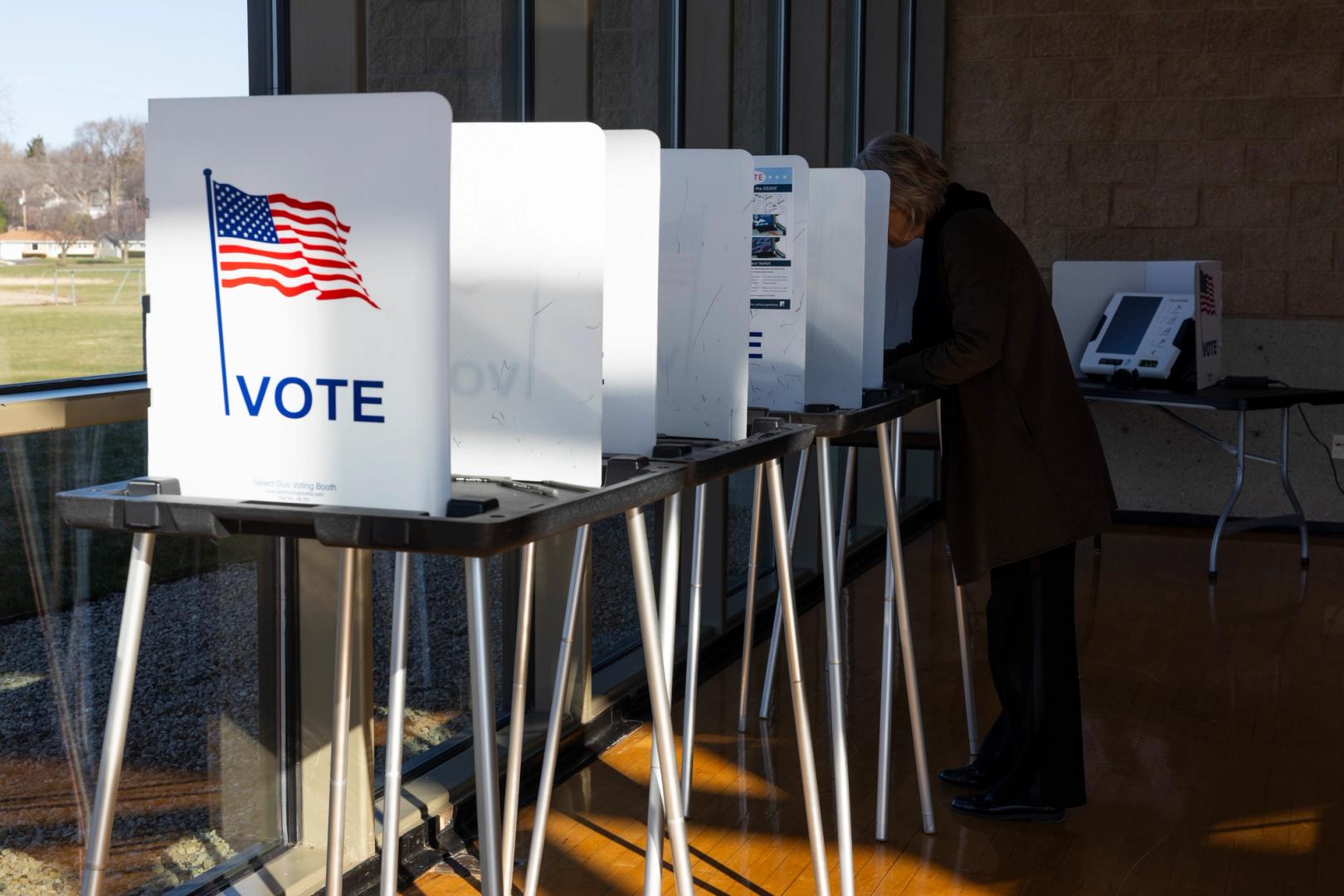
U.S. voters placed cryptocurrencies toward the bottom of a list of their highest priorities for the upcoming midterm election.
Just 1% of respondents said they ranked crypto as their top concern, according to a survey of 1,000 randomly selected registered U.S. voters, though other responses revealed a wider view of the technology as an important political issue.
The survey was conducted near the end of April by Public Opinion Strategies on CoinDesk's behalf, as part of CoinDesk's coverage of the 2026 U.S. midterm election. The survey was evenly split between Republican and Democrat respondents (41% of respondents identified with each party to some degree), with a credibility interval of plus or minus 3.53%.
Crypto won't be on the ballot this year, but the industry still has a vested interest in who wins. The market structure bill, one of the most important pieces of legislation, is seen as the top priority for crypto. Though the bill known as the Clarity Act still has a path to becoming a law before the end of the year, it's taken far more time than expected and still needs to clear a number of hurdles. Other bills, including expected tax reform legislation, will likely end up before Congress in the coming months. Ahead of the election, the crypto industry has dedicated hundreds of millions of dollars intended to support friendly candidates, after being the single largest donor industry in the 2024 election.
This article is part of a CoinDesk series on voters' views for the 2026 midterm election.
- U.S. voters don't trust Trump administration to oversee crypto sector, CoinDesk poll finds
- Americans still prefer banks over crypto for financial access, CoinDesk's survey shows
As of press time, the most likely outcome of the 2026 election is that Democrats will become the majority party in the House of Representatives, while the Senate is more likely to remain dominated by Republicans. A generic question in POS's poll for CoinDesk about whether voters would choose the Republican or Democrat candidate gave a slight edge to Democrats (44% to 41%); this +3 margin is roughly in line with a number of other polls, according to a tracker hosted by The New York Times.
Prediction market provider Kalshi has the Senate at an even split. But Democrats have a much tougher road to picking up a majority there, Cook Political Report said in April.
This poll also showed U.S. President Donald Trump with a net negative approval rating, with 40% of respondents saying they somewhat or strongly approved of his performance, while 60% disapproved.
And unsurprisingly, respondents said the cost of living (36%), jobs and the economy (13%), and Social Security and Medicare (11%) were their single most important issues. Other issues, such as immigration and border security, healthcare, national security, government spending and more, all saw single-digit percentage responses. Crypto ranked at the bottom, largely among voters leaning toward the Republican Party. Artificial intelligence came in just a smidge higher, with 2% of respondents calling it their single most important issue.
Views on crypto
Crypto itself does not enjoy a favorable image among the survey respondents. While participants who leaned toward the GOP had a slightly more favorable view of cryptocurrency than unfavorable (41% to 39%), base GOP (33% to 39%), independents (27% to 48%), Dem-leaning voters (26% to 54%) and base Dems (25% to 58%) all had a more unfavorable view.
Just over a quarter of participants (27%) said they had invested, traded or used a cryptocurrency, while another 27% said they haven't but might one day. Of those who had invested, 2% currently have over $10,000 worth of digital assets, 9% said they owned between $1,001 and $10,000 and 12% said they had $1,000 or less in crypto.
In terms of the November election, 49% of participants who said they were "much more interested" in this year's election than in the 2022 election said they owned $1,000 or more worth of crypto.
According to the data, 47% of respondents said Republicans were more supportive of cryptocurrencies, compared to just 14% who said the same about Democrats. These figures don't necessarily indicate whether respondents saw that as a good thing, however. Interestingly, Democrats maintained a slight edge in voter trust in crypto, with 27% of respondents saying they trusted the party, compared with 25% who said they trusted Republicans more. A greater proportion of respondents — 40% — said they didn't trust either party.
Roughly 40% of respondents also said they would be more likely to vote for a candidate who shared their views on crypto, though the survey did not ask whether this was tied to positive or negative views of crypto.
Crypto also had lower favorability (30%) than Republicans (39%) or Democrats (43%). Meanwhile, DeFi — also known as finance on the blockchain — had 17% of respondents saying they had a favorable view, though only 60% of respondents overall said they'd even heard of it.
Artificial intelligence had rosier numbers — 46% of respondents had a favorable view, while 45% had an unfavorable view.
Despite all that — and in somewhat of a contradiction to not flagging crypto as their top issue — when asked directly how important crypto was for the 2026 election, 3% of respondents said it was the "single most" important issue, and a further 22% said it was an important issue. That represents a much higher awareness of digital assets than voters had several years ago.
CoinDesk will release data from this survey on Tuesday at Consensus Miami.
免责声明:本文章仅代表作者个人观点,不代表本平台的立场和观点。本文章仅供信息分享,不构成对任何人的任何投资建议。用户与作者之间的任何争议,与本平台无关。如网页中刊载的文章或图片涉及侵权,请提供相关的权利证明和身份证明发送邮件到support@aicoin.com,本平台相关工作人员将会进行核查。


