Author: Mustufa Khan
Translation: PANews Big Pliers
Apple is dead, it just hasn't filed the paperwork yet.
This is not a shocking statement, but a structural judgment on what has happened over the past six months—and it is the view Naval Ravikant confirmed last week on his podcast. (Related reading: Naval steps in: The historic collision of ordinary people with venture capital)
This most patient investor in the tech circle, one of the sharpest capital allocators of the past twenty years, has issued a judgment on the entire software industry: pure software is not worth investing in.
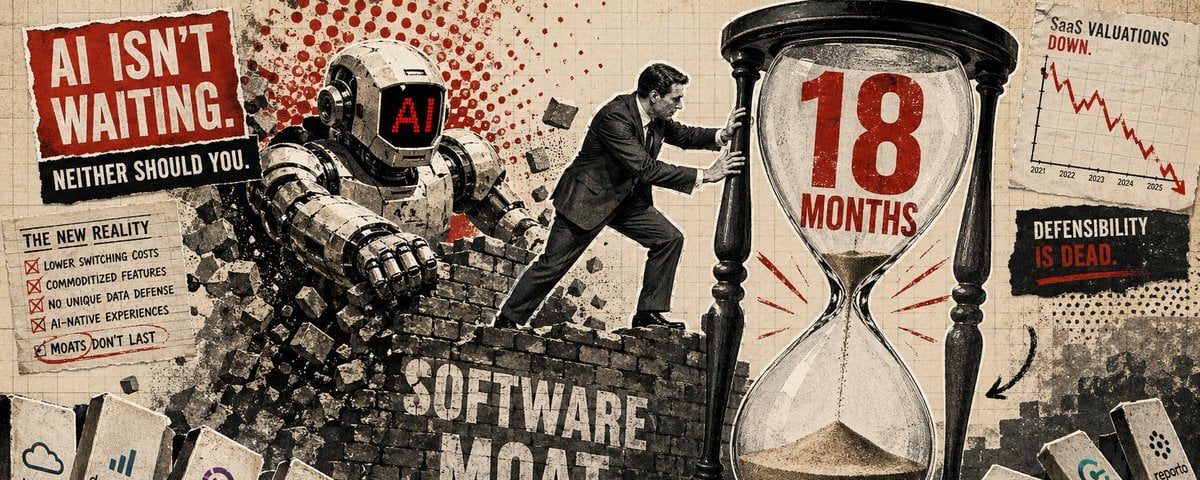
If you are an entrepreneur reading this article, the question is not whether you believe this judgment, but whether you have 18 months to realign before the market reacts.
Background: Naval is the founder of AngelList and an early investor in Twitter, Uber, Notion, and about 200 companies that have shaped the tech landscape over the past decade. He doesn’t post often, but when he speaks, he does so with the care of someone who knows his words will be quoted for years to come. So when he states unequivocally "pure software is not worth investing in," it is not a comment, but a formal judgment.
Below are his words and what they mean for all entrepreneurs.
No one can stop the structural death of Apple
Apple will not go bankrupt, and it will not disappear from your pocket next year. The collapse Naval describes is not operational but economic.
Apple's $3 trillion valuation is entirely built on one thing: high-end hardware profits supported by excellent software experiences. Once this experience fades, Apple becomes better-built Samsung. And this is happening.
The interactive interface layer is being commoditized in real-time.
Within the next 24 months, the way most people open applications will change drastically—they will converse directly with AI agents, which will generate any interface they need on the spot. Apple’s meticulously curated app store, human-computer interface standards, design craftsmanship, and ecosystem lock-in… all of this will become meaningless when the interface itself can be generated in real-time by AI running on any phone.
In the face of this shift, what is Apple's response? They have licensed Gemini from Google. Their own AI bets have underperformed expectations. This company, which built its entire brand identity on "controlling the experience layer," has just outsourced that layer to its biggest competitor.
This is a fast-forward version of the "post-mobile era Microsoft" script.
Microsoft missed the mobile era because they refused to start from scratch to build a touch-native operating system.
Their dominance from the previous era led them to mistakenly believe that the old paradigm would continue. By the time they accepted the new paradigm, Apple had already won the next decade. Microsoft is still valued at $3 trillion today, but Windows has lost the consumer wars it could have won.
Apple is now repeating the same mistakes in the field of AI. They are betting that their "hardware-first" identity can carry them through the transition to an agent-driven era, but it won’t work. When operating systems commoditize, Apple’s profit margins will compress to ordinary hardware levels—this means a structural collapse of revenue from its highest-profit business segment, which is funding everything else.
You can continue to hold Apple stock, but don’t pretend you are holding a growth company anymore.
The most valuable hardware company in history is about to find out how much hardware is worth without a software moat.
If your moat is software, you have 18 months
For entrepreneurs, the tougher part is coming.
Naval says pure software is not worth investing in, and he is right. But he did not elaborate on what this means for the thousands of SaaS companies still sitting on Series A and B valuations—valuations raised in another world.
It means: most of these companies are already dead; they just don’t know it yet.
Let’s do the math: your SaaS company exists because building the product was hard at the outset. You could raise funds because technical execution required a team. Your moat—whether you want to admit it or not—is the difficulty of replicating what you have built.
And that difficulty has just collapsed.
Two people using Claude Code can now replicate 80% of most B2B SaaS products’ functionalities in 90 days—not toy versions, but real products with reasonable architecture, basic security guarantees, and scalability. The remaining 20%—your specific system integration, your enterprise sales processes, your compliance systems—do exist, but they are not a moat; they are merely friction. And that friction is being continuously compressed by new generations of AI agents iterating every quarter.
Look at what has already happened: Adobe acquired Figma for $20 billion in 2022 because Figma’s product was structurally hard to replicate. Now, independent developers are building design tools with 70% of Figma’s core functionality in just a few months. Salesforce is the most valuable SaaS company ever, but AI-native CRMs, which didn’t exist 18 months ago, are already starting to eat into its mid-market. Workday, ServiceNow, Atlassian, Asana—each of them is now a potential replacement, with substitutes that might consist of smaller teams than their HR departments.
The companies that will survive this transformation will not necessarily be the ones that do software best. Software itself is trending towards zero value. What will survive are the companies that have built things AI cannot replicate:
Distribution channels, network effects, data flywheels, hardware integration, brand, community, regulatory barriers. These are the last remaining durable defenses in the new world.
If your honest answer to the question "What is our moat?" is "Our product is better"—then you have 18 months to find a real moat, or you will watch your valuation evaporate by 70% to 90% in the next funding round.
The entrepreneurs who will live through this transformation will be those who read articles like this now and take this warning seriously. Those who scoff at it as hype will be the ones posting layoff announcements on LinkedIn in 2027, confused at "how did this happen so fast."
Which one are you?
The companies that will win the next decade are not in software
Distribution channels are the new moat. The companies that will win today are not those with the best products but those with direct relationships with customers. The product is merely a vessel for serving them. Your audience is your moat. Your mailing list is your moat. Your community is your moat. Your reputation is your moat.
If you still think "marketing" is something you do after you make a good product, you’ve already lost. Marketing is now the product itself; the product is downstream of attention.
Compound network effects. The businesses that will survive in an AI commoditized world are those whose value comes from other users rather than function features. Discord, Roblox, LinkedIn, Reddit—they cannot be replicated, not because of how complex the software is but because users are locked in by other users.
If your product gets significantly better as more users join, you have longevity. If your product delivers the same experience to 100 users and 100,000 users, you are done for. AI agents can replicate functionalities, but they cannot replicate community.
Data flywheel. Companies that train better models, accumulate proprietary data through user interactions, and build feedback loops that competitors cannot replicate are the ones that endure. Tesla's autonomous driving data, Bloomberg Terminal's financial data—data compounds, whereas software shells stuck on public APIs do not.
If your product generates unique data with every user interaction, you have an asset. If your product is just a layer of UI on a public API, you have nothing.
Hardware integration. Companies with a physical layer are protected for the longest. Tesla, Anduril, SpaceX, Apple’s chip business (not its applications business), Boston Dynamics. Hardware is tough; AI can’t make chips, batteries, or rockets. The material world remains the most durable moat in the economy.
Vertical depth. Horizontal SaaS giants are exposed to risks, while those deeply specializing in workflows, data, and relationships within a specific industry are not. General-purpose project management tools are dead, but a dedicated platform in the construction industry that masters approval processes, acceptance networks, and regulatory data will not be. Deepening in one industry is better than skimming across ten.
If you are currently restructuring your strategy, the question is simple: what kind of moat can you build for your business in the next 12 months? Not someday in the future, but now. Because the entrepreneurs who reposition themselves first will capture the survivor's market share when others fall.
The collapse's other side is the greatest opportunity in history
Most entrepreneurs, upon reading "software is dead," only see what is being destroyed and miss what is becoming possible.
Naval's most optimistic judgment on the podcast is: data is ushering in a renaissance for individual creators. It's not the death of software but the democratization of software.
Historical patterns already exist: Notch developed Minecraft solo, Markus Frind built Plenty of Fish to tens of millions in annual profits single-handedly, Instagram's original team had only 13 people when it was acquired by Facebook for $1 billion, and WhatsApp had only 55 employees at its $19 billion exit. Each of these companies represents a direct manifestation of a singular visionary idea into product, without dilution from coordinating teams.
Each one of them is an anomaly, and logically, they shouldn’t have achieved such scale.
What is changing now is the ceiling. In the past, solo entrepreneurs could create interesting things, but would hit a hard wall during scaling—teams had to grow, and compromise followed, diluting the vision until that unique aspect of the product was worn down by every committee decision.
Naval's vision is: a one-person company operating at the speed of a 50-person team. Users report bugs via in-app buttons; the agent reviews feedback every 24 hours, writes fixes, initiates pull requests, runs tests, with the founder reviewing, approving, and publishing. Customer service is handled by agents, which can even write code to fix root issues. Feature requests are voted on by users, and agents are responsible for building, with the founder ensuring quality.
No collaborative inefficiency, no office politics, no compromised vision, no engineer resistance to founder’s marginal cases, no designers arguing over icon placement, no product managers sandbagging bold ideas into conservative versions.
The founder's thoughts go from mind to launch without distortion.
This is not theory; it is already happening in parts. Pieter Levels has built multiple seven-figure revenue businesses as an independent operator. More and more independent developers are running businesses that would have required Series A funding three years ago. The movement of AI-native independent operators is producing results that the venture capital industry has yet to price.
The next billion-dollar company may have just one employee. The next ten-billion-dollar company may have no more than ten people.
If you are a creator, operator, marketer, or entrepreneur who has been waiting for "permission" to take action—the permission has arrived. The technological bottlenecks have vanished, and the energy barriers to launch have crumbled. Now, the only things standing between you and a real business are three questions: do you have something to say, do you have the taste to judge what is good, and do you have the discipline to put it out there.
This is either the worst time ever to do general software, or the best time ever to create differentiated products.
Both can be true at the same time. Which one applies to you entirely depends on what you do in the next 18 months.
The 18-month window is open right now
From now on, there are three choices.
Choice one: ignore it all as hype. Convince yourself that Apple is too big to fail, your SaaS company is special, AI programming agents are exaggerated, and everything will calm down. You will have plenty of company—most entrepreneurs will choose this, and most will thus fail.
Choice two: panic. Rapidly cut cash runway, lay off teams, and blindly pivot. This is what happens when realization comes too late. The entrepreneurs destroyed in this transformation are not those who didn’t see it coming, but those who realized it 12 months late, had to hastily pivot under pressure, with no runway, no time to test, and no chips.
Choice three: take this 18-month window seriously. Rigorously scrutinize your moat, begin building distribution channels before you truly need them, find angles that AI cannot replicate, and position yourself for the coming world.
Naval is precise.
"Pure software is not worth investing in, period."
This is not someone playing tai chi; this is a judgment made by someone who has spent twenty years determining what is worth investing in, now concluding that most of what is being invested in today is not worth it.
Apple is dead. Most SaaS entrepreneurs are next in line. And the entrepreneurs who will survive will be those who listened to this warning and acted before everyone else caught on.
The window is open now, but it won’t be open forever.
Will you build a lasting moat over the next 18 months, or will you watch your existing moat erode in real-time?
Most will not make it.
A few will.
The difference lies in what you do this quarter.
免责声明:本文章仅代表作者个人观点,不代表本平台的立场和观点。本文章仅供信息分享,不构成对任何人的任何投资建议。用户与作者之间的任何争议,与本平台无关。如网页中刊载的文章或图片涉及侵权,请提供相关的权利证明和身份证明发送邮件到support@aicoin.com,本平台相关工作人员将会进行核查。


