Author: Frank, PANews
During the cryptocurrency bear market cycle, asset scarcity has evolved into an industry-wide predicament. Liquidity is nearing exhaustion, market activity has plummeted, and the market is facing not just a slump but a true survival test.
In the first quarter of 2026, the cryptocurrency market is in a sluggish calm period. Statistics from TokenInsight show that the total trading volume of cryptocurrency exchanges in the first quarter of 2026 was approximately $17.9 trillion, a 32% decrease compared to the fourth quarter of 2025, with both spot and derivatives trading volumes hitting multiple quarterly lows.
When trading volume is no longer the only growth narrative, how can exchanges retain traffic, funds, and trading demand? Huobi HTX may have provided an answer.
On April 17, Huobi HTX exchange released its first-quarter report for 2026, stating that as of the end of March 2026, Huobi HTX had surpassed 59 million registered users, reaching over 53.55 million users during the quarter. The number of users increased by approximately 4 million from the end of 2025, a growth rate of about 7.3%.
More than half of newly listed assets are first-time launches, seizing potential assets in the bear market
During the bear market lull, investors are often reluctant to continue betting on the rebound of old projects, preferring to allocate funds to new assets with high multiples in search of higher potential returns. Especially as most mainstream assets continue to decline, the cryptocurrency narrative has almost collectively fallen silent.
In the first quarter of 2026, Huobi HTX listed a total of 39 new assets, with first-time launches accounting for 53.85%. In a quarter where mainstream assets are not performing strongly, this ratio reflects the platform's proactive approach to discovering potential assets and building liquidity, rather than passively accommodating existing market hotspots.
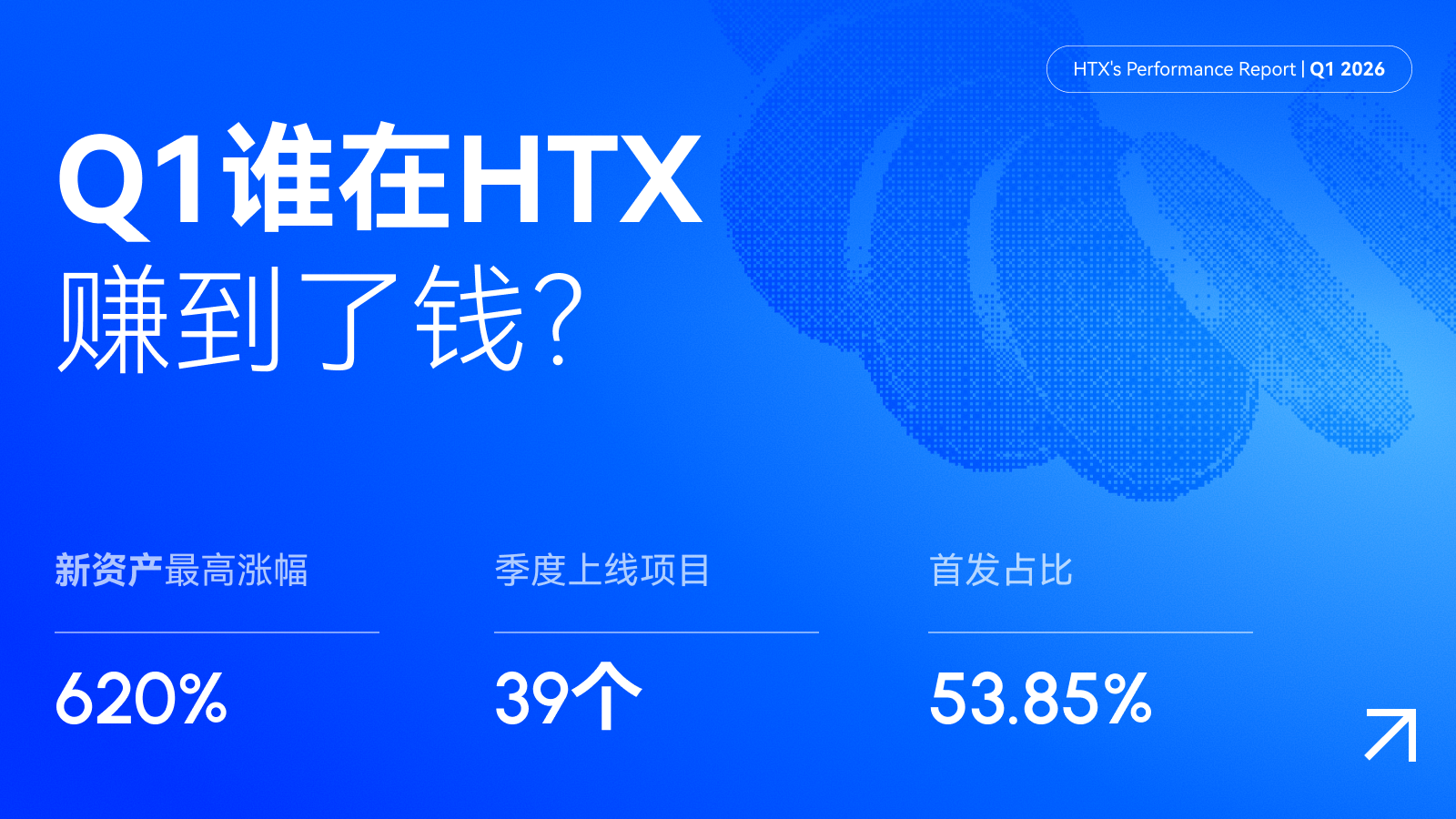
Meme coins, which are sentiment-driven lottery-like assets, remain one of the most关注ed areas by investors. In Q1, Huobi HTX listed multiple Meme assets, including ELSA, Laozi, and I Am Coming, which experienced peak increases of 620%, 572.73%, and 411.81%, respectively, generating significant wealth effects.
However, peak increases do not equate to actual returns for users. Meme coins often rely heavily on market sentiment, leading to extreme price volatility and characteristics of sharp rises and falls. Among the vast sea of Meme coins, Huobi HTX has become a bridge to build user trust and exchange traffic with its fast and accurate potential asset discovery capabilities. From the final outcomes, these newly listed assets brought over $3 billion in spot trading volume to Huobi HTX, becoming a significant support force for its spot trading volume.
Of course, in addition to Meme coins, the market still shows enthusiasm for projects with potential for ecological discovery narratives. First-time projects like BTW, BNKR, and RIVER exhibited strong performances in the quarter, also demonstrating Huobi HTX's capability in asset discovery, with BTW achieving a peak increase of 3,899.2%, BNKR reaching 3,403.6%, and RIVER hitting 2,865.3%.
Only focusing on hotspots risks becoming an emotional casino. Only basic assets may fail to keep up with market pace. True effective asset discovery ability often lies between the two, capturing the most sensitive market sentiment fluctuations while filtering out assets with longer narratives for users.
The bear market tests not only yields but also trust in funds
The cryptocurrency industry has long been a major target for hacker attacks, and security alarms have never ceased. Especially with the rapid proliferation of AI technology, the efficiency and concealment of hacker attacks have greatly improved, posing a greater challenge to industry security. According to the Q1 report released by Hacken, the total losses in Web3 amounted to $482.6 million, with the recent Kelp DAO vulnerability incident resulting in nearly $300 million stolen in one attack. More concerning is that the losses extend far beyond just financial aspects, severely eroding investor confidence.
The transparency of exchanges and the stability of fund channels are no longer merely compliance or branding issues; they are foundational infrastructures that directly affect user retention.
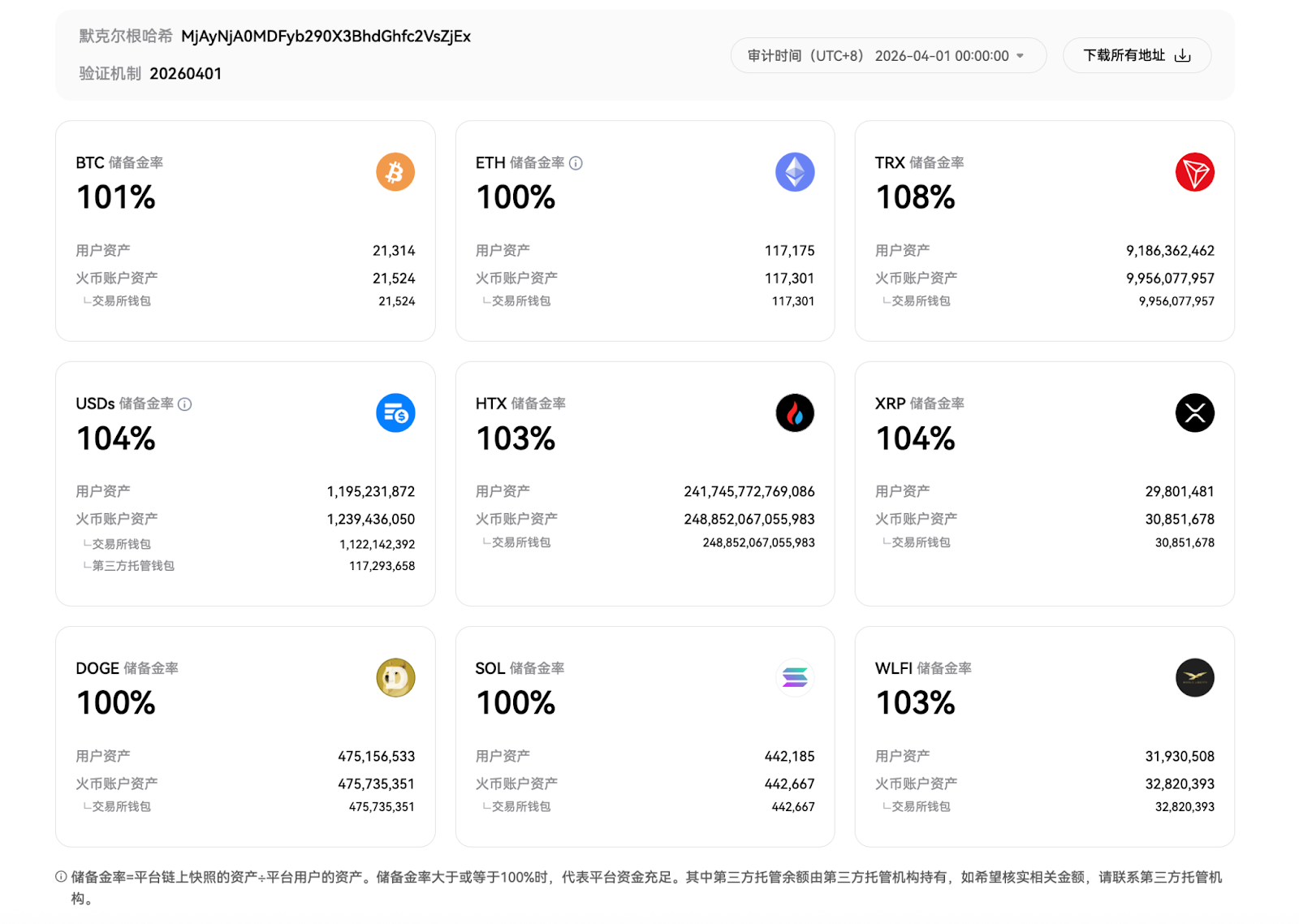
In response to industry security anxieties, Huobi HTX demonstrates transparency through action. The Merkle tree reserve proof released by Huobi HTX shows that as of April 1, 2026, the platform's main asset reserve ratios remain above 100%. Specifically, the BTC reserve ratio is 101%, with user assets amounting to 21,314 BTC; the ETH reserve ratio is 100%, with user assets at 117,175 ETH; the TRX reserve ratio is 108%, with user assets at 9,186,362,462 TRX; the USDs reserve ratio is 104%. Huobi HTX has consecutively published reserve proof reports for 42 months, dispelling user concerns with a consistently excellent reserve ratio of over 100%.
For users, in a buoyant market, profit opportunities often overshadow some of the platform's risks. However, when the market cools down, funds become more discerning. When the market lacks certainty in returns, the ability to prove asset coverage and reduce uncertainties in fund inflows and outflows will, conversely, become key reasons for platforms to attract fund retention.
In the critical OTC segment for embracing fund inflows, Huobi HTX seems to be attempting to establish the same level of certainty. Public information indicates that its C2C selection platform, which features "0 freeze + 100% full compensation," recently celebrated its first anniversary. From the actual operational data of the past year, this special zone has maintained a zero freeze account record. It is noteworthy that behind this is a "7x24 hour manual minute-level intervention" risk control mechanism, which, to some extent, raises the safety threshold of the current C2C track, leaning towards heavy asset investment. Objectively, the smoothness of fund inflow and outflow channels is also a crucial foundational stone for long-term fund retention from prudent large capital considerations.
As the competition among exchanges enters a phase of stock retention, defensive capabilities themselves can also become offensive abilities. Safe, transparent, and stable fund inflow and outflow experiences may not sound stimulating without high multiple rises, but they could be the real reasons large funds are willing to stay long-term. For trading platforms, the most capable of retaining funds may not always yield the highest returns, but rather the base that users are still willing to believe in under extreme conditions.
From crypto prices to oil prices, moving closer to a macro trading terminal
As the window for cryptocurrency dividends gradually closes, investors are shifting their focus from crypto assets to global asset allocation. Especially as Bitcoin underperforms gold, silver, oil, and tech stocks, the altcoin season has nearly vanished.
An increasing number of centralized exchanges (CEX) are turning their attention to traditional financial products, becoming new tools for investors to hedge risks and supplement returns in the bear market.
The report shows that in the first quarter of 2026, Huobi HTX added more than 22 assets in its traditional financial contracts area, covering gold, silver, oil, US stocks, and major indices, with the total number of trading pairs exceeding 276.
In the past, CEX primarily served cryptocurrency trading. Users looking to trade gold, oil, or US stock indices often had to leave cryptocurrency trading platforms and go to brokerage or contract for difference platforms, navigating complex compliance certifications and account opening procedures. With mainstream CEX fully bridging asset barriers, crypto users can seamlessly trade crypto and traditional financial assets using the same account. This one-stop experience greatly reduces switching costs, allowing users to flexibly switch in real-time between Bitcoin and traditional assets 24/7, achieving risk hedging and cross-asset allocation.
This shift not only significantly enhances user retention and trading frequency but also transforms cryptocurrency exchanges from mere liquidity venues within the crypto sphere to a macro trading terminal operating around the clock.
If traditional financial contracts are broadening the "width" of user trading, then Earn products are addressing the "length" of fund retention. In a bear market environment, users' preference for certainty increases significantly, and they are more willing to allocate funds to reservoirs that provide both asset hedging and low-risk returns.
Huobi HTX's first-quarter report reveals that the SmartEarn product achieved a maximum annualized return of 7.21% in the first quarter of 2026, with a quarterly average return of 2.68%; the VIP flexible products offered for Prime 5+ users provide an annualized return of up to 9% in USDT, with a maximum limit of 100,000 USDT per user.
Additionally, the report mentioned that Huobi HTX opened a tiered high-interest channel for hedging funds, with the maximum annualized return for USDT flexible products reaching 10%, and the maximum annualized return for the compliant stablecoin USD1 reaching 15%; subscriptions for USDe and USAT flexible products and related activities exceeded $110 million; and six new coin Earn activities saw subscriptions surpassing $10 million.
From this perspective, the role of Earn products is not just to provide returns, but to transform users from "staying during trading" to "staying during trading breaks." When an exchange offers spot, contract, stablecoin flexible, structured activities, and new coin subscription scenarios, the pathways for user funds within the platform will be extended, making it easier for the platform to form a loop of trading, earning, and re-trading.
The changes at Huobi HTX in the first quarter are not simply about "launching more trading pairs" or "providing higher yields," but rather an attempt to integrate crypto trading, macro assets, and idle fund management into the same account system, hinting that the next phase of competition for CEX might not be who can capture a market event but who can offer more complete fund retention capabilities between different user states of trading, observing, and hedging.
Continuous product innovation to bridge cycles with hard infrastructure
Beyond merely acquiring new users and retaining funds, elongating the user’s use path is even more critical. In the first quarter, Huobi HTX optimized user experience continuously through user-centered technical and product innovations, catering to diversified needs in different market cycles.
The report indicates that following the launch of Huobi HTX Copy Trading 4.0 and Smart Copy, the copy trading volume increased by 50% in the first quarter of 2026, the number of copy trading users doubled, and forced liquidation scale decreased by 61%. This signifies that the platform is not just providing trading tools, but is also lowering the entry barrier for new users into derivative trading through strategy replication, risk control optimization, and user stratification.
The value of copy trading products lies in packaging some professional trading abilities into a replicable path. For ordinary users, the most challenging aspects of derivative trading are not simply clicking buy or sell, but managing positions, adhering to stop-loss disciplines, and making market judgments. While copy mechanisms cannot eliminate loss risks, they can shift trading behavior from fully self-decided to a semi-automatic process that references professional traders and system rules. Therefore, when market trends are unclear, this becomes an important strategy for many retail investors.
Meanwhile, Huobi HTX launched the beta version of an AI assistant in the first quarter, supporting market analysis and personalized recommendations for Earn; the community posting area increased topics and bullish and bearish sentiment indicators; the platform also launched the Huobi HTX Private membership rights system and desktop client. These features are transforming the platform from a mere trading entry point into a composite terminal for information, decision-making, execution, and asset management.
From these actions, it is evident that Huobi HTX in the first quarter was not merely focused on trading volume but on attempting to integrate asset discovery, trading execution, yield retention, community interaction, and AI tools into a unified user path. The more an exchange resembles a comprehensive terminal, the higher the cost for users to leave; conversely, the platform will also have higher demands for product experience, risk control, and transparency.
When market conditions cannot automatically generate user growth, exchanges must create more reasons for users to stay. What Huobi HTX is showcasing is how an exchange can transition from a simple liquidity provision platform to an opportunity discovery platform in a sluggish market.
From this goal, Huobi HTX is attempting to evolve from a singular trading venue towards an integrated financial terminal combining asset discovery, macro trading, fund management, and intelligent tools. The real competition for CEX is no longer just ranking trading volumes in a bull market, but whether the platform can continuously provide verifiable product capabilities in different market environments.
免责声明:本文章仅代表作者个人观点,不代表本平台的立场和观点。本文章仅供信息分享,不构成对任何人的任何投资建议。用户与作者之间的任何争议,与本平台无关。如网页中刊载的文章或图片涉及侵权,请提供相关的权利证明和身份证明发送邮件到support@aicoin.com,本平台相关工作人员将会进行核查。


