The voting result of this Federal Open Market Committee presents a rare and serious division since October 1992.
Written by: Mahe, Foresight News
In the early hours of April 30, Federal Reserve Chair Jerome Powell held his last FOMC press conference at the Federal Reserve headquarters in Washington. This press conference coincided with the conclusion of the Federal Reserve's policy meeting on April 28-29 and marks the countdown of Powell's eight-year chairmanship—his term will officially end on May 15, with the nomination of his successor Kevin Warsh recommended earlier that day by the Senate Banking Committee.
The meeting outcome was predictable: the Federal Open Market Committee (FOMC) decided by majority vote to maintain the federal funds rate target range at 3.5%-3.75%, marking the Federal Reserve's third consecutive time holding steady.
Internal voting shows division, will serve as a governor after leaving
In his opening remarks, Powell stated straightforwardly, "My colleagues and I remain firmly focused on achieving our dual mandate of maximum employment and price stability for the benefit of the American people." He then briefly reviewed the economic data: the U.S. economy is expanding at a robust pace, consumer spending shows resilience, business fixed investment continues to grow strongly, while activity in the housing sector remains weak. Regarding the labor market, the unemployment rate in March was 4.3%, with little change in recent months, and job growth remains low. Powell particularly noted that the slowdown in job growth over the past year is partly due to a deceleration in labor supply growth, while labor demand has also clearly softened. Other indicators such as job vacancies, layoffs, hiring, and nominal wage growth have remained basically stable.
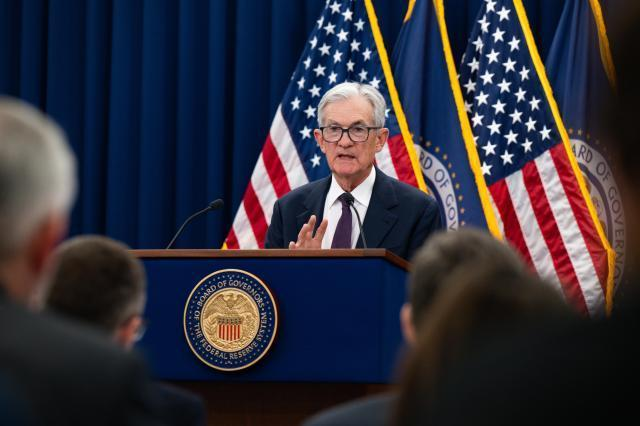
Inflation was the focal point of the press conference. Powell clearly stated, "Inflation has risen recently and is above our long-term target of 2%." According to estimates based on the Consumer Price Index and other data, the 12-month personal consumption expenditure (PCE) price index increased by 3.5% year-over-year as of March, mainly driven by a significant increase in global oil prices triggered by the Iran war; the core PCE, excluding food and energy, rose by 3.2%, a large part of which reflects the impact of tariffs on goods prices. Recent inflation expectation indicators have increased, but long-term inflation expectations remain broadly consistent with the 2% target.
Powell emphasized that the situation in the Middle East brings a high degree of uncertainty to the economic outlook, with energy prices likely to push overall inflation higher in the short term, while the comprehensive impact on the economy—the scope, duration, and direction of the conflict—remains unclear.
Regarding policy stance, both the FOMC statement and Powell reiterated that the current monetary policy stance is "appropriate," and they will "carefully evaluate incoming data, evolving outlooks, and risk balances," making decisions on a meeting-to-meeting basis, "with no preset path." The statement particularly mentioned that developments in the Middle East are exacerbating uncertainty in the economic outlook, and the committee will continuously monitor risks on both sides of its dual mandate.
The voting result of this Federal Open Market Committee (FOMC) shows a rare and serious division since October 1992. Among the 12 voting members, 8 supported the resolution, while 4 voted against it.
The dissenting votes came from two entirely different directions: Federal Reserve Governor Stephen I. Miran advocated for an immediate rate cut of 25 basis points; meanwhile, Cleveland Fed President Beth M. Hammack, Minneapolis Fed President Neel Kashkari, and Dallas Fed President Lorie K. Logan supported maintaining the current rates but strongly opposed the inclusion of a "dovish tilt" implying future rate cuts in the policy statement.
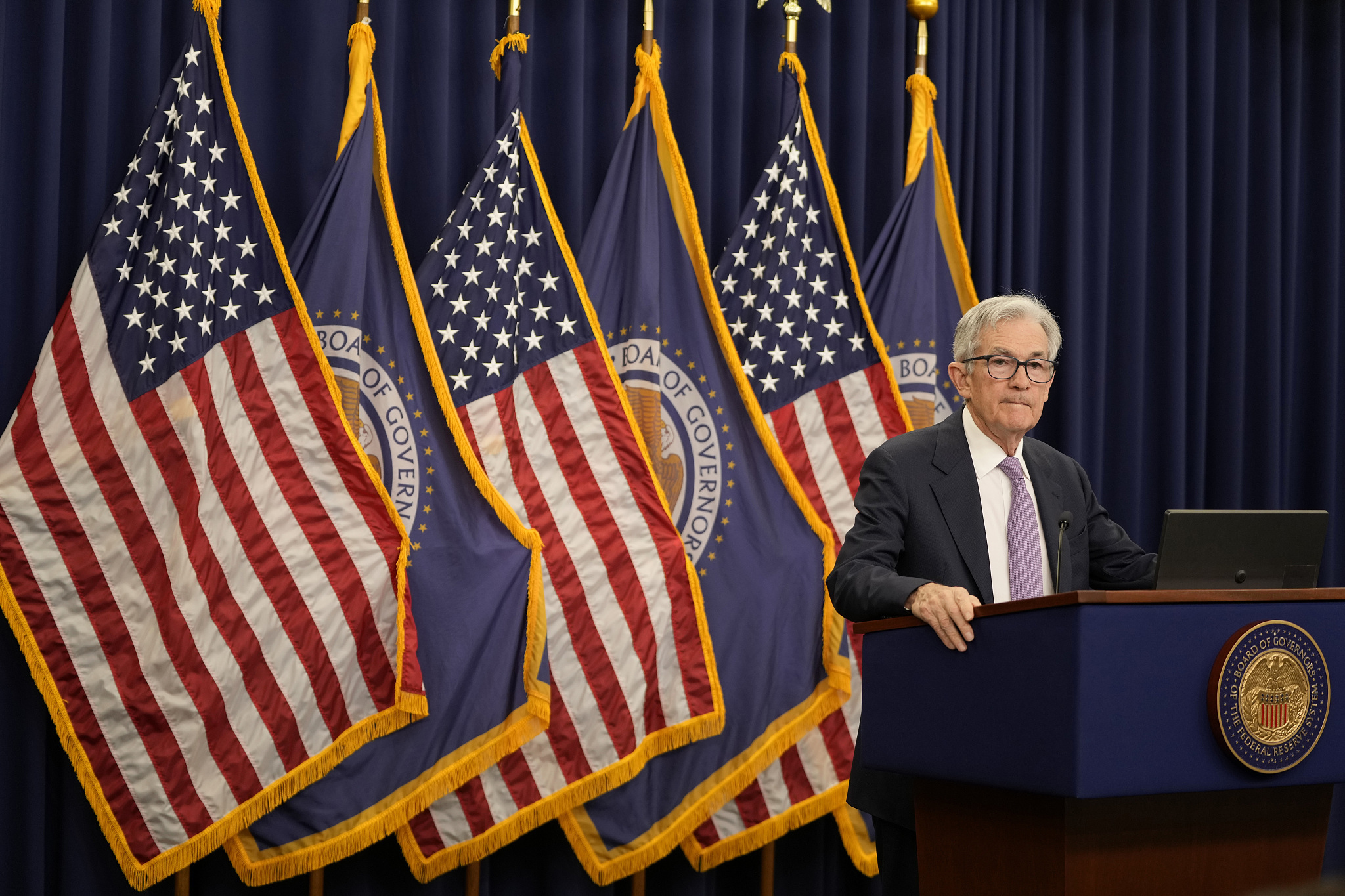
After entering the Q&A session, Powell was asked multiple times about the potential drag of the Iran war on consumer spending. He responded that no significant slowdown has yet been seen in the spending data: "You haven't seen it yet... consumers are still spending." He pointed out that despite a significant increase in gasoline and airfare prices due to the conflict, the economy has shown remarkable resilience, having withstood multiple shocks for several years. He also stated that the Federal Reserve is "well positioned" to decide the timing and extent of future adjustments based on data.
As his last appearance as chair, Powell offered personal remarks at the end. He first congratulated Warsh on his nomination progress with the Senate Banking Committee and emphasized that the core mission of the Federal Reserve is to "create conditions for stable prices, strong employment, and a reliable financial system for American households and businesses."
He then described in detail his personal situation: although his term as chair is ending, he will continue to serve as a Federal Reserve governor for some time, until the Department of Justice's investigation regarding him is "fully concluded, transparent, and definitive." He mentioned that last Friday the Washington D.C. prosecutor announced the closing of the criminal investigation and received assurances that the Justice Department would not arbitrarily restart it, but to maintain the agency's independence, he chose not to step down from his position on the board and stated he would serve in a "low-profile" manner.
Market reaction and significant adjustment in rate cut expectations
Trump stated today after Powell announced his continued role as a governor, "Too late, sir," suggesting Powell wants to stay at the Federal Reserve because he can't find work elsewhere—nobody wants him.
After the press conference, traders further reduced their expectations for the rate cut path in 2026.
According to the latest FedWatch data, the bond market is now almost fully pricing in zero rate cuts this year, and even a slight probability of a rate hike has appeared— the possibility of a rate hike in December's meeting rose from 0% before the press conference to about 9.1%. This contrasts with the March FOMC dot plot (SEP), where the median projection still indicated only one rate cut (25 basis points) in 2026, but the current geopolitical risks and resurgence of inflation have clearly weakened easing expectations.
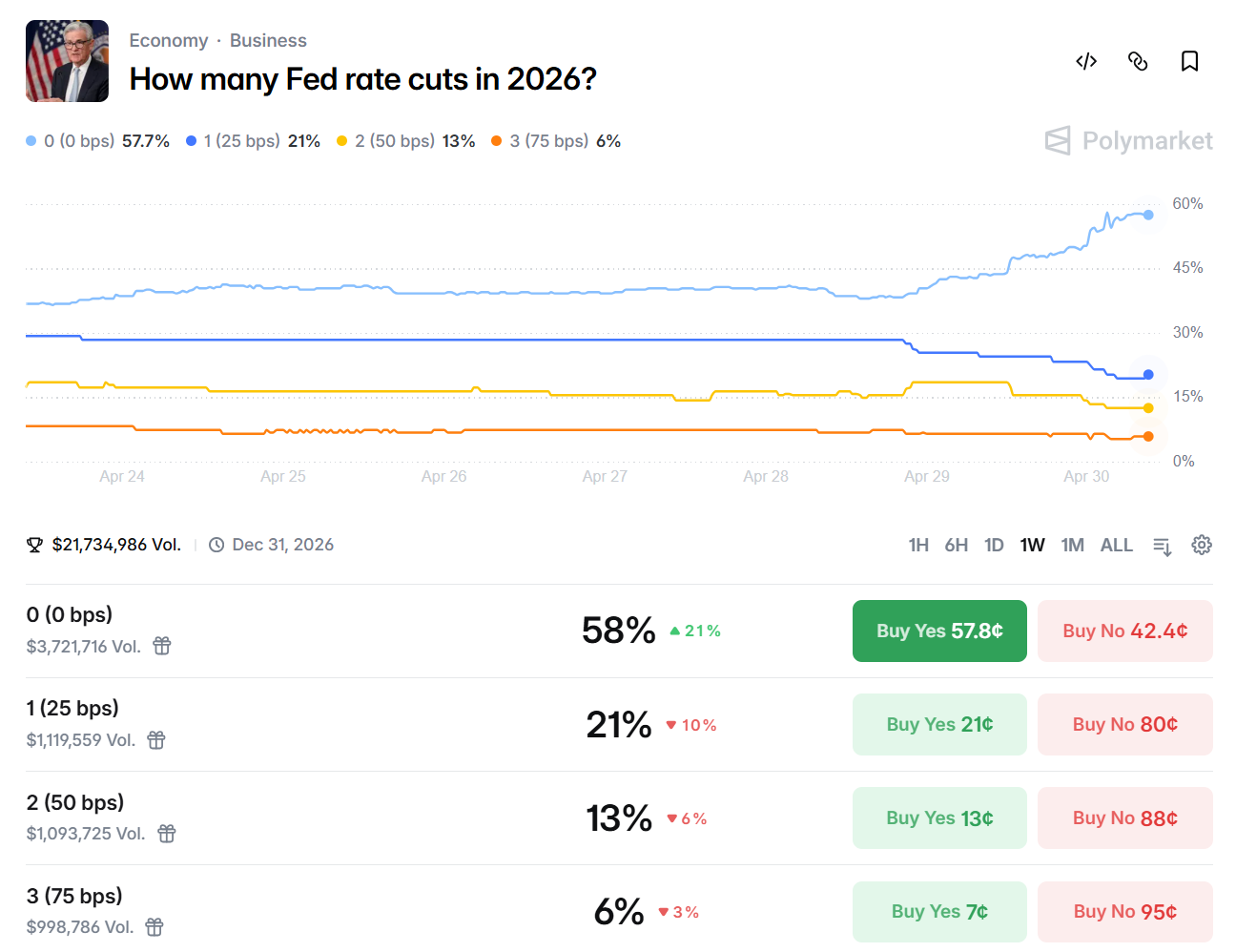
Polymarket's latest data show that the market's betting odds for the Federal Reserve holding steady this year have risen to 58%.
The stock market reacted relatively mildly: the S&P 500 index and NASDAQ composite index fluctuated slightly before and after the meeting, while the Dow Jones Industrial Average fell by about 0.5%-0.6%, but overall there was no intense volatility. Bond market yields rose slightly, reflecting increasing acceptance of a "higher for longer" interest rate environment.
Risk assets such as Bitcoin and Ethereum remained volatile before and after the press conference, and if rate cuts are unlikely this year, a liquidity-driven bull market may be hard to see in the short term.
免责声明:本文章仅代表作者个人观点,不代表本平台的立场和观点。本文章仅供信息分享,不构成对任何人的任何投资建议。用户与作者之间的任何争议,与本平台无关。如网页中刊载的文章或图片涉及侵权,请提供相关的权利证明和身份证明发送邮件到support@aicoin.com,本平台相关工作人员将会进行核查。


