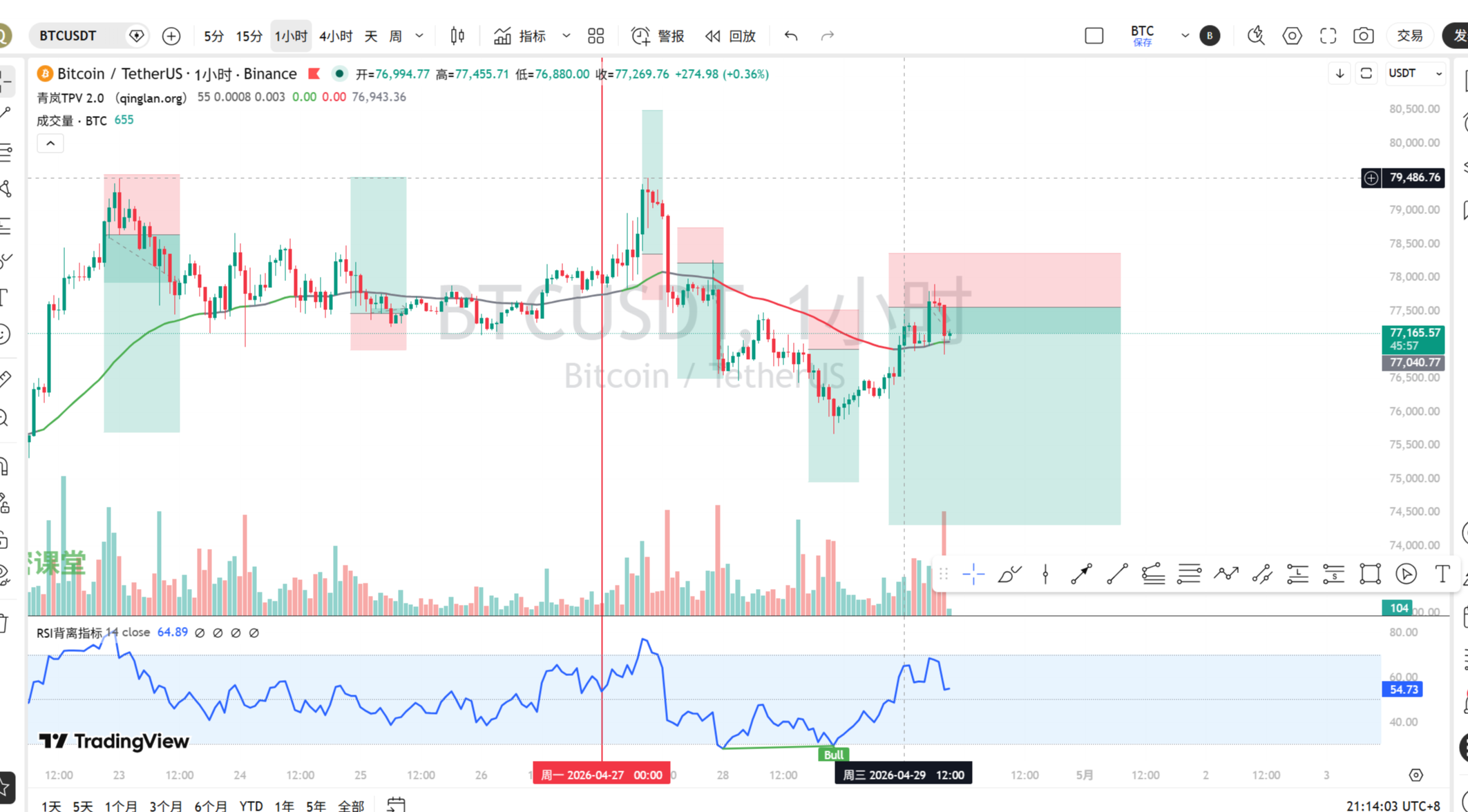
The US President Trump has instructed aides to prepare for an extended blockade against Iran, to continue to strike at its economy and oil exports. This decision was finalized during a recent meeting in the White House Situation Room. Multiple US officials disclosed to the media that Trump believes that continuing to squeeze Tehran by preventing shipping in and out of Iranian ports is a lower risk than resuming military bombing or the complete withdrawal from the conflict. Current blockade measures are effectively restricting Iran's ability to store unsold oil and prompting Iran to re-engage with Washington to seek negotiations.
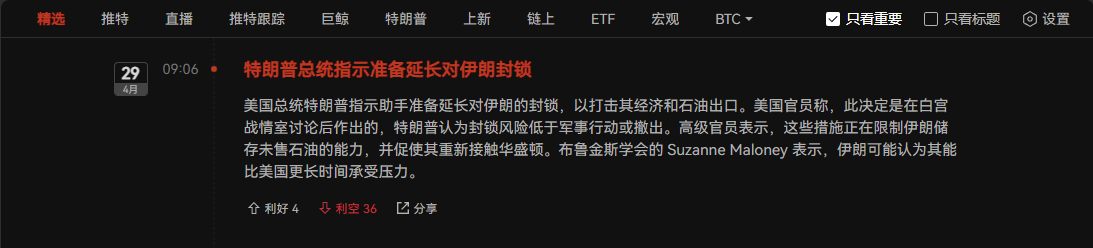 This latest development comes at a critical juncture as the US-Iran conflict enters its third month. The context is that after a joint military operation by the US and Israel in February, both sides reached a temporary ceasefire, but the maritime blockade has been in place since mid-April. Iran has recently conveyed a proposal through Pakistan, willing to reopen the Strait of Hormuz (a global shipping route for about one-fifth of oil and liquefied natural gas) and end the war in exchange for the US lifting the blockade, while postponing nuclear negotiations to a later date. Trump and his national security team made it clear in the Situation Room meeting that they were "not satisfied" with this framework, insisting that nuclear issues must be resolved from the outset, and the blockade will continue until Iran submits a more comprehensive proposal. The White House spokesperson reiterated that America's "red line" is to ensure Iran stops uranium enrichment and abandons its nuclear weapons program.
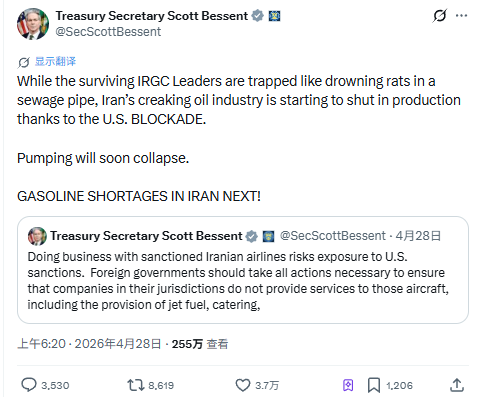
Trump himself claimed on social media that Iran has informed the US that it is in a "state of collapse" and is eager for the US to quickly open the Strait of Hormuz. He also announced an indefinite extension of the ceasefire, but the blockade will not be lifted. Treasury Secretary Scott Bessent stated on platform X that the Iranian oil industry is "groaning" due to the blockade, nearing collapse in production, with a gas shortage imminent. "The surviving leaders of the Iranian Islamic Revolutionary Guard are trapped like drowned rats in a sewage pipe, while Iran’s shaky oil industry has begun to shut down due to the US blockade." wrote Bessent.
The actual effects of the blockade have become apparent. Recent analysis shows that since the blockade came into effect, the shipping volume of Iranian crude oil has plummeted by about 70%, and the current daily export volume is only about 567,000 barrels, far below March’s 1.85 million barrels. Iran's domestic oil storage capacity is rapidly running out: onshore idle capacity can only support 12 to 22 days at most. Tehran has taken emergency measures, including reactivating poorly maintained or unused old oil storage tanks in southern oil town Ahvaz and Asaluyeh, temporarily storing crude oil on offshore tankers, and even considering transporting oil to China by rail. However, railway transport is costly and inefficient, unable to replace the scale of maritime transport. Satellite images also show several tankers stranded in waters near Chabahar Port, collectively capable of carrying about 14 million barrels, highlighting the difficulties in export routes. Analysts point out that if this situation continues, Iran may be forced to cut production by 1.5 million barrels per day by mid-May, which would not only cause permanent damage to oil fields but also further weaken the regime's finances.
Suzanne Maloney, an expert on Middle East policy at the Brookings Institution, pointed out that Iran may believe it can endure pressure longer than the US. "The Iranian regime believes time is on its side, and they have the capacity to endure the hardships caused by the blockade, because the global economy has already been hit hard due to disruptions in the Strait, and Tehran can continue to operate by suppressing domestic discontent." Maloney analyzed that although the Iranian economy has been heavily impacted, its leverage through controlling the Strait to cause global energy shocks still exists, and in similar previous "maximum pressure" policies, Tehran had also demonstrated resilience.
This strategy reflects the pragmatic considerations of the Trump administration: maintaining a tough stance against Iran's nuclear program while avoiding greater military entanglements or the strategic vacuum created by a hasty withdrawal. Officials emphasize that the blockade is not aimed at global shipping, but specifically targets Iranian vessels, with the goal of cutting off its illegal "tolls" and control through the Strait of Hormuz. Secretary of State Marco Rubio reiterated in an interview that the nuclear issue is the root of the conflict and must be resolved from the beginning, rather than postponed as suggested in Iran's proposal of a "phased" approach. However, the side effects of the blockade have had global repercussions. Shipping volume through the Strait of Hormuz has fallen to its lowest level since the outbreak of hostilities, international oil prices surged after the news broke, with Brent crude surpassing $111 per barrel and WTI crude rising to $100.5 per barrel. The tensions in the global energy market have increased, and US domestic gasoline prices are under upward pressure, which may pose hidden risks to Trump's approval ratings and midterm elections. European and Asian allies are also experiencing the ripple effects of the supply chain disruptions, and China, as a major buyer of Iranian oil, is facing rising costs from alternative sources.
Amid severe oil price fluctuations and ongoing geopolitical risks, many savvy investors are actively seeking diversified asset allocation channels to hedge against potential uncertainties. The Gate platform, with its secure and stable trading system, a wide variety of digital asset offerings, and convenient entry for new users, has become a focal point in the market. New registered users can enjoy exclusive welcome rewards and transaction fee discounts through simple authentication, offering more flexible options for personal asset preservation and appreciation in an increasingly uncertain global market.
One-click registration:
https://jump.do/zh-Hans/xlink-proxy?id=5
Core Advantages:
1. Market Position and Overall Strength
- Top Trading Volume: Spot trading volume ranks among the top three globally, with brand influence and international voice continuing to rise.
- Ecological Synergy: Creating a "spot + derivatives + wealth management + Web3" multi-business matrix, with increased capital inflow and trading activity across product lines (such as Perp DEX, Launchpool), building a positive cycle.
2. Trading Products and Innovation Capability
- Leading Multi-Asset Derivatives: Perp DEX's quarterly trading volume has surpassed $13 billion, introducing perpetual contracts for gold, silver, and crude oil, becoming an important infrastructure linking on-chain liquidity with traditional markets.
- Diverse Asset Matrix: Supports trading in over 4,500 digital assets, with liquidity and market depth continually increasing, consistently ranking among the top globally in spot and contract trading volumes.
- Quality Project Incubation: Launchpool and Launchpad maintain a stable rhythm, with high oversubscription rates, continuously attracting quality assets and users.
3. Compliance Qualifications and Security Assurance
- Global Compliance Layout: Holds a payment institution license (PI) granted by the Malta MFSA under PSD2 and EU MiCA qualifications, with strong compliance advantages in stablecoin payments and Web3 infrastructure.
- Reserve Ratio of 122%: Its March reserve report shows an overall reserve coverage of 122%, with BTC reserve ratio as high as 147%, significantly above the 100% industry safety benchmark, reflecting the platform's sufficient redundancy and robust risk hedging capability in a volatile market environment.
 Iran's response has also been firm. The Deputy Commander of the Navy of the Islamic Revolutionary Guard recently claimed that absolute control over the Strait of Hormuz has been achieved, and passing vessels are required to pay a toll. Tehran's permanent representative to the UN emphasized that lifting the maritime blockade is a prerequisite for resuming negotiations with the US. After visiting Russia, Iranian Foreign Minister Amir-Abdollahian returned to Tehran to report, hinting that a revised proposal may be submitted through Pakistan, but there has been no softening of the nuclear stance as of yet.
Some viewpoints suggest that Iran is attempting to evade the blockade using a "shadow fleet," and although 26 tankers have succeeded, overall exports remain heavily restricted. From a broader geopolitical perspective, this decision to extend the blockade highlights the structural stalemate in US-Iran negotiations. Both sides maintain military readiness during the ceasefire extension but struggle to reach a "100% complete agreement." The Trump administration insists on addressing nuclear issues first, while Iran uses its control of the Strait and oil exports as core leverage, attempting to force the US to lift the blockade first. Think tanks like the Brookings Institution warn that if Iran can indeed "outlast," the blockade could evolve into a long-term war of attrition, potentially driving global inflation higher and sparking new regional instability—such as heightened activity from Iranian-backed proxy forces or escalated accidental conflicts in the Strait.
In the current situation, the blockade has become a pragmatic choice in Trump's pursuit of a "decisive victory."
Whether the Trump team will adjust its strategy under prolonged high oil prices or domestic pressure remains to be seen in the coming weeks.
This decision continues the US's logic of "maximum pressure" against Iran, but it also exposes the risks of prolonged conflict. Global markets, energy security, and non-proliferation issues are intertwined, testing the strategic patience of all parties involved. Subsequent developments will not only affect stability in the Middle East but will also profoundly impact the international energy landscape and geopolitical map in 2026.
Join our community to discuss and become stronger together!
Official Telegram community:
AiCoin Chinese Twitter:
Gate benefit group:
https://aicoin.com/link/chat?cid=de0QGAe7W
免责声明:本文章仅代表作者个人观点,不代表本平台的立场和观点。本文章仅供信息分享,不构成对任何人的任何投资建议。用户与作者之间的任何争议,与本平台无关。如网页中刊载的文章或图片涉及侵权,请提供相关的权利证明和身份证明发送邮件到support@aicoin.com,本平台相关工作人员将会进行核查。