The Federal Reserve's April FOMC is almost certain to hold steady, but the real suspense of this meeting goes beyond that—changes in wording within the statement may signal to the market that "rate cuts are basically off the table"; Powell's news conference is expected to express a tough stance, affirming the decision to hold steady, and stating that the current policy is well-prepared to face the risks associated with its dual mandate.
Written by: Zhao Ying
Source: Wall Street Journal
The results of the Federal Reserve's April FOMC meeting are nearly predictable—interest rates are expected to remain unchanged, but the true focus of this meeting lies in the signals that Powell will convey as he presides over his final policy meeting, and whether the committee will officially communicate a hawkish position to the market indicating that "rate cuts are basically off the table".
The Federal Reserve will announce its interest rate decision at 2:00 AM Beijing time on April 30, with the benchmark rate expected to remain in the range of 3.5% to 3.75%. Market consensus is highly aligned, with only board member Miran expected to dissent, advocating a 25 basis point rate cut.
The latest developments come from the inflation front, as the Iran war and energy shocks continue to disrupt the outlook, with gasoline prices remaining above $4 and traffic in the Strait of Hormuz still highly obstructed. Meanwhile, recent employment data has shown resilience, diminishing the urgency among dovish committee members to support immediate stabilization of the labor market.
Federal Reserve officials generally expect that the decline in inflation will be delayed by a full year. Market expectations for rate cuts have narrowed significantly, with Deutsche Bank having withdrawn its previous September rate cut prediction, adjusting its base scenario to a situation where the Fed remains "indefinitely on hold" around neutral rates.
The core debate of this meeting revolves around the wording of the statement and the risk assessment during the news conference—adding or omitting a word in the forward guidance may convey completely different policy signals to the market. Additionally, with the Department of Justice concluding its investigation into Powell, Kevin Warsh's nomination as Federal Reserve Chairman has become smoother, adding historical significance to this meeting.
Consensus on Holding Steady, Controversy Shifts to "Next Step"
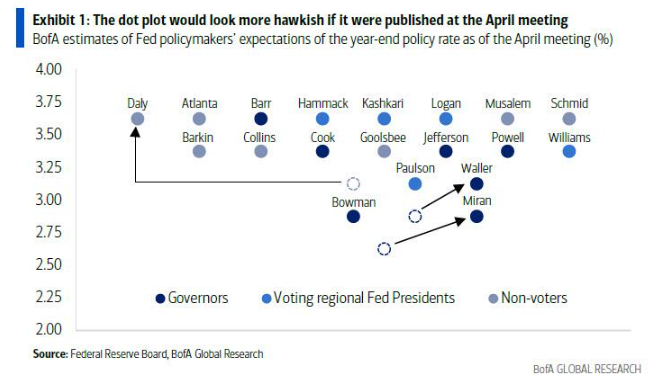
This FOMC does not include a dot plot, and the interest rate itself is nearly a non-issue. The focus is on whether the Fed is still willing to retain the policy hint that "the next step is more likely to be a rate cut" or whether it will begin to acknowledge that risk has now shifted to a two-way nature.
According to Bank of America, the current inflation outlook remains as unclear as it was during the March meeting. While the stock market seems to trade as if the Iran war is over, disruptions in energy and shipping still persist, and there remains high uncertainty regarding the transmission of conflict to core inflation.
The employment front has not provided sufficient reasons for the Fed to be eager to pivot dovishly. March non-farm payrolls, ADP, and initial jobless claims data have all shown resilience in the labor market, with even some signs of improvement. This means that committee members who previously advocated for rate cuts now find it harder to emphasize "downward risks in employment" as the primary policy rationale.
Doves Tighten Up, Urgency for Rate Cuts Decreases
Before this meeting, the most notable change within the Federal Reserve was that previously dovish committee members have subsequently tightened their statements.
Waller emphasized last week not only the inflation upside risks brought by the Iran war but also the labor supply shocks. He believes this implies that the economy may be able to maintain stable unemployment without needing or requiring net job additions. Bank of America believes Waller may still want rate cuts this year, but the magnitude of the cuts may be less than previously expected, and the timing may be pushed further back.
Daly's statement went further. She indicated that if the policy remains unchanged throughout the year, it would provide good restraint on inflation without harming the labor market. She also believes that the impact of the Iran war on inflation may be greater than on growth, with Daly's current baseline scenario now being that the interest rate path remains flat for the year.
Even the most dovish member in the FOMC, Miran, expressed a preference for three rate cuts this year instead of four, citing that inflation conditions have worsened since the beginning of the year. Bank of America believes that if there had been a dot plot at the April meeting, some committee members' interest rate expectations for 2026 would already have moved upwards, and by June, the risk of more "dots" shifting upward is still increasing.
Statement Wording: A Difference of a Word, Signals Differ
The most significant aspect of this FOMC statement is whether the Federal Reserve will hint that the risks to the policy path have shifted to "two-way".
The current statement's reference to "additional adjustments" implies a dovish presumption that the next action will be a rate cut. Changing it to "any adjustments" or directly omitting "additional" would mean that the direction of the next action is no longer presumed to be a rate cut, formally shifting the policy path to a two-way openness. The minutes from the March meeting showed that the number of committee members supporting the adoption of a two-way risk statement rose from "several" in January to "a few," and the firmness of the wording has also strengthened.
Bank of America views this as a near 50-50 judgment, but the majority of committee members still tend to prefer maintaining the existing forward guidance language unchanged. Deutsche Bank, on the other hand, leans toward believing that substantive guidance adjustments will be delayed until June, when the committee will have more clarity on the Middle East situation, labor market stability, and inflation transmission paths, although the risk clearly leans toward a hawkish stance.
Furthermore, one expected adjustment in the statement may be the description of economic activity, potentially downgrading it from "solid" to "moderate" given the fourth quarter GDP downgrade and weak consumption in January and February. However, Bank of America points out that this adjustment itself carries dovish overtones, which contradicts the committee's current intention to convey a hawkish signal to the market.
News Conference: Powell's Tough Stance is Inevitable
If this indeed is Powell's last news conference as Chairman, he is likely to maintain a moderately hawkish position.
According to Bank of America, Powell's core message is likely that the Fed will firmly hold steady, with the current policy well-prepared to face the risks associated with its dual mandate. In the face of high uncertainty, the Fed has no reason to contradict the market's pricing of a flat interest rate path.
The most sensitive question at the news conference will be the threshold for rate hikes. If Powell reiterates that a rate hike is not the baseline scenario for the majority of the committee, markets may interpret this as a dovish signal. If he emphasizes the importance of completing the inflation-fighting task or points out that inflation has exceeded the target for several consecutive years, it will be viewed as a hawkish signal.
It is noteworthy that "inflation" was mentioned 67 times in the March press conference, while "labor market / employment / unemployment" was mentioned only 40 times, clearly indicating that inflation is the heaviest factor on the policy balance. He is expected not to provide a quantified rate hike threshold.
Regarding the Iran war, Powell is expected to acknowledge both the inflationary upside risks and the downturn risks related to growth and the labor market. However, the market is more concerned with which side he leans toward. If his statements are close to Daly's—indicating that the war's impact on inflation is greater than that on growth—the market may view this as quite hawkish.
Is Focus on Rate Cuts Paused or Just Delayed?
Nick Timiraos, often referred to as the "New Federal Reserve Correspondent", wrote before the meeting that the April meeting marks a pivotal point in a deeper policy debate: how long can the Federal Reserve maintain the position that "the next step is more likely to be a rate cut rather than a rate hike."
Timiraos pointed out that two years ago, Powell downplayed concerns about stagflation, stating, "neither stag nor flation is visible." But now, the energy shocks triggered by war and inflation that has not yet returned to the 2% target are overlapping, making the historical mirrors of 1970s stagflation feel much less distant.
He emphasized that the Federal Reserve is observing how the U.S. economy digests its fourth supply shock within five years, including the pandemic restart, the Russia-Ukraine conflict, tariff disputes, and the Iran war. Each shock can be interpreted as an event that does not require a policy response, but when they accumulate, managing inflation expectations becomes trickier.
Timiraos believes the statement itself may be as important as the interest rate decision. If the Fed modifies the formal statement wording to imply that rate cuts are basically off the table, its market impact could be comparable to a policy action.
The Final Dance and Transition of Positions
This meeting is receiving more attention also because it could be Powell's last FOMC as Chairman.
Powell's term as Federal Reserve Chairman will expire on May 15, and he previously committed to serve as "acting Chairman" until his successor is confirmed. With the DOJ stopping its investigation into Powell-related matters, Kevin Warsh's Senate confirmation path is clearer.
UBS expects Kevin Warsh to be sworn in before the FOMC meeting on June 16-17. If this pace holds, the April meeting will become the last complete policy communication window of the Powell era, and the market will pay more attention to whether he leaves a policy starting point of "not cutting rates for a longer time" for the next chairman.
Market Reaction: Tail Risks Under the Cloak of a Non-Event
Goldman Sachs trading desk views the overall market as perceiving this FOMC as a low-volatility event, but different assets still have directional sensitivities.
On interest rates, Goldman Sachs analyst Brian Bingham expects no significant hawkish shift in inflation wording in the statement, and Powell will reiterate a wait-and-see approach. However, the current pricing until December reflects only about a 5 basis point change, making further large sell-offs and accounting for substantial rate hike probabilities a high threshold. If the base scenario deviates, risks are more likely directed toward higher rates, fewer rate cuts, and a flatter yield curve.
In the foreign exchange market, Goldman Sachs trader Carlie Ladda believes the Fed's slight hawkishness may bring some dollar buying, but it is unlikely to form a sustained trend. The market remains more focused on the situation in Iran, corporate earnings reports, and end-of-month factors. The trading desk prefers to sell dollars when the dollar rebounds.
In the stock market, Goldman Sachs' Vickie Chang points out that the main risk of the FOMC for the stock market is if Powell emphasizes the inflation risks brought by commodity price shocks too cautiously, which may dampen risk appetite. Current risk assets have largely downplayed the impact of the conflict, and the downside tail risks may be underestimated.
免责声明:本文章仅代表作者个人观点,不代表本平台的立场和观点。本文章仅供信息分享,不构成对任何人的任何投资建议。用户与作者之间的任何争议,与本平台无关。如网页中刊载的文章或图片涉及侵权,请提供相关的权利证明和身份证明发送邮件到support@aicoin.com,本平台相关工作人员将会进行核查。


