Recently, several narratives that were originally flowing separately suddenly converged on the same screen within the same time frame: the legislative clock in Washington has begun its countdown, on-chain prediction markets are pricing the "future" with real money, and AI companies are dragging computing power and macro hedge assets onto the stage while compressing reasoning costs.
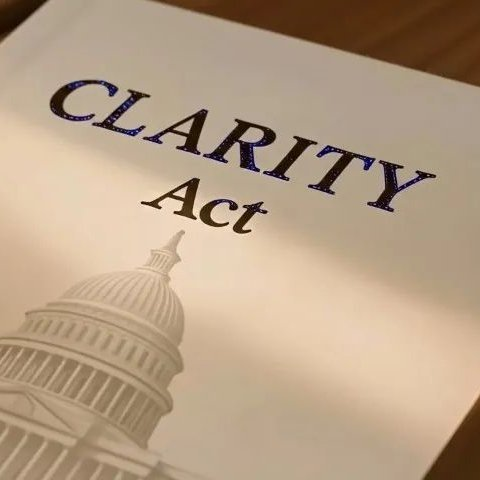
In the U.S. Senate, the time remaining for the Clarity Bill is precisely measured in weeks: there are about 13 overall weeks available, but excluding recesses and other agendas, there are only about 9-10 working weeks left to actually advance this crypto regulation bill. Revisions are expected to start in May, and the lobbying power of the industry is already tightly knitted together—CEO Ji Kim of the Crypto Innovation Council stated clearly that they hope to get the bill to President Trump’s desk for signature before August, but everyone understands that this is more a gamble against procedure and time rather than a straightforward "schedule" that can merely be realized through effort.
The on-chain sentiment, however, offers another answer through numbers. The fear and greed index has plunged from 47 the previous day to 33, falling back into the "fear" range; the speed of the retreat in risk appetite is more honest than any public hearing. At the same time, the macro hedge anchor points are slightly lifting: in the Asian early trading session, spot gold rose about 0.2%, oscillating around $4700/ounce. The market is evaluating Iran's conditions offered to the U.S. — stopping attacks in the Strait of Hormuz in exchange for an end to the war and a relaxation of port blockades — while continuing to use gold to hedge against this uncertain possibility of "potential easing or potential failure."
But beneath the surface of panic and wait-and-see is another group of more aggressive participants. Polymarket has chosen to complete its migration to CLOBv2 at this moment and has thrown out a liquidity reward of $1 million in one shot on the migration day: $500,000 for the first 2 hours, and another $500,000 for the remaining time, while layering a rebate mechanism to encourage users to continue quoting for the future on days when the "panic index is at its lowest." An account that has accumulated over $11.6 million in profits on the platform even placed a six-figure bet on the -11.5 spread of the Nuggets versus Timberwolves in the NBA playoffs — this is not just sentiment bottom-fishing, but a bet with extreme confidence in the time difference, exchanging historical performance for chips.
Institutional footprints are also taking shape in the prediction market. Kalshi announced the completion of its first customized large transaction, with liquidity provided by Jump Trading and matched by Greenlight Commodities, representing an environmental hedge fund based in Houston — while crypto regulation remains unclear, and the legislative clock races toward August, some traditional funds have chosen to occupy the position of "how to bet on macro events" before the rules are completely written down.
In parallel, the AI narrative rapidly advanced during the same timeframe. OpenAI launched GPT-5.5, DeepSeek released the preview version of DeepSeek-V4, and Citic Securities believes that the significant reduction in reasoning costs will ignite exponential growth in token consumption, triggering an application-side explosion and supporting demand for computing power; Morgan Stanley’s chief economist reminds that while AI is spreading at record speed, the global labor market remains relatively stable, currently more akin to a “marginal enhancer” of productivity rather than a “substituter.” As the computing power story, hedge assets, and prediction markets intertwine, AI is no longer just a technology cycle but is becoming an “infrastructure” for pricing the future.
This is the position we find ourselves in at the end of April 2026: on one side is a legislative window of only 9-10 working weeks and the suspense of signing before August; on the other side is the panic index dropping to 33 and gold oscillating around $4700; in the middle are prediction markets like Polymarket and Kalshi, as well as the AI narrative restructured by GPT-5.5 and DeepSeek-V4, all seeking a common thread — who can first find opportunities in the time differences amidst the panic.
9-Week Legislative Sprint: Can the Clarity Bill Get Passed Before August?
The Senate calendar shows about 13 weeks, but what is truly left for the Clarity Bill is only 9-10 weeks after layers are subtracted — recess will consume several weeks, while topics like budget, defense, and diplomacy will also line up to take away time. On the schedule, every hour must be "divided" among different agendas; for the Clarity Bill to advance before the August recess, it must continuously occupy sufficient agenda “bandwidth” within these 9-10 weeks.
The industry is not unfamiliar with this. CEO Ji Kim of the Crypto Innovation Council has openly expressed (according to a single source) the hope to get this bill to President Trump’s desk for signature before August. In other words, the industry sees these 9-10 weeks as the last window for a “legislative sprint”: on one side is a gray area long dominated by law enforcement, and on the other side are the rules written on paper; if they can complete signing before the recess, the timeline will draw a clear divide in the summer.
If the Clarity Bill can really be passed before August, what it brings is not first and foremost a price, but rather expectations: transitioning from “who will be prosecuted today” to “what rules will be followed tomorrow.” For the U.S. crypto industry, long suppressed by regulatory uncertainty, this means they can make medium- and long-term plans along compliant paths — how new projects are established, how old projects are rectified, and how trading platforms redraw business boundaries, all have the opportunity to shift from “guessing regulation” to “interpreting statutes.” For the funding side, a transparent framework itself is a risk premium compressing mechanism: institutions and large funds are more willing to deploy capital in jurisdictions where the rules are clearly written, even if the tax burden and compliance costs are not low; as long as they are predictable, they can be priced.
However, legislation is not a sprint timed by a stopwatch; it is more like a relay race that can easily “deviate." The revisions to the Clarity Bill are not expected to enter the advancement stage until May, and the specific content and dates are still undisclosed, meaning that the very existence of the finish line is still under discussion. Every modification of the wording and every procedural blockage could potentially push the originally scheduled signing timeline further back. More troubling is that up until now, no White House officials have publicly commented on this bill, and the ultimate stance remains blank — this adds another layer of political uncertainty to the timeline regarding “signing before August.”
In this situation, the market has to learn to price “time” and “procedure” itself. If we view these 9-10 weeks as an option: passing before August brings compliance expectations and restores confidence in funding; delays after August imply that law enforcement directives continue to prevail, pushing the clear vision of rules further back. The current fear and greed index has dropped to 33, significantly down from 47 the previous day, indicating that the risk appetite at the price level is shrinking, but this does not mean the market has given up betting on the “regulatory inflection point”—it has simply shifted focus from short-term fluctuations to the harder-to-measure variable: how fast the legislative machine can operate within the remaining 9-10 weeks.
From $1 Million Rewards to Large Transactions: Speeding Up the Prediction Market
In the same week that panic sentiment tightened at the price level, it was platforms specifically designed to “price uncertainty” that accelerated.
Polymarket chose to push the gas pedal to the floor at the point of its tech stack upgrade. On the day of the CLOBv2 migration, the platform directly threw out a total of $1 million in liquidity rewards: $500,000 for the first two hours after the completion of migration and another $500,000 for the remaining time, while adding a rebate mechanism to return a portion of the matchmaking fee to high-frequency traders and market-making accounts. For retail investors, this means placing an order is not just about betting on direction but also about seizing subsidies; for professional market makers, each additional layer of orders in the order book corresponds to a “quantifiable business” with a clear subsidy curve.
The result is a very clear behavioral channel:
● Users holding a wait-and-see attitude have been pushed into the market by the densely released rewards in a short time;
● Players who originally only made small exploratory moves have begun to repeatedly place and withdraw orders under the incentive of rebates, filling the price gaps;
● Market makers have used tighter spreads and larger two-way quotes to transform this $1 million into long-term deep-seed capital.
In this environment, individual risk appetites have been rapidly elevated. An account that has accumulated over $11.6 million in profits on Polymarket has chosen to place a six-figure bet on the -11.5 spread in the Nuggets versus Timberwolves G5 playoff market. The specific amount has not been disclosed, but the mere existence of a “six-figure bet” speaks volumes: this is not merely an emotional outburst but a long-term profitable veteran player at the platform, raising their risk threshold again during a window of volatility and subsidies.
Such "whale" behavior, like the 9-10 weeks in the regulatory timeline, carries a clear sense of countdown: the confirmation key must be pressed before the match kicks off, and if the odds position is incorrect, a six-figure amount is a real price to pay; but for someone who has already made eight figures, this kind of short-term large exposure is precisely a way to accumulate advantages — using greater chips to amplify their understanding of probability while conveniently soaking up the incentives released by the platform during the CLOBv2 upgrade.
If Polymarket's story is pushing retail and high-net-worth players into a higher frequency and more leveraged behavioral model under the narrative of “subsidies + rebates,” then Kalshi's path is almost a different script.
Also recently, Kalshi announced it has completed its first customized large transaction. On the surface, this sounds like a somewhat dry structural design: liquidity is provided by Jump Trading, and matchmaking is handled by Greenlight Commodities, and the transaction itself represents an environmental hedge fund based in Houston. The specific scale and target have not been disclosed, but the role assignment sufficiently indicates the nature of this transaction — this is not a public order book where thousands of retail investors are betting against each other, but a risk position tailored for a single institutional client within a regulatory framework.
The logic behind large transactions is in stark contrast to the raucous nature of the “full venue sugar distribution” on the day of Polymarket's CLOBv2 upgrade:
● It deliberately steers clear of the public order book, hiding the volume and price within bilateral negotiations and matching channels;
● It relies on the balance sheets of professional liquidity providers like Jump rather than on fragmented orders from hundreds of small users;
● It serves hedge funds with clear compliance requirements, auditing, and risk control constraints, rather than sports fans who only open the app a few hours before the game.
From the perspective of results, the two paths almost constitute a “dual-track experiment” for prediction markets: on one side, the crypto-native platform represented by Polymarket stacks the order book thicker with $1 million rewards and rebates under a still-not-fully-clear regulatory environment, attracting retail investors, market makers, and a few whales to gamble under the same set of rules; on the other side, the regulated platform represented by Kalshi pulls traditional financial roles like Jump Trading and environmental hedge funds into customized, non-public large transactions that hedge or express views on specific risks.
At this time when the U.S. Clarity Bill is still in a 9-10 week countdown, this dual-track development has a clear implication:
Before the rules have been fully written into statutes, the market itself has already produced two prototypes — one quickly democratizing through incentives and subsidies, allowing sentiments, views, and probabilities to rapidly crystallize into prices through a vast number of small orders; the other accelerating institutionalization through compliance and structural design, allowing hedge funds and professional traders to finely cut risks of policies, climates, or macro events with large contracts.
While the legislative machine continues to deliberate over the wording, Polymarket and Kalshi have each provided their own answers: the future prediction market can either be like a street casino that is always open or like a private trading room that only serves appointment-only clients — the real game is not just about betting on who wins or loses but about which form the regulators ultimately choose to write into that bill that is currently counting down.
Plummeting Reasoning Costs: The AI Computing Power Story Continues
While the Senate is still tangling over every wording of the Clarity Bill, another timeline has fast-forwarded to the next scene: computing power capital does not wait for the bill to take effect, first rewriting the cost curve. Recently, Citic Securities mentioned in a research report that OpenAI released GPT-5.5 and DeepSeek released the preview version of DeepSeek-V4, drastically reducing the reasoning costs of large models within the same time window — not "slightly cheaper," but at a level that could change the game rules (according to a single source).
When tickets become cheaper, audiences will flock in. Citic Securities' judgment thus appears aggressive: lower cost per reasoning does not mean that the demand for computing power has peaked; it might actually trigger an exponential increase in token consumption — with the price of invoking a model dropping, enterprises and individuals are willing to stack AI over more scenarios and longer chains, upgrading the behavior of “trying it out” to the underlying infrastructure of daily workflows. The logic given in the research report is that this explosion on the application side will keep total demand for computing power rising, just shifting from “expensive and scarce computing power” to “cheap but massive reasoning requests” (according to a single source).
Almost concurrently, Morgan Stanley’s chief economist offered another set of coordinates: AI is spreading at the fastest rate in history, but global labor market indicators remain relatively stable (according to a single source). In the face of this data, the traditional narrative of “AI = wave of unemployment” temporarily fails, and another role positioning emerges — AI as a productivity “incrementor,” first helping people improve efficiency rather than immediately massively replacing jobs (according to a single source). This means that in the short term, AI is more like an accelerator layered onto the existing economy, rather than a shockwave that could immediately alter the labor supply-demand structure.
Putting these two perspectives together in the context of the crypto market generates a new focal point:
● From Citic Securities' perspective, the drop in reasoning costs brings a token-level expectation of “usage explosion” — AI-related tokens and computing power assets are seen as derivatives of the computing power demand curve in the coming years, where prices are not just betting on today’s GPU supply-demand but on how many units of “model calling rights” will be consumed daily in the future (according to a single source).
● From Morgan Stanley’s perspective, AI doing the “incrementor” rather than “substituter” role implies a macro-level growth narrative leaning more toward “moderate acceleration”: productivity is improved, profit margins are opened up, yet unemployment rates and social risks remain temporarily under control (according to a single source). This provides a subtle premise for pricing risk assets — the market can enhance its imagination for medium-to-long-term growth without pricing systemic unemployment shocks.
In this layered narrative, AI-related tokens and computing power assets have been pushed to a special position: on one side, they follow traditional tech sectors, capturing macro premiums from AI diffusion and productivity elevation; on the other side, they are seen as the most direct, highest-beta betting tools for “ongoing expansion of computing power demand.” The current acceleration of large model iterations has already led the market to generate discrepancies over future demand for computing power and related industries (including crypto assets related to computing power): some interpret the drop in reasoning costs as a signal of “hardware cycle peaking,” while others, following Citic's logic, see it as the starting point of “token consumption just about to take off” (according to a single source).
And in the 9-week countdown window until the deadline for the bill, this kind of divergence will not remain merely in research reports. It will first manifest itself in the sharp fluctuations of AI conceptual tokens and computing power assets, reflected in the pricing distribution of prediction markets concerning “how much AI will boost future growth,” and ultimately be written into interest rate expectations, valuation models, and even written into that still-unfinished Clarity Bill — as regulators question “how should it be regulated,” the market has already given a more direct question with real money: in a world where reasoning costs are continuously plummeting, who truly holds discourse power over the narrative of future computing power.
Ceasefire Signals from Hormuz: Gold Hovering Around $4700
While the market is still digesting abstract topics like “AI reasoning cost avalanche,” a tangible message about war and peace has come crashing in from the direction of the Strait of Hormuz — Iran has proposed to the U.S. that it is willing to stop attacks targeting the Strait in exchange for the end of the war and a relaxation of port blockades. There have been no public details regarding the channel of communication, but the information itself is sufficient to create a new uncertainty: is this a substantive ceasefire bargaining chip or a move likely not to materialize?
The Strait of Hormuz is one of the world’s most sensitive chokepoints in the global energy and shipping narratives; any winds of attacks or ceasefires will be amplified into a repricing of regional security and supply chains. Thus, after this “potential easing” message was thrown out, the market had to weigh whether the risks had truly diminished while still reserving buffers for the worst-case scenario — this tug-of-war has been most directly reflected in the gold market.
In the Asian early trading session, spot gold slightly lifted, increasing about 0.2%, oscillating around $4700/ounce. The increase is not extraordinary, but it sufficiently communicates the issue: in a state where ceasefire signals and geopolitical shadows coexist, funds are not rushing to exit hedge assets; rather, they are choosing to maintain positions near high levels, as if to allow time to validate this “Hormuz ceasefire proposal.” Gold once again takes on the role of a global barometer for risk-averse sentiment — not soaring, but hesitantly staying elevated; this hesitation itself represents an attitude.
At the same time, the cryptocurrency fear and greed index has dropped to 33, once again falling into the fear range, significantly lowering from 47 the previous day. Gold hovering around $4700 and a crypto market spinning in the fear range starkly write the division of funding preferences: some chips have shifted toward traditional hedge assets, hoping to use the weight of metal to hedge against the uncertainties in Hormuz; while another part has passively or actively withdrawn from high-volatility assets, making the already fragile crypto liquidity appear even more sensitive.
This is a slow rebalancing. With the regulatory timeline hanging over our heads, the Clarity Bill is still being hastily refined; AI and computing narratives make the story of risk assets seem endless, but as geopolitical uncertainties escalate, pricing power will temporarily return to established hedge assets like gold. Between crypto and gold, it is no longer a simple “risk/hedging” binary opposition but rather the result of the same capital quickly switching between different narratives — today believing Hormuz may ease a bit, tomorrow fearing negotiations might collapse, thus both sides dare not overcommit.
The real suspense lies ahead: if Iran’s ceasefire proposal proves to have substantive effectiveness and regional tensions gradually decrease, then what will happen to gold, which stands high at $4700 per ounce—will it continue to be propped up by “habitual fears,” or will it begin to pull back and shed its risk premium? If gold eases, it indicates that global assets are willing to release part of their risk budget — these budgets may not directly flow into crypto, but during the recovery process from a fear index of 33, risk appetite has the opportunity to be gradually elevated.
Therefore, the ceasefire signal from Hormuz is not only related to oil tankers and shipping lanes, but also concerns where the capital markets will line up next: will they continue to hold onto gold as a “safety rope,” or in the current climate of regulatory games remaining unclear, rising AI narratives, and the rapid pricing of prediction markets, will they re-explore the boundaries of high-volatility assets? Gold's hesitation around $4700, in a sense, serves as a rehearsal for this choice question.
Fear Index at 33: Time-Difference Opportunities in Crypto and Macro
The fear and greed index has dropped to 33, a sharp decrease from the previous day's 47, already pricing in “panic” at the price level. However, on the same timeline, the story does not seem to be retracting: the U.S. Senate has only about 9-10 weeks of valid working window left for the Clarity Bill, with lobbying and revisions expected to ramp up in May; Polymarket has rolled out $1 million in migration rewards, combined with rebates, pushing retail and market-making liquidity onto the new version; Kalshi has directly invited Jump Trading and an environmental hedge fund into the fray, completing a customized large transaction that has marked its debut in the institutional layer. The fear index is falling, yet participants are pushing their chips to the table — this dislocation comes from here.
If we juxtapose the account on Polymarket that has cumulatively earned over $11.6 million and is still willing to place six-figure bets in high-volatility markets like the Nuggets -11.5 spread with Kalshi's environmental hedge fund facilitated by Jump's liquidity and matched by Greenlight Commodities, we can clearly see a dual-track: retail investors are being drawn back into the market through rewards and rebates, while institutions are quietly setting up pathways in the form of large transactions. This creates a typical situation where “prices are in panic, but participants are laying plans”—the structure of the chips is quietly rearranging, while the market sentiment remains stuck in the shadow of the previous cycle.
AI cues add a layer of temporal dimension to this reshuffling. OpenAI has released GPT-5.5 and DeepSeek has launched the preview version of DeepSeek-V4; Citic Securities' research report believes that the drop in reasoning costs will amplify application-side explosions through token consumption, thus supporting demand for computing power; Morgan Stanley’s chief economist reminds us that while AI is spreading rapidly, it currently acts more as a “incrementor” of productivity than a “substituter” in the short term. This means that for crypto market sentiment, the expectations concerning the relationship among computing power, infrastructure, and token narratives are being pulled larger by the AI industry's own discrepancies — some are laying plans based on “exponential diffusion,” while others are pricing based on “gradual penetration.”
Layering another timeline are geopolitical and hedge assets. Iran has thrown out a proposal to stop attacks in Hormuz in exchange for ending the war and relaxing port blockades; in the Asian early trading session, gold strengthened slightly around $4700/ounce, risk-averse sentiment has not truly exited, but has shifted from “panic flight” to “wait-and-see.” This indicates that crypto assets are fluctuating in a subtle macro backdrop: gold is still being allocated, the bill is still being negotiated, AI is still spreading with reduced costs, yet the fear index has already retreated to 33.
In this multilevel dislocation, crypto investors truly need to focus not on a single price curve but on three timelines:
● Regulatory timeline: May’s revisions of the Clarity Bill are the first checkpoint, followed by about 9-10 weeks until August that determine the rhythm of moving from enforcement to legislation. If the industry expects to finalize rules before Trump signs, then every hearing, modification, or tightening of wording will be amplified both on-chain and on the desk.
● AI diffusion timeline: Iterations like GPT-5.5 and DeepSeek-V4, along with ongoing reductions in reasoning costs, will continuously refresh the hypotheses of “computing power demand” and “token valuations”; the divergence in expectations between Citic Securities and Morgan Stanley is essentially about different discount paths for future cash flow and risk premiums — whoever’s path is adopted by the market sooner will have the advantage in timing.
● Macro and hedge timeline: Whether Iran’s proposal can be realized, and whether gold’s position around $4700 is consolidation or a starting point will determine when “hedge funds” will shift from bullion to risk assets. For crypto, this is not a simple risk switch but a region that swings between geopolitical easing and new risk events.
When viewing these three timelines together, the main line of this week becomes clear: a regulatory window now reduced to 9-10 weeks, a prediction market expansion curve from Polymarket to Kalshi, and a trajectory of declining AI costs driven by GPT-5.5 and DeepSeek-V4, all interweaving to form a new game under the shadow of a fear index at 33. The next points worth watching are essentially three types: the direction of specific revision wording of the Clarity Bill in May, whether Polymarket and Kalshi can continue to ramp up institutional depth, and how the next round of large model updates will redraw expectations for computing power and the sentiment curves in crypto.
For those still present in the market, this is not a black-and-white opportunity to “bottom-fish,” but a race against time differences: whoever understands the rhythm of regulation, the speed of AI diffusion, and the inflection points in geopolitical hedging sooner has a greater chance of completing their position rebalancing before panic pricing has not been adjusted. A fear index that stops at 33 merely tells you where the sentiment lies; what is truly important is which side of time you choose to stand on.
Join our community to discuss together and become stronger!
Official Telegram community: https://t.me/aicoincn
AiCoin Chinese Twitter: https://x.com/AiCoinzh
OKX Benefits Group: https://aicoin.com/link/chat?cid=l61eM4owQ
Binance Benefits Group: https://aicoin.com/link/chat?cid=ynr7d1P6Z
免责声明:本文章仅代表作者个人观点,不代表本平台的立场和观点。本文章仅供信息分享,不构成对任何人的任何投资建议。用户与作者之间的任何争议,与本平台无关。如网页中刊载的文章或图片涉及侵权,请提供相关的权利证明和身份证明发送邮件到support@aicoin.com,本平台相关工作人员将会进行核查。