
Author: Kuri, Shenchao TechFlow
Decentralized finance has a core tenet: users' money is safeguarded by code, and in case of issues, there is no need to find anyone to cover it.
Now, AAVE, the largest lending protocol in DeFi, is organizing the entire industry to gather funds for a bailout.
In the early hours of April 23, Aave founder Stani Kulechov posted on X that he intends to contribute 5,000 ETH, worth approximately $11.5 million at the current price, to a fund called "DeFi United."
This money is intended to fill the gap.
Six days ago, a hacker exploited a vulnerability in the KelpDAO cross-chain bridge to create a batch of fake tokens, unsupported by any collateral, which were put into Aave as collateral, resulting in borrowing real ETH worth nearly $200 million. Aave is the largest lending protocol in DeFi, managing over $30 billion in user assets. Once the news spread, whales and institutional users were the first to flee, and within six days, Aave's total deposits evaporated by nearly $15 billion, with the core liquidity pool drained to the bottom.
Those deposit users who did not flee are now unable to withdraw their own money. According to CoinDesk, the utilization rate of the USDT and USDC liquidity pools once approached 100%.
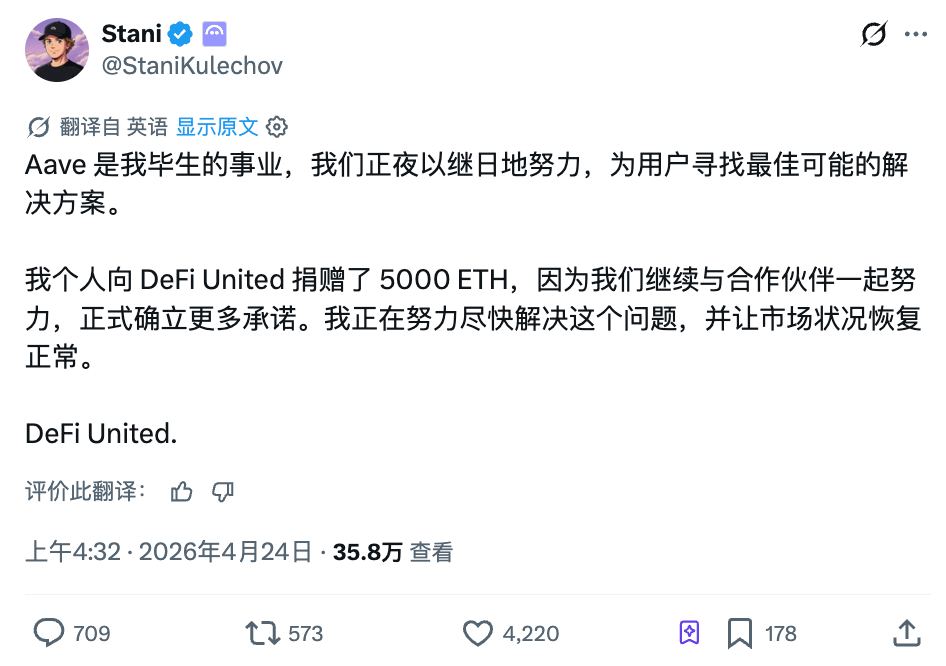
Stani's wording in that tweet is worth savoring; he called Aave his "lifelong career." When a founder publicly uses this term, it typically indicates that the situation has become serious enough to warrant a statement.
Thus, this DeFi United is an industry relief mechanism led by Aave's founder. As of today, those publicly committing funds include the Ethereum staking protocol Lido, the re-staking protocol EtherFi, the Golem Foundation, and Mantle, which is under Bybit.
However, upon closer inspection, it becomes apparent that the relief efforts from these five entities have not yet fully materialized.
What can be definitively confirmed at present is Stani's own 5,000 ETH and the Golem Foundation's contribution of 1,000 ETH. The proposal from Lido to allocate 2,500 stETH and the proposal from EtherFi to contribute 5,000 ETH are still undergoing their respective DAO voting processes. Mantle's proposed 30,000 ETH is characterized as a loan and is currently in the planning stage on the governance forum.
Moreover, Lido's proposal includes a prerequisite: funding will only be allocated if the complete recovery plan is assembled. This means that if the total amount is insufficient, it may not be disbursed.
How significant was the gap from KelpDAO previously?
The hacker borrowed approximately 99,600 ETH in total, with the Arbitrum security council freezing about 30,700 ETH, leaving a remaining gap of approximately 68,900 ETH, equivalent to about $160 million.
The potential support from five parties adds up to around 43,500 ETH, still falling short by 25,000 ETH, currently unclaimed by anyone.
The DeFi version of "Troubled Asset Relief Program"
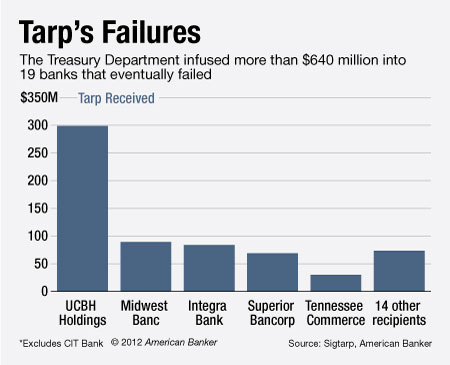
In September 2008, two weeks after the collapse of Lehman Brothers, the U.S. Treasury launched something called TARP, officially known as the "Troubled Asset Relief Program." In simple terms, Wall Street messed up, and the government organized a group of financial institutions to contribute funds to the pool to share the burden of bad debts and avoid a complete systemic explosion.
What DeFi United is doing is structurally almost identical to TARP.
If Aave's bad debts are not filled, the consequences will not just concern Aave alone. The rsETH token is used as collateral by many DeFi protocols, and according to Aave's incident report, Aave holds approximately 83% of the circulating supply of rsETH.
If this batch of assets cannot maintain its peg, the bad debts would spread like an infectious disease to all protocols accepting rsETH. According to Lido's proposal, users in just the EarnETH treasury could potentially face forced liquidation losses of up to 9,000 ETH.
This is why even competitors are coming forward to contribute. Lido and EtherFi are not aligned with Aave; they operate their own lending or staking businesses. However, if rsETH becomes completely unpegged, their users and liquidity pools will also be affected. Saving Aave is essentially saving themselves.
The logic of financial crises tends to follow this pattern. Goldman Sachs did not contribute to TARP out of fondness for Merrill Lynch; they did so because if Merrill fell, Goldman could not survive either. The contagious nature of the financial system dictates that "too big to fail" institutions, when faced with problems, necessitate a collective contribution from all.
However, the key difference is well understood by us all.
TARP had the U.S. Treasury and the Federal Reserve backing it. The Treasury has the authority to compel financial institutions to participate, and the Federal Reserve can inject liquidity without limitation.
This time, there is no institution behind DeFi United with the authority to compel anyone to contribute funds. Lido's 2,500 stETH needs DAO voting, EtherFi's 5,000 ETH requires DAO voting, and Mantle's 30,000 ETH awaits governance discussion.
So, DeFi or AAVE's current predicament is that it needs a "relief plan," but its relief plan is a crowdfunding effort. Whether DeFi United succeeds depends on each participant's community vote, deciding whether it is worth using their treasury funds to fill someone else's hole.
This may be the first time the crypto industry has reached this crossroads.
In the past, when DeFi protocols encountered issues, either the founding team contributed funds to cover losses, or users accepted losses and walked away. There has never been a case where competitors sat down together to jointly inject capital to rescue a shared systemic risk.
This time, am I footing the bill again?
Whether DeFi United can gather enough of the 68,900 ETH remains unknown today. But one thing is already clear: regardless of the outcome, the entities that will be responsible for covering this gap have already been identified.
According to the incident report on Aave's governance forum, if the gap cannot be fully filled, the bad debts will be distributed among Aave's deposit users. Specifically, those who deposited WETH into Aave to earn interest may find their accounts diminished in value.
The report estimates the scale of the bad debts based on how the losses from rsETH are allocated, ranging from approximately $123 million at minimum to up to $230 million at maximum.
What did these users do? They deposited some ETH, earning a few points of annualized return. They likely had no idea that KelpDAO would encounter issues, and were even unaware of a cross-chain bridge using a messaging verification mechanism called LayerZero, which had security configuration problems.
Yet, their money was used as counterparties for the ETH borrowed by the hacker.
If all proposals pass and funds are fully acquired, deposit users might walk away unscathed. However, if the funds are insufficient, these users' deposits will be cut back, to the extent depending on how big the gap is.
And they have no voting rights in this matter. The deposit users who will bear the consequences have no voting buttons to press during this process.
According to CoinDesk, Circle's chief economist, Gordon Liao, has proposed an emergency plan on Aave's governance forum, suggesting raising the borrowing interest rate cap from 10% to 50% to attract new funds and alleviate liquidity exhaustion...
In other words, Aave's current strategy is to use more expensive funds to fill deeper holes.
After the 2008 financial crisis, the world spent a lot of time establishing various deposit insurance systems, stress testing, and frameworks for systemic risk regulation, with a core goal of:
Ensuring that ordinary depositors no longer foot the bill for the reckless actions of financial institutions.
DeFi has spent nearly a decade building a system that bypasses these frameworks. However, the pitfalls that the banking industry has encountered over hundreds of years will not automatically disappear just because you change the code. Bank runs, bad debt infections, and innocent depositors being forced to pay—none of this has been spared.
As of the time of writing, the available liquidity in Aave's USDC liquidity pool is less than $3 million. If you wish to withdraw your deposited stablecoins from the largest lending protocol in DeFi now, the chances are still low that you will succeed.
Whether in DeFi or CeFi, we hope that this time, ordinary people will not be the ones footing the bill.
免责声明:本文章仅代表作者个人观点,不代表本平台的立场和观点。本文章仅供信息分享,不构成对任何人的任何投资建议。用户与作者之间的任何争议,与本平台无关。如网页中刊载的文章或图片涉及侵权,请提供相关的权利证明和身份证明发送邮件到support@aicoin.com,本平台相关工作人员将会进行核查。


