Author: Jae, PANews
The $100 anchor point was once the cornerstone of Strategy's financing magic. The financing perpetual motion machine crafted by Michael Saylor for purchasing Bitcoin has now stalled.
On April 14, the perpetual preferred stock STRC under Strategy dropped below the $100 par value anchor on Nasdaq, plummeting to a low of $99.06, with trading volume sharply reduced to 47% of its normal level, and it has continued to operate within a discount range since.
The financing efficiency of STRC directly determines whether Strategy can continue to accumulate more. Once STRC falls below par value, it means Saylor's financing engine for hoarding Bitcoin has temporarily stalled.
When this global leader in Bitcoin holdings, DAT (Digital Asset Treasury), loses its most crucial incremental funding channel, the marginal buying support for the entire Bitcoin market becomes shaky.
STRC 11.5% High-Yield Lock Price, Strategy Builds Bitcoin Buying Machine
In July 2025, STRC was officially born, addressing Saylor's pain point: continuously drawing from traditional capital markets to buy Bitcoin without diluting the voting rights of MSTR common stock.
The original design of STRC was to control the trading price around the $100 par value, ensuring the company can continuously raise funds through the "At-the-Market" (ATM) program.
If the price remains below $100, the board will raise the dividend to attract investors seeking stable cash flow;
If the price significantly exceeds $100, it will maintain or lower the dividend to reduce financing costs.
Starting from an initial 9% annual dividend, STRC has continuously raised the rate for seven months and has reached 11.5% to date. Continuous investors seeking stable high yields have kept STRC consistently above par value, allowing Saylor to convert traditional market funds into buying power in the Bitcoin market through the ATM program.
In addition, Saylor abandoned the traditional net profit valuation model of the capital markets and instead adopted a "Bitcoin Gain" metric to define the value of Strategy as a "Bitcoin Standard" enterprise.
This metric measures the percentage growth of Bitcoin holdings corresponding to each share of common stock.
In the first quarter of 2026, Strategy achieved a 6.2% Bitcoin gain, with a full-year target of 9.5%.
STRC is the lever to achieve this target: by issuing preferred stocks with fixed financing costs to buy Bitcoin with long-term appreciation potential.
According to Saylor's estimates, as long as the annualized long-term growth rate of Bitcoin exceeds 2.05%, common stock shareholders will continue to benefit.
For more than the past half a year, this logic has been a repeating cycle: issue STRC financing → buy Bitcoin → Bitcoin price increases → stock market value rises → STRC becomes more sought after → raise more money to buy more Bitcoin.
STRC operates like an unceasing money printing machine, supplying Saylor's Bitcoin empire with continuous ammunition.
STRC Falls Below $100 Anchor Point, Strategy Launches “Biweekly Dividend” Strategy
The $100 par value is the lifeblood of the entire financing flywheel of STRC. Once it falls below this threshold, the ATM issuance will come to a halt, and the money printing machine will stop operating.
This de-linking is a dual blow of macro headwinds compounded by deteriorating expectations.
The war in Iran became the last straw crushing STRC.
Shipping through the Strait of Hormuz was hindered, oil prices surged, igniting inflation concerns, and market expectations for a Fed rate cut were pushed back from mid-2026 to 2027.
For preferred stocks like STRC, which possess strong bond characteristics, a long-term high baseline interest rate means that the attractiveness of its 11.5% dividend is being diluted by rising risk-free rates.
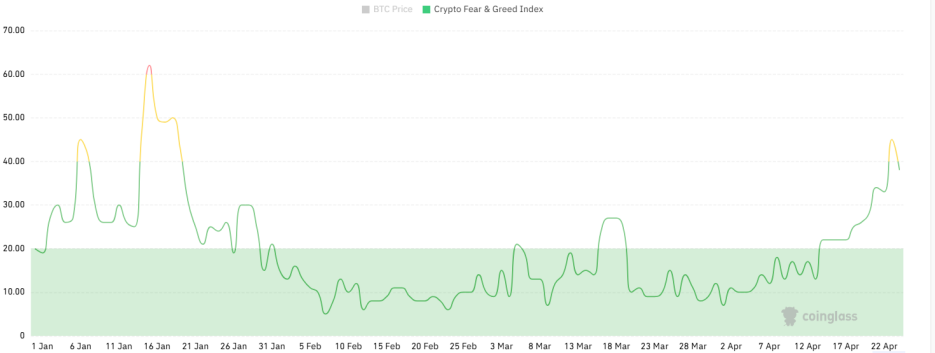
At the same time, the fear and greed index in the crypto market plunged to 9, indicating "extreme fear." Funds that originally pursued stable returns began to sell non-core assets, and the relatively illiquid STRC was the first to suffer.
If the macro environment served as the external trigger, then the dividend decision on April 1st was the needle that burst the bubble.
On this day, Strategy announced it would maintain the dividend at 11.5% but would terminate the monthly rate increase routine that had been in place for seven consecutive months.
PANews believes that the company's intention was to convey confidence to the market: the interest rate has reached a steady state, and prices are close to par value. However, in the eyes of investors, this action was misinterpreted as a sign that the company's financing ability had peaked and they had lost confidence in the later-stage price increase of Bitcoin.
Among STRC holders, retail investors account for as much as 80%. Their motivation for entry was based on the inertia expectation of "monthly rate increases and price stability above par value."
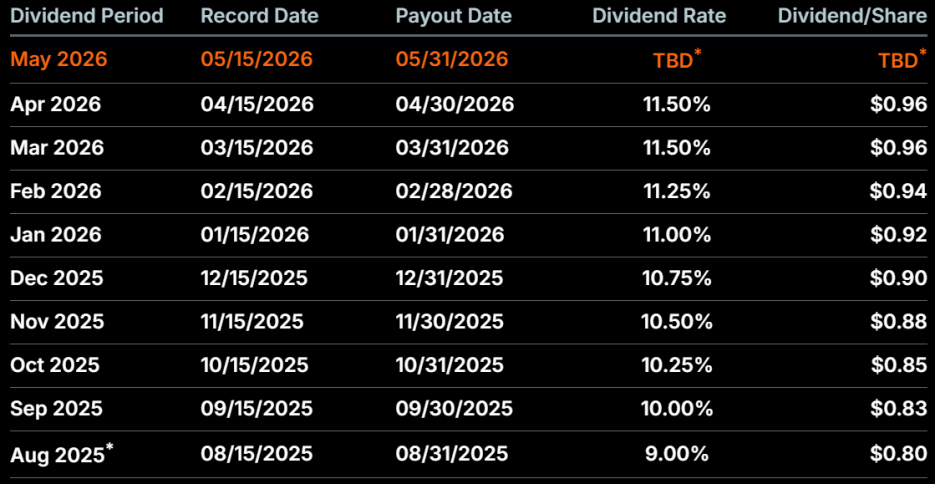
The first halt in the rate increase directly shattered this belief, causing a mass exit of retail investors, a sharp decline in trading volume, and the par value anchor was broken.
STRC falling below par value impacts not just Strategy, but the entire supply-demand structure of the Bitcoin market.
When the price of STRC falls below par, the ATM market issuance loses significance. Issuing shares at a discount would further suppress the price, creating a vicious cycle, forcing Strategy to halt issuance.
Real data supports this: the latest financing tracking shows that the additional financing amount for STRC is zero. The recent large purchase of 34,164 Bitcoins by Strategy was made using leftover funds from the previous financing.
With STRC financing stalled, the largest bullish entity in the Bitcoin market has temporarily come to a stop. The Bitcoin market has thus lost the marginal buying support of $1 to $2 billion weekly.
Facing the crisis of tool failure, Strategy acted quickly, attempting to regain pricing power through financial means.
Strategy announced a shareholder vote on April 28, proposing to increase the dividend frequency of STRC from monthly to biweekly.
This is a precise psychological tactic aimed at retail investors. By shortening the dividend cycle, it reduces the price gap caused by the ex-dividend date (the next trading day following the record date for the dividend distribution). Historically, STRC has averaged a drop of 45 cents on the ex-dividend date, taking about 12 days to return to par value.
A biweekly cash flow return can significantly lower the reinvestment lag for investors, making it more appealing for cash-flow-sensitive retail investors and income funds.
If the proposal is passed, STRC will become one of the few publicly traded equity instruments globally that offer biweekly dividends.
To counter the market's Ponzi-like doubts, Strategy also emphasized the depth of its non-Bitcoin assets. According to disclosures, the company currently holds approximately $2.25 billion in cash reserves, sufficient to cover all preferred share dividend obligations for about 30 months without issuing new shares or selling Bitcoin.
Additionally, its traditional business intelligence software segment can generate a gross profit of $320 million annually, safeguarding the company's survival in extreme market conditions.
4.3x BTC Reserves Can't Dissolve Controversy, STRC Hides Chronic Hemorrhage Risk
Although STRC has Bitcoin reserves as support, controversies surrounding this tool have never ceased.
Traditional financial experts like Peter Schiff argue that Bitcoin itself produces no earnings, and the high dividend of STRC is essentially reliant on new investors entering or sacrificing the interests of common stock shareholders.
Their logic follows this path: Bitcoin price declines → STRC price decreases → loss of financing function → unable to continue buying Bitcoin to support the price → forced to sell Bitcoin to pay dividends → Bitcoin price further declines.
While Strategy can actively intervene to prevent a "death spiral," it will still face a dilemma: either significantly dilute the equity of common stock shareholders to raise funds, or continue raising yields to maintain attractiveness, incurring higher financing costs.
Thus, STRC may not experience a UST-style death spiral, but it faces a "self-reinforcing" downward risk, resembling "chronic hemorrhage" instead.
Strategy counters by stating that the STRC model is based on Bitcoin's property as a long-term deflationary asset. As long as the appreciation of Bitcoin exceeds the financing cost, the preferred stock financing will produce a positive asset accumulation effect rather than merely shifting funds from one area to another.
It has been disclosed that the current coverage ratio of Bitcoin reserves to preferred stock principal exceeds 4.3 times, meaning that only if Bitcoin falls below approximately $18,000 will STRC face substantial insolvency.
However, capital markets always react ahead of fundamentals. Before reaching this threshold, STRC's secondary market price may collapse due to the panic in the Bitcoin market.
It is worth noting that investors trading STRC often overlook its underlying legal definitions. Although it has a nominal par value and fixed dividends, legally it falls under equity securities, which lack the mandatory repayment obligation of bonds and have no fixed maturity date.
In the hierarchy of capital repayment, STRC ranks behind convertible bonds, secured debts, and other types of debt. In extreme market crash scenarios, holders may face permanent loss of principal.
STRC falling below the $100 par value is a deep water crossing that Bitcoin as a DAT asset must navigate on its path to maturity.
For ordinary investors, STRC's de-linking serves as a wake-up call. In the crypto market, any form of "anchoring" is not absolute; liquidity is always the primary survival principle.
The current 11.5% high yield of STRC may be tempting, but it conceals inherent credit risks and liquidity traps.
On the journey towards a "Bitcoin standard," STRC's fall below par value is merely a brief interlude. While pursuing larger scales, ensuring the structural stability of the financing machine is the key to winning this long race.
免责声明:本文章仅代表作者个人观点,不代表本平台的立场和观点。本文章仅供信息分享,不构成对任何人的任何投资建议。用户与作者之间的任何争议,与本平台无关。如网页中刊载的文章或图片涉及侵权,请提供相关的权利证明和身份证明发送邮件到support@aicoin.com,本平台相关工作人员将会进行核查。


