Written by: KarenZ, Foresight News
In Silicon Valley, the name Naval Ravikant itself is a form of credit.
He is a co-founder of AngelList and one of the most representative early investors of the past decade, having backed companies like Uber, Twitter, and Notion. Today, within the USVC Venture Capital Access Fund (USVC), Naval is not just making a symbolic appearance. According to the fund's supplemental disclosure document from April 2026, he serves as the chair of the investment committee, responsible for portfolio construction and strategic oversight.
This arrangement is significant because what USVC offers is not just a concept of a "low-threshold fund." What it truly seeks to provide is access to an ability that was previously only open to a select few: earlier access to private growth companies.
If viewed superficially, USVC might be understood as a "venture capital fund for retail investors." However, when examined alongside the official website, prospectus, and portfolio page, the core story AngelList wants to tell is actually clearer and sharper: a growing number of the most imaginative companies today are going public later; IPOs are increasingly resembling exit points rather than entry points; and ordinary investors are kept out, not just from risks but also from that segment of the most "ripe" growth.
The significance of USVC lies in its attempt to pry this door open a little bit.
The core of USVC is not selling a fund but selling "pre-IPO" entry access
The homepage of the USVC website presents the issue very straightforwardly: the next wave of growth is happening in private markets. The website also provides a set of representative comparative data: the median age of a company's IPO in the U.S. in 1980 was 6 years, and it has now increased to 13 years. The additional 7 years means that a significant amount of value creation occurs outside the public market.
This is precisely the key product logic of USVC. The USVC prospectus states that USVC primarily invests in VC funds, SPVs, and private growth-oriented companies. The most easily overlooked but most critical term here is "private growth-oriented companies." The document defines it directly as private companies that investment advisors believe "have significant growth potential at the time of investment."
In other words, the selling point of USVC is not abstract "allocation to venture capital" but bringing ordinary investors to the most attractive segment of assets in the primary market. What it wants to sell is a channel to access private growth companies.
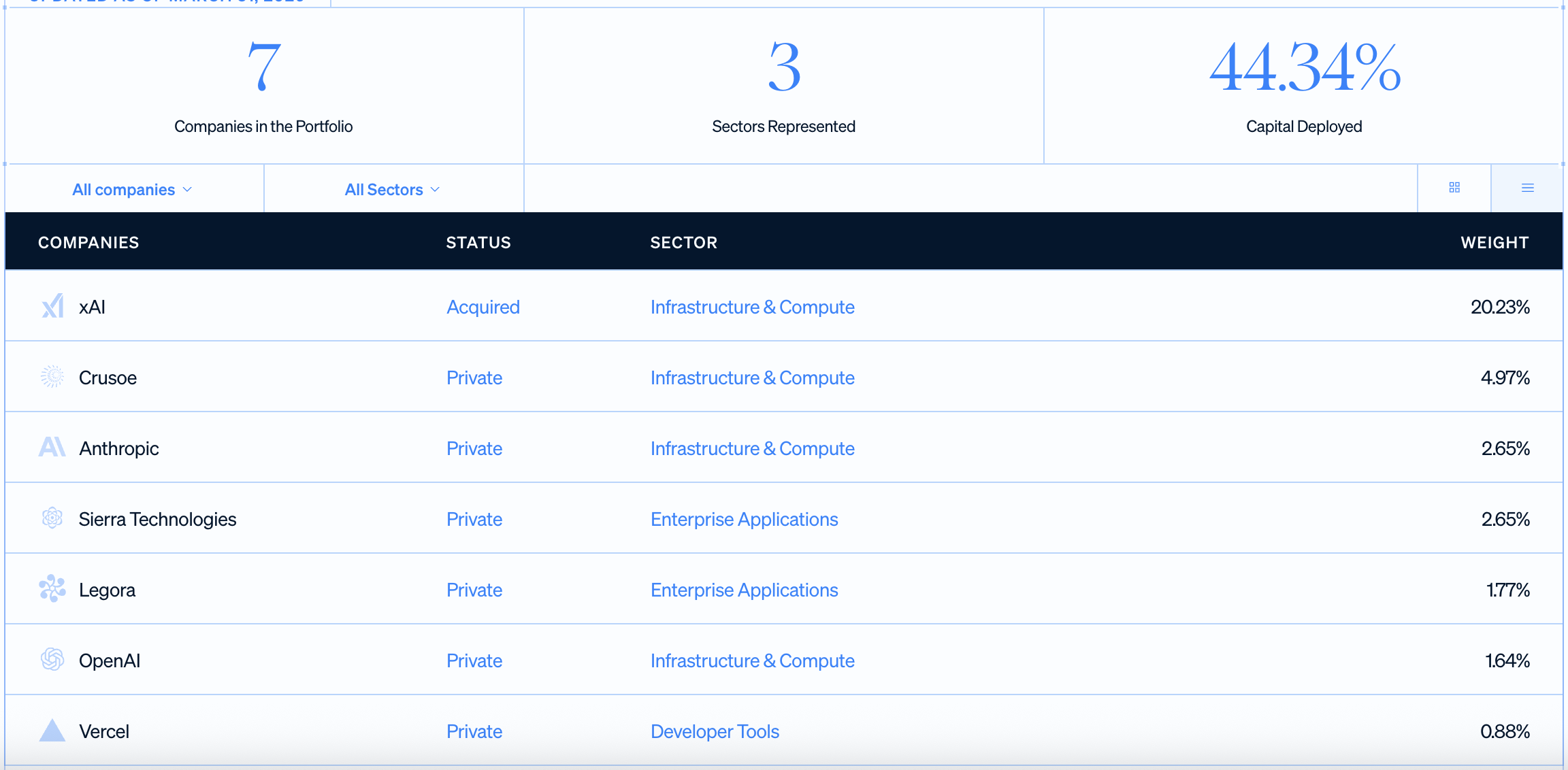
This is also why it continually emphasizes names like OpenAI, Anthropic, xAI, and Vercel. The portfolio page on the website shows that as of March 31, 2026, USVC has deployed 44.34% of its capital, with 7 companies already in the portfolio, the largest single holding being xAI, followed by Crusoe, Anthropic, Sierra, Legora, OpenAI, and Vercel. Regardless of how these positions ultimately perform, the message that AngelList wants to convey to investors is clear enough: you could only see these companies' names in the news before, but now you can gain some exposure through a fund before they go public.
For ordinary investors, this kind of appeal is very strong. Because in traditional paths, they typically only have the opportunity to buy after a company's IPO. By that time, the earliest and most intense growth may have already been taken by the founding team, employees, early funds, and institutional shareholders.
From a legal structure perspective, this fund is registered as a closed-end management investment company under the U.S. Investment Company Act of 1940. It was initially established on April 8, 2021, and converted to a Delaware statutory trust on August 7, 2025, currently raising funds through continuous issuance. The initial investment threshold is $500, with no minimum for subsequent contributions, and the website even supports monthly contributions.
This packaging is clever. It retains the core attractions of the private market, which is pre-IPO growth companies; on the other hand, it tries to make the purchase process resemble a retail financial product. U.S. users do not need to become accredited investors first, nor do they need to enter the high-net-worth circle, and they do not have to endure complex tax filings like traditional private equity funds. At least at the purchasing entry point, AngelList tries to make it look straightforward.
Accessing private companies does not equal a simple investment
Also because USVC’s narrative is sufficiently enticing, what really needs to be clarified are the constraints behind it.
First, what investors buy is only a share of a fund. The fund holds these private growth companies either directly or indirectly through VC funds, SPVs, and direct investments. In other words, what investors gain is the "opportunity to access private growth companies," rather than a clear and immediately liquid ownership experience like buying stocks.
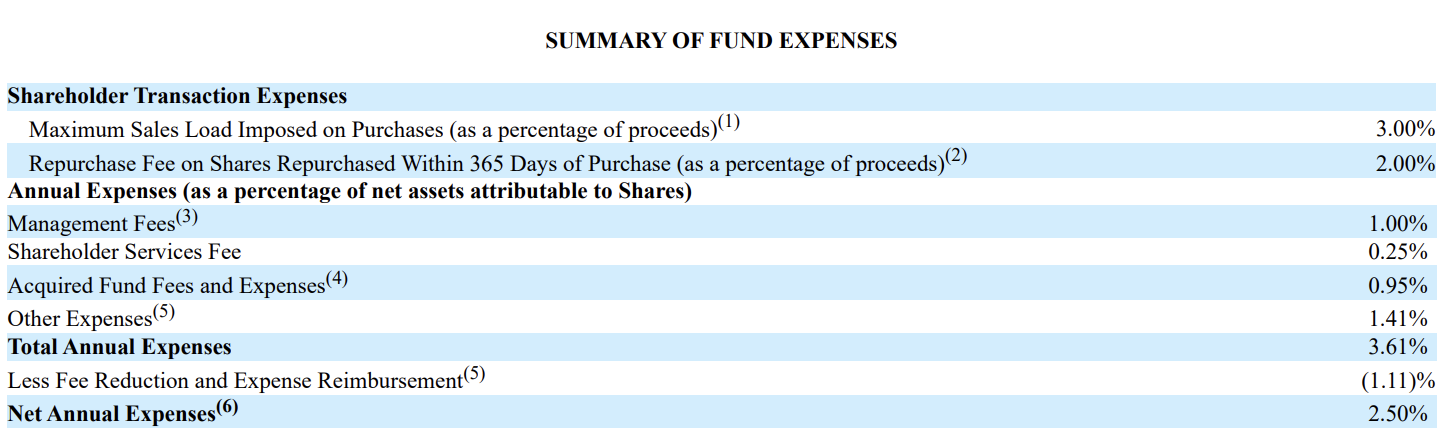
Second, this access comes at a cost, and it is not low. The fee schedule on page 20 of the Prospectus shows that USVC’s management fee is 1.00%, shareholder service fee 0.25%, underlying fund fees and expenses 0.95%, other fees 1.41%, resulting in a total annual fee rate of 3.61%. After fee waivers (at least continuing until October 29, 2026), the net annual fee rate is 2.50%. After penetrating through to the underlying VC vehicle and operational costs, investors are faced with a product that does not currently have a low net fee rate.
Third, this fund does not provide ordinary investors with a truly high liquidity exit path. USVC is not listed on any exchange, does not have a public trading market, and liquidity primarily relies on whether the board initiates quarterly buybacks, which usually do not exceed 5% of net assets. The document initially set a 2% buyback fee for holdings of less than one year, but the board has currently decided to waive it (modifiable or terminable). This means it is a bit more flexible than traditional VC funds but still far from being "easy to enter and exit".
Fourth, USVC does not have a fixed termination date like traditional 10+2 year venture funds, but it is also a long-term closed-end structure without a specified expiration date. When the underlying assets realize value still depends on whether liquidity events such as IPOs, mergers, or secondary private placements occur. The prospectus also clearly reminds that many portfolio investments may take years to appreciate.
Moreover, even after the investment company's IPO, it is often still subject to lock-up restrictions, with a common lock-up period of 180 days. During this period, the fund itself, or the underlying VC/SPV managers the fund invested in, may not be able to sell immediately.
Why is the Web3 community paying attention to this fund?
The reason USVC has attracted additional attention from the Web3 community is related to Naval and AngelList's sustained investment in the crypto industry over the years.
Naval has long been one of the most openly supportive investors of crypto assets and the Web3 narrative in Silicon Valley. In 2017, he mentioned in an interview with Laura Shin that his attention had largely shifted to Crypto; by 2021, he had a systematic discussion about Web3, NFTs, and digital ownership with a16z partner Chris Dixon in a long conversation with Tim Ferriss.
At the platform level, AngelList has not treated Crypto as a marginal business in recent years, starting in 2022 to support investors making investments through USDC on its platform. AngelList’s website currently lists a separate Crypto solutions page and clearly states its cooperation with CoinList to support Crypto SPVs and related fund vehicles.
In addition, on the other hand, more and more cryptocurrency exchanges and Web3 projects are starting to accelerate the launch of Pre-IPO products. USVC represents a slow variable within the system, while most products in Web3 Pre-IPO represent fast variables driven by efficiency and can typically exit at any time.
The two worlds originally used different languages but are now competing for the same group of investors, competing for the same narrative, and competing for the same kind of anxiety: if great companies are going public later and later, can ordinary people still get a piece of the pie "before they go public"?
The name Naval can push that door open. AngelList’s platform network can bring private companies closer. But the world behind the door has not become very easy as a result.
免责声明:本文章仅代表作者个人观点,不代表本平台的立场和观点。本文章仅供信息分享,不构成对任何人的任何投资建议。用户与作者之间的任何争议,与本平台无关。如网页中刊载的文章或图片涉及侵权,请提供相关的权利证明和身份证明发送邮件到support@aicoin.com,本平台相关工作人员将会进行核查。


