Original | Odaily Planet Daily (@OdailyChina)
Author | Azuma (@azuma_eth)
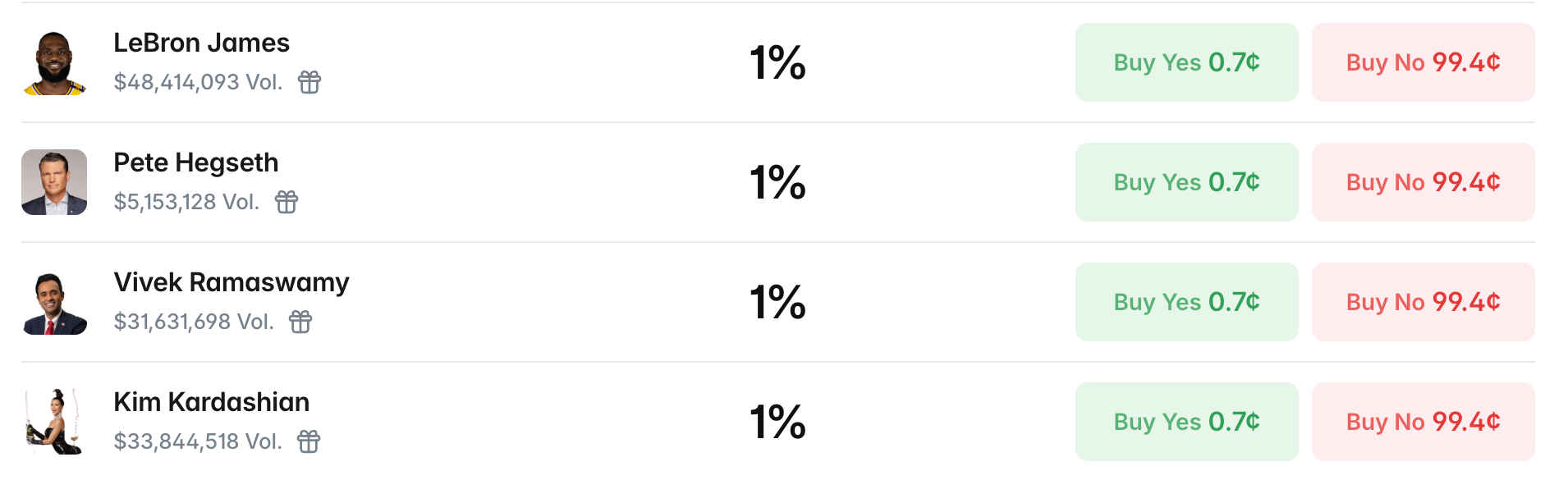
This morning, Nick Devor, a reporter for Barron's, posted a very "strange" phenomenon on X — in the "2028 Presidential Election" prediction event on Polymarket, approximately 70% of the trading volume is concentrated on candidates who are nearly impossible (real-time probability less than 1%).
For instance, the highest trading volume is surprisingly NBA star LeBron James ($48.41 million), followed by socialite Kim Kardashian ($33.84 million), and even candidates who do not have U.S. citizenship (not eligible to run), such as billionaire Elon Musk ($23.14 million) and New York City Mayor Zohran Mamdani ($18.39 million)...
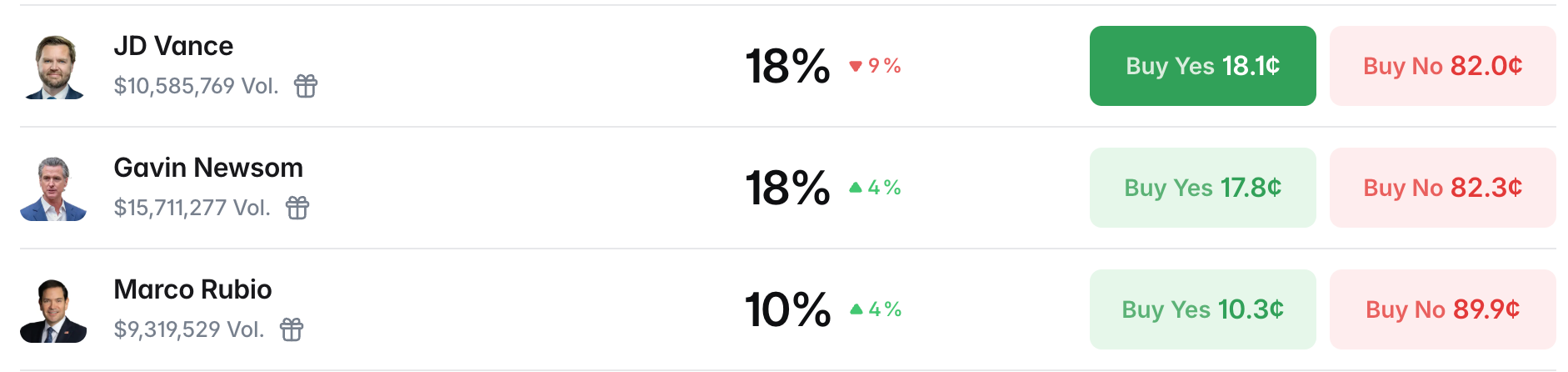
As for the truly high-probability candidates, such as the leading real-time probability Vice President JD Vance ($10.58 million), California Governor Gavin Newsom ($15.71 million), and Secretary of State Marco Rubio ($9.32 million), their trading volumes are significantly lower than those of the aforementioned "celebrity candidates."
According to official data from Polymarket, the total trading volume for the "2028 Presidential Election" has reached $549 million, making it the most popular betting event on the platform. However, a closer look at the trading volume data for the 36 candidates presents the aforementioned abnormal situation. Why is this? Are people crazy for betting on candidates who are almost or completely impossible?
The answer is naturally not so straightforward. Earlier this year, Odaily published an article titled "Who Is Betting Against Common Sense in the Prediction Market?", which used examples like "the Second Coming" and "flat earth theory" to explain how the groups trading or providing liquidity in these absurd market events can be categorized into three main types: "lotto players, bots, and arbitrageurs."
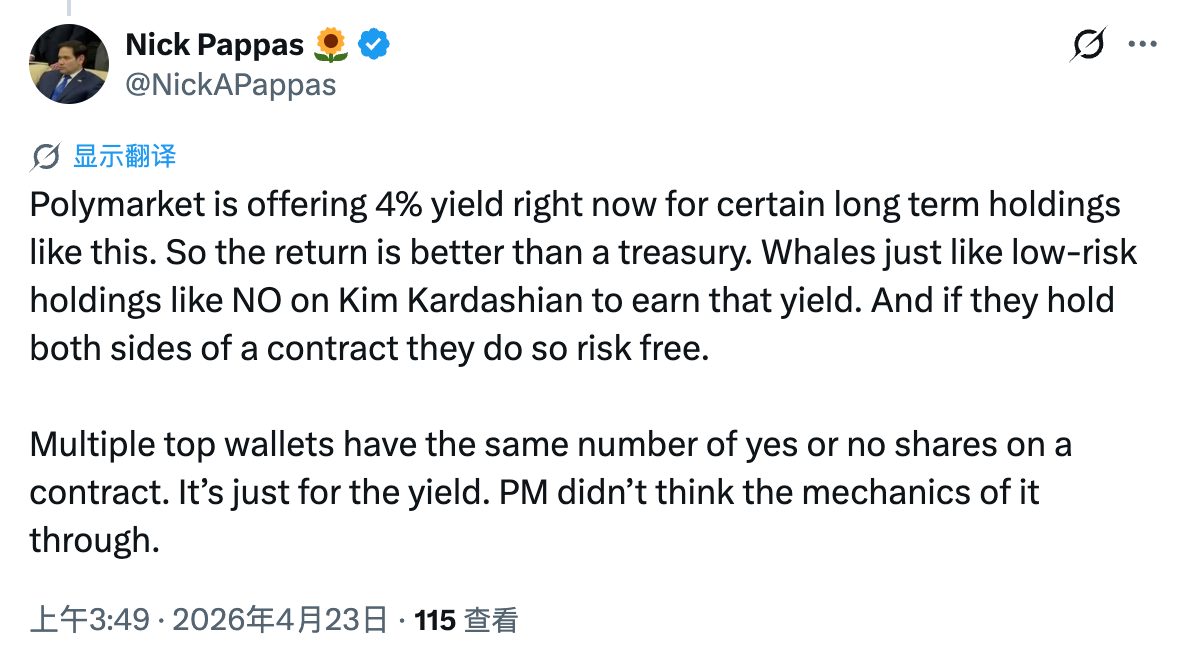
Nick Devor’s explanation aligns with the third logic we listed, as he discovered that multiple top addresses hold the same number of YES and NO shares on the same candidate, which is essentially to earn Polymarket's subsidized risk-free returns — to maintain long-term pricing accuracy, Polymarket offers a 4% annualizedholding reward for some positions based on the total position value, and the "2018 Presidential Election" is one of these subsidized events.
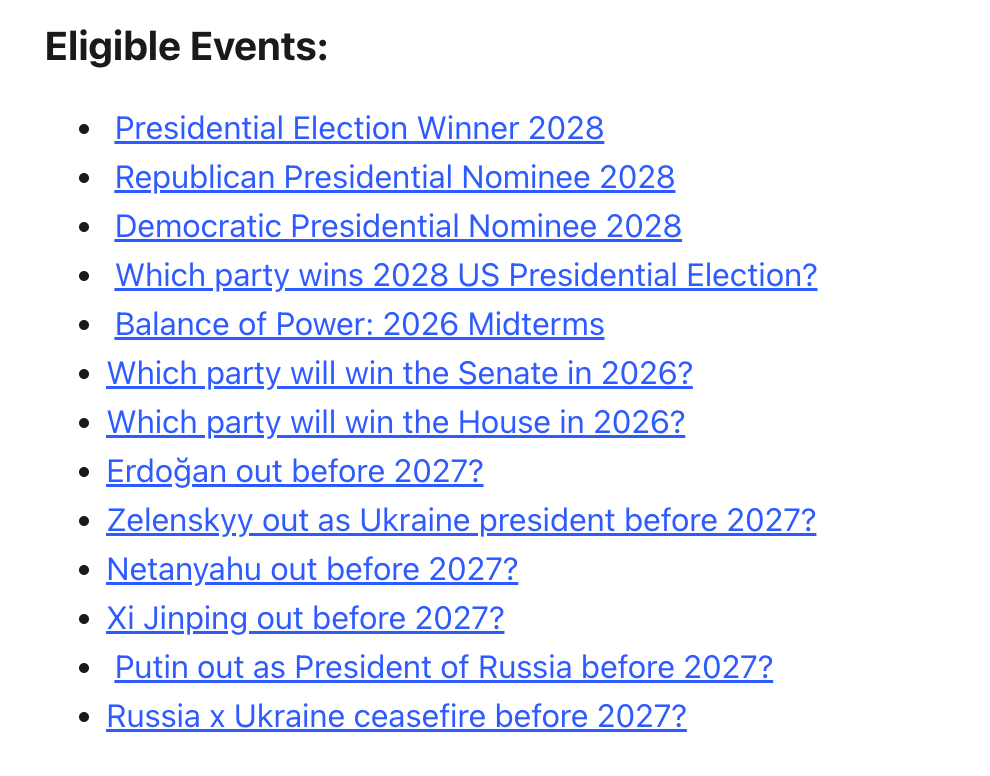
Nick Devor stated that the 4% annualized yield is already higher than the real-time U.S. Treasury return rate (3.98% for 5-year), and whales would prefer such low-risk positions, such as buying NO on James or Kardashian (after all, it's the same, just buy whoever is popular) to gain these returns; if they hold both YES and NO shares, they can achieve risk-free profits.
As for why some users might hold small amounts of YES on such low-probability candidates, another X user A5 (@probablythenuts) explained that in this multi-option market, Polymarket provides a function that allows users to convert a set of NO shares into corresponding YES shares.
Many users use this feature considering liquidity depth or the advantage of pricing — that is, instead of directly buying YES for the candidates they believe will win, they first buy NO for the candidates they believe won’t win, and then convert those NO into a corresponding set of YES shares. Moreover, they can also buy NO for multiple candidates at the same time and hold the corresponding YES for other candidates after conversion, including any new candidates that may be added in the future.
So, in the Polymarket "2028 Presidential Election" event, users trading James and Kardashian are neither crazy nor foolish; they are either aiming for stable annualized returns or seeking better execution paths. Their actions may seem absurd, but they are still driven by rationality.
免责声明:本文章仅代表作者个人观点,不代表本平台的立场和观点。本文章仅供信息分享,不构成对任何人的任何投资建议。用户与作者之间的任何争议,与本平台无关。如网页中刊载的文章或图片涉及侵权,请提供相关的权利证明和身份证明发送邮件到support@aicoin.com,本平台相关工作人员将会进行核查。


