Author: 137Labs
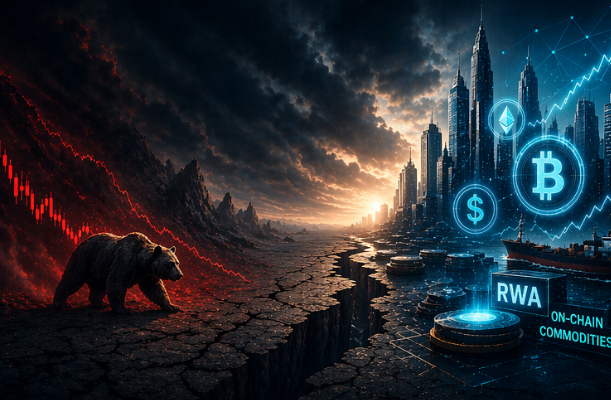
In the first quarter of 2026, the cryptocurrency market did not see a rebound; instead, it further worsened in the downward trend that began at the end of 2025, gradually entering a more defined "bear market phase". Under the dual influence of a tightening macro environment and geopolitical conflicts, the entire industry has shown clear signs of contraction and restructuring.
To summarize this quarter in one sentence:
The market is not just declining, but undergoing a reshuffle.
I. Overall Market: Decline is Just the Surface, the Key is "Loss of Growth Momentum"
In Q1 2026, the total market capitalization of the cryptocurrency market shrank significantly:
- Total market capitalization fell to $2.4 trillion
- Quarterly decline of approximately 20%
- Compared to the peak in October 2025, the overall retracement is close to 45%
This marks the second consecutive quarter of decline.
More critically—the decline mainly concentrated in a short period from mid-January to early February.
An important trigger was the nomination of Kevin Warsh as chairman of the Federal Reserve, which the market interpreted as: future monetary policy may be more "hawkish" (interest rate hikes/tightening liquidity).
Changes in Market State
Throughout the quarter, a clear characteristic emerged: the market entered a sideways consolidation.
Even with geopolitical conflicts (such as the US-Iran war), there were no drastic fluctuations.
Note: Panic selling has been released, but funds have not re-entered.
Decline in Trading Activity
- Daily average trading volume dropped to approximately $117.8 billion
- Month-over-month decline of 27%
This means:
The market is not only falling but is also becoming "increasingly quiet."
II. Stablecoins: "Liquidity Anchor" in a Bear Market
In a significantly shrinking overall market, stablecoins displayed entirely different characteristics:
- Total scale remained approximately $309.9 billion
- Slight growth of approximately 0.5%
The underlying implication is critical: stablecoins have become a "funding docking point" in the market, rather than a risk asset.
Structural Changes: Funds are Being Redistributed
1) Tether experiences a supply contraction for the first time
- Decline of approximately 1.6%
- Market share still high at 59%
This is the first significant decrease since 2022.
Indication: A portion of funds is withdrawing from the crypto system.
2) USD Coin continues to grow
- Growth of approximately 2.4%
Indicating: more compliant and transparent stablecoins are gaining favor.
3) New players rapidly expanding
USDS, USD1 and others achieving 30%+ growth.
Essence:
Stablecoin competition has entered a "product + ecosystem-driven" phase.
III. Macro Asset Comparison: Cryptocurrency Assets Clearly Losing Position
The most noteworthy aspect of this quarter is not within the crypto circle, but in cross-asset performance:
Commodities are experiencing strong surges
- Crude oil increased by +76.9%
- Gold increased by +8.1%
Reasons:
- US-Iran conflict causing supply shocks
- Global risk aversion sentiment rising
Cryptocurrency assets are clearly lagging
- Bitcoin dropped 22%
- NASDAQ dropped approximately 7.1%
- S&P 500 dropped approximately 4.8%
The conclusion is very clear:
In a risk-averse environment, cryptocurrency assets are not considered "safe-haven assets".
At the same time:
The US Dollar Index (DXY) rose slightly.
Indicating:
Funds are flowing back to "traditional safe assets," rather than into crypto.
IV. Exchanges: Overall Decline in Activity
Centralized Exchanges (CEX)
- Total trading volume: $2.7 trillion
- Month-over-month decline: 39.1%
Key phenomena:
- January maintained high levels
- Then continued to decline
- In March, it fell to nearly two-year lows
Exchange Landscape
- Binance remains at the top (37%)
- MEXC second (10%)
- HTX experienced the largest decline
Essence:
In a bear market, there are no winners, only "those who fall less and those who fall more."
Decentralized Exchanges (DEX)
Solana continues to lead
Market share: 30.6%
Although trading volume has decreased, it still ranks first.
Changes in Competitive Landscape
BNB Smart Chain: second place
Ethereum: third place, but surpassed Solana in March.
Trend:
Competition among top chains is intensifying, rather than being one-sidedly overwhelming.
New chains are beginning to enter the spotlight
Monad has entered the top ten.
Indicating:
Even in a bear market, infrastructure competition continues.
V. The Most Interesting Change: "Trading Oil" Begins On-Chain
Hyperliquid
A very critical but easily overlooked trend is: Commodity trading is starting to go on-chain.
Data Performance
- Commodity perpetual contracts account for about 30% of total holdings
- Explosion of crude oil trading demand
- Daily trading volume even exceeded Bitcoin at one point
The Mechanism Behind It
Through the HIP-3 proposal: anyone staking funds can issue contracts, including stocks, gold, crude oil.
This means the crypto market is becoming a "24-hour global exchange".
VI. The Real Core Conclusion
1) The market enters a "defensive mode"
Funds flow towards stablecoins.
Investors reduce trading.
Risk appetite declines.
2) Crypto loses "independent trends"
No longer rising independently.
Clearly influenced by macro factors.
Essence:
Crypto has become a part of the global financial system.
3) Trading behavior is changing
Speculation is decreasing.
Practical demand is increasing (such as commodity trading).
4) A new narrative is forming
Past: NFT, meme, AI.
Now: stablecoins, RWA, commodity on-chain trading.
Conclusion
In the first quarter of 2026, the cryptocurrency market did not see a rebound; instead, under the combined pressures of macroeconomic factors and geopolitical conflicts, it officially entered a "structural bear market".
Funds are withdrawing from high-risk assets and shifting towards stablecoins and real asset mappings; trading activity continues to decline, while on-chain infrastructure is quietly evolving.
This is not just a cyclic downturn; it feels more like a key turning point for the crypto industry from a "speculative market" to "financial infrastructure".
免责声明:本文章仅代表作者个人观点,不代表本平台的立场和观点。本文章仅供信息分享,不构成对任何人的任何投资建议。用户与作者之间的任何争议,与本平台无关。如网页中刊载的文章或图片涉及侵权,请提供相关的权利证明和身份证明发送邮件到support@aicoin.com,本平台相关工作人员将会进行核查。


