Authors: Alex Immerman and Santiago Rod
Translation: Blockchain in Plain Language

The financial world consists of many verticals, each with its recognized “one true summit.” Healthcare providers, payers, and biotech leaders gather in San Francisco every year for the J.P. Morgan Healthcare Conference. Global macro giants and politicians head to the Swiss Alps annually for the Davos Forum. Each industry, from technology, media, telecommunications, real estate, and industrials to financial services, has its top summit.
At the end of March this year, Kalshi's academic and institutional research division, Kalshi Research, held its inaugural research conference in New York, bringing together academics, Wall Street executives, former politicians, and the traders who truly energize the market. The makeup of the attendees reflects that “this industry is maturing.”
The conference opened with a dialogue between Kalshi co-founders Tarek Mansour and Luana Lopes Lara and Bloomberg's Katherine Doherty. Here are some key points from the conference regarding the industry.
1. Life (and the market) is about more than just elections and sports.
In significant news cycles, a pattern often emerges: a major event (such as the 2024 election, the Super Bowl, or the recent “March Madness” college basketball tournament) dominates the headlines, subsequently leading to a surge in trading volume in the prediction market, creating the impression that “prediction markets are only good at this.”
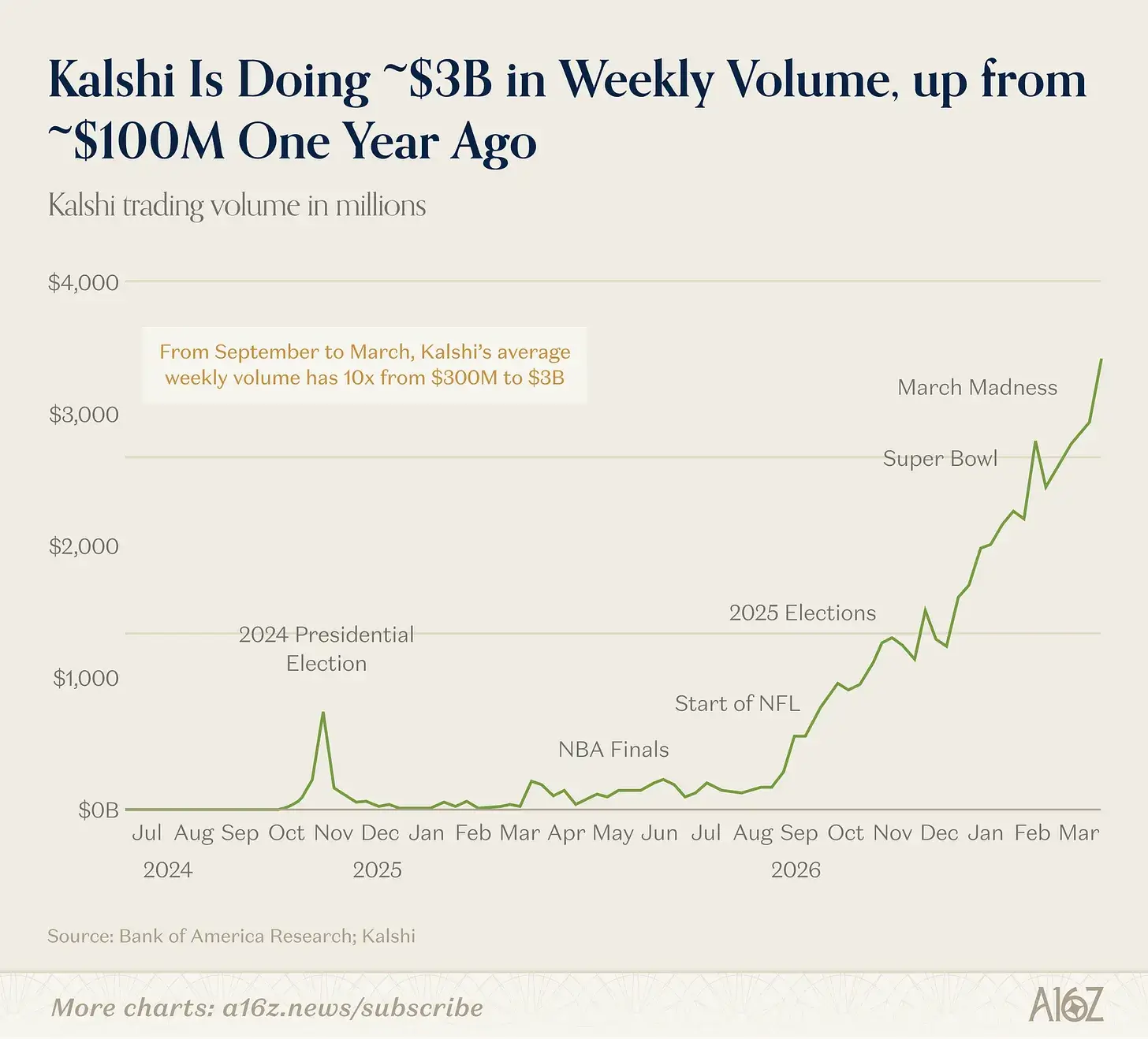
However, while early narratives may suggest that prediction markets are only vibrant during election cycles, Kalshi has seen significant growth in other areas.
At the time of the research conference, the weekly trading volume of sports trades had just reached nearly $3 billion, accounting for approximately 80% of Kalshi's total trading volume, primarily driven by “March Madness.” Tarek and Luana view this dominance as a phase.
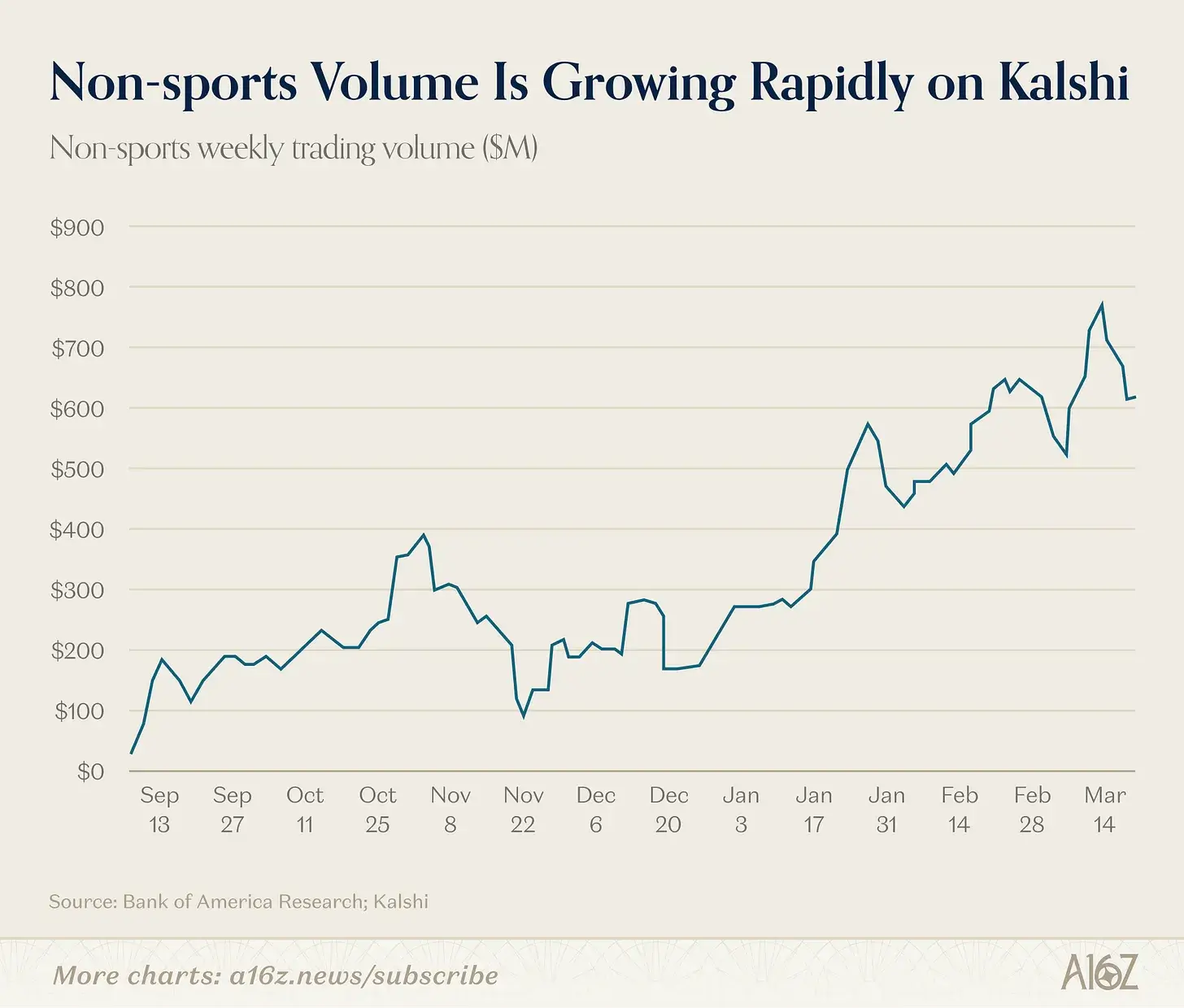
More revealing data indicates that the share of sports trades in the total trading volume is actually at a historical low, despite its absolute trading volume reaching an all-time high. All other categories are growing faster.
Tarek and Luana pointed out that categories like entertainment, cryptocurrency, politics, and culture show stronger user growth, and their trade retention rates outperform sports. Sports serves as a mass market catalyst—it is a familiar, scheduled product that evokes emotional investment.
But the company is also seeing significant growth in its long-tail markets (which account for over 20% of Kalshi's remaining trading volume), which will become crucial for institutional hedging and information markets.
A subsequent institutional panel discussion confirmed this observation from the demand side.
Goldman Sachs Co-Head of Global Equities, Cyril Goddeeris, stated that predictions related to macro events and CPI data are the categories that Wall Street is most concerned about.
CNBC Executive Vice President of Growth, Sally Shin, mentioned that she has been using Federal Reserve Chair markets and non-farm payroll data predictions as narrative tools.
Tradeweb Co-Head of Global Markets, Troy Dixon, described a future where major investment banks will establish dedicated prediction market trading divisions, with financial contracts as core products.
2. Why is Kalshi attracting Wall Street's attention?
There are many reasons why traditional financial markets work well, but one key reason is that every major asset has a recognized benchmark—the S&P 500 index is the average of 500 stocks; crude oil has an Intercontinental Exchange (ICE) benchmark.
However, for political and economic events (such as who will win the election, whether tariff proposals will pass, and the outcomes of Supreme Court cases), there has previously been almost no widely accepted (and dynamically changing) benchmark. Prediction markets have changed that. Now, we can almost provide a vivid, liquid benchmark for the future of any event.
Once you have a credible price, for example, a 30% tariff has a 30% chance of passing, institutional counterparties can trade based on that price. This creates a mechanism to directly trade the event itself, or to hedge against downside risks in other parts of the portfolio. As Troy Dixon of Tradeweb remarked:
“Looking back at Trump's first election, there were many hedging moves in the market. The trade back then was to short the S&P 500 because it was clear that if Trump won, the market would drop. That was a bad trade. The challenge was: how do you price these things? What is the benchmark?”
Tarek described a similar motivation for founding Kalshi: he worked on a trading desk at Goldman Sachs that recommended trades tied to the 2024 election and Brexit. Without prediction markets, institutions trying to hedge political or macro events through related assets were essentially making two bets: one on the event itself and another on the correlation between that event and the asset being traded. This second bet could easily go wrong.
With a direct benchmark for the event itself, these two bets can merge into one. As Tarek stated: “This community is now pricing things.”
3. Three stages to achieve true institutional adoption.
If Wall Street firms are making large trades on Kalshi, that may be somewhat premature: most institutions are still using Kalshi primarily as a data source, rather than a trading platform.
However, Luana indicated that there is indeed a clear path for broader adoption of Kalshi on Wall Street, which she summarized as follows:
The first stage is data: integrating Kalshi's prices into institutional workflows, until one day, a portfolio manager at Goldman Sachs casually glances at Kalshi's odds, just as they would check the VIX (Volatility Index). This is already happening to some extent. As Jonathan Wright, a professor at Johns Hopkins University and former Federal Reserve official, noted: “For certain things, like Federal Reserve decisions, unemployment rates, and GDP, Kalshi is really the only player.”
The second stage is integration: involving compliance and legal approvals, technological integration, and internal education—essentially the process of introducing new tools.
The third stage is harvesting: genuinely transferring risk on a trading platform, at which point trading volume and market depth start to create a compounding effect. At this stage, more hedgers attract more speculators, and narrower spreads attract more hedgers, thereby self-reinforcing the benchmark.
Currently, most institutions remain in the first stage, a substantial number are in the second stage, and only a few have reached the third stage.
A major reason why more institutions have not reached the third stage is that currently, trading prediction market contracts requires depositing the full nominal value as collateral: a $100 position requires a $100 deposit at the clearinghouse. This is feasible for retail traders but poses a significant limitation for hedge funds or banks operating under leverage and capital return constraints.
As Tarek noted: “If you want a $100 hedge, you have to put $100 at the clearinghouse. That is too expensive for institutions. Citadel or Millennium would not do that.” Kalshi has just obtained NFA (National Futures Association) approval and is working with the CFTC (Commodity Futures Trading Commission) to bring margin trading to market.
4. What comes next?
Bloomberg Chief Market Innovation Officer Michael McDonough said it most directly: “Success means these things become boring.”
McDonough compared it to the options market in the 1970s: there were similar concerns about market manipulation and regulatory uncertainty, but ultimately these issues were resolved, and the options market became an infrastructure that people no longer thought much about.
Toby Moskowitz, head of AQR, stated that he “talks the talk” and believes prediction markets will become a viable institutional tool within five years, possibly even sooner.
Garrett Herren of Vote Hub described the eventual state: “The question will no longer be ‘Should we use prediction markets?’ but rather ‘How to use them?’. Once you start asking this question, you know it has become indispensable.” In fact, while prediction markets are relatively small now, the hedging market is massive:
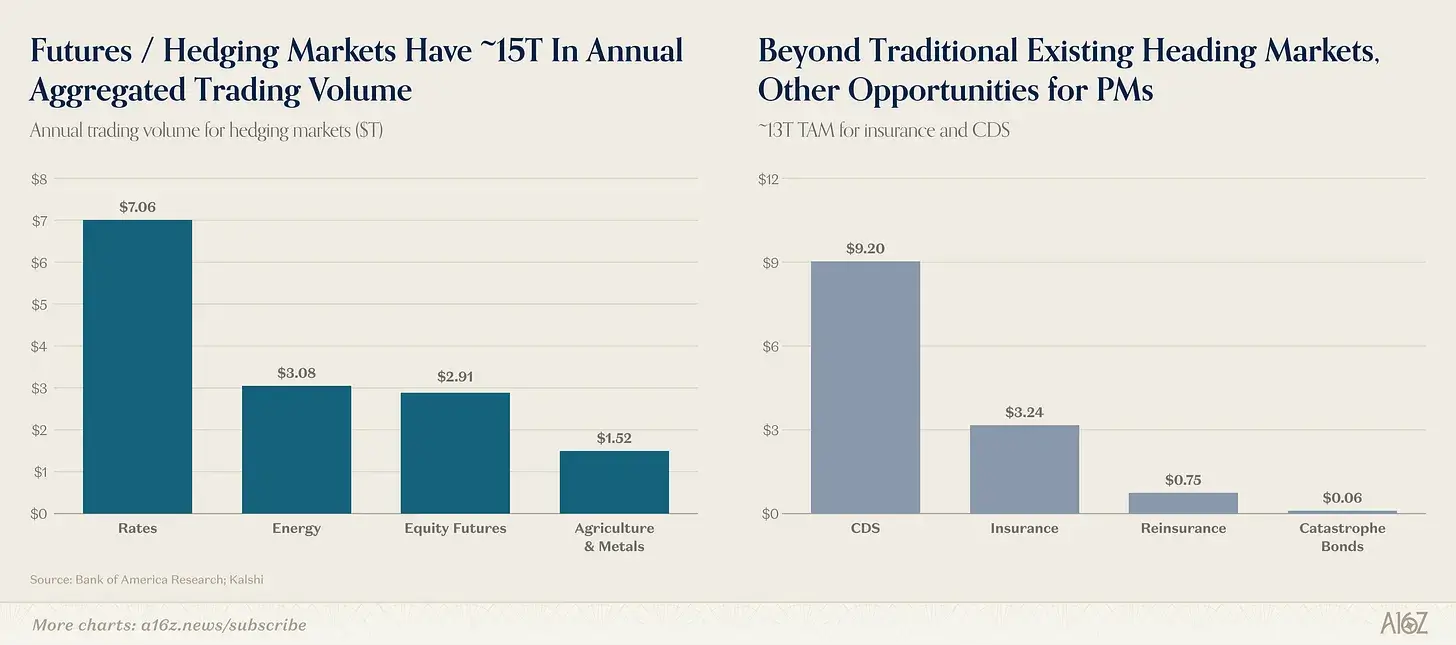
The reality is that the normalization of prediction markets is already underway.
During the political panel discussion, former Congressman Mondaire Jones pointed out that bipartisan congressional leaders—President Trump, House Minority Leader Jeffries, Senate Minority Leader Schumer—have all publicly quoted Kalshi's odds. DDHQ's Scott Tranter confirmed that prediction market data is now standard input information for party committees. Vote Hub also announced that it will integrate Kalshi data directly into its midterm election forecasting models.
These situations did not exist two years ago. Two years ago, the most successful traders on Kalshi were still enthusiasts. The situation is different now. It is even unfair to refer to them as “enthusiasts” anymore.
In the Kalshi panel titled “The People Behind the Markets,” four traders described careers built on the habits familiar to professionals—such as obsessing over the Billboard charts for 11 years or having been in prediction markets since 2006 when it was still a “geek hobby” with no real money involved. None of the panel members had a financial background; they came from music, politics, and poker. But all panel members unanimously agreed that the platform rewards deep domain knowledge instead of diploma titles.
Prediction markets have come a long way. They were once seen as academic curiosities, then as election novelties, and then as products adjacent to sports betting. This conference clearly demonstrates that prediction markets are maturing, becoming the infrastructure that provides uncertainty pricing for various participants (from retail traders to the largest institutions).
Article link: https://www.hellobtc.com/kp/du/04/6293.html
Source: https://www.a16z.news/p/prediction-markets-they-grow-up-so
免责声明:本文章仅代表作者个人观点,不代表本平台的立场和观点。本文章仅供信息分享,不构成对任何人的任何投资建议。用户与作者之间的任何争议,与本平台无关。如网页中刊载的文章或图片涉及侵权,请提供相关的权利证明和身份证明发送邮件到support@aicoin.com,本平台相关工作人员将会进行核查。


