Author: Thejaswini MA
Translation: White Paper Blockchain
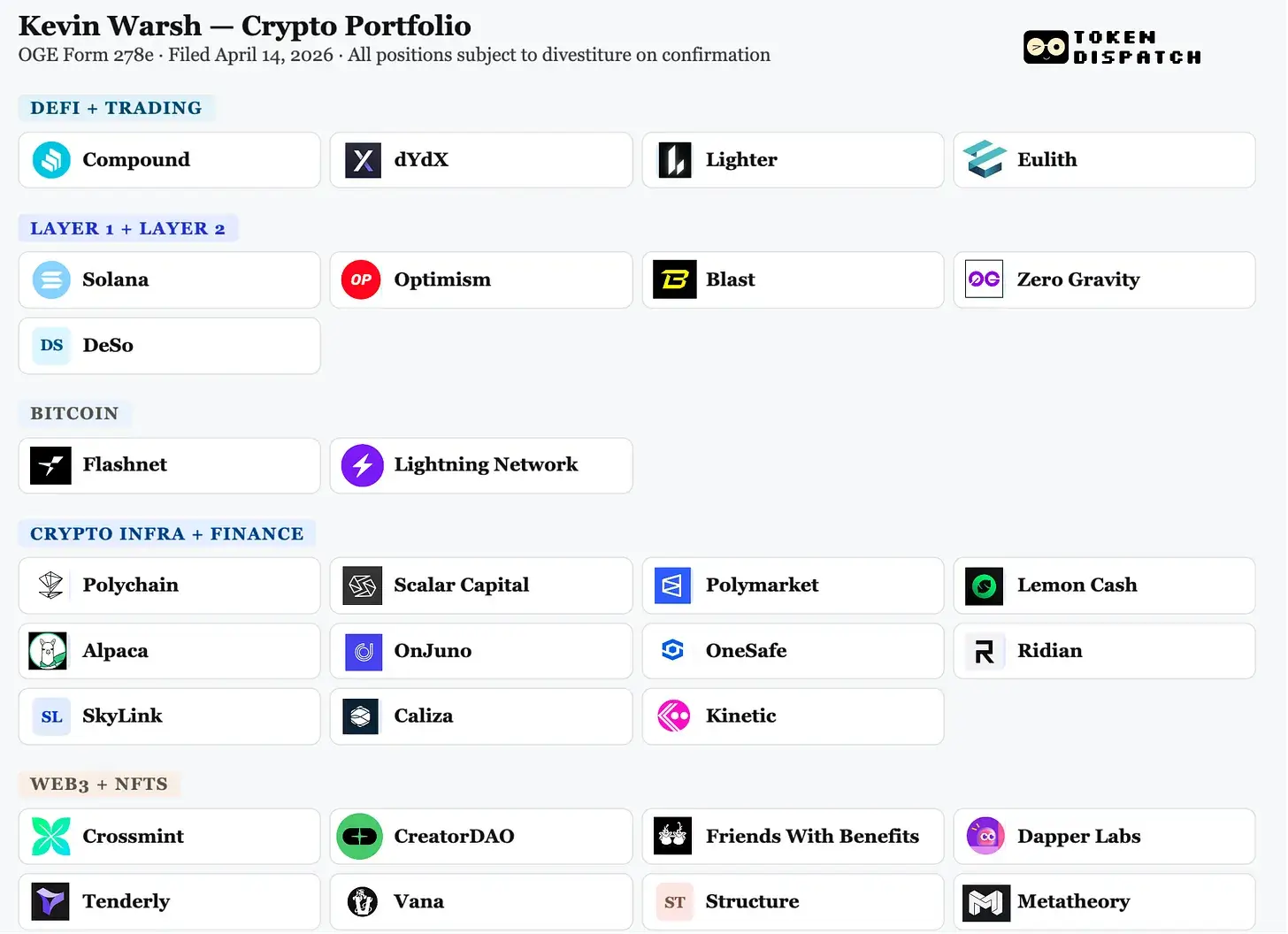
If Kevin Warsh wants to lead the Federal Reserve, he must sell his shares in Solana, dYdX, Optimism, Polymarket, Dapper Labs, and roughly twenty other companies. This is indeed a strange prerequisite for taking office, but it is legally mandated and applies to anyone seeking to regulate the U.S. financial system, regardless of their understanding of the system.
The disclosure that triggered all of this occurred on April 14. A lengthy69-page document was submitted to the government ethics office, clearing the last bureaucratic hurdle prior to his confirmation hearing. This document is a standard compliance form. And if you know where to look, it is also one of the most significant pieces of written evidence submitted to the Senate committee.
Warsh and his wife Jane Loud, whose family business includes Estée Lauder Companies, estimated by Forbes to have a net worth of around $1.9 billion, collectively ownat least$192 million in assets. Most of these assets are held in two stakes worth over $50 million in Juggernaut Fund LP, which relates to his consulting work for Stanley Druckenmiller's Duquesne family office. These assets are subject to confidentiality agreements. OGE certified officials specifically pointed out these assets and confirmed that once Warsh divests the required holdings, he will comply with the federal ethics laws.
The portfolio covers decentralized finance (DeFi) protocols, Ethereum layer two scaling networks, Bitcoin payment infrastructure, and prediction markets.It reads as if he has carefully studied the entire cryptocurrency industry and deliberately selected some investment targets from each sector. Through AVGF I, Warsh indirectly holds stakes in Solana, Optimism, and the Lightning Network. Through DCM Investments 10 LLC, disclosures show he holds shares in dYdX, Polychain Capital, Compound, Blast, Lighter, and Lemon Cash. Another series of AVF funds has invested in Dapper Labs, DeSo, Friends With Benefits, and Zero Gravity.He also directly holds shares in Metatheory, which is a Web3 gaming company valued between $1,000 and $15,000. The Bitcoin merchant payment startup Flashnet and Polymarket are also included in his portfolio.
Most of these cryptocurrency positions are located within fund vehicles, and these funds' individual investment reports do not specify amounts, which according to OGE rules means each investment is worth less than $1,000. These are all small-scale venture investments rather than concentrated positions. Scale is not the focus; breadth is key. This portfolio encompasses L1 blockchains, L2 scaling solutions, DeFi lending, decentralized derivatives, NFT infrastructure, Bitcoin payments, and prediction markets. The only missing category is meme coins, gaming tokens, mining companies, and directly held Bitcoin. All of the assets he holds are infrastructure, financial infrastructure, or developer tools.
What money tells us
Kevin Warsh believes that cryptocurrency is the next layer of financial infrastructure, built on protocols that handle real transactions, and what those who build these protocols do is, in some respects, quite like fintech.
In the entire disclosure, the closest thing to speculative investment is Friends With Benefits, which is a social token community. Considering everything else in the portfolio, it feels more like someone took him out to dinner, and out of politeness, he wrote a small check.
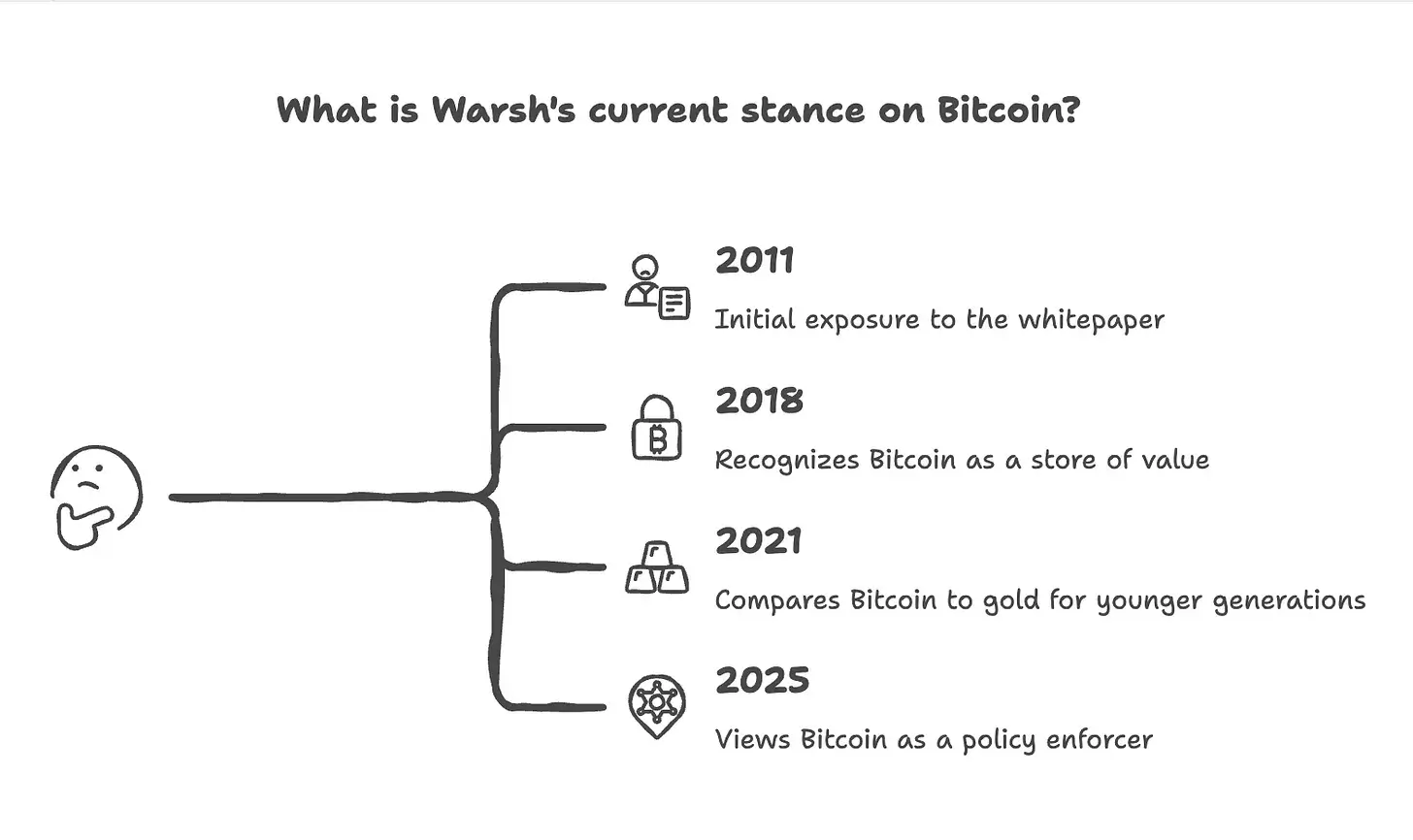
His public statements align with this. In 2011, Warsh saw the Bitcoin white paper at a dinner hosted by Marc Andreessen. In 2018, he wrote in The Wall Street Journal that Bitcoin could become a sustainable store of value like gold. In 2021, he stated on CNBC that Bitcoin is the new gold for those under 40 years old.In 2025, at the Hoover Institution, he made the most comprehensive statement to date: Bitcoin will not replace the dollar, but it could become an excellent regulator of monetary policy.I would not call Warsh a Bitcoin extremist. A monetary policy expert who views Bitcoin as a reliable signal of the dollar's health may, in some ways, be more valuable to the industry.
Warsh received $10.2 million in consulting fees from the Duquesne family office (Stanley Druckenmiller's investment firm). Druckenmiller is one of the most reputable macro investors globally and one of the few top investors who have seriously discussed cryptocurrency.Last month, this Druckenmiller told Morgan Stanley that stablecoins will become the entire payment system of the United States in 10 to 15 years. In the same interview, he referred to other cryptocurrencies as "solutions proposed to find problems." Warsh's cryptocurrency investments are aligned with this investor network of one of the most reputable macro investors today. Druckenmiller believes that stablecoins represent the future, and everything else is noise, while Warsh's portfolio is filled with infrastructure that supports the operation of stablecoins, suggesting that both hold the same investment philosophy.
Warsh has committed to divesting completely. Selling positions in liquid tokens is relatively straightforward. However, divesting limited partnership (LP) interests in Polychain Capital or venture capital fund holdings in illiquid early-stage companies is much more complex. According to OGE regulations, some funds with multiple LPs typically do not need to divest. But OGE certified officials specifically pointed out the Juggernaut Fund's positions and mandated complete divestment as a condition of compliance. Because confidentiality agreements have been signed previously, the underlying assets of these positions have not been disclosed.
Federal ethics guidelines generally require that there must be a one-year cooling-off period for matters that directly affect recent economic interests. As the Federal Reserve weighs stablecoin legislation, tokenized deposits, securities, and central bank digital currency (CBDC) research, this regulation may seem particularly significant.Consider what this means in practice. Congress is currently actively discussing stablecoin frameworks. The CLARITY Act is still being reviewed in the Senate. Banks are conducting pilot projects for tokenized deposits. The Federal Reserve plays a continuous role in all these areas. And the Fed Chair, who genuinely invests in decentralized finance (DeFi) protocols, Bitcoin payment infrastructure, and prediction markets, may be forced to sit on the sidelines for the first year, watching colleagues who have never used crypto wallets weigh in.
It is challenging to discuss Warsh's cryptocurrency holdings without mentioning the context of his nomination. Before any cryptocurrency-related legislation is signed, the Trump family's cryptocurrency investments have already generated enormous returns. According to The Wall Street Journal, Barron Trump has been listed as a "DeFi visionary" for the DeFi project World Liberty Financial on its website, which has created at least $1.2 billion in actual profits for the Trump family by early 2026. Meanwhile, the president, who allows 401(k) accounts to invest in cryptocurrency, has family members selling off cryptocurrency investments.
Warsh’s holdings are a small venture investment structured through funds. The Trump family's holdings are large concentrated investments in projects that directly benefit from federal policy. The two are fundamentally different in scale and structure. The commonality is that this president, benefiting from the Fed's crypto-friendly policy, chooses a Fed chair nominee with economic interests in the cryptocurrency sector, the very industry he is about to regulate. Whether this represents blatant corruption, strategic coherence of interests, or merely the natural evolution of American institutions depends on individual perspectives. And this perspective often hinges on whether you hold relevant assets.
Senator Tom Tillis stated that he would oppose any Fed chair nominee until the Department of Justice's investigation into Powell is concluded comprehensively and transparently. The committee is divided by party, meaning that any Republican defection could delay the confirmation of the nominee. Powell's term as Fed chair ends on May 15.
If Warsh fails to gain confirmation before then, Powell will continue to serve as a transitional chair amid soaring oil prices above $100 a barrel, an unresolved situation in Iran, and a market still trying to determine whether the Fed has a leader.
For the cryptocurrency circle, Warsh's disclosures are a classic "mixed blessing" joke. The good news is? We finally have a Federal Reserve Chair who truly understands the difference between liquidity pools and swimming pools. The bad news is? Because he deeply understands the workings of cryptocurrency, the federal ethics law effectively puts him in a year-long "digital corner," forced to watch those anti-cryptocurrency colleagues attempt to regulate a technology they may consider a sequel to The Matrix.
These two things can coexist. He has an in-depth understanding of DeFi. At the same time, he also believes that the Fed's primary task is monetary stability, while asset price inflation is a sign of policy failure. These views are sure to make the FOMC meetings very interesting.
Warsh’s disclosure is less a signal of institutional change than a quiet acknowledgment of path dependency. Our past choices and technological evolution inevitably restrict the future. For decades, the Fed has employed traditional operational modes. As the monetary architecture shifts from paper currency to protocol money, the "path" is naturally expanding.
This is a process of slowly and steadily integrating new literacy into the existing system. It means that people are gradually recognizing that to master the future of the dollar, one must first understand the language of writing the future.
Article link: https://www.hellobtc.com/kp/du/04/6292.html
Source: https://www.thetokendispatch.com/p/the-fed-chairs-portfolio
免责声明:本文章仅代表作者个人观点,不代表本平台的立场和观点。本文章仅供信息分享,不构成对任何人的任何投资建议。用户与作者之间的任何争议,与本平台无关。如网页中刊载的文章或图片涉及侵权,请提供相关的权利证明和身份证明发送邮件到support@aicoin.com,本平台相关工作人员将会进行核查。


