Written by: Qiunan
Last week, a sharing session was held at the agents' special zone to explore the opportunities and challenges of the AI+ services theme. The discussion encompassed trend insights, opportunity points, case studies, and challenges, providing a comprehensive exploration of the topic. The following is a summary of the sharing content:
Sequoia recently made a core judgment about AI+ services: the next trillion-dollar company will be a software company disguised as a service company. I particularly agree with this point.
It has long been said that "software eats the world." However, after the arrival of large AI models, software has been deconstructed. What we previously referred to as "software as a service" has shifted; the logic has now transformed into software becoming a carrier of value within the service process, only a tool for delivery.
Users or customers' expectations of software are actually to achieve results and value after using it, rather than just receiving a standard software workflow.
01 The Paradox of the Service Industry: The More Specialized, the Harder to Scale
Strategic consulting is a typical service that can be transformed by AI+ services. In discussing this specific scenario, everyone can relate more easily to what the logic of the service industry should be and what the strategies for implementing AI+ services could look like.
Starting from the Scalability of the Consulting Industry

Expertise is a moat for the service industry, but it is also a shackle for scalability. To scale, without the support of AI, you can only rely on what? Adding headcount, increasing manpower, and layering resources linearly to achieve scalability.
Currently, most consulting firms around the world are doing just that. For instance, you look at companies like Capgemini, Accenture, and Deloitte. Capgemini currently has around 400,000 employees, while IBM has about one million globally. These consulting firms primarily achieve their service scaling through sheer manpower.
How Small Teams Build Competitive Advantages
We focus on product strategic consulting, but not solely around product strategy. We start from this core point and integrate products along the entire chain of strategy and capability, incorporating areas like technology, marketing, design, and strategic consulting, which is essentially a management consulting-related business.
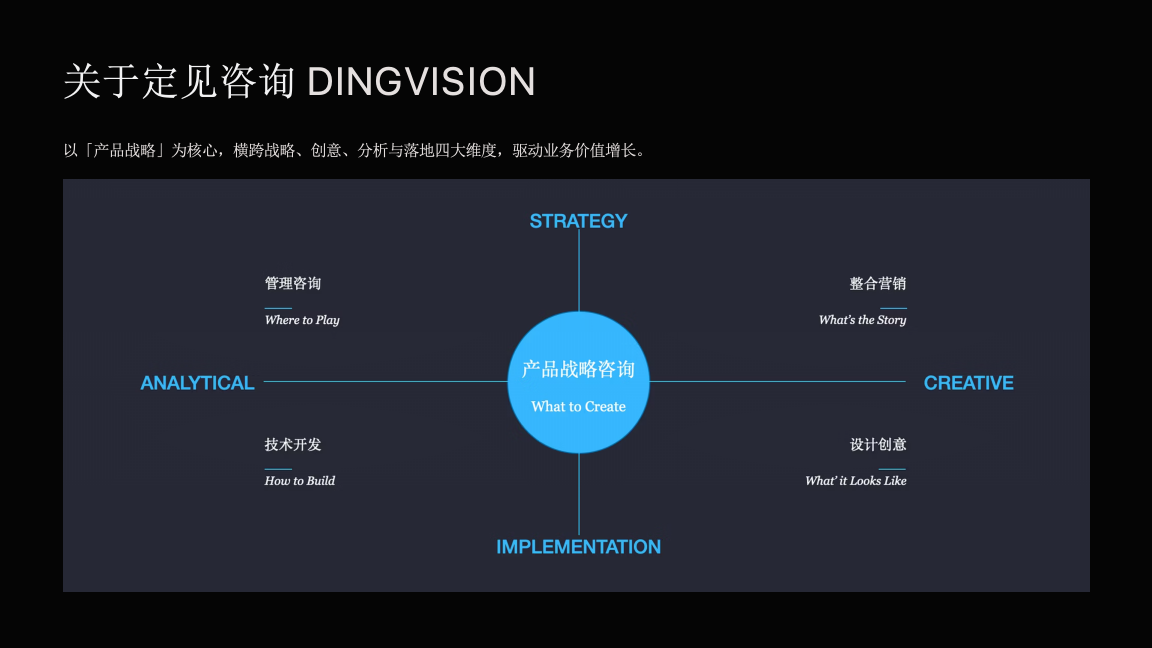
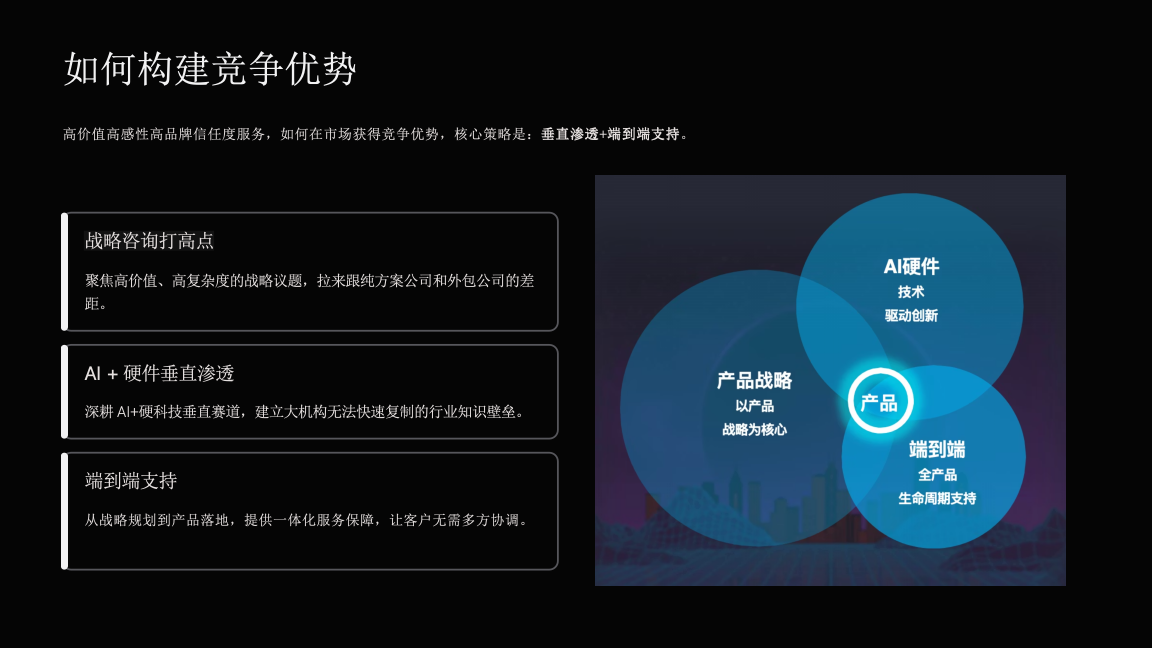
Our niche specialization comes from years of accumulation in this field; we have handled products on the scale of millions and also introduced new categories, like AI+ smart hardware products, through many iterations from 0 to 1. Thus, we have a very good understanding of the entire industry and business model, which is our competitive advantage.
The second point is end-to-end support. As we have substantial experience in this industry, we can adaptively match resources like strategy planning, design, development, manufacturing, and marketing according to actual conditions for this type of product. We do not simply provide a strategy and deliver a PPT; we support the entire process end-to-end.
Four Challenges of Strategic Consulting
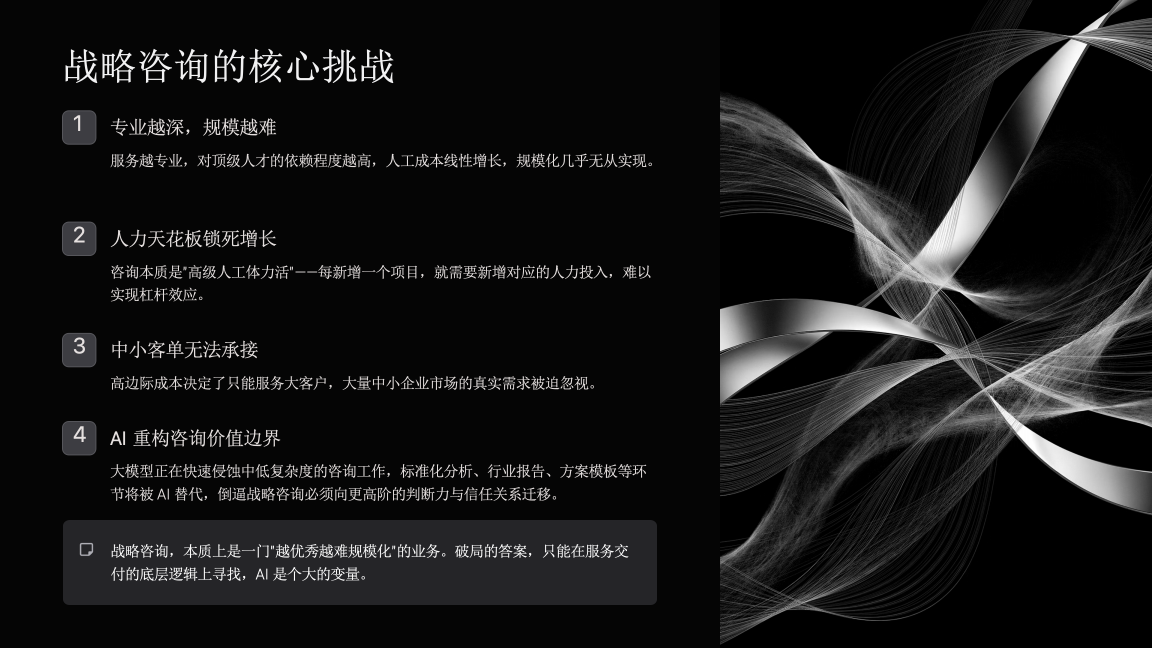
Second, the ceiling of manpower can be locked in. Either you expand your scale and hire more people, or you are effectively capped by your manpower ceiling, but adding manpower also brings complexities in management.
Third, in the past two years, we have turned down many small to medium teams. "Can you help us clarify our business model?" "Can you help us conduct competitive research in the industry?" We genuinely lack the manpower to take on such projects. Especially for small and medium-sized enterprises, if you invest manpower to clarify their business model, there may not be subsequent business as client acquisition costs are high and unsustainable.
Fourth, AI is reconstructing the boundaries of consulting value. Currently, AI has accelerated many aspects of our consulting processes, such as information gathering, industry research, and document preparation tasks.
Strategic consulting itself is a luxury that can only cater to large companies, as the scale of such companies can sustain this business model. For us, there are two paths: either extend our strategy into innovative services to scale up, or figure out how to combine AI to make the originally non-standard, customized strategic consulting services relatively standardized. Only after standardization can we provide services to small and medium-sized clients, which we are also exploring.
02 Relevant Trends and Insights of AI+ Services
Software Service Transformation and Hardware Automation
In the current wave, pure software, especially SaaS software, has not been performing well in recent months. The logic of AI indicates that the strong will become even stronger; standardized software is gradually being locked out by tech giants and large models.
Simple and low-complexity hardware will also slowly be consumed by AI. For instance, I attended a meeting in Hong Kong a few days ago, where many people brought single-function recording microphones. Will such single-function hardware be phased out? Will Apple's AI make many of them obsolete? Very likely.
Those creating software need to become "softer" and focus on service-oriented software. It’s no longer about software reigning supreme, but rather service taking the lead, treating software as a tool that can be standardized and executed in a process-driven manner. On the hardware level, the future logic focuses on how to enhance influence in the physical space. For example, if a robot is merely simple hardware, like a microphone, and lacks sufficient influence in the physical space, while many alternatives exist in the virtual space, it is likely to be outcompeted by AI and other platform products.
The trend of software service transformation combined with hardware automation indicates AI's upgrade of labor, essentially meaning AI is replacing human labor with agents.

The Huge Market Opportunity of AI+ Services
According to Sequoia's 2024 data, the entire SaaS market occupies about 61% of the software market, while SaaS accounts for only 4.7% of the services market. How much space is there? 95.3%.
Data from a16z indicates that the global software market is expected to reach about $300 billion by 2026, while the labor market—referring to AI replacing or augmenting human labor—amounts to $13 trillion, and this is just the labor market in the United States.
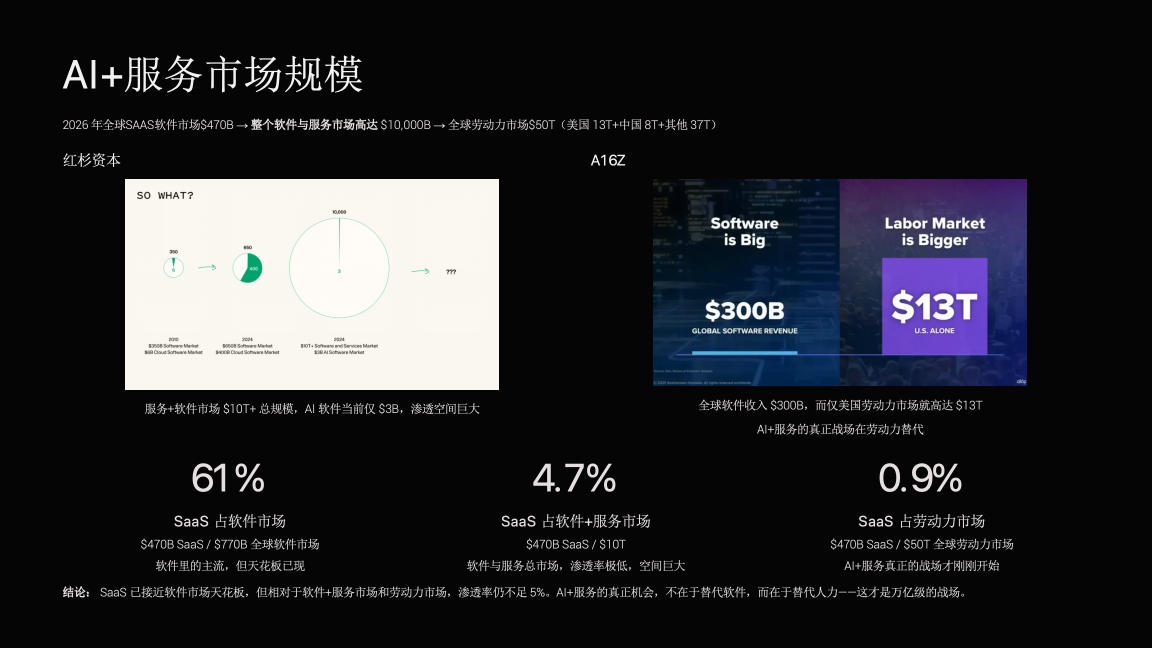
The scale and void in the AI+ services market are sufficiently large. Currently, the limitation arises from how AI integrates with industries or the present intelligence and maturity levels of AI, as it is still in the early stages.
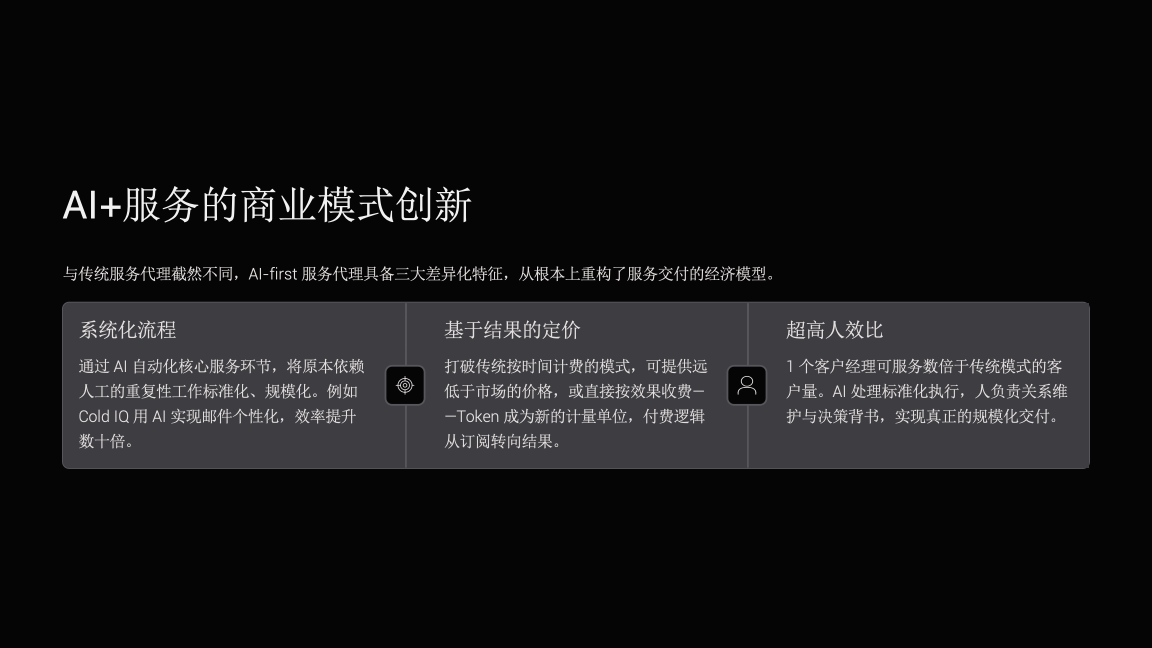
What should the business model of AI+ services look like? First, how to utilize AI to formalize and standardize previously non-standard service processes. Second, how to shift pricing based on results; previously, SaaS pricing was about how much to sell software monthly, but now it should be based on results or using tokens as new units of measurement. Third, how to enable one person to perform the work of ten, achieving high cost-effectiveness and efficiency.
High-Value Zones Transitioning from Execution to Insights and Trust
AI can increasingly handle tasks at the execution level. So, where will the high-value areas of the entire industry chain be? As execution becomes easier, the value of execution relative to AI's capabilities diminishes or is replaced by AI's execution abilities.
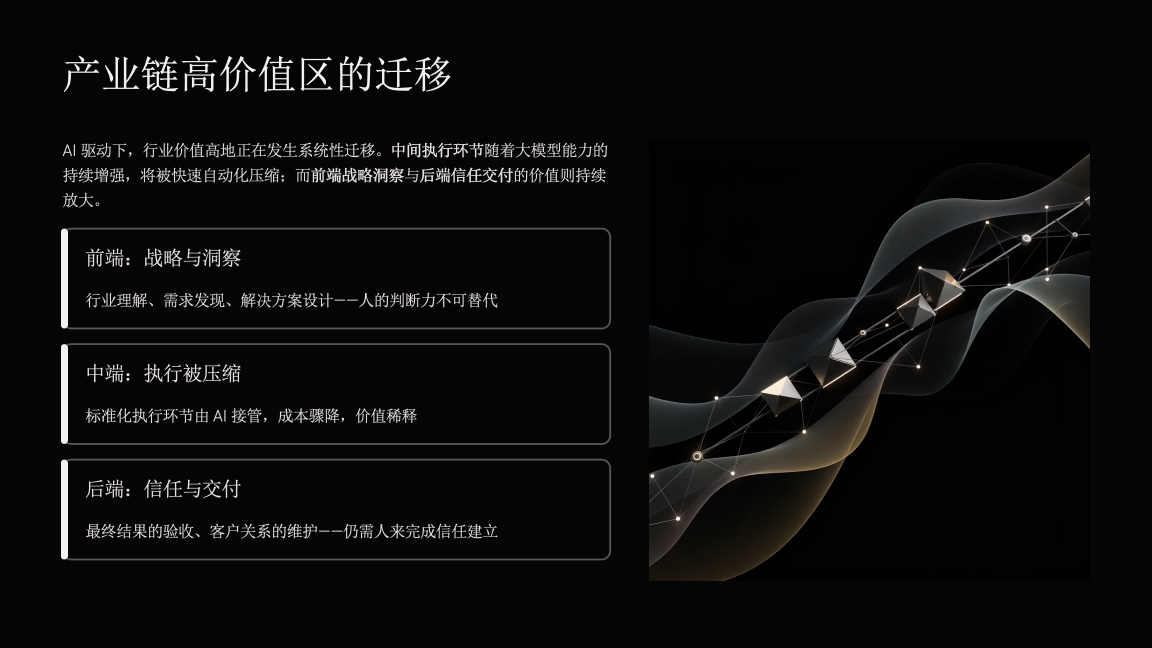
The remaining high-value zone of the industry chain lies in the areas ahead and behind. Before execution comes strategy and insights; understanding the industry and having insight will become increasingly crucial. The latter part is about trust and delivery. Everyone can produce a PPT or conduct competitive analyses using AI, but the quality of the end-to-end delivery and clients' confidence in the value of the report is what truly matters.
When AI compresses the intermediate execution layer, high-value areas expand towards the front and back.
Sequoia's AI+ Services Four Quadrants: Outsourcing + High Judgment as the High Value Zone
Sequoia essentially pulls the entire opportunity of AI+ services along two dimensions: one is whether it is outsourced, and the other is the level of intelligence and judgment involved. Currently, AI's intelligence level is strong enough, but there is still room for improvement in judgment capabilities. Sometimes it needs human validation or confirmation on whether something is correct and meets requirements.
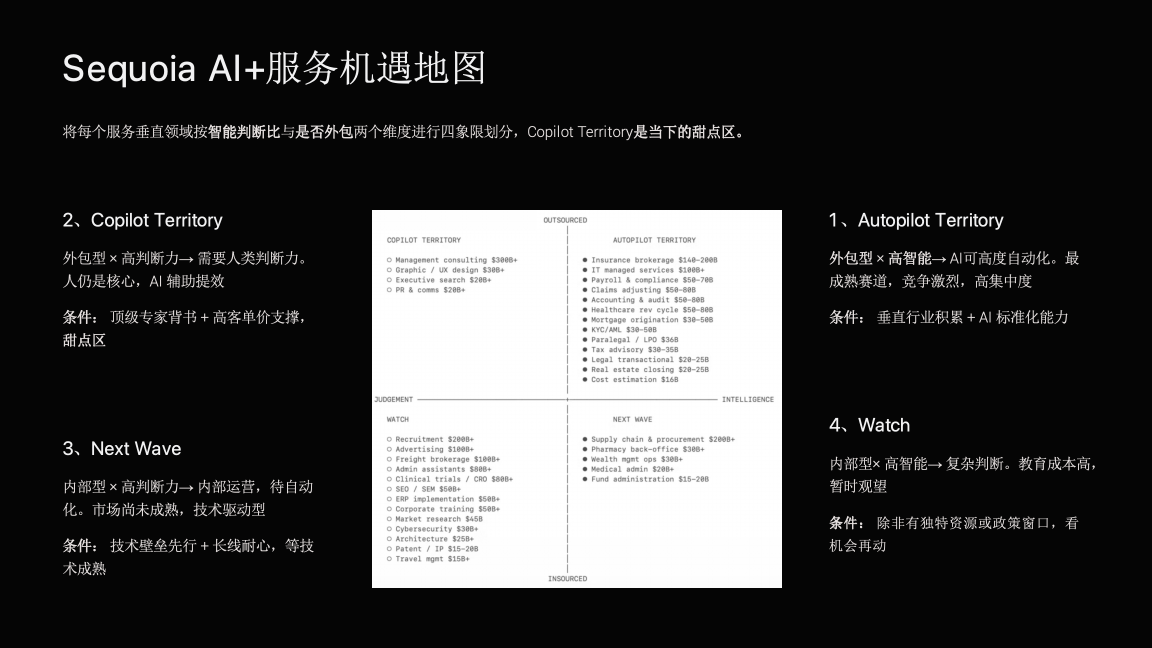
Sequoia has delineated several areas. The first is the originally outsourced type of businesses, such as IT operating services, which can be highly intelligent in the digital space and thus are capable of using AI to quickly standardize services. However, this also means intense competition and great opportunities, which I believe small teams find difficult to pursue.
The second area where I see considerable space is for outsourced models combined with high judgment. Outsourcing implies that external budget is available for collaboration; high judgment indicates that human intervention is still necessary, allowing for a trust premium. This area would constitute a high-value zone.
The third area would require high judgment internally; internal teams combined with high judgment are generally harder to penetrate, demanding higher technical requirements. You need to persuade an internal team why to delegate tasks externally rather than managing them internally unless your technical prowess is sufficient to provide competitive advantage.
The last area is a wait-and-see zone, as the education costs are too high.
This opportunity distribution map reveals a clear feeling: it looks logical for investment institutions to conduct industry research, but I haven’t identified any particularly useful points. They provided me with a framework and discussed the broad aspects, but did not delve deeply into specific opportunity points or notable directions. You can look at platforms like Taobao and see if any hidden AI+ service transformation opportunities exist across various industries.
The Golden Era for Builders and Makers
The upcoming phase will be the golden era for Builders and Makers. The influence of these individuals will steadily grow. Creating tools specifically for these individuals will provide ample opportunities.
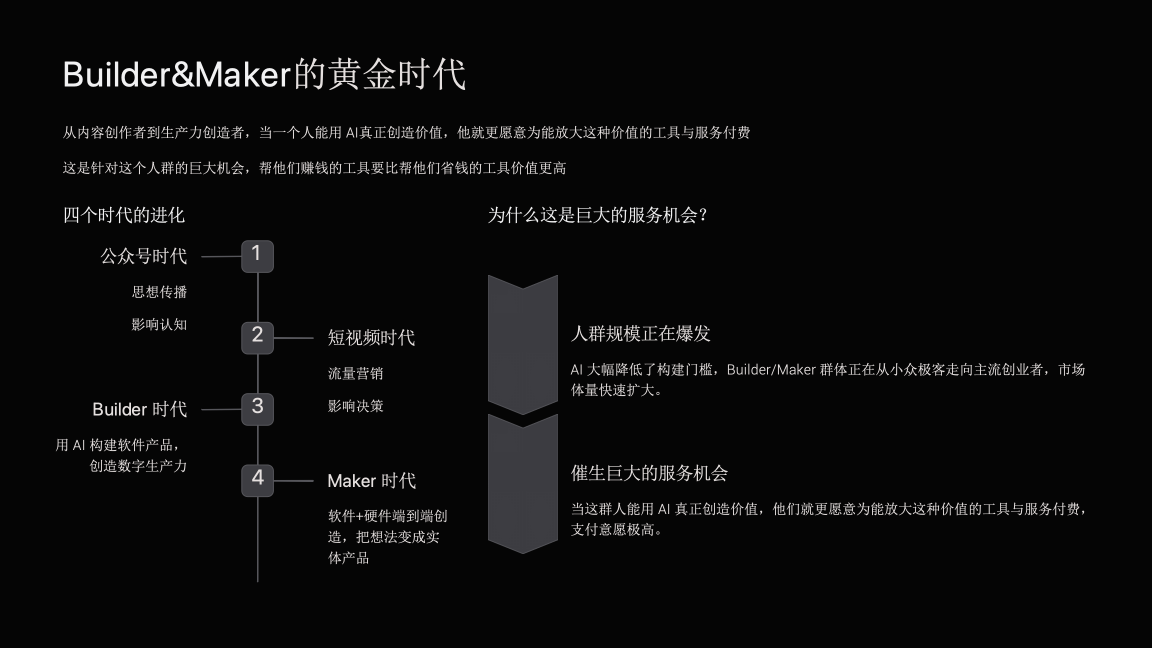
From a narrative perspective: in the public account era, some used writing to influence cognition; during the short video era, marketing was done through traffic; Builders create value in the digital space through software. Moving forward, software paired with hardware can end-to-end influence physical space, creating even greater value, albeit with more difficulty.
How do I perceive this opportunity? It’s about how to provide tools for Builders and Makers, helping them create value. This group is very willing to pay for things that can generate value. Previously, spending $20 on ChatGPT might have seemed pointless, but if tokens could truly create a website or product, then when it transforms into productivity, spending thousands a month would feel worthwhile since it creates value and enhances productivity.
For example, products like 3D printers or cutting machines, or Anker's UV printer, are typical large consumer markets providing value to creators. Their crowdfunding amounts to about $47 million, making it the highest funding project in crowdfunding history.
03 Opportunities and Challenges for AI+ Services
Medvi: Two People, $400 Million
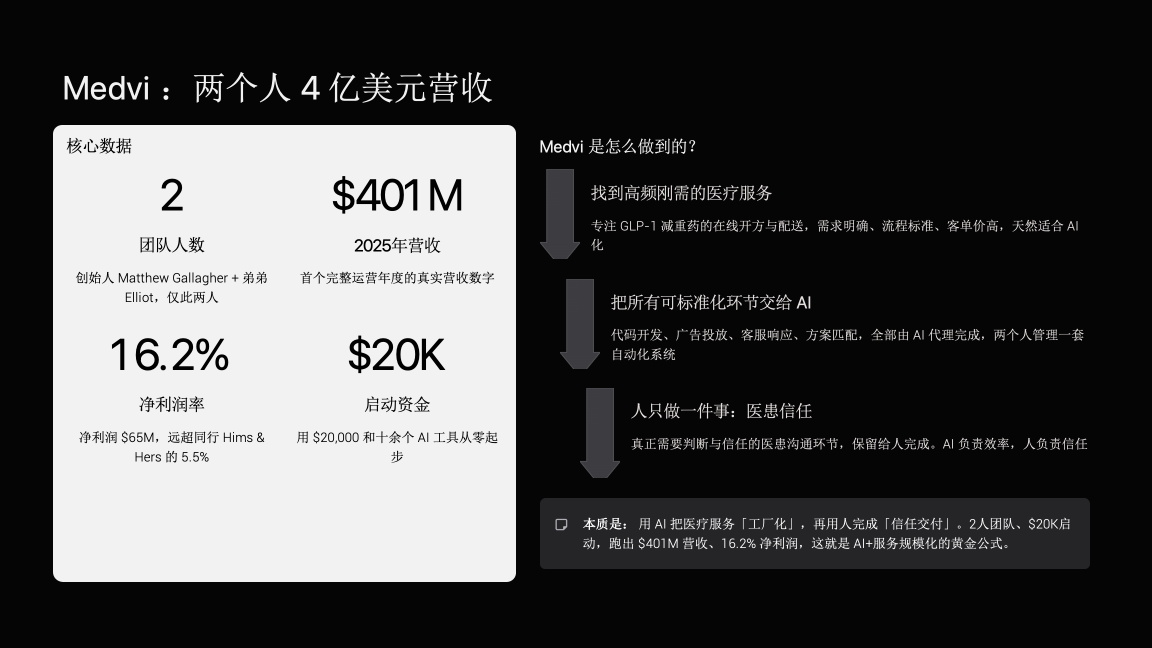
The case of Medvi. Two people: one is the founder who managed R&D and marketing, executing the entire process using AI. His brother mainly assisted in business dealings, and there were also some outsourced personnel involved. This product is anticipated to achieve sales of $400 million by 2025, and this number isn’t fabricated; it has been confirmed by financial media. This year’s target is to reach $1.8 billion.
What did he do? Initially, he created a platform selling weight loss drugs. The population in the U.S. looking to lose weight is substantial, and it is a high-value, high-frequency, and long-term scenario. Previously, to prescribe such weight loss medication, there was a standard known as GLP-1, requiring offline consultation with doctors for diagnosis, assessment, and a prescription flow, which was quite lengthy.
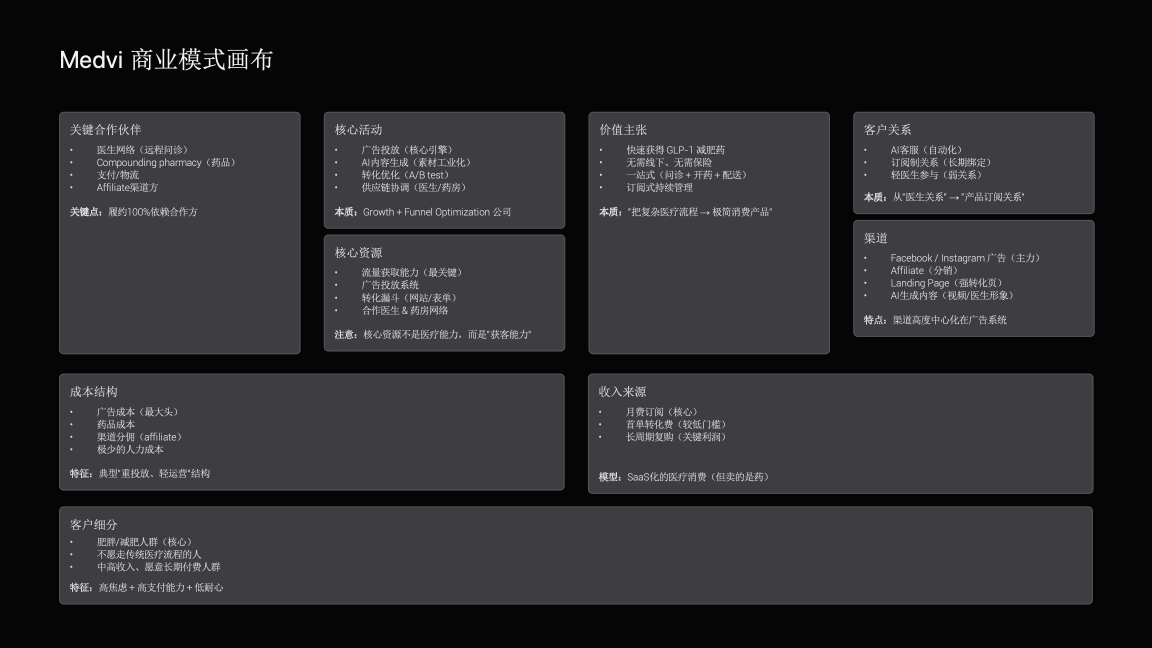
What did he accomplish? He digitized the entire process using AI. Users can receive AI-driven consultations and records; then, at the final stage, a doctor merely confirmation of the AI's records. If everything is correct, they authorize it; if there are issues, they point out what's wrong.
He standardized the service of consulting with doctors offline to obtain prescriptions. From traffic marketing, website development, customer service on the platform, to diagnosis orders, everything was managed using AI, and finally, doctors just need to check. People were only left with one task: doctor confirmation, with doctors sourced from external third parties coming to do checks.
What is the core logic? Identify a high-value scenario, transform the previously difficult to provide service into standardized processes using AI, then have a person contribute high-value confirmation at the end.
His team resembles what? It looks somewhat like the original micro-business model selling weight loss drugs; only previously, micro-businesses heavily relied on manual efforts and social connections, while now it is managed through AI. If he adds a layer of distribution, he will surely exceed $2 billion this year.
What AI+ Service Scenarios Are Worth Pursuing
How should the identification of standardized AI+ service opportunities be judged? What are the core dimensions?
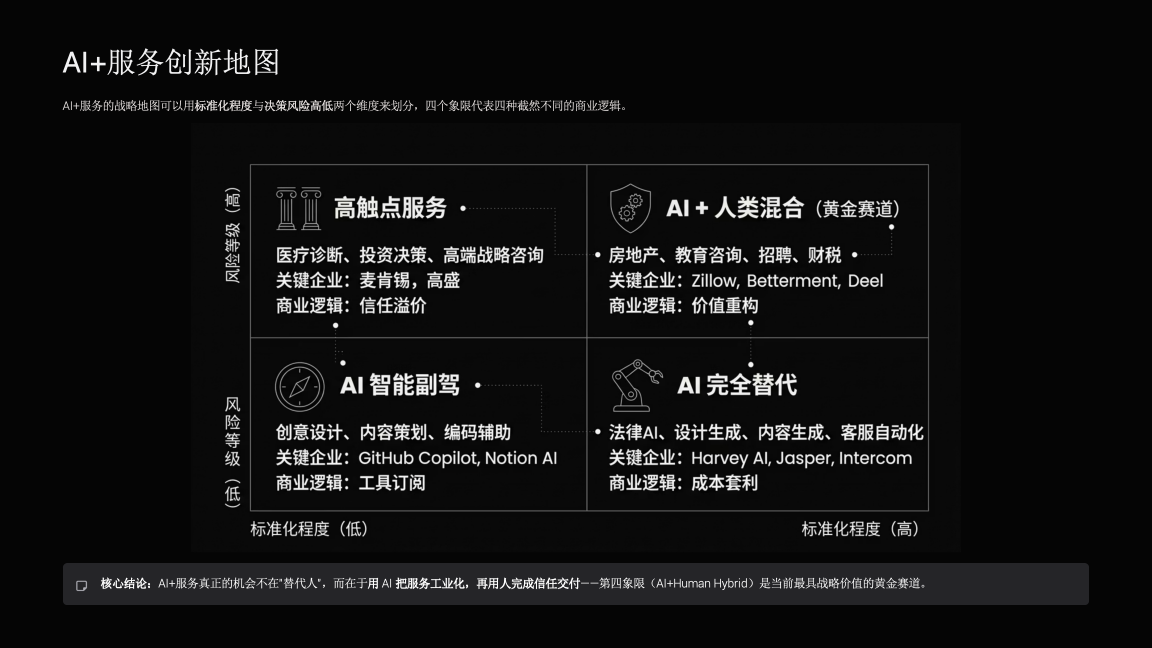
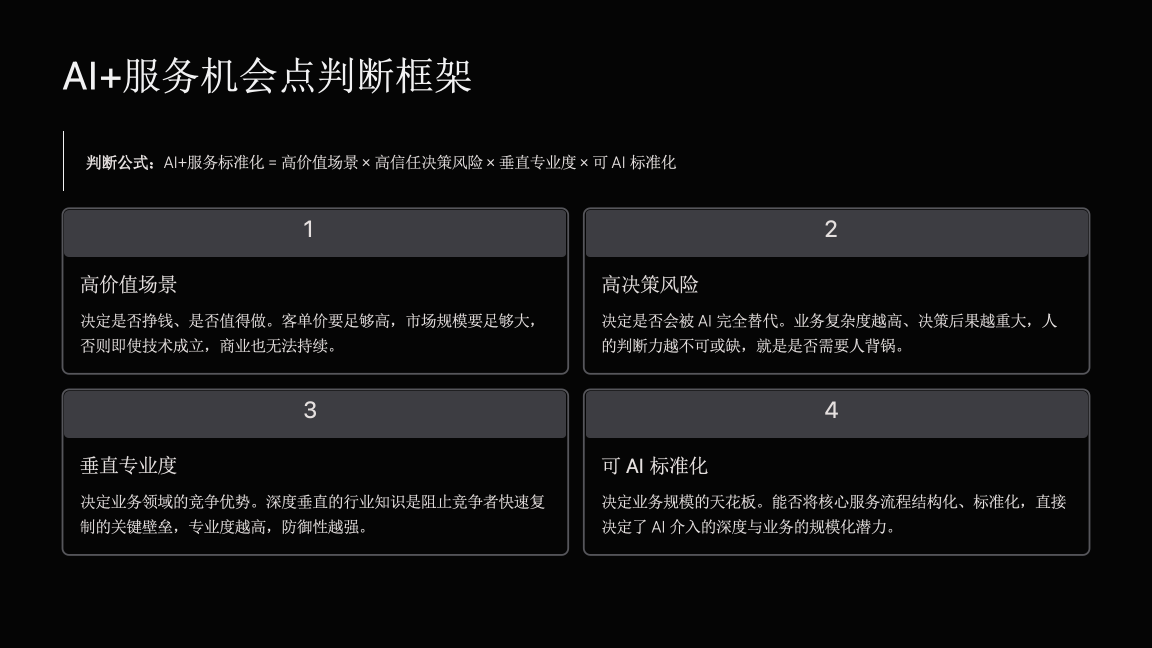
First, is there a high-value scenario? Strategic consulting itself is a high-value scenario.
Second, is there a high decision-risk involved? High decision risk means there is a trust premium. The medical case and the strategic consulting case previously mentioned showcase high-value, high-decision risk business models.
Third, vertical professionalism is necessary. Only in the process of using AI to standardize operations can one achieve greater ease with enough vertical depth. For example, Medvi addresses a straightforward need: users consult online, AI generates a diagnosis report, doctors confirm before prescriptions are delivered directly to their homes via third parties.
Fourth, standardization is key. Can the service and business processes be standardized using AI?
These points are the ones I think everyone can discuss after listening to this presentation.
Three High Pain Point Samples: Education, Housing, Founder IP
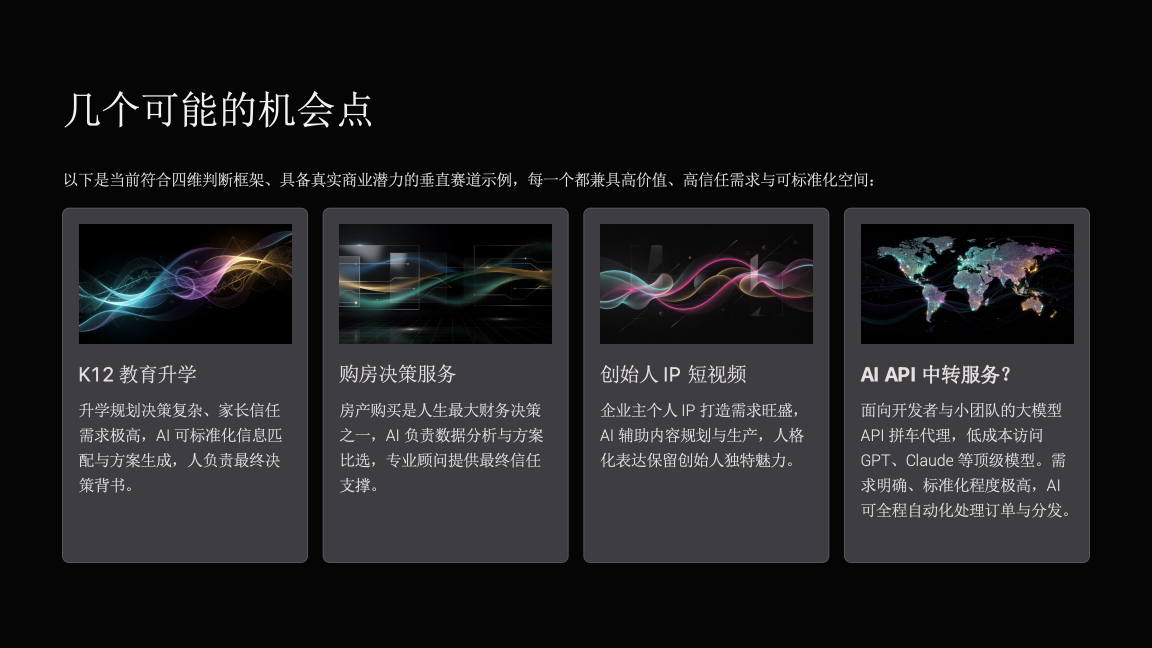
Several aspects are my own pain points.
First, rising education enrollment for children. I've recently been struggling; with my child needing to go to school, what choices should I make? Observing a plethora of information and various points, property requirements and other unrelated paperwork demand much time for research. When consulting some intermediaries, they sometimes push unrelated options beyond my original need, leading to confusion in decision-making.
Second, the decision to purchase a home. Buying a home is a scenario with strong decision-making complexity and high value. For example, I often check transaction data in specific communities to determine how many homes are sold. I will give salespersons specific criteria—homes within a certain price range in core areas—but they often present options beyond my budget or outside my designated area, wasting my time.
In such high-value scenarios, is it possible for AI to provide standardized services that make recommendations based on my personal situation? Yet, there still needs to be a sales consultant involved because signing loans, contracts, and managing procedures still requires a trustworthy human touch at the final nodes.
Third, the need for services to build a founder's IP. I have a strong demand to produce short videos, but I lack time. After reviewing various short video tools, I have yet to find a tool specifically suited to help founders create videos efficiently.
Bosses with some time might spend $1 million over six months to cover all writing and short video production tasks—a very labor-intensive process without guaranteed outcomes. Therefore, I have not found a highly suitable product form in this field so far.
The Dessert Zone of AI+ Services
The entering logic of AI+ services revolves around a few core points.

You should select businesses that are already engaged in outsourcing. If enterprises are already involved in such activities, it means you won't need to educate the market further. Moreover, outsourcing businesses typically have budgets that are approved annually.
Buyers pay for results. For example, when it comes to trademarks and patents, a buyer's requirement is simply for you to resolve the problem; they’re unconcerned about where and how you submit documents, as long as you achieve the outcome they seek.
For example, we applied for the trademark "dingvision" a couple of years ago, but Alibaba DingTalk's legal department claimed it was too similar to theirs—they're also "ding." Honestly, that logic is quite ridiculous; if you call yourself Alibaba, shouldn’t other trademarks also be disallowed? Moreover, what’s maddening is that our objection was dismissed, and we are still in the process of contesting the trademark!
To handle this, we sought a trademark agency. Some quoted several thousand, others tens of thousands. After much discussion, we found no useful advice. Ultimately, we turned to Taobao, where we found a store that could handle it for just 150 yuan, effectively navigating the trademark process with deep understanding of the issue.
Could we discover market gaps for AI+ services on Taobao and Xianyu? Currently, these gaps may appear small, but the future holds promise, akin to the trademark scenario.
Best MVP Organization for AI Applications
The best organizational structure for AI applications' MVP will likely revert to the internet era's triangular model: product, operations, and development. Of course, the terms may not be entirely accurate, but this captures the essence.
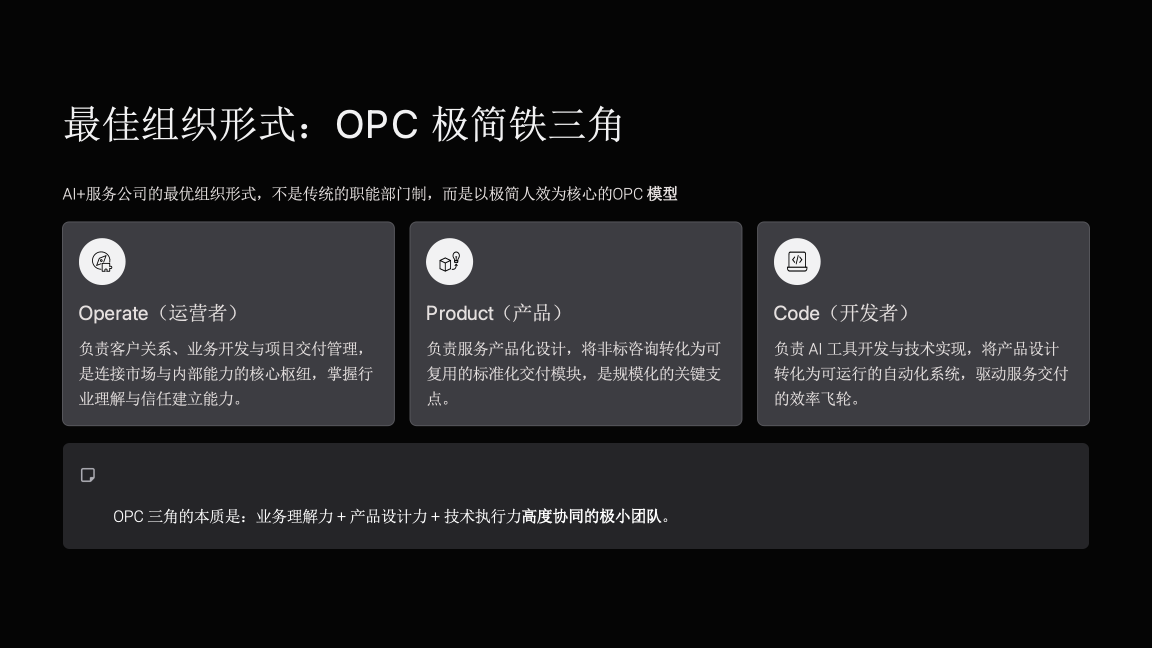
Product, operations, and development represent different perspectives or capability models. If an individual attempts to manage everything alone, as in the Medvi case where theoretically one person handles all tasks, but they still require assistance from others in operations. As scale increases, professional division becomes necessary.
Referring back to the Medvi case, while it seems impressive, there are numerous criticisms: they fabricated many doctors to promote products and created fictitious cases. During traffic acquisition, they used AI digital personas claiming to be doctors from a certain hospital, although these individuals did not exist. They face many operational grievances now.
The core issue is the lack of a strong operations personnel; one person managing everything means many aspects likely remain unaddressed.
OPC should not rest on one individual; consolidating efforts within a team of three can ensure greater robustness. Naturally, an initial MVP may begin with one person, but once the product is launched and running for a period, the team must scale. I have consistently disagreed with pure OPC unless the self-media field permits a single person to juggle every process accurately.
How to Build Competitive Advantages in AI+ Services
Why did I discuss so much about our business? Not to advertise, but to highlight the core logic: how to develop service competitiveness in AI+ services mirrors how we build competitive advantages in product strategic consulting.
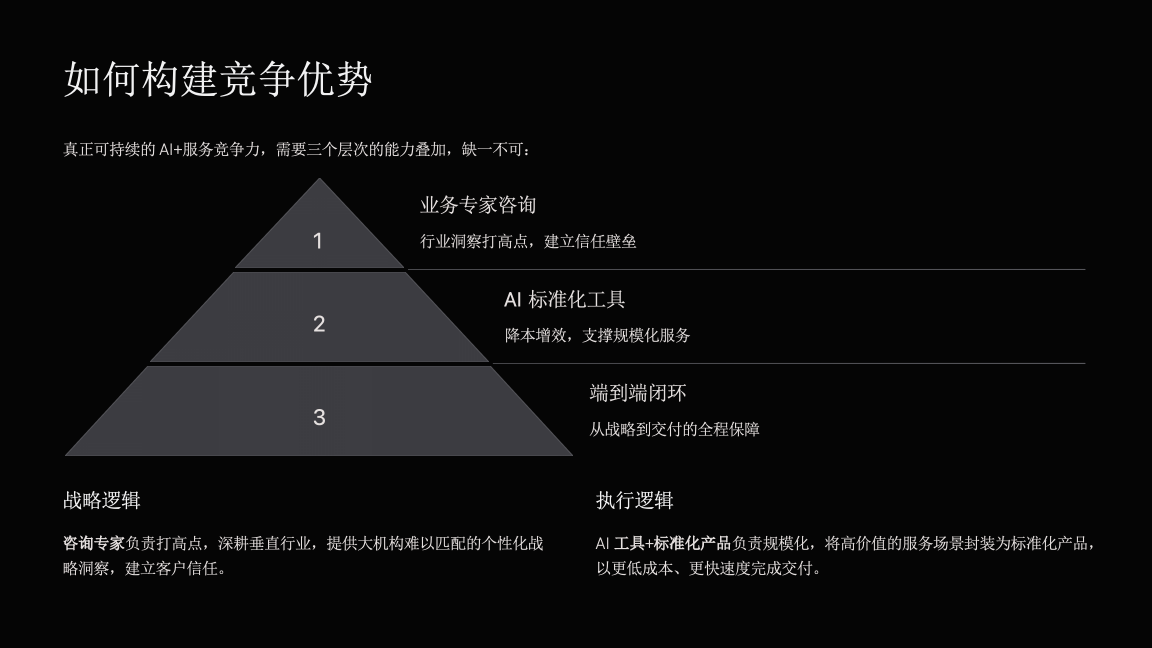
First, there should be a strong business expert involved. This returns to our operations because of the deep accumulation in this domain; we have dealt with numerous projects progressing from 0 to 1 and therefore understand the necessary resources, structures, and potential bottlenecks throughout the industry chain.
So coming back, if you aim to create a standardized AI tool, you must first be a business expert. For instance, in real estate sales, I do not grasp intricate business logic; you certainly need a professional who deeply comprehends the process to guide these activities effectively.
On another level, you need to secure high-value premiums. Often, seeking out a real estate salesperson, if they are professional enough and you trust them, the products they recommend will naturally carry added value in your eyes, and you will be willing to pay for that trust.
Second, it requires standardization; using the capabilities of AI, transform non-standard services into scalable customized offerings.
Third, end-to-end closure. To ensure the success of this closure, the understanding of business must be profound, and the scenarios should be small and specific. While others may replicate your success, can you manage the closure effectively, managing the end-to-end experience like Medvi? The prerequisite being, you must be an expert in the field and know precisely where each business's key points and pain points lie.
Lastly, addressing the end-to-end issue. Take the example of image generation; executing it is simple—just connect to a major model. However, achieving quality results and balancing perfection are entirely different matters.

Where lies the challenge? First, understanding industry operations. Many individuals working on platforms, products, or technologies lack business acumen and do not truly understand the industry intricacies.
Second, merging business with technology can be challenging to close the loop. Those who understand the business typically do not grasp the boundaries of AI's technological capabilities, while those focused on technology often immerse themselves in optimizing tools and swiftly resolving bugs.
Third, this emerging field is often filled with uncertainties.
To summarize: it's straightforward to produce results, as AI capabilities are substantial. However, genuinely executing it well and ensuring the closure of the process presents significant challenges, especially within innovative AI+ services scenarios.
The core answer lies in finding the right individuals who can match business experts and technical experts effectively. However, in the current market or organizational structures, achieving this match is difficult; vertical communities could provide a useful solution by enabling better alignment between business and technical capabilities, particularly in the realm of AI+ services, where there are many micro-scenarios to explore.
As everyone spends plenty of tokens daily, is it possible to create some minor products for market validation? I believe the community will yield many possibilities.
免责声明:本文章仅代表作者个人观点,不代表本平台的立场和观点。本文章仅供信息分享,不构成对任何人的任何投资建议。用户与作者之间的任何争议,与本平台无关。如网页中刊载的文章或图片涉及侵权,请提供相关的权利证明和身份证明发送邮件到support@aicoin.com,本平台相关工作人员将会进行核查。