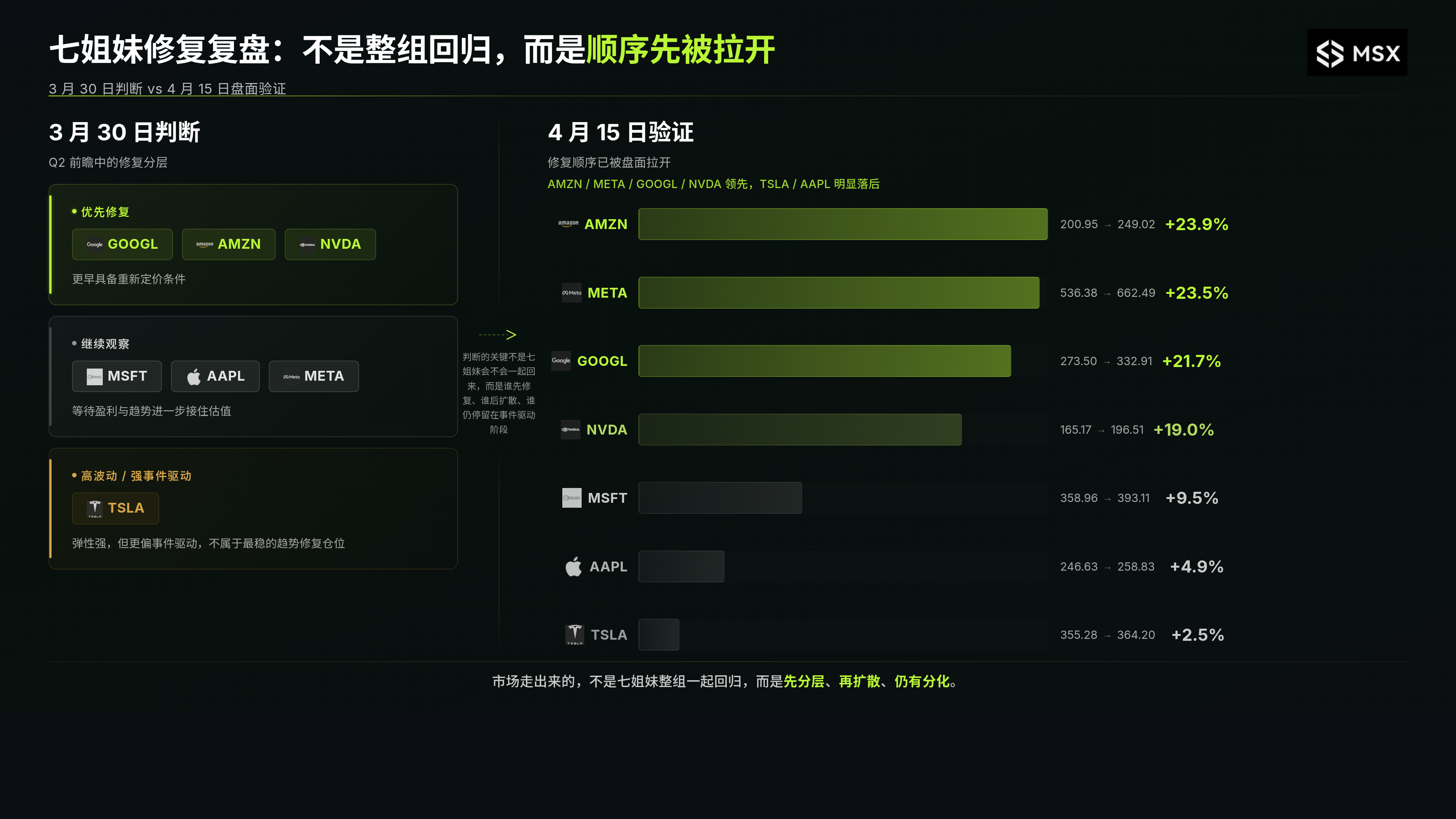
This round of repair validates the forward-looking judgment of Q2, categorizing the repair order into three categories, following the rhythm of "first separating layers, then expanding."
In 15 days, the Nasdaq experienced a round of ups and downs.
At the end of March, there was still a significant divergence in the market regarding the seven sisters, with pressures of overvaluation yet to be cleared, and funding very difficult to truly distance from core technology; however, by April 15, the Nasdaq Composite Index had risen for 11 consecutive trading days, breaking the longest consecutive rise record since November 2021, while the S&P 500 also concurrently reached a historical high.
If looking only at the index, this seems like a familiar tech stock rebound story, but looking closer, one finds that what drives this round of upturn is not just the tech stocks themselves—expectations for easing Middle East tensions, lower-than-expected PPI data, and stronger-than-expected earnings at the beginning of the earnings season are all working together. In other words, this is not merely a rebound pulled by sentiment, but a simultaneous occurrence of index repair, renewed risk preference, and re-pricing of profit expectations.
Moreover, it is noteworthy that the movements of the seven sisters themselves are not consistent. Some have already returned to trend ahead of others, some are still catching up, and some still haven't established a clear trend. MSX's prior Q2 outlook had also anticipated that this round of the seven sisters might not return together, likely prioritizing a repair order (further reading: “Surging Oil Prices, Tough to Lower Rates, Seven Sisters Lay Low: What Main Lines Should We Focus on for Excess Returns in U.S. Stocks in Q2?”), breaking it down into three layers: Alphabet (GOOGL.M), Amazon (AMZN.M), and NVIDIA (NVDA.M) are the candidates for repair that are more suitable for priority attention; Microsoft (MSFT.M), Apple (AAPL.M), and Meta (META.M) are more suitable for inclusion on the watch list; while Tesla (TSLA.M) remains highly volatile and event-driven.
This judgment seemed very restrained at the time, even insufficiently “opinionated.”
But now, what the market has demonstrated is precisely this rhythm of “first separating layers, then expanding.”
1. Which batch returns first, and why?
Returning to the end of March, there was a significant divergence in the market regarding the seven sisters.
On one hand, there were concerns that the pressure of overvaluation had not yet cleared, while on the other, the reality was that it was difficult for funds to truly move away from core tech assets. The most concentrated discussion at the time was “Will big tech return?” However, looking back, this question was too coarse; the real issue was never “whether to return,” but “who will return first, and on what basis?”
And now, half a month later, the answer has been written on the board itself.
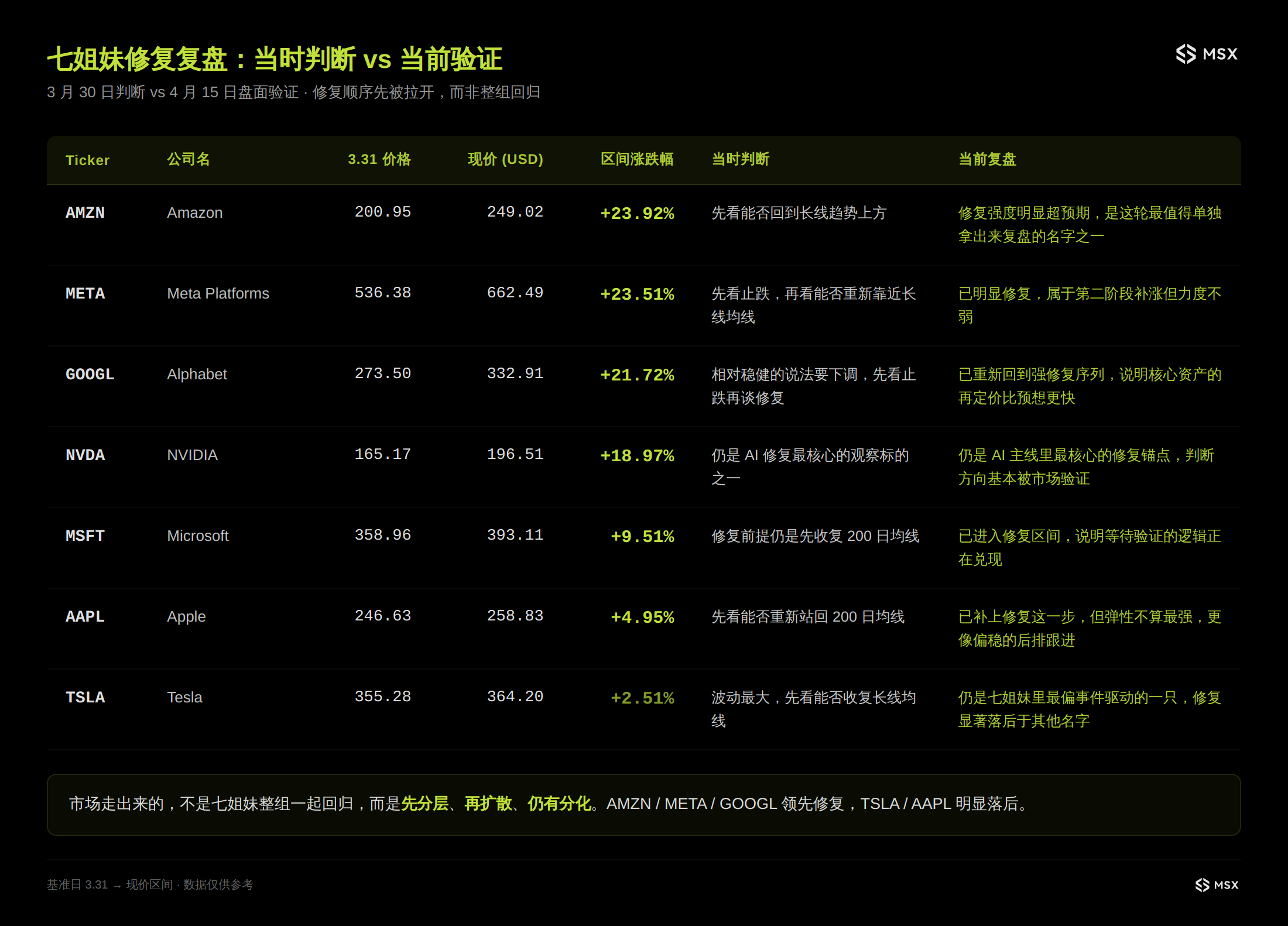
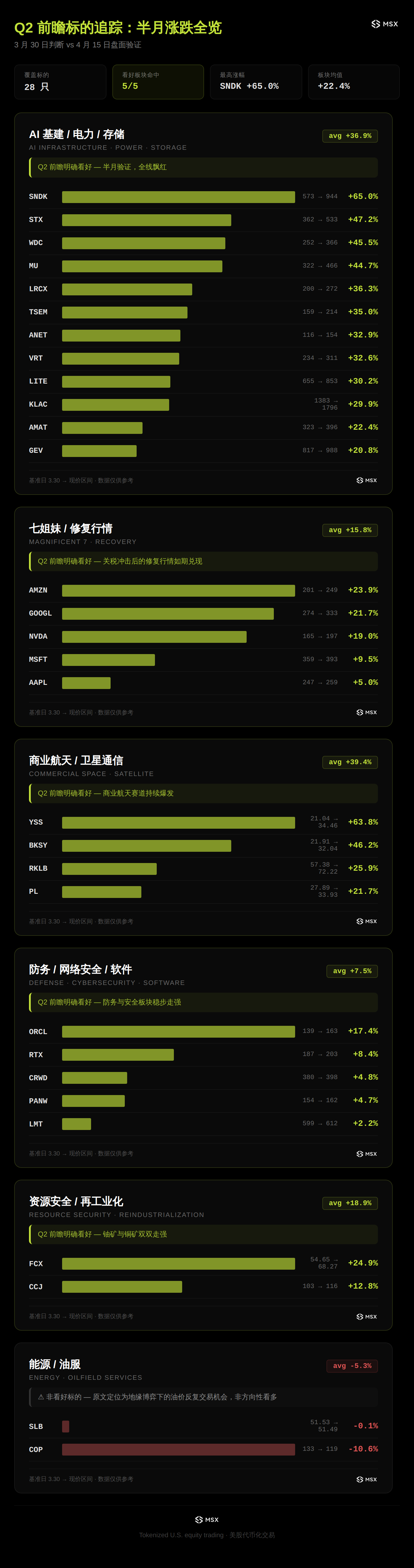
From the performance from the end of March to April 15, Alphabet (GOOGL.M), Amazon (AMZN.M), Meta (META.M), and NVIDIA (NVDA.M) led the gains, followed by Microsoft (MSFT.M) and Apple (AAPL.M), while Tesla (TSLA.M) lagged significantly, further verifying that this was not a period of uniform rises and falls, but a hierarchical repair ranking.
Among those that repaired first, the logic behind Alphabet (GOOGL.M), Amazon (AMZN.M), and NVIDIA (NVDA.M) varies but has a common point: they made the market believe earlier that “investment can still yield growth”:
- Alphabet's (GOOGL.M) repair logic is the clearest: the resilience of cash flow from core advertising business supports the valuation floor, while AI's penetration into search and cloud businesses allows the market to see the continuation of the growth narrative, purely based on the verifiability of fundamentals, which regained investors' trust first;
- NVIDIA's (NVDA.M) position needs little explanation: as long as AI remains the main line of this tech cycle, NVIDIA stays as the core anchor. The market's debate over it has never been about “whether AI needs computing power,” but “how long can this growth rate be maintained?” Therefore, at least at this stage, both the capital expenditure plans of cloud vendors and the demand signals on both training and inference sides continue to support its repair logic;
- Amazon's (AMZN.M) changes are actually the most worth watching: in this round, the market's patience with Amazon was not at its highest, primarily due to ongoing concerns over the slowdown in e-commerce growth and the competitive pressure faced by AWS, but as the profitability of cloud business continues to improve, investments in AI capital expenditures begin to correspond to visible revenue clues, and the overall logic of profitability is gradually being re-accepted, Amazon has actually entered the repair range earlier than many expected. Thus, its return is not dependent on a single catalyst but is the convergence of multiple clues reaching the threshold for the market to reprice;
In other words, the market first revaluing assets was not necessarily the most “stable” names, but those companies that made funds believe earlier that “investment can still yield growth, and repair can still lead towards trends.”
Which of the seven sisters gets repaired first and which gets repaired later essentially compares not the strength of sentiment but who regained the interpretative authority earlier.
2. Repair is spreading, not narrowing
More notably, this round of repair has not only stayed with the first batch of names.
Originally more suitable for the watch list, Microsoft (MSFT.M), Apple (AAPL.M), and Meta (META.M) have now clearly caught up. In other words, the market is not just focusing on the few that moved out first; rather, after confirming that the first phase of repair has been established, it continues to expand to the second layer.
This is actually quite crucial. Because if this is merely a short-term emotional rebound, the market usually reacts more roughly: rising sharply together, then falling back together—fast and with limited sustainability. But the current market is not like that. It resembles more that indices repair first, followed by funds returning to core assets, then continuing to reorder within these core assets. Those whose performance can sustain valuations, and whose investments can still correspond to growth, will remain in the repair sequence; those that primarily simply follow sentiment will lag behind in the differentiation process.
This is why this round of the seven sisters seems more like a "sequential pull apart," rather than "the whole group returning together."
More crucial is that this round of repair has not only stayed with the first batch of names.
The originally more suitable candidates for the watch list, such as Microsoft (MSFT.M), Apple (AAPL.M), and Meta (META.M), have now clearly kept pace; in other words, the market is not just focusing on the few that moved out first and stopped there, but continues to expand to the second layer after confirming the establishment of the first phase of repair.
The significance of this is greater than it appears. Because if this were merely a short-term emotional rebound, the market would typically react more roughly: they rise sharply together and then quickly retract, with speed and limited durability. But the current structure is clearly not like that; it is more like the index repairs first, then funds return to core assets, and continue to reorder within these core assets.
This means that those whose performance can sustain valuations, and whose investments can still correspond to growth, will remain in the repair sequence; those that primarily just follow sentiment will fall behind in the differentiation process.
This is also why this market trend seems more like "repair diffusion" rather than "a culminated rebound," causing the seven sisters not to surge together and quickly fizzle out, but rather to repair the first batch, then diffuse the second batch, and continue to screen who can stay in the trend during the diffusion process.
Objectively speaking, this structure itself indicates that the market is using a more patient approach to reprice core assets.
However, it must be mentioned that within this ranking, Tesla (TSLA.M) remains the most special variable.
It certainly possesses elasticity and has a strong market focus. But so far, Tesla still resembles a highly volatile, event-driven asset, rather than a core position that has steadily returned to the trend repair sequence. The market’s pricing for Tesla often relies more on anticipated trades and event-driven factors—such as developments in autonomous driving policies, the Robotaxi timetable, and Elon Musk’s public statements—rather than stable profit realizations.
This does not imply that Tesla lacks trading value, on the contrary, its volatility itself presents trading opportunities. But its presence precisely shows that this round of the seven sisters has not returned neatly together. Some have returned to trend, some are in the process of catching up, and some still stand on the edge of the trend. To characterize this round of the seven sisters as “a whole group returning” is too coarse; understanding it as “the repair sequence has already unfolded” is closer to the market itself.
3. How far can this round of repair go?
At this point, the discussion worth having is no longer "Has this round risen too much?" but "Is there a basis for this round of repair to continue unfolding?"
From the perspective of institutions, the answer leans towards the positive. The BlackRock Investment Institute has upgraded its view on U.S. stocks from neutral to overweight, partly due to the resilience of corporate earnings, especially in technology; Citigroup has also upgraded U.S. stocks to overweight. S&P 500’s expected earnings growth for Q1 has been revised up from 12.7% before the Middle East conflict to 13.9%. This means that what supports this round of repair is not just a warming of risk preference, but even more importantly, the earnings expectations themselves have not collapsed.
This is particularly crucial to the main line of repair for the seven sisters. Because the logic of this round of repair has never been founded on sentiment or liquidity drives, but on the fundamental judgment of "Can the profits of core tech companies still be realized?" Continued upward revision of earnings expectations means that the foundation for repair still exists, whether for the first batch that has already been repaired or the second batch that is catching up, there is still space to continue functioning along the trend.
Of course, variables have not disappeared. The IMF has downgraded the global growth outlook due to Middle Eastern conflicts and rising energy prices, and warned that if the conflict drags on and oil prices remain high, the global economy will be closer to adverse scenarios. In other words, the biggest disturbances for this market trend might not come from an internal logic failure among the seven sisters, but rather from external macro factors—oil prices, inflation, and geopolitics.
However, at least so far, the market's answer leans positive: the index repairs first, core tech undergoes layer-by-layer repair, and after the first batch completes, it diffuses outward instead of rising sharply as a whole and then quickly extinguishing. As long as the market continues to operate within this structure, this round resembles an ongoing process rather than a story nearing its end.
In Conclusion
The Nasdaq's 10 consecutive rises mean more than just how long the index has risen.
It more resembles how the market, through the board itself, has answered one of the most heated questions from the end of March: Are the seven sisters making a complete return, or will they first sort out an order?
Now the answer is clear.
To be honest, the market has never lacked in post-analysis or follow-up summaries. What is truly rare is when the divergence is greatest, whether there is someone who can extract the key points first; and the Q2 outlook from the end of March precisely did not pursue a hotter and more easily spread conclusion, but instead placed the most critical aspects of this round of market trend upfront: The seven sisters will not return as a whole; the market will first distinguish the order of repair, and what truly determines the subsequent space is not who bounces back fastest in the first wave, but who can continue to stand firm in the subsequent earnings, trends, and risk preferences.
Ultimately, whether it be the differentiation in the earnings season or a new round of diffusion outside of core technology, what truly deserves attention are those judgments that can clarify the key points of the market early—rather than waiting until the trend has completed to provide a seemingly smooth explanation.
Before the next turning point arrives, let’s continue to extract the market's key points and aim accurately.
Let us encourage each other.
免责声明:本文章仅代表作者个人观点,不代表本平台的立场和观点。本文章仅供信息分享,不构成对任何人的任何投资建议。用户与作者之间的任何争议,与本平台无关。如网页中刊载的文章或图片涉及侵权,请提供相关的权利证明和身份证明发送邮件到support@aicoin.com,本平台相关工作人员将会进行核查。


