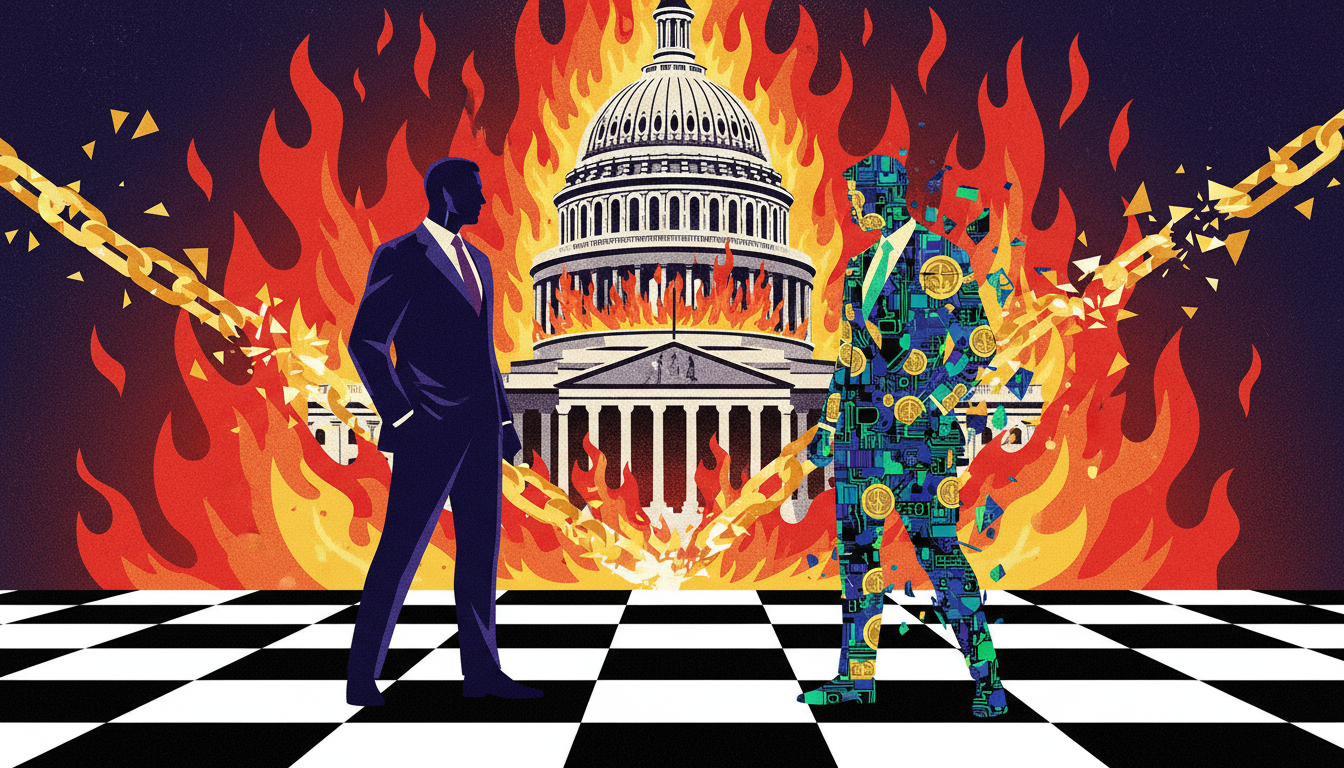
On April 15, Eastern Eight Time, the agreement reached between the U.S. and Iran regarding the extension of the ceasefire is merely a vague "principled agreement", lacking a deadline and implementation details, making the already tense situation in the Middle East seem more like a temporary pause than a genuine de-escalation. At the same time, it was reported that the U.S. military is dispatching thousands of soldiers to the Middle East, including the "George" aircraft carrier strike group carrying about 6000 soldiers (all from a single source), with diplomatic mediation and military displays facing off on the same stage. WTI crude oil futures oscillate around $89.2 per barrel, with the market pricing in the progress of the ceasefire while also reserving a risk premium for potential reignition of the conflict, creating a high-level volatility that is affecting global risk assets and investor sentiments.
The Ceasefire is Just a Paper Commitment: The Pressure of Immediate Invalidity Under the Principled Agreement
Currently, the U.S. and Iran's so-called results of extending the ceasefire remain at the level of a "principled agreement", with publicly available information neither specifying a deadline nor providing verifiable implementation details or oversight mechanisms. This highly abstract political representation resembles a gesture document rather than a proper institutional arrangement that genuinely constrains military actions of both parties, which also implies that any new friction may serve as an excuse to tear up the agreement.
The Iranian military openly warned that "continued blockades will undermine the ceasefire", pointing to the fragile foundation of the ceasefire—whenever external pressure is perceived as a "blockade" or "siege," it can be used to justify terminating the ceasefire. The market reads this as a signal that one can "legally flip at any time": the ceasefire is not locked in by a desire for peace but is instead determined by the parties' immediate judgments regarding pressure and benefits.
At the negotiation level, both the specific deadline of the ceasefire and the deeper thematic framework are currently categorized as pending verification information, with open channels failing to provide cross-verified details. This also determines that the current agreement is more like a temporary tourniquet against escalating conflict—gaining time and adjusting deployments for all parties, rather than a structural solution. For the market, this temporariness means that any bets on lasting peace are clearly speculative in the short term.
Aircraft Carrier at the Border and Negotiation Table: The Dual Track Game of Military Exercises and Diplomacy
Behind this fragile ceasefire agreement is the gradual military build-up of the U.S. forces in the Middle East. According to publicly reported information, the U.S. military has dispatched thousands of soldiers to the Middle East, including the "George" aircraft carrier and a grouping of around 6000 soldiers (all from a single source), this deployment is neither a full-scale war mobilization in the traditional sense nor can it be termed a withdrawal or de-escalation, but is deliberately maintained at a critical threshold that can be quickly escalated.
From a geopolitical convention perspective, the aircraft carrier strike group itself is a movable bargaining chip. It serves as strategic deterrence—sending a hard signal to the opponent that says "do not misjudge," while also acting as a diplomatic tool of "military endorsement", adding weight to one’s position at the negotiation table. In this structure, diplomats speak with language, while the military provides tone and bottom lines, forming a complete policy sentence.
This military pressure primarily reflects in the market as support for risk premiums: as long as the aircraft carriers remain in the region and troops are in a state of high alert, oil prices and related assets are unlikely to fully relinquish the premiums accumulated due to conflict expectations. However, from a longer time dimension, the continuous escalation of military presence may rebound against the U.S. itself—domestic doubts about the costs of external military intervention, policy disputes during election cycles, and the possibility of greater impacts should the regional situation run out of control will all limit how long such a high-pressure stance can be maintained.
Therefore, for investors, aircraft carriers and troop deployments are not simply "bullish" or "bearish," but a time-uncertain bargaining chip: in the short term, it reinforces the tense narrative, raising oil prices and safe-haven demand; in the medium to long term, it is constrained by the tolerance of U.S. domestic politics and whether the regional situation shifts towards a more dangerous turning point.
Oil Prices Hovering at $90: The Lifeline of Macro Bulls
In the financial echoes of this play, WTI crude oil futures reported at $89.2 per barrel (April 15 data), almost directly touching the $90 key psychological and macro threshold. On one hand, the market is slightly cooling pricing due to news of the ceasefire extension, while on the other hand, it must leave a safety margin for the potential invalidation of the agreement and the continued presence of the aircraft carrier strike group; high-level oscillation is a reflection of this contradictory expectation.
Morgan Stanley's chief economist Chetan Ahya provided a clear macro-bull coordinate: "If oil prices fall back below $90, the industrial cycle is expected to accelerate again". This means that current oil prices are almost probing the threshold of industrial recovery—every attempt to break downwards will be viewed as a positive signal for manufacturing and global growth expectations; while every time it re-establishes or even moves away from $90 will reignite concerns about cost pressures and growth slowdown.
If oil prices remain at current levels or even higher for an extended period, the chain reaction will start to spread from corporate costs outward: increased energy and transportation expenses will compress profit margins, and companies will either try to pass these costs down through price hikes or cut back on investments and hiring to hedge against pressure, creating a negative feedback on consumption and employment. This combination is likely to weaken the risk appetite in equity and commodity markets, with investor patience for high-beta segments and emerging growth targets shortening, deepening valuation discounts.
Zooming out to a global perspective, if oil prices fall from high levels, it will clearly benefit the performance of emerging markets and high-beta assets: capital can be more willing to offer premiums to growth and cyclical assets in an environment where cost pressures ease, and also be more willing to take on higher volatility. Conversely, should oil prices stay persistently high or even break through critical ranges, it could easily trigger a flight of funds back to dollar assets and safe-haven varieties, compressing the valuation space of emerging markets and amplifying the volatility elasticity of currency and asset prices.
Trump's Tough Statements: Sensitive Market Nerves Under the Nuclear Red Line
Amid the dual pulls of diplomacy and military actions, American political rhetoric adds another layer of uncertainty to this ceasefire. Trump publicly stated: “If Iran intends to possess nuclear weapons, the United States will not reach an agreement with them”. This brief yet sharp statement effectively draws a clear red line for U.S. policy: any ambiguous space regarding nuclear issues has been compressed to serve as reasoning for dialogue termination at any moment.
From the market's perspective, such tough rhetoric directly undermines confidence in a lasting ceasefire. Even if there is currently a principled agreement, as long as mutual suspicions surrounding the nuclear program remain unresolved, investors will find it hard to believe that the current ceasefire can smoothly evolve into a structural peace arrangement. Thus, the ceasefire is priced as a state that could potentially be overturned by policy declarations at any time, making it naturally difficult for oil prices and related assets' risk premiums to compress significantly.
More complex is that U.S. domestic politics and election cycles amplify the intensity of such tough statements on the market. Candidates emphasizing “hardline” and “non-negotiable” stances in foreign policy often do so from the demands of domestic voter mobilization and intra-party competition, but in the highly sensitive region of the Middle East, any escalation in rhetoric can be interpreted by the adversary as a rehearsal for actual policy direction, thereby influencing their choices on the battlefield and at the negotiation table. For capital markets, this internal-external echo of U.S. politics will manifest in higher risk discount rates for the Middle East situation: prices will more frequently react to rhetorical movements, and the volatility range will be elevated overall.
The Ceasefire is Not the Endpoint: Risk Assets Search for a Anchor in Uncertainty
In summary, the principled agreement of the U.S.-Iran ceasefire, the U.S. military's deployment in the Middle East, and the tough statements from the U.S. political realm together constitute a highly uncertain geopolitical framework. The ceasefire has not truly locked in conflict risks but has only temporarily reduced its intensity; the aircraft carrier strike group and the increased troops keep the possibility of military escalation hanging in the air; and the nuclear red line could at any moment become a political trigger for overturning the existing arrangement.
Within this framework, the oil price around $90 becomes not just a technical threshold but a macro hub connecting multiple asset categories. The level above indicates industrial cycles being constrained by costs, inflation expectations becoming harder to anchor down, and prolonged periods of tight central bank policies; while the level below signifies a window opening for industrial acceleration, Asian economic recovery, and warming of emerging markets and high-beta assets. Therefore, each directional choice of oil prices will stir echoes across global stock markets, bond markets, commodity sectors, and even cryptocurrency assets.
Looking ahead, investors need to closely monitor the evolution of three main lines: first, whether the ceasefire can move from abstract principles to more specific deadlines and implementation arrangements, thereby weakening the expectation of "immediate invalidity"; second, whether U.S. and regional military presence continues to escalate or gradually retreats to a low-profile existence, thereby repricing conflict premiums; third, whether oil prices can effectively break down and stabilize below key ranges, providing clearer macro support for industrial cycles and risk assets. Until these three main lines are clarified, the market will continue to engage in an extended neural war between ceasefire and conflict, recovery and inflation, risk-taking and risk aversion.
Join our community, let's discuss and grow stronger together!
Official Telegram Community: https://t.me/aicoincn
AiCoin Chinese Twitter: https://x.com/AiCoinzh
OKX Welfare Group: https://aicoin.com/link/chat?cid=l61eM4owQ
Binance Welfare Group: https://aicoin.com/link/chat?cid=ynr7d1P6Z
免责声明:本文章仅代表作者个人观点,不代表本平台的立场和观点。本文章仅供信息分享,不构成对任何人的任何投资建议。用户与作者之间的任何争议,与本平台无关。如网页中刊载的文章或图片涉及侵权,请提供相关的权利证明和身份证明发送邮件到support@aicoin.com,本平台相关工作人员将会进行核查。