Author: Claude, Deep Tide TechFlow
Deep Tide Insight: On Tuesday, Amazon announced it would acquire satellite operator Globalstar for $11.57 billion, gaining scarce mobile satellite spectrum, about 24 satellites in orbit, and a long-term service agreement with Apple, with plans to deploy a direct-to-device (D2D) system by 2028, directly challenging Musk's Starlink satellite network of tens of thousands. After the deal was announced, Globalstar's stock rose over 9%, and Amazon's stock rose 3%.
Amazon has officially dropped a bombshell into the satellite internet market.
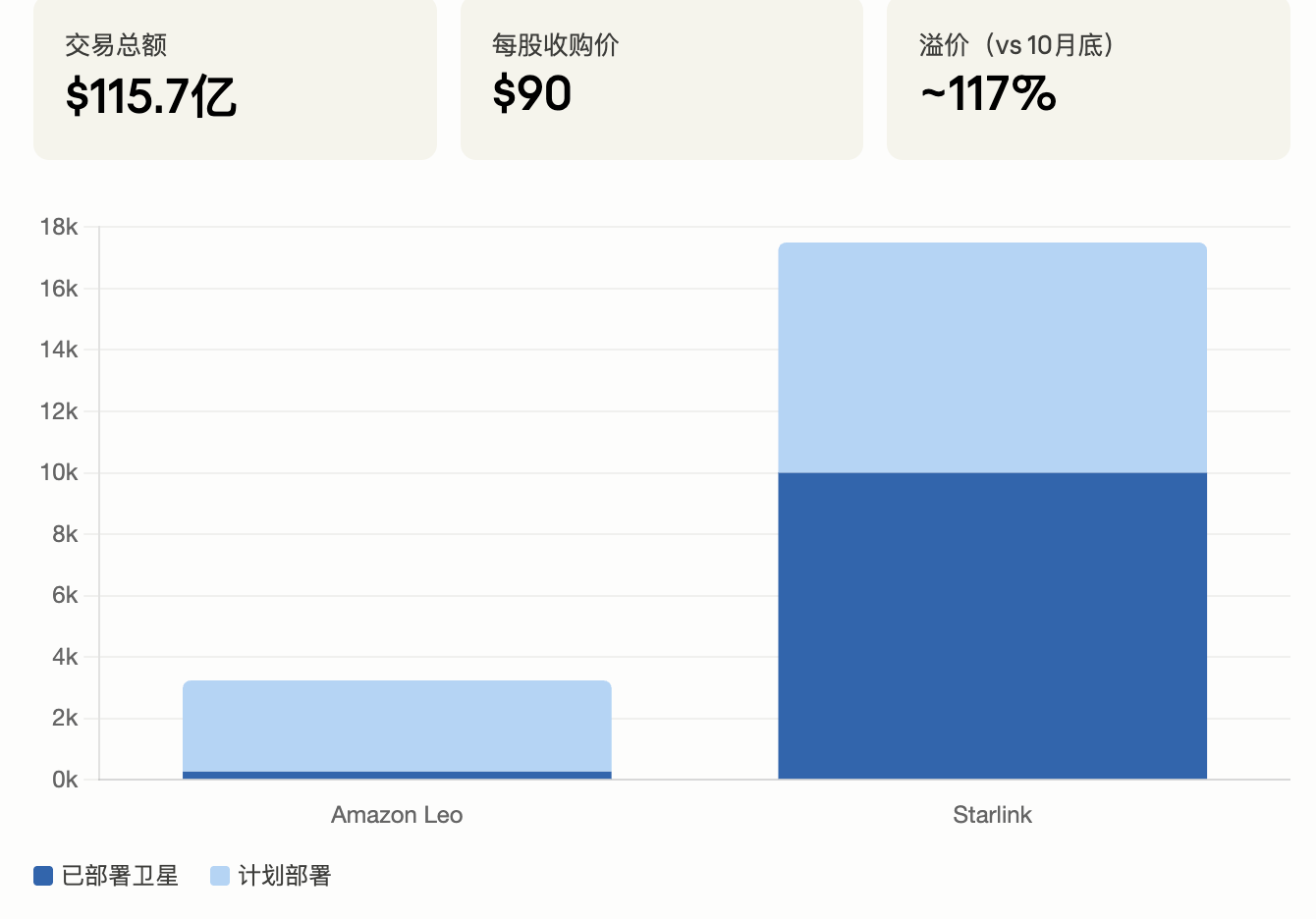
According to a report by Reuters on April 14, Amazon announced on Tuesday that it would acquire satellite operator Globalstar for $11.57 billion to accelerate its catch-up with Musk's Starlink. Globalstar shareholders can choose to exchange their shares for $90 in cash or 0.3210 shares of Amazon common stock. According to Bloomberg data, this price represents nearly a 117% premium over the stock price reported by Bloomberg when it first reported that Globalstar was exploring a sale at the end of October last year.
The deal was not without warning. Less than two weeks ago, the Financial Times reported that Amazon was in discussions to acquire Globalstar, at that time estimating the deal's size at about $9 billion. The final price significantly exceeded rumors, showing Amazon's determination to secure the acquisition.
Buying Spectrum, Buying Time, Buying Apple: One Deal Solves Three Problems
The core logic of this acquisition, according to Armand Musey, founder and president of Summit Ridge Group, is that Amazon has always lagged behind Starlink in the satellite broadband field, and acquiring Globalstar allows it to quickly catch up in D2D spectrum positioning and make a leap in D2D deployment.
Globalstar is a veteran operator in the global mobile satellite services (MSS) field, holding globally authorized L-band spectrum licenses. This type of spectrum is a scarce resource that can take years to obtain through applications and auctions. Amazon bypassed the lengthy regulatory approval process with this acquisition.
More critically, there is Apple's connection. Apple invested about $1.5 billion in Globalstar in 2024, acquiring a 20% stake to expand the satellite emergency communication features for the iPhone. As part of the acquisition agreement, Amazon Leo will provide satellite functionality support for future iPhones and Apple Watches, including Emergency SOS, messaging, Find My location, and roadside assistance services.
Apple's senior vice president Greg Joswiak confirmed this collaboration arrangement in a statement, expressing the expectation of deepening cooperation with Amazon on the expanded network of Amazon Leo.
In other words, by acquiring Globalstar, Amazon has obtained spectrum assets, in-orbit satellite infrastructure, and a long-term service bundling with the world's largest consumer electronics brand all at once.
243 Satellites vs. 10,000 Satellites, The Satellite Quantity Gap Remains a Major Challenge
Despite the clear strategic logic, the challenges Amazon faces at the execution level are equally enormous.
Currently, Amazon has deployed only 243 satellites, while it committed in 2019 to sending 3,236 satellites into low Earth orbit. In contrast, Starlink operates a network of about 9,500 satellites, serving over 9 million users.
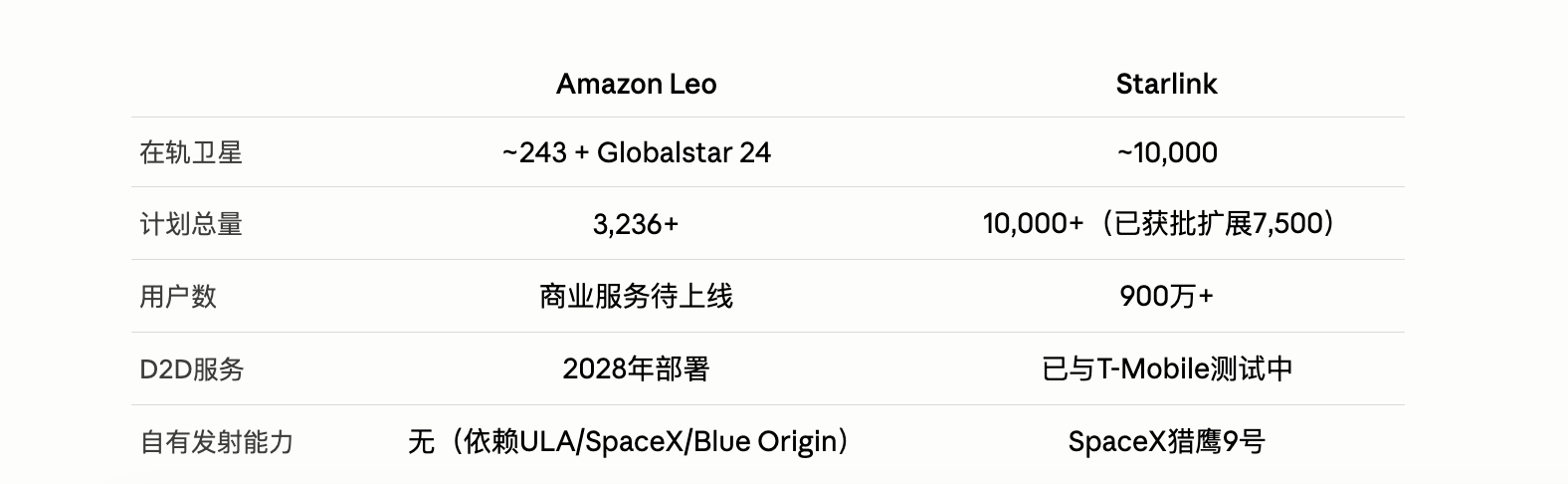
The acquisition of Globalstar adds approximately 24 satellites (expanding to 54 satellites), which does little to narrow this gap. The real bottleneck lies in the launch vehicles.
According to Reuters' analysis, rocket shortages, manufacturing disruptions, and launch delays have severely constrained Amazon's deployment pace, even forcing it to use competitor SpaceX's Falcon 9 rocket for launches. Gregory Radisic, a senior lecturer at Bond University, bluntly stated that unless Amazon can solve the issues of deployment speed and launch capacity, the gap remains structurally unbridgeable.
Earlier this year, Amazon applied to the FCC for a two-year extension on the deployment deadline for about 1,600 satellites (originally scheduled for this July), but the FCC has not yet ruled. This means that Amazon has not completed the deployment of even the approved constellation size.
Amazon's long-term solution may come from Blue Origin, founded by Jeff Bezos, and its new Glenn heavy launch vehicle currently in development, but that rocket has not yet proven if its launch frequency can meet the needs of large-scale constellation deployment.
Direct-to-Device Satellites: Competition from Emergency Communication to Daily Services
The strategic significance of this acquisition is not limited to broadband internet.
Amazon plans to launch its own direct-to-device (D2D) service by 2028, allowing phones to connect directly to satellites for voice, text, and data communication, without relying on ground base stations.
D2D is the next battlefield in the satellite internet sector. SpaceX has already completed SMS functionality testing for Starlink Mobile through partnerships with T-Mobile, gaining a first-mover advantage. Amazon, by acquiring Globalstar, has gained immediate capabilities, bypassing the long approval process for spectrum.
Panos Panay, Amazon's senior vice president of devices and services, stated in a statement that the company would work with mobile network operators to extend reliable high-speed connections to every corner of the globe.
However, Amazon has yet to disclose its target throughput, latency benchmarks for its D2D system, or the specific performance comparisons of its L-band architecture with SpaceX's solutions.
Market Reaction and Background to SpaceX's IPO
After the deal was announced, Globalstar's stock rose 9.6%, closing at about $79.68 (still about a 13% arbitrage space compared to the $90 acquisition price, reflecting uncertainty and time costs in completing the transaction). Amazon's stock rose 3%, and Globalstar's next-generation satellite main contractor, MDA Space, also jumped 9%.
The timing is intriguing. Amazon's acquisition closely follows SpaceX's advancement of its IPO plans. Starlink is believed to contribute about 50% to 80% of SpaceX's revenue, with the upcoming listing likely to become one of the largest IPOs in history. By locking in Globalstar during this time window, Amazon signals not only a strategic layout but also a competitive signal to the capital markets.
The transaction has already received written consent from Thermo Funding II, a major shareholder holding over 57% of the voting rights in Globalstar, and is expected to close in 2027.
免责声明:本文章仅代表作者个人观点,不代表本平台的立场和观点。本文章仅供信息分享,不构成对任何人的任何投资建议。用户与作者之间的任何争议,与本平台无关。如网页中刊载的文章或图片涉及侵权,请提供相关的权利证明和身份证明发送邮件到support@aicoin.com,本平台相关工作人员将会进行核查。


