Author: Deep Tide TechFlow
While the market's attention is drawn to U.S. stocks, AI, and gold in succession, Sui recently announced a new move:
Hashi, the Bitcoin collateral primitive based on Sui, is about to launch and has garnered support from numerous top institutions.
Bitcoin finance, a topic that has been talked about many times, yet has not been clearly defined to this day:
As the largest vault of on-chain assets valued at over 1.4 trillion, the proportion of Bitcoin used in DeFi is still less than 0.22%.
The core reason for the lack of clarity lies not in insufficient functionality, but in the improper foundations of trust. In many past attempts, users were often misled; you thought your Bitcoin was in your hands, but it was actually on someone else's ledger. The collapses of projects like Celsius, Voyager, and Genesis have repeatedly rung the alarm for the logic of "sacrificing trust for efficiency."
Especially for synthetic Bitcoin, although it has attracted quite a number of retail investors, this structure has not converted a large amount of Bitcoin into DeFi funds, nor can it attract institutions and large asset holders who require stronger guarantees.
This, in fact, presents a significant opportunity for the launch of Hashi, the developer primitive by Sui:
To reconstruct the critical foundation of trust in Bitcoin finance.
To allow the native BTC collateral to be organized more transparently in Sui's smart contract environment, without packaging, without synthesis, without handing the keys to any centralized entity, and directly turning this capability into a reusable interface.
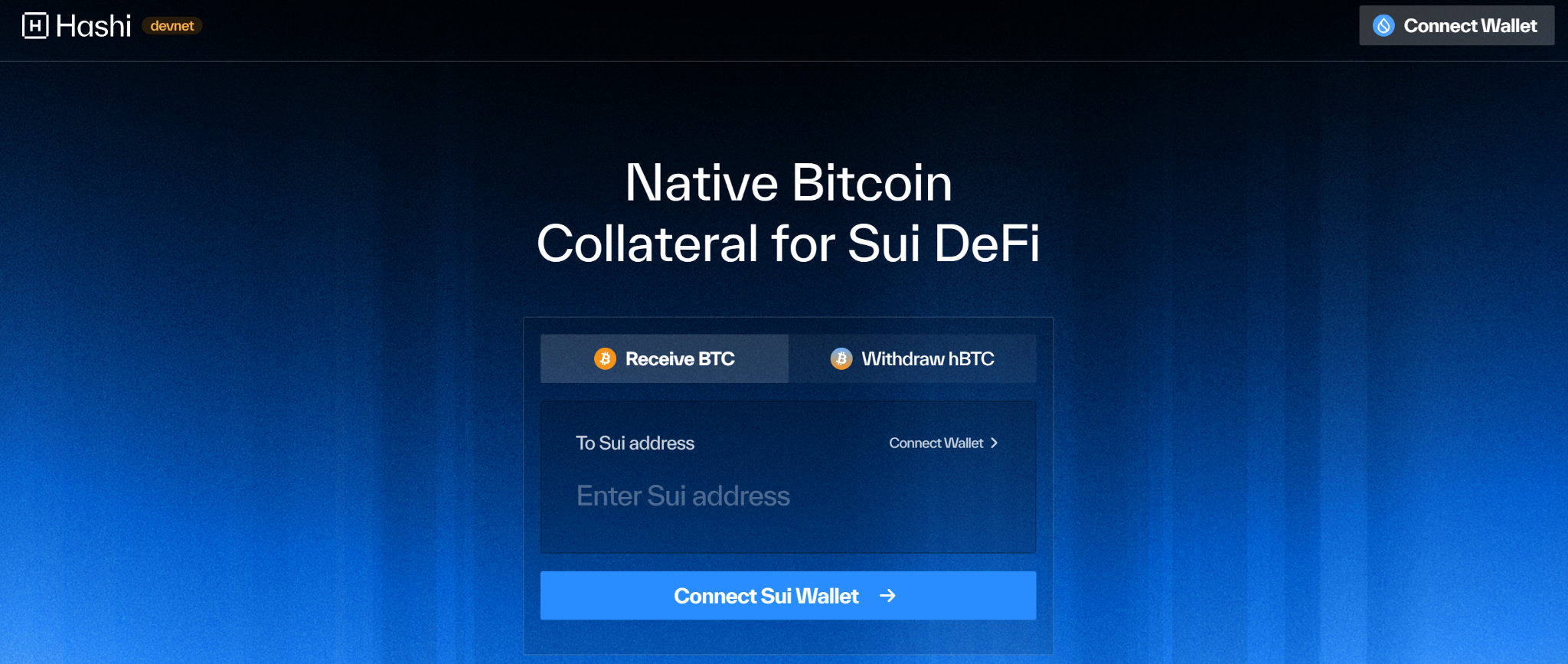
Hashi Native BTC Programmability: BTC Remains on Chain, Collateral Rights Enter Sui Network
The design concept of Hashi can be summarized in one sentence:
Assets are on the Bitcoin network, rights are on the Sui network, both exist simultaneously and do not interfere with each other.
If you have one Bitcoin, you want to use it as collateral to borrow some USDC.
In most past solutions:
You either deposit BTC into a centralized platform to exchange for a borrowing limit, or accept Wrapped BTC. At some point, your Bitcoin has to be handed over to another party, essentially exchanging "trust in a certain entity" for "programmability."
However, in Hashi:
- Deposit: Users deposit BTC into a dedicated address (a unique Bitcoin deposit address generated for their Sui address by Hashi), the private key of this address does not belong to any individual, but is jointly managed by the validators on the Sui network, and the BTC can only be utilized once a sufficient number of validators reach consensus. This means no single entity can take your money, unless they control more than one-third of the entire Sui validator network at the same time.
- Certification Generation: Validators monitor the Bitcoin network concurrently. When they confirm that your BTC has indeed been locked, they generate a corresponding collateral certificate on the Sui chain. This certificate is not a newly issued token, not a wrapped asset; it is a proof on the chain, demonstrating that there is a real BTC locked here, and its owner is you.
- As Collateral: With this certificate, you can borrow money in Sui's smart contracts, participate in DeFi, set up yield strategies. All rules are written in code, executed automatically, and no one can tamper with it in between.
- Repayment and Withdrawal: After repayment, the validators automatically release the native BTC on the Bitcoin mainnet through MPC threshold signatures, which can be withdrawn to any Bitcoin address, all without human intervention.
- Guardian Layer: To prevent extreme situations (such as collusion among validators), Hashi additionally introduces a Guardian Layer as a secondary check and backup protection, primarily monitoring large withdrawals or abnormal thresholds to prevent potential systemic risks.
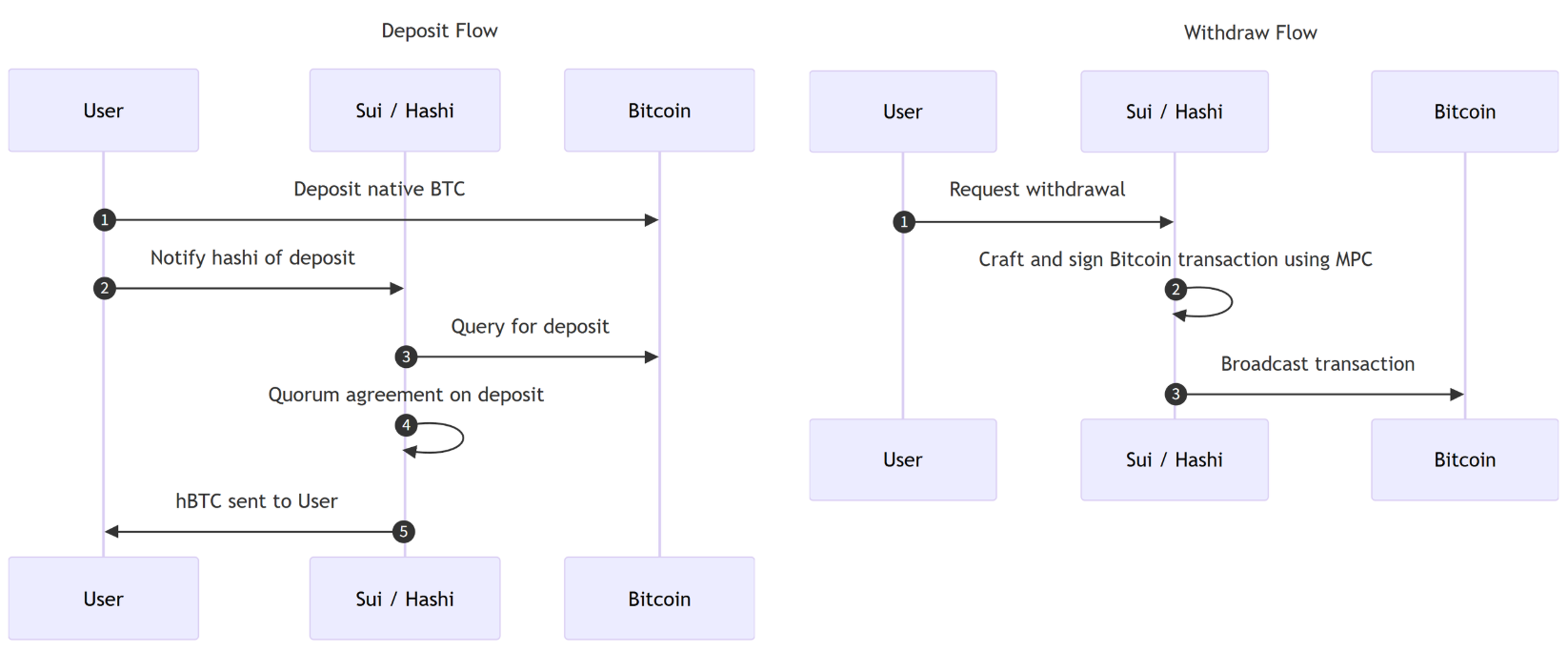
Throughout the entire lifecycle:
BTC always remains on the Bitcoin mainnet, rather than being moved into an internal account of any platform;
No single centralized entity monopolizes private key control;
The rights to real BTC collateral circulate on Sui, and the programmability of native BTC is reopened;
And the only parties users need to trust are the validator network and the smart contracts.
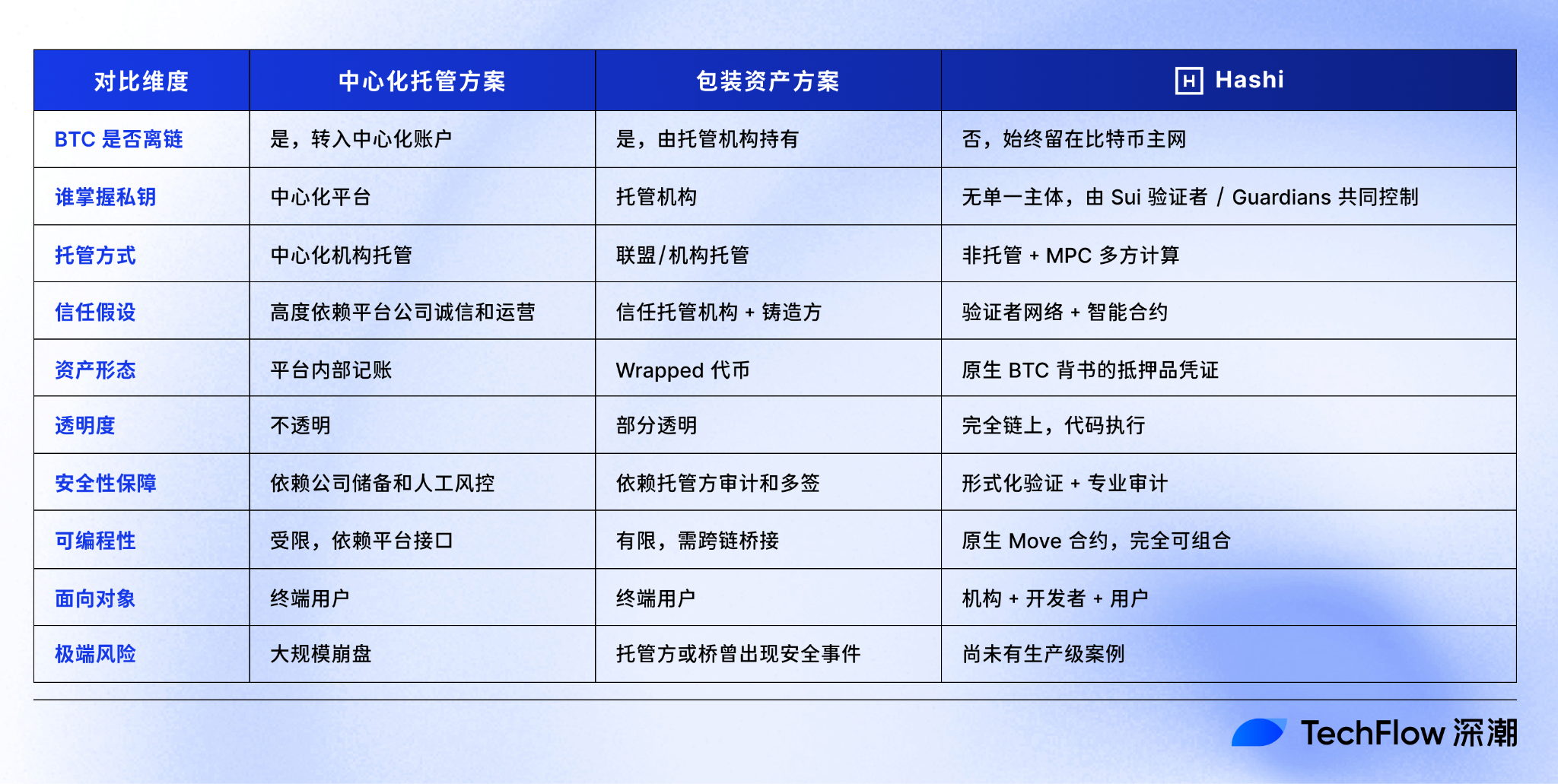
In simple terms, Hashi is dedicated to enabling the collateral relationship of native BTC to be directly recognized by the on-chain financial system without transferring trust to centralized entities.
In a stable market, users may perceive this difference as weak, but in extreme situations like platform collapses or liquidity crises, it makes all the difference in whether your BTC is still there.
Not a Product, but a "Primitive": A Reusable "Standard Brick"
From a design perspective, Hashi is a more decentralized, trust-minimized, and safer and more transparent Bitcoin finance solution.
However, if Hashi is understood solely as a "solution," one might miss its most potent aspect.
It's important to note that for a long time, Sui has been striving towards the direction of moving from "one chain" to "a complete set of developer infrastructure." Whether it’s launching Walrus, Seal, or Nautilus, the goal has been to achieve full-stack native capabilities from execution, storage, permission control to off-chain computation, providing convenience for developers and building the necessary foundation for ecological prosperity.
This is no exception when it comes to Bitcoin finance.
According to official definition:
Hashi is the first decentralized Bitcoin collateral primitive developed by Mysten Labs, allowing developers to actively handle the UTXOs of the Bitcoin network within the native Sui smart contract language.
The key term is "primitive."
In the context of blockchain and DeFi, primitives often refer to foundational building blocks or underlying infrastructure components, similar to a "standard brick" in LEGO sets:
It's not an end product for ordinary users but a foundational module for developers to build products.
Just like TCP/IP is not an app, but all apps run on it; Hashi is not a product, but lending platforms, yield strategies, and structured products can be built upon it.
In other words, what Hashi provides is not a closed financial service but a layer of underlying capability that allows native BTC to become collateral that Sui smart contracts can directly invoke.
As for how this collateral is utilized, under what rules it is used, Hashi does not dictate, leaving it to contracts, developers, and the market.
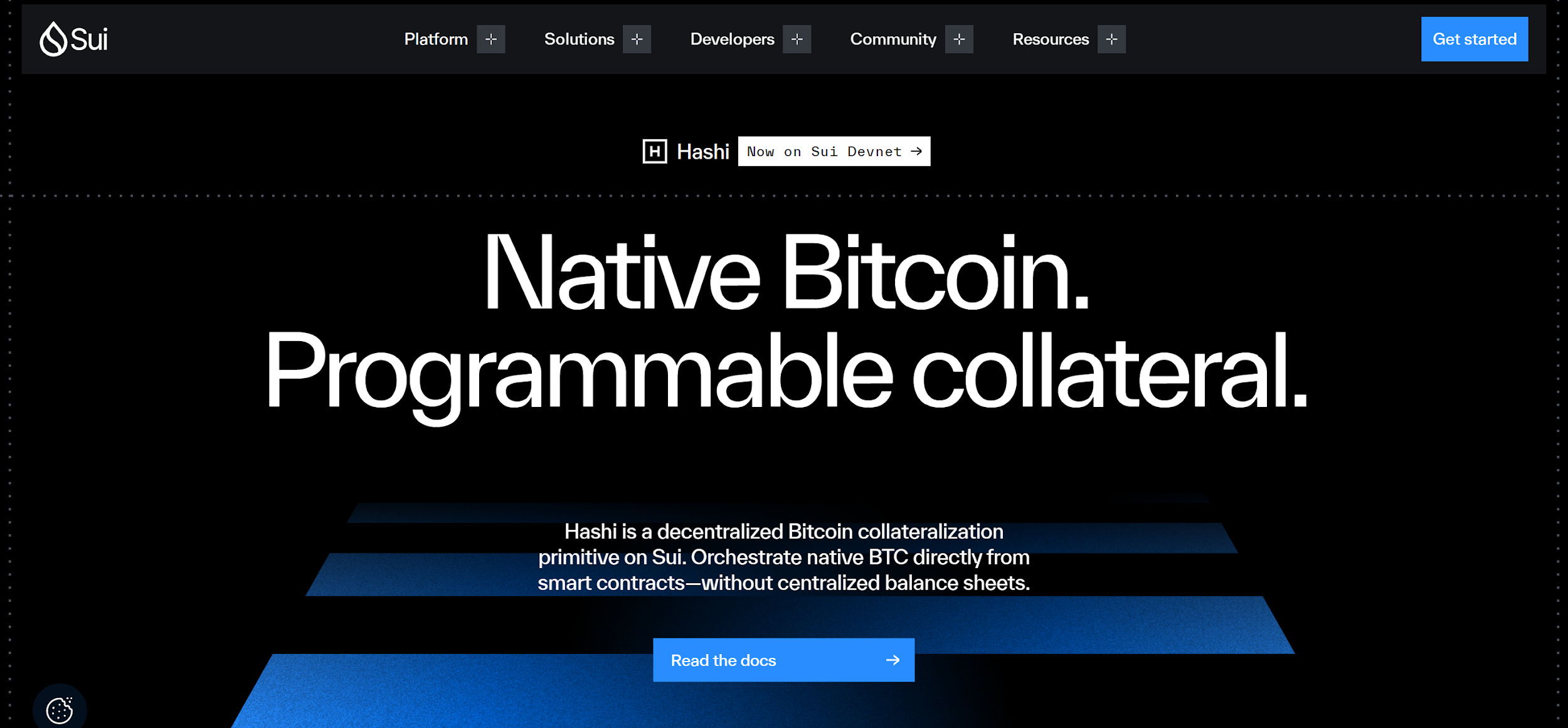
Before Hashi, if developers wanted to build a protocol using BTC as collateral, they faced numerous challenges: either accept the trust risks that come with centralized custody, or implement the entire complex logic of native BTC collateral from scratch.
Hashi, as a primitive, turns this problem into a directly reusable interface.
Now, when developers are building specific products, they can directly call the mechanisms provided by Hashi, allowing the protocols they develop to naturally inherit native BTC collateral capability without needing to solve the underlying issues again, significantly reducing the development threshold and time costs.
And users, whether institutional or ordinary, will gain the ability to earn yields with Bitcoin for the first time through products built on Hashi, all while maintaining control over it. In the early stages of its launch, lending will be the primary use case for Hashi, allowing BTC to be lent out or used as collateral to borrow stablecoins, and in the future, Hashi scenarios will gradually expand to vaults, insurance, structured products, credit derivatives, and RWA yield strategies.
Bitcoin is the most widely recognized and liquid asset globally, but in the past, this wealth was nearly invisible to the on-chain financial world: it is vast yet non-programmable; it is valuable yet cannot be directly perceived and invoked by smart contracts.
Therefore, when Hashi transforms the native BTC collateral capability into an interface directly callable by any developer, the potential upper-level application space it can leverage is far more than just a single specific product or protocol.
And this judgment of correctness has already been confirmed by the significant institutional support Hashi has garnered.
Institutional Day One Support: Building a Complete Ecological Map Around Hashi
Currently, Hashi has been launched on the Sui Devnet, mainly for developers to test and audit, and it has not yet entered a production environment but has received explicit support commitments from several industry-leading institutions.
In terms of custody and infrastructure: Major institutions, including BitGo, Blockdaemon, Cobo, and Ledger, have established direct channels for institutional BTC to transition from cold storage to on-chain collateral scenarios.
In terms of trading and liquidity: Major institutions such as FalconX, Bullish, and CF Benchmarks bring reliable pricing, liquidity outlets, and institutional trading counterparties to Hashi.
Looking at security and compliance: Several teams, including security audit agency OtterSec, smart contract formal verification security company Certora, and cryptography and zero-knowledge proof research and engineering team Asymptotic, have chosen to support Hashi by conducting smart contract audits, formal verification, cryptography, and zero-knowledge proof research before Hashi goes live.
Meanwhile, projects like Suilend, Scallop, NAVI Protocol, Matrixdock, and Bluefin have announced that they will integrate Hashi, unlocking on-chain financial potential and allowing retail and institutional users to quickly access BTC collateral lending experiences.
Additionally, Soter Insure, a provider focused on institutional-level insurance solutions, has announced a partnership with Hashi to bring built-in institutional-level insurance mechanisms as a risk protection layer.

These institutions represent hundreds of billions of nominal value in Bitcoin and mature compliance infrastructure, and their decision to make integration commitments during the Hashi Devnet phase signifies that once Hashi officially launches, there will be substantial institutional Bitcoin assets ready to enter the on-chain scenario.
Furthermore, examining these 20 or so institutions together reveals an interesting fact: they nearly cover every aspect needed for a complete Bitcoin financial ecosystem:
From Bitcoin's secure custody, on-chain collateral, price pricing, liquidity support, lending protocols, yield strategies, RWA integration, to security audits and user entry points, an end-to-end chain link is already beginning to take shape.
In other words, behind this list of supporters, a complete ecological map of Bitcoin finance centered around the Hashi primitive is prepared to be ready from the day Hashi mainnet goes live.
Conclusion
Of course, Hashi is still in the Devnet stage; it has not yet experienced the long-term testing of a mainnet environment, real asset scale, and extreme market volatility, and production-level performance will take time to validate. The path of Bitcoin finance will never become smooth just because a new primitive appears.
However, the integration commitments from over 20 leading institutions from Day One for custody, liquidity, security, protocol layers, and more indicate a clear market acknowledgment of this path.
The story of Bitcoin finance has been told for many years, but the real breakthrough point is not about "what can be done," but "what can be trusted."
Past solutions, whether centralized custody or wrapped assets, fundamentally required users to make the same choice: either give up control for yield, or keep the keys but be cut off from on-chain finance.
Hashi attempts to rewrite this question entirely: allowing the native BTC's collateral capacity to become an underlying interface directly callable by developers, making the sleeping trillion-dollar vault of Bitcoin, for the first time, truly "seen" by the world of smart contracts in a non-custodial, verifiable, and composable way.
The reconstruction of trust is often more difficult than the stacking of functions.
If the ultimate goal of Bitcoin finance is to make Bitcoin truly become the native collateral of on-chain finance, then what Hashi is doing may be laying the first pile for this bridge.
免责声明:本文章仅代表作者个人观点,不代表本平台的立场和观点。本文章仅供信息分享,不构成对任何人的任何投资建议。用户与作者之间的任何争议,与本平台无关。如网页中刊载的文章或图片涉及侵权,请提供相关的权利证明和身份证明发送邮件到support@aicoin.com,本平台相关工作人员将会进行核查。


