Written by: Yangz, Techub News
Once calling Trump a "benefactor of the crypto industry," Sun Yuchen has completely turned against him in the past few days.
On the afternoon of April 12, Sun Yuchen suddenly published a post attacking the DeFi project World Liberty Financial (WLFI), which is supported by the Trump family. He threw out a series of accusations, claiming that the WLFI team never obtained community governance authorization but privately extracted fees from users, secretly implanted backdoors to control assets, froze investors' funds without disclosure and due process, and even treated the entire crypto community as a "cash machine."
A few hours later, WLFI responded bluntly, stating "Does anyone still believe Sun Yuchen?" and dropped the line "See you in court." Sun Yuchen immediately countered, demanding that the project leaders reveal their real names instead of hiding in the dark, as the project's largest investor.
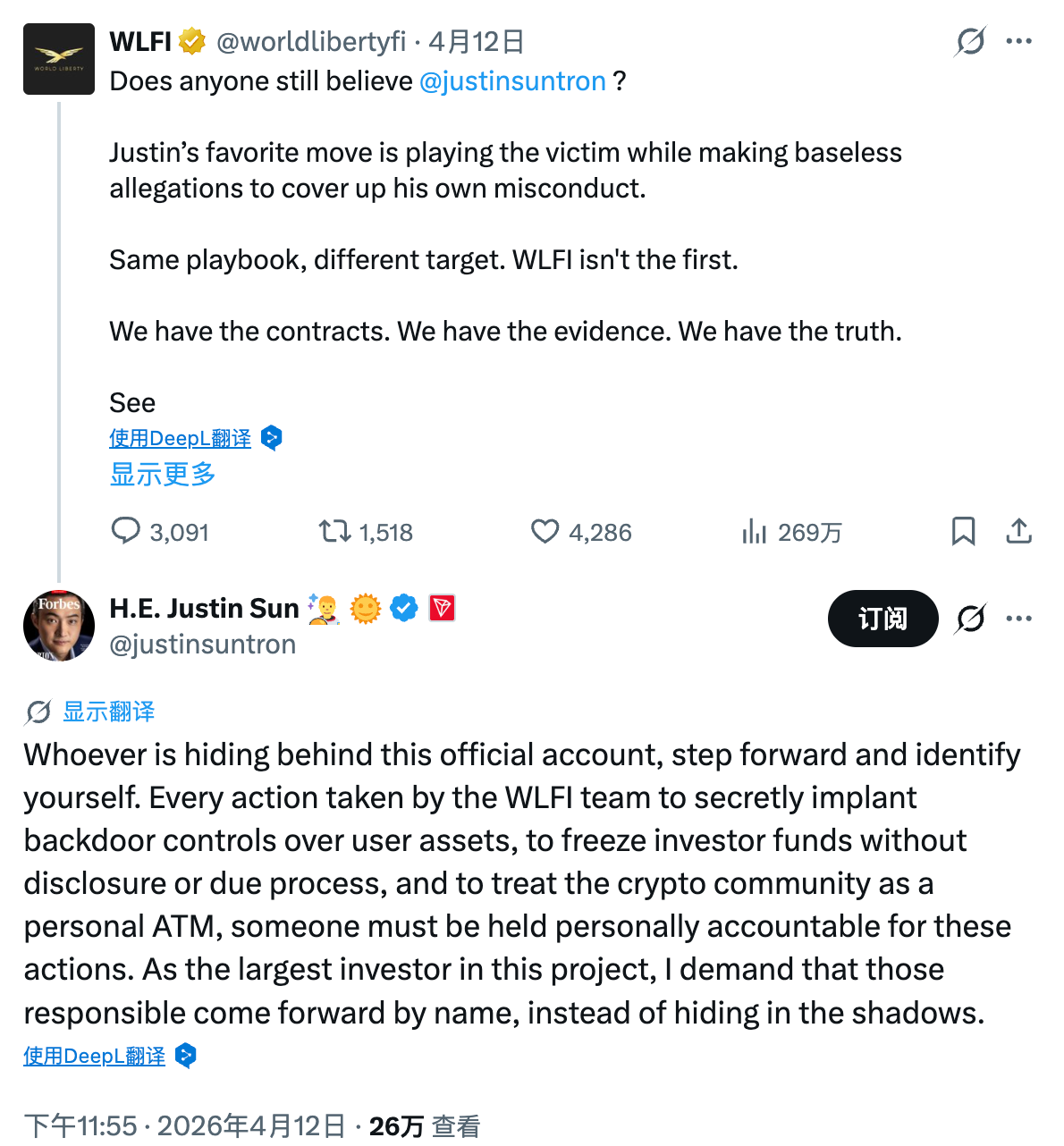
This public shouting match came suddenly, but looking closely, the grievances between the two parties did not arise overnight. To understand why Sun Yuchen flipped the table now, one must first look at how hard he had worked to support WLFI back then.
Once, they were "family"
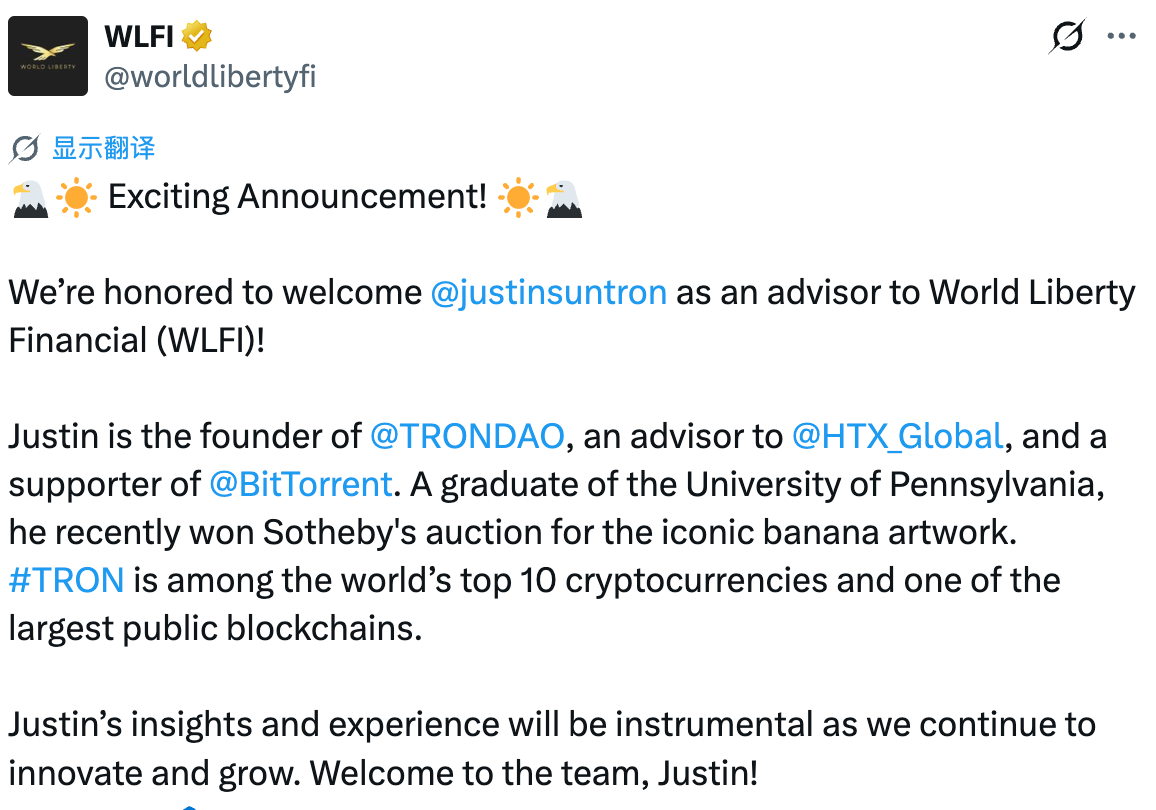
Backtrack to late 2024. At that time, WLFI's token was not selling well, and almost no one was buying it. Just when the project team was in trouble, Sun Yuchen made his appearance in a suit. In November 2024, he invested $30 million through a related company, becoming WLFI's largest investor at that time, accounting for more than half of the total fundraising amount. WLFI official even gave him face, directly hiring him as a project advisor, praising that his "insight and experience are crucial."
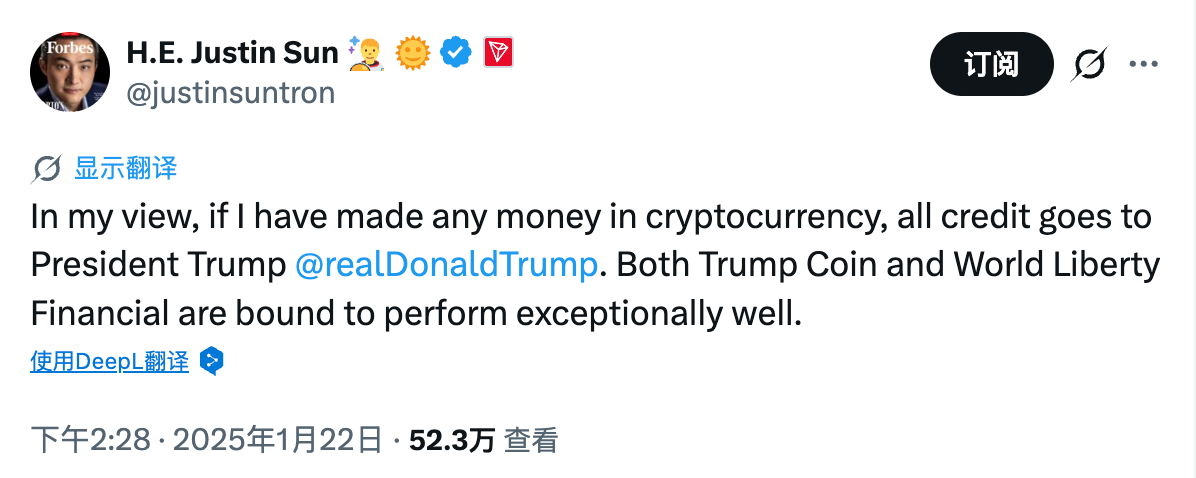
But that wasn't enough. In January 2025, on the eve of Trump's inauguration, Sun Yuchen added another $45 million and stated, "If I make money in the crypto industry, all the credit goes to President Trump."
After that, the relationship between Sun Yuchen and the Trump family rapidly heated up. By May 2025, Sun Yuchen made another large purchase, buying Trump's meme coin TRUMP, becoming the "top holder" of the token. This transaction also earned him a very rare entry ticket: a private dinner at Trump's National Golf Club in Virginia.
At that dinner, Sun Yuchen not only received a $100,000 custom Trump-branded gold watch, symbolizing his identity as a "top fan," but also was invited to speak on stage. He thanked Trump for his support of the crypto industry in front of the camera, and the atmosphere at that moment was very harmonious.
More intriguingly, about two weeks after this dinner, the SEC temporarily postponed a civil fraud and securities violation lawsuit against Sun Yuchen and his three companies, announced by the presiding judge in the Southern District of New York. Subsequently, Tron announced plans to go public in the U.S. through a reverse merger with Nasdaq-listed SRM Entertainment, a deal orchestrated by Dominari Securities, an investment bank connected to the Trump family. By July, Sun Yuchen again pledged to purchase $100 million worth of TRUMP tokens.
This inevitably led outsiders to speculate: while the visible menu at the dinner was not impressive, the hidden menu was quite rich.
Honeymoon ends: The locked wallet
However, the good times did not last long. In September 2025, the sweet narrative between the two parties suddenly took a sharp turn.
At that time, on-chain data monitored that a related address of Sun Yuchen transferred about 50 million WLFI (then worth about $9 million) to his HTX exchange. The market exploded in response, and the price of WLFI token dropped from $0.19 to $0.16.
Sun Yuchen hurriedly came out to douse the flames, saying he was only "testing the deposit process of the exchange" and had no intention to sell.
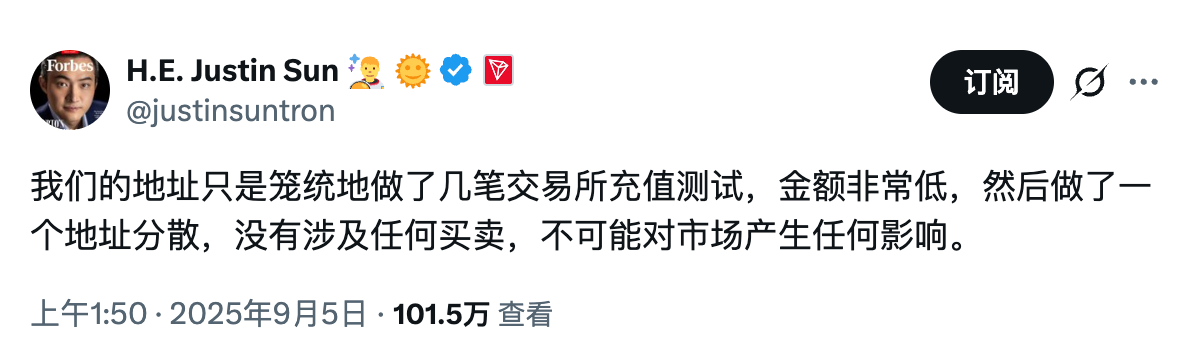
But the WLFI team clearly did not believe so. After the transfer, the team blacklisted three core wallet addresses of Sun Yuchen on the grounds of "protecting investors," stating that there were a total of 272 addresses frozen, not targeting Sun Yuchen personally.
According to monitoring, the assets frozen from Sun Yuchen included 595 million unlocked WLFI (then worth about $107 million), plus 2.4 billion tokens still in the lockup period. Sun Yuchen grew anxious and publicly shouted "Unlock my tokens," even promising to purchase $10 million worth of ALTS and $10 million worth of WLFI (Alt5 Sigma is WLFI's treasury company), trying to prove to the Trump family that he was a steadfast long-term holder. However, the WLFI side always ignored him. Subsequently, Sun Yuchen deleted his promise tweet.
Why Wait Six Months to Flip the Table?
After being frozen, Sun Yuchen did not immediately tear his face. In the following months, he remained restrained, perhaps still harboring hopes privately. After all, real money was involved, and a fallout would not be beneficial to him. Moreover, seeing Zhao Changpeng obtain Trump's "full pardon," he may have been hoping that this "friendship" he bought with heavy money would also earn him a pardon.
By March 5 this year, the SEC officially applied to the Manhattan federal court to withdraw all civil fraud charges against Sun Yuchen, the Tron Foundation, and the BitTorrent Foundation. Although Sun Yuchen received a case dismissal after paying a $10 million fine, rather than the glittering presidential pardon like CZ's, nonetheless, the largest regulatory cloud hanging over him finally dissipated.
However, after this alert was lifted, Sun Yuchen discovered that WLFI, this "ally," was becoming more and more dangerous. In early April, on-chain monitoring showed that the WLFI team had mortgaged 5 billion of their own tokens, borrowed $75 million in stablecoins from Dolomite, and transferred some of the funds to Coinbase Prime, raising suspicions of "cashing out and running away." Additionally, the price of WLFI token had dropped to about $0.07, and his over $100 million asset had shrunk by more than half.
Since retrieving assets honorably had become a luxury, continuing to maintain the nominal title of "advisor" would only make him look like a sucker. Sun Yuchen likely thought, instead of sitting by and waiting for death, it was better to completely flip the table, bring everything to light, and force the counterpart to respond.
Thus, the public outburst on April 12 happened.
After Sun Yuchen's attack on WLFI, the anonymous developer of Yearn Finance, Banteg, pointed out that WLFI's original contract was not so "domineering"; the blacklist function was "sneaked in" through the V2 version upgrade, 11 months after Sun Yuchen's investment and one week before the trading opened. Even more chillingly, the project team subsequently added an asset seizure function—ostensibly to "deal with phishing hackers," but in reality gained the power of physical "confiscation." More specifically troubling was the design of WLFI's lockup mechanism. In its contract code, a separate category was specifically allocated for Sun Yuchen. As the only user in this category, Sun Yuchen did not enjoy normal linear unlocking treatment. The project team initially threw out the bait of "20% unlocking at the start," and once he used this small amount of funds, they quickly activated the blacklist, permanently locking the remaining 80% of his assets. Furthermore, its governance structure was even more ridiculous: freezing an address only required one guardian address signature, while seizing assets required a 3/5 multi-signature vote. In other words, any single person had the unilateral power to freeze the assets of any token holder.
Sun Yuchen promptly retweeted this analysis and demanded WLFI disclose the identities of those hiding behind EOA accounts and the 3/5 multi-signature.
Conclusion
As of the time of writing, WLFI has not made any substantive response to Sun Yuchen's accusations and Banteg's on-chain analysis besides that phrase "See you in court." This phrase has officially declared the bankruptcy of Sun Yuchen's more than a year-long political gamble costing nearly a hundred million dollars.
He once thought that what he bought was a charter to the core circle of American politics. In the end, he found out that what he bought was merely a line of cold codes written dead on a blacklist. This hefty tuition fee may have helped him see the regulatory clouds dissipate, but it certainly made him realize the arrogance of power.
Whether the two parties will actually go to court is no longer important; this farce of "the financier tearing apart the project party" has been enough to ring alarm bells for all investors who blindly worship celebrity endorsements: in the crypto world, trust is often priced in the hundreds of millions, while a backdoor that takes everything from you only requires a line of free code.
免责声明:本文章仅代表作者个人观点,不代表本平台的立场和观点。本文章仅供信息分享,不构成对任何人的任何投资建议。用户与作者之间的任何争议,与本平台无关。如网页中刊载的文章或图片涉及侵权,请提供相关的权利证明和身份证明发送邮件到support@aicoin.com,本平台相关工作人员将会进行核查。


